
Is Lead Magnetic? A Complete Scientific Guide Explained Simply
The question “is lead magnetic” is commonly searched by students, engineers, recyclers, and curious learners. Many people associate heavy metals with magnetism, assuming that weight or density makes a metal magnetic. However, science tells a very different story.
Lead is one of the oldest known metals used by humans, yet its magnetic behavior is often misunderstood. In this in-depth article, we will explore whether lead is magnetic, why it behaves the way it does, how magnetism works, and how lead compares with truly magnetic metals.
This guide is written in simple language but backed by real scientific principles, making it useful for beginners and advanced readers alike.
Is Lead Magnetic? The Short and Clear Answer
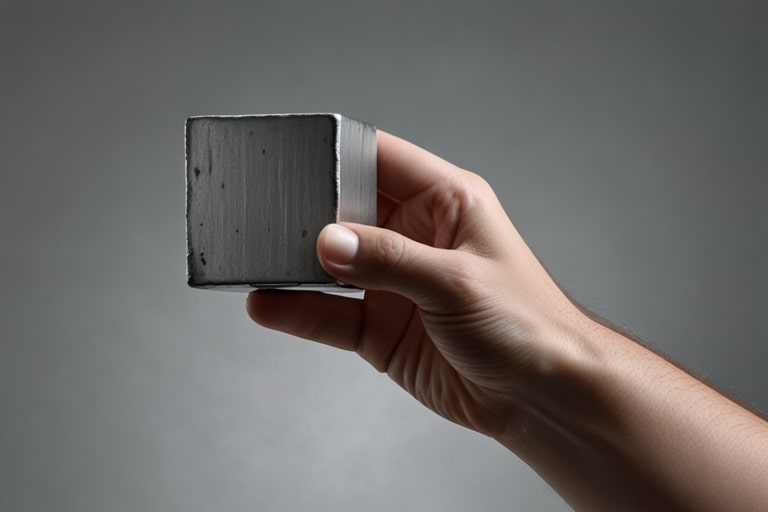
Lead is not magnetic.
It does not stick to magnets and does not show attraction to magnetic fields under normal conditions.
Scientifically, lead is classified as a diamagnetic material, which means it produces a very weak repulsive effect when exposed to a magnetic field. This effect is so small that it cannot be noticed without specialized laboratory equipment.
So, if you place a magnet near a piece of lead and see no movement, that is exactly what science predicts.
What Is Lead? Understanding the Metal Itself
Lead is a heavy, soft, and malleable metal with a long history of human use. Its chemical symbol is Pb, derived from the Latin word plumbum. Lead is known for its high density, corrosion resistance, and low melting point.
Because lead is so dense, many people mistakenly believe it should be magnetic. In reality, density and magnetism are unrelated properties. A metal can be heavy and still completely non-magnetic.
Lead’s atomic structure plays a much bigger role in determining whether it is magnetic.
Physical and Chemical Properties of Lead
Understanding lead’s properties helps explain why it is not magnetic.
| Property | Description |
|---|---|
| Chemical Symbol | Pb |
| Atomic Number | 82 |
| Density | 11.34 g/cm³ |
| Melting Point | 327.5°C |
| Electrical Conductivity | Poor |
| Magnetic Behavior | Diamagnetic |
| Texture | Soft and malleable |
These properties show that lead is optimized for shielding, weight, and stability, not magnetism.
What Does Magnetic Mean in Science?
Magnetism is a physical phenomenon caused by the movement and alignment of electrons inside atoms. For a material to be magnetic, its electrons must be arranged in a way that produces a net magnetic field.
Only a few metals naturally exhibit strong magnetism. These metals have unpaired electrons that align in regions called magnetic domains. When these domains align in the same direction, the material becomes magnetic.
Lead does not form these domains, which is why it does not behave like a magnetic metal.
Why Is Lead Not Magnetic? Atomic-Level Explanation
The real answer to “is lead magnetic” lies at the atomic level.
In lead:
- Most electrons are paired
- Magnetic effects cancel each other out
- No permanent magnetic domains form
Because of this electron pairing, lead cannot generate its own magnetic field or respond strongly to external magnetic fields. Instead of being attracted, it slightly resists magnetic influence.
This behavior places lead firmly in the diamagnetic category.
Types of Magnetism and Where Lead Fits (Bullet Points)
Different materials respond to magnets in different ways:
- Ferromagnetic materials: Strong attraction (iron, nickel, cobalt)
- Paramagnetic materials: Very weak attraction (aluminum)
- Diamagnetic materials: Weak repulsion (lead, copper, gold)
- Non-magnetic materials: No noticeable response
Lead belongs to the diamagnetic group, which explains why it does not stick to magnets.
Lead vs Magnetic Metals Comparison
This comparison clearly shows why lead behaves differently.
| Metal | Magnetic? | Magnetic Type |
|---|---|---|
| Lead | No | Diamagnetic |
| Iron | Yes | Ferromagnetic |
| Nickel | Yes | Ferromagnetic |
| Cobalt | Yes | Ferromagnetic |
| Copper | No | Diamagnetic |
Can Lead Ever Become Magnetic?
Under normal conditions, lead cannot become magnetic.
Even under extreme situations such as:
- Very high pressure
- Extremely low temperatures
- Strong electromagnetic fields
Lead does not change its magnetic classification. Its electron configuration remains stable, preventing ferromagnetism.
Some metals can change magnetic behavior under extreme laboratory conditions, but lead is not one of them.
Simple Experiment to Test: Is Lead Magnetic?
You can test a magnet’s magnetism with a simple experiment at home or in a classroom.
Place a strong magnet near a piece of lead. Observe. You will notice:
- No attraction
- No movement
- No sticking
This confirms that lead is not magnetic and behaves exactly as scientific theory predicts.
Why Do People Think Lead Is Magnetic?
This misconception usually comes from confusing weight with magnetism. Lead is very heavy, so people assume it should react strongly to magnets.
Another reason is confusion during metal testing. When people test unknown metals with magnets, non-magnetic heavy metals are often mistakenly assumed to be lead or magnetic materials.
Education and proper testing methods help clear this confusion.
Real-World Applications of Lead Where Magnetism Matters
Lead’s non-magnetic nature is actually very useful in many industries.
Lead is commonly used in:
- Radiation shielding
- Lead-acid batteries
- Electrical cable protection
- Counterweights and ballast
- Soundproofing materials
In these applications, magnetic interference would be a disadvantage, so lead’s lack of magnetism is beneficial.
Is Lead Used in Magnetic or Electrical Devices?
Lead is not used to create magnetic fields. However, it is often used around magnetic or electrical devices as shielding or structural support.
Because lead does not interact with magnetic fields, it does not distort or interfere with sensitive equipment, making it ideal for protective roles.
Does Molten Lead Become Magnetic?
Melting lead does not change its magnetic properties.
Whether solid or liquid, lead remains diamagnetic. Temperature changes affect physical state but do not alter electron configuration enough to create magnetism.
So, molten lead is just as non-magnetic as solid lead.
Final Conclusion: Is Lead Magnetic or Not?
The answer is clear and scientifically proven:
Lead is not magnetic.
It does not attract magnets, does not hold magnetic fields, and does not behave like iron or nickel. Its atomic structure prevents magnetic domain formation, placing it firmly in the diamagnetic category.
Understanding this helps in science education, industrial applications, recycling, and everyday metal identification.
FAQs
1. Is lead magnetic or non-magnetic?
Lead is non-magnetic. It does not attract magnets and does not produce its own magnetic field because its atomic structure prevents magnetic domain formation under normal conditions.
2. Why is lead not attracted to a magnet?
Lead’s electrons are paired in a way that cancels magnetic effects. This prevents alignment of magnetic domains, so magnets cannot pull or stick to lead.
3. Can strong magnets attract lead?
No, even very strong magnets cannot attract lead. Lead only shows extremely weak diamagnetic repulsion, which is not noticeable without specialized laboratory instruments.
4. Does molten lead become magnetic?
Molten lead remains non-magnetic. Changing lead from solid to liquid does not alter its electron configuration or create magnetic properties.
5. Is lead affected by electromagnetic fields?
Lead is not significantly affected by electromagnetic fields. It does not absorb or distort magnetic fields and only shows very weak diamagnetic behavior.
6. Why is lead used near sensitive equipment?
Lead is used because it does not interfere with magnetic fields. Its non-magnetic nature makes it ideal for shielding and protective applications.
7. Is lead considered diamagnetic or paramagnetic?
Lead is diamagnetic. It weakly repels magnetic fields rather than being attracted, which is typical behavior of materials with fully paired electrons.
8. Can lead ever become magnetic in extreme conditions?
No, lead does not become magnetic even under extreme pressure or temperature. Its stable atomic structure prevents any form of permanent magnetism.