

How Do Travel Agents Get Paid? Breakdown of Commissions, Fees, and Earnings
Many travelers assume travel agents work for free, since there’s rarely a separate line-item charge when booking a vacation. That assumption is understandable, but it isn’t quite right — and the real answer says a lot about how the travel industry actually works.

Travel agents typically earn income through several revenue sources at once: supplier commissions, planning fees, service fees, bonuses, travel insurance sales, and host agency commission-sharing arrangements. The exact mix depends on the type of advisor, the products they sell, and the business model behind their agency.
Understanding where the money actually comes from helps travelers make sense of the industry, and helps aspiring advisors set realistic expectations before they build a business around it. This guide follows the money from booking to payout, explains who really pays travel agents, and works through concrete, real examples of how commissions, splits, and annual income come together in practice.
How Do Travel Agents Get Paid?
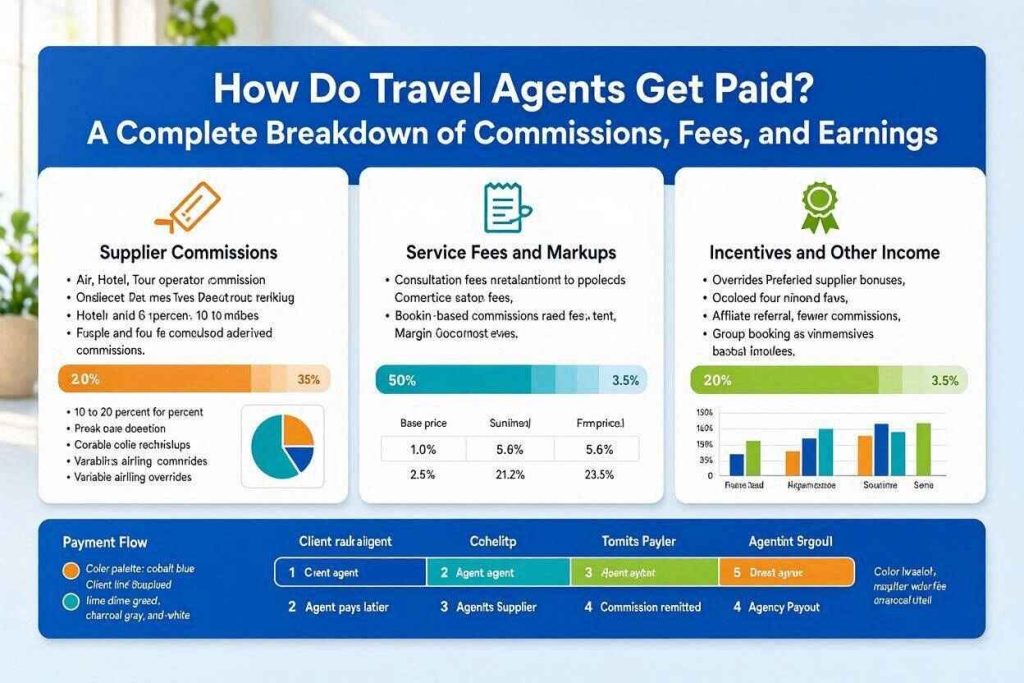
Travel agents are paid primarily through supplier commissions, client fees, host agency commission splits, and performance bonuses. In most leisure bookings, suppliers such as hotels, cruise lines, resorts, and tour operators pay commission once the traveler has completed the trip — not when the booking is first made.
How Travel Agent Compensation Works
Travel agent compensation is easier to follow when it’s broken into a simple sequence:
Basic Compensation Process
- A traveler contacts a travel agent.
- The agent researches and plans the trip.
- The agent books the travel products.
- The traveler pays for the trip.
- The traveler completes the trip.
- The supplier releases commission.
- The agent receives payment.
New advisors are often surprised to learn that payment can land weeks or months after the booking was made, not right away. That delay is one of the main reasons many advisors charge planning fees on top of commission — it’s income they can count on regardless of how long a supplier takes to pay out.
The Short Answer: Four Main Revenue Sources
Most travel agent income comes from four primary sources.
| Revenue Source | Who Pays | Typical Use |
| Supplier Commission | Travel Supplier | Hotels, cruises, tours |
| Planning Fee | Client | Research-intensive trips |
| Service Fee | Client | Ticket changes, support |
| Bonus or Override | Supplier | Volume-based rewards |
For most leisure travel advisors, supplier commission remains the largest single source of income — the remaining three sources exist mainly to smooth out cash flow and reward growth.
Who Actually Pays Travel Agents?
In most bookings, the travel supplier pays the travel agent, not the traveler. Some advisors also charge planning or service fees directly to clients, depending on how complex the trip is to plan.
One of the most persistent myths in travel is that agents secretly inflate prices to cover their pay. In reality, commission is generally built into the supplier’s own pricing structure well before an advisor ever gets involved.
Supplier-Paid Commissions
Hotels, resorts, cruise lines, tour operators, and vacation package providers commonly compensate advisors through commission. The supplier benefits because advisors bring qualified, pre-vetted bookings into their sales channel — many suppliers treat it as a marketing cost rather than a discount given away.
- Hotel bookings
- Resort packages
- Cruise vacations
- Guided tours
- Vacation packages
- Travel insurance
In most cases, a traveler pays the same advertised rate whether they book directly with the supplier or through an advisor.
Client-Paid Fees
Not every booking generates meaningful commission, so many advisors charge clients directly for their time and expertise.
- Trip planning fees
- Consultation fees
- Airfare booking fees
- Itinerary design fees
- Research fees
- Emergency support fees
These fees compensate for professional expertise and hours spent — not simply for making a reservation a traveler could technically make alone.
Host Agency Revenue Sharing
Most home-based travel advisors operate under a host agency rather than holding their own supplier contracts and accreditation. A host agency provides:
- Supplier relationships
- Booking systems
- Commission processing
- Training
- Industry accreditation
When a supplier pays commission, it goes to the host agency first, which then distributes the advisor’s agreed-upon share. That commission-sharing arrangement is explained in full later in this guide.
OTAs vs. Travel Advisors: How Compensation Compares
Online travel agencies (OTAs) such as Expedia and Booking.com sit between the traveler and the supplier too, but they’re compensated very differently from an independent advisor. OTAs typically negotiate their own commission or margin directly with suppliers, commonly in the 10% to 30% range depending on the platform and product, and that margin is baked into the price the traveler sees — whether or not a human is ever involved in the booking.
Independent travel advisors, by contrast, generally earn a smaller, more transparent commission (typically 7% to 20%, covered in detail later in this guide). Suppliers often accept a lower rate for advisor-driven bookings specifically because those bookings tend to be better-matched to the product, generate fewer cancellations, and come with a built-in layer of client support the supplier doesn’t have to provide itself.
There’s also a hybrid worth knowing about: programs like Expedia’s Travel Agent Affiliate Program (TAAP) let accredited advisors book from an OTA’s own inventory and still earn a supplier-style commission on top, rather than replacing the advisor relationship. It’s a useful gap-filler for last-minute availability or destinations where an advisor lacks a direct supplier contract, but most full-time advisors still rely primarily on direct supplier and host agency relationships for the bulk of their business.
Who Pays in Most Bookings?
Payment Flow: How Money and Commission Liability Move
Money moves through several hands before an advisor is actually paid, and the party financially “on the hook” for the commission shifts as the booking progresses:
- Traveler pays the supplier (directly or via the advisor’s booking system).
- Supplier delivers the travel product and holds the commission as a liability owed to the advisor or host agency.
- Supplier’s accounting team confirms the trip was completed without a qualifying cancellation or refund.
- Supplier releases the commission into its settlement or payment system.
- Host agency receives the commission (if the advisor operates under a host).
- Advisor receives their share of the commission.
Revenue Source Comparison
| Revenue Source | Primary Payer | Common? |
| Hotel Commission | Supplier | Yes |
| Cruise Commission | Supplier | Yes |
| Tour Commission | Supplier | Yes |
| Travel Insurance Commission | Supplier | Yes |
| Planning Fee | Client | Sometimes |
| Service Fee | Client | Sometimes |
| Override Bonus | Supplier | Less Common |
The takeaway is straightforward: travel agents are usually paid by suppliers, but a meaningful share also collect direct compensation from clients through planning and service fees — and the balance between the two shapes how stable an advisor’s income is month to month.
The Travel Agent Income Stack: Every Way Agents Make Money
The Travel Agent Income Stack is a framework for understanding the six layers of revenue available to an advisor, from foundational supplier commissions up to advanced group-travel earnings. Most new advisors rely almost entirely on the first two layers; established advisors build real income stability by adding layers on top rather than simply booking more of the same thing.
Travel agents rarely rely on one revenue source. The most successful advisors deliberately stack several income streams, which is exactly why two advisors doing similar booking volume can end up with very different take-home income.
Income Stack Framework
| Level | Revenue Source | Difficulty to Access | Scalability | Income Stability |
| 1 | Supplier Commissions | Low — available from day one | Medium — limited by hours in the day | Low — depends on trip completion |
| 2 | Planning & Consultation Fees | Low–Medium — requires client buy-in | Medium | High — often collected upfront |
| 3 | Booking & Service Fees | Low | Low–Medium | High — collected at time of service |
| 4 | Travel Insurance Commissions | Low — add-on to existing bookings | Medium | Medium |
| 5 | Overrides & Supplier Bonuses | Medium–High — needs sales volume | High | Low–Medium — tied to thresholds |
| 6 | Group & Destination Wedding Earnings | High — needs specialization | High | Medium — large but infrequent |
Advisor Maturity Model
Most advisors move through three broad stages as their business matures, and the composition of their income stack shifts accordingly:
| Stage | Primary Income Levels | Typical Focus |
| New Advisor (Years 0–2) | Level 1, occasionally Level 2 | Building a client base; still learning to charge fees with confidence |
| Established Advisor (Years 2–5) | Levels 1–4 | Fees become routine; insurance attached to nearly every booking |
| Veteran / Specialist Advisor (5+ Years) | All six levels | Group travel and overrides begin to rival core commission income |
This progression matters more than any single commission rate: an advisor who reaches Level 5–6 income is far less exposed to any one supplier, cancellation, or slow season than one still relying entirely on Level 1.
Revenue Diversification: An Example Mix
The table below illustrates a realistic revenue mix for an established, diversified advisor. It’s an example distribution built from the ranges used throughout this guide, not a claimed industry average — actual mixes vary widely by niche and business model.
| Income Source | Example % of Revenue |
| Supplier Commissions | 55% |
| Group & Destination Wedding Earnings | 10% |
| Planning & Service Fees | 15% |
| Travel Insurance Commissions | 8% |
| Overrides & Bonuses | 7% |
| Referral & Ancillary Income | 5% |
Supplier Commissions
Supplier commissions form the foundation of most travel businesses. When an advisor books a hotel, cruise, resort, guided tour, or vacation package, the supplier generally pays a percentage of the booking value once travel is complete.
- Product knowledge
- Client support
- Booking management
- Problem resolution
- Destination expertise
For most advisors, supplier commission represents the largest single portion of annual revenue — which is exactly why the remaining five layers exist: to reduce how dependent an advisor’s income is on that one line.
Planning Fees
Planning fees compensate advisors for the work performed before a booking ever happens. As itinerary design has gotten more complex, these fees have become more common rather than less.
- Luxury travel
- Multi-country trips
- Honeymoons
- Group travel
- Customized itineraries
A planning fee protects an advisor from spending hours on a consultation only to have the client quietly book the same trip elsewhere.
Booking Fees
Booking fees are distinct from planning fees. A planning fee covers research and itinerary creation; a booking fee covers the transactional work — reservation processing, ticket issuance, documentation, and administrative follow-through. Some agencies charge one, some charge both.
Overrides and Bonuses
Suppliers often reward high-performing agencies with volume bonuses, sales incentives, preferred-partner bonuses, or seasonal promotions. Overrides are generally tied to total sales volume rather than any single booking, so larger agencies and host networks tend to benefit most from these programs.
Travel Insurance Commissions
Travel insurance is frequently underestimated as a revenue source. Because it attaches to a booking that’s already happening, it adds income without requiring a separate sale — and insurance commissions are consistently among the highest percentages in the industry.
- Trip cancellation coverage
- Medical coverage
- Emergency evacuation coverage
- Travel interruption coverage
Group Travel Earnings
Group travel is one of the most profitable segments in the industry, because a single event generates dozens of individual bookings at once.
- Destination weddings
- Corporate retreats
- Family reunions
- Educational tours
- Religious travel groups
Example: A Destination Wedding Room Block
Consider a 25-room destination wedding block at an all-inclusive resort, with rooms averaging $2,800 for a five-night stay — $70,000 in total group booking value. At a typical group commission rate of 10%, that’s $7,000 in gross commission from the room block alone, before any planning fee. Resorts commonly credit one complimentary room for roughly every ten paid rooms booked, so the advisor may also secure a free stay for the couple. After an 80/20 host split, the advisor’s net commission on this single event is about $5,600, plus a typical destination-wedding planning fee in the $250–$750 range. A handful of well-run group bookings like this can generate what would otherwise take dozens of individual reservations.
Commission vs Profit
Commission and profit are often confused, but they aren’t the same thing.
| Item | Meaning |
| Commission | Gross amount earned |
| Expenses | Business costs incurred |
| Profit | What remains after expenses |
An advisor who earns a commission still carries real business costs — host agency fees, marketing, technology subscriptions, training, and insurance — and profit is only what’s left once those are covered.
Worked Example: From Gross Commission to Profit
| Line Item | Amount |
| Gross Commission | $1,000 |
| Host Agency Share (20%) | –$200 |
| Net Commission to Advisor | $800 |
| Estimated Business Overhead* | –$80 |
| Approximate Profit | $720 |
*Overhead estimate based on typical errors-and-omissions insurance (roughly $400–$450 per year for a solo advisor), CRM and marketing tools, and association dues, allocated across a representative volume of bookings. Actual overhead varies by agency size and business model.
Travel Agent Commission Rates by Travel Product
Most travel agents earn their highest commissions from cruises, luxury resorts, and group travel, while standalone airfare typically pays the least. Commission rates vary meaningfully by product type, and understanding those differences explains why many advisors steer their business toward certain categories.
Commission Comparison Matrix
| Product | Commission | Payment Timing | Difficulty | Avg. Booking | Revenue Potential | Repeat Potential |
| Hotels | 8–15% | After travel | Low | $150–$400/night | Moderate | High |
| Cruises | 10–20% | After final payment | Medium | $1,500–$5,000+ | High | High |
| Tours | 10–20% | After completion | Medium | $2,000–$6,000 | High | Moderate |
| Travel Insurance | 20–37% | Varies | Low | 5–8% of trip cost | Moderate (add-on) | High |
| Flights | Often 0–5% | Varies | Low | $300–$1,200 | Low | High |
Ranges reflect typical 2026 market practice across hotels, cruise lines, tour operators, and insurance underwriters. Overall, cruises, luxury packages, and group travel offer the strongest commission opportunities, while airfare-only bookings remain the thinnest margin in the industry — individual supplier and host agency agreements should always be confirmed directly.
Industry professionals generally treat commission rate as only one input alongside booking size and repeat potential — a 10% hotel commission on a $4,000 family vacation often outperforms a 20% commission on a $400 add-on tour, and specialists typically build their business mix around total revenue potential rather than the headline percentage alone.
Hotel Commission Rates
Hotels are among the most common commission-producing products advisors sell. Many chains compensate advisors for bringing guests through approved booking channels, and hotel commissions tend to be straightforward because inventory is abundant, booking systems are standardized, and payment processes are well established. Chains such as Marriott, Hilton, and Hyatt run advisor-facing commission programs, and boutique or luxury independent properties often pay toward the higher end of the typical range.
Hotel bookings often serve as a reliable source of recurring commission income precisely because they’re easy to repeat with the same client year after year.
Cruise Commission Rates
Cruises are frequently considered the strongest commission category in the industry. Cruise lines such as Royal Caribbean, Carnival, and Norwegian often run advisor promotions, group booking incentives, and volume-based override programs on top of standard commission. One nuance worth knowing: most cruise fares include non-commissionable fees (NCFs) — port charges and taxes — so even at a strong contracted rate, the commission applies only to the commissionable portion of the fare, not the full sticker price.
Cruise specialists can build substantial businesses around repeat clients and group departures, since cruisers tend to rebook with the same advisor more than almost any other travel segment.
Tour Package Commission Rates
Tour operators typically pay commission on packaged travel products — guided tours, adventure travel, escorted vacations, and multi-city itineraries. Tour commissions can be attractive simply because package prices tend to run larger than standalone bookings, which lifts the dollar value of a given percentage.
Travel Insurance Commission Rates
Travel insurance is often the most overlooked revenue stream in an advisor’s business, largely because it’s easy to forget to offer on every quote.
| Insurance Product | Potential Revenue Opportunity |
| Trip Cancellation | Additional commission source |
| Medical Coverage | Additional commission source |
| Comprehensive Plans | Higher commission potential |
| Annual Policies | Repeat revenue opportunity |
Commission on travel insurance commonly runs from about 20% up to the high-30s percentage range, with some comprehensive plans paying even higher — among the richest margins of any product an advisor sells, and one reason experienced advisors make it a standard part of every quote rather than an afterthought.
Airline Commission Reality
Many travelers assume airlines still pay travel agents substantial commission. That was true before the mid-1990s, when air travel could generate up to 80% of a traditional agency’s revenue on a flat, uncapped 10% commission. The turning point came in 1995, when Delta Air Lines introduced a hard cap on domestic ticket commissions — other airlines quickly followed, and commission-based airfare largely disappeared over the following decade.
Today, most airlines pay little or no commission on domestic tickets, with international and premium-cabin fares sometimes offering somewhat better rates. Because that income is so unpredictable, most advisors now charge a flat service fee on air-only bookings instead — commonly around $35 for domestic tickets and $50 for international itineraries.
Airline Commission Comparison
| Travel Product | Commission Potential |
| Cruises | High |
| Resorts | High |
| Tours | Medium–High |
| Hotels | Medium |
| Travel Insurance | Medium |
| Flights | Often Low |
Highest-Paying Travel Products (Typical Ranking)
| Rank | Travel Product | Typical Commission Level |
| 1 | Luxury cruises | High |
| 2 | Group travel programs | High |
| 3 | Luxury resort packages | High |
| 4 | Guided tours | Medium–High |
| 5 | Travel insurance | Medium |
| 6 | Hotels | Medium |
| 7 | Airfare-only bookings | Low |
This is exactly why many advisors build their business around complete vacation packages rather than selling standalone flights — the economics simply favor it.
When Do Travel Agents Get Paid?
In short: the traveler books and pays a deposit, the trip is completed, the supplier finalizes its accounting, the host agency processes payment (if applicable), and the advisor receives commission — typically two to twelve weeks after the trip ends, depending on the supplier.
Travel agents usually receive commission after the traveler completes the trip, not when the booking is made. That delay can range from a few weeks to several months depending on the supplier, payment schedule, and host agency processing timeline.
Why Agents Usually Get Paid After Travel
Suppliers generally wait until travel is completed because cancellations, modifications, and refund requests can still affect commission eligibility right up until departure.
- The trip occurred
- The traveler checked in
- Services were delivered
- No refund invalidated the booking
Only once those are confirmed is commission typically released — which protects the supplier from paying out on travel that never actually happened.
The Travel Agent Commission Lifecycle: A 10-Step Breakdown
The simple version — book, travel, get paid — skips over several stages that materially affect when an advisor actually sees the money. Here’s the fuller lifecycle:
- Initial Consultation & Planning — the advisor researches options and builds a proposal.
- Booking Confirmed — the reservation is created with the supplier.
- Deposit Collected — the traveler pays an initial deposit, typically due at booking.
- Deposit Remitted to Supplier — the advisor or host agency forwards the deposit.
- Final Payment Collected — the traveler pays the balance, usually 60–120 days before departure.
- Final Payment Remitted to Supplier — the booking becomes financially locked in.
- Travel Date Arrives / Trip Completed — the traveler completes the trip.
- Supplier Accounting & Commission Calculation — the supplier confirms no cancellation or refund affected the booking.
- Host Agency Commission Processing — the host receives payment from the supplier and applies the agreed split.
- Advisor Receives Commission — funds land in the advisor’s account, typically 30–90 days after travel for most suppliers.
One notable exception: cruise lines often calculate and release commission once final payment is received — commonly 90 to 120 days before the sailing date — rather than waiting until after the cruise itself. That changes the payment timing, though a late cancellation can still trigger a clawback once the ship has sailed without the traveler aboard.
Typical Payment Timeline
| Stage | Timing |
| Booking Made | Day 1 |
| Deposit Paid | Day 1–30 |
| Final Payment | Weeks or months later |
| Travel Completed | Travel date |
| Commission Released | After travel (or after final payment, for many cruise lines) |
| Agent Paid | Days or weeks after release |
Why Payments Get Delayed
Several factors can slow commission payments beyond the normal timeline:
| Delay Factor | Impact |
| Supplier Review | Moderate |
| Booking Changes | Moderate |
| Refund Requests | High |
| Travel Rescheduling | High |
| Administrative Errors | Moderate |
Experienced advisors learn to manage cash flow around this reality — planning fees, in particular, exist partly to smooth out the gap between doing the work and getting paid for it.
How Host Agency Commission Splits Work
A host agency commission split determines how supplier commission is divided between the host agency and the independent advisor. The split varies by host and typically reflects the level of support, technology, training, and supplier access the host provides.
What Is a Host Agency?
A host agency is an established travel business that lets independent advisors operate under its infrastructure — its accreditation, its supplier contracts, and its back-office systems — in exchange for a commission split and, usually, a modest monthly fee.
| Benefit | Value to Advisor |
| Supplier Access | High |
| Commission Processing | High |
| Training | Medium |
| Marketing Support | Medium |
| Technology Platforms | High |
| Industry Credentials | High |
What IATA, ARC, and Similar Accreditations Actually Do
Suppliers need a reliable way to recognize an agency, track its bookings, and route commission correctly — that’s the role accreditation plays. In the United States, the Airlines Reporting Corporation (ARC) accredits agencies to issue airline tickets and manages settlement between agencies and airlines. The International Air Transport Association (IATA) performs a similar function for agencies outside the U.S., and its U.S. counterpart, IATAN (International Airlines Travel Agent Network), mirrors ARC’s numbering system for American agencies so international carriers and other suppliers recognize them too. Cruise-focused advisors often also join CLIA (Cruise Lines International Association), which carries its own production requirements.
Hotels, cruise lines, and tour operators typically ask for one of these accreditation numbers at the time of booking specifically so they know which advisor — or which host agency — to credit with the commission. Most new, home-based advisors use their host agency’s accreditation rather than obtaining their own, which is one of the main practical reasons hosts remain the dominant entry point into the profession.
Getting Started: The Home-Based Advisor Path
Most new advisors follow a similar path: New Advisor → Joins a Host Agency → Gains Supplier & Accreditation Access → Starts Earning Commission. Building direct supplier relationships and independent accreditation from scratch is realistic for an established agency, but rarely practical for someone just starting out, which is why the large majority of new advisors begin under a host rather than going independent immediately. Full independence — and an advisor’s own IATA/ARC accreditation — typically only becomes worthwhile after several years of production, once the higher commission retention clearly outweighs the cost and effort of building those supplier relationships directly.
Typical Commission Split Examples
Host agency arrangements vary widely: some prioritize higher commission retention, others offer more support in exchange for a larger share.
| Gross Commission | Split | Agent Keeps |
| $100 | 70/30 | $70 |
| $100 | 80/20 | $80 |
| $100 | 90/10 | $90 |
| $500 | 80/20 | $400 |
| $1,000 | 90/10 | $900 |
Actual split ranges vary by host agency and typically run from around 50/50 for brand-new advisors up to 90/10 (or, with some hosts, 100% in exchange for a higher flat monthly fee) for high-volume, experienced advisors. 70/30 or 80/20 is a common starting point for new advisors, and many hosts use tiered structures that raise the split automatically once an advisor’s annual production crosses set thresholds.
Why the Split Percentage Matters Over a Full Year
The gap between split tiers looks small on a single booking, but it compounds significantly across a year of production. On $100,000 in annual gross commission — a realistic total for a solidly established advisor — the difference between common tiers adds up fast:
| Split | Advisor Keeps | Host Agency Keeps | Annual Difference vs. 70/30 |
| 70/30 | $70,000 | $30,000 | — |
| 80/20 | $80,000 | $20,000 | +$10,000 |
| 90/10 | $90,000 | $10,000 | +$20,000 |
Higher splits are rarely available on day one — most hosts tie them to sustained production, tenure, or a higher monthly fee, which is why the Advisor Maturity Model matters as much as the split percentage itself. An advisor chasing a 90/10 split in year one, before they have the volume to support it, often pays more in fees than they save in commission.
Independent Agent vs Host Agency
| Factor | Host Agency | Independent Agency |
| Startup Cost | Lower | Higher |
| Supplier Access | Immediate | Must build |
| Training | Often Included | Self-managed |
| Technology | Often Included | Self-funded |
| Commission Share | Split Required | Keep Full Amount |
| Administrative Work | Reduced | Greater |
A host agency generally helps advisors launch faster; full independence can offer greater long-term control once an advisor has the volume and relationships to support it.
A host agency split is the percentage of commission shared between a host agency and an independent travel advisor. For example, under an 80/20 split, the advisor keeps 80% of the commission while the host agency retains 20% in exchange for services, supplier access, and operational support.
How Much Does a Travel Agent Make Per Booking?
Earnings per booking depend on trip value, commission percentage, supplier type, any fees charged, and the advisor’s host agency split — a single booking might generate under $100, while a luxury or group trip can produce thousands. The more useful question isn’t how much commission exists on a booking, but how much of it actually reaches the advisor after splits and expenses.
Booking Walkthrough: Following One Reservation From Quote to Payout
To make the mechanics concrete, here’s how a single mid-sized booking flows through an advisor’s business. A client requests a seven-night all-inclusive trip to the Riviera Maya for two people. The advisor spends roughly three hours across two consultations researching resorts, comparing quotes, and building the itinerary, then books a $4,200 package with a preferred resort partner. The client pays a $500 deposit at booking and the remaining balance 75 days before departure. The advisor’s host agency operates on an 80/20 split, and the supplier’s standard commission on this resort is 12%.
At $4,200 and 12% commission, gross commission is $504. After the 80/20 split, the advisor’s net commission is $403.20. Roughly 45 days after the couple returns home, the supplier finalizes its accounting and releases the commission to the host agency, which processes payment within its usual two-week cycle — so the advisor is paid in full a little over three months after the original consultation. That timeline, not any single dramatic booking, is what most leisure travel commission actually looks like.
Example: $1,000 Booking
| Item | Amount |
| Booking Value | $1,000 |
| Commission Rate | 10% |
| Gross Commission | $100 |
| Host Split (80/20) | –$20 |
| Agent Receives | $80 |
Example: $5,000 Booking
| Item | Amount |
| Booking Value | $5,000 |
| Commission Rate | 10% |
| Gross Commission | $500 |
| Host Split (80/20) | –$100 |
| Agent Receives | $400 |
Example: $10,000 Booking
| Item | Amount |
| Booking Value | $10,000 |
| Commission Rate | 12% |
| Gross Commission | $1,200 |
| Host Split (80/20) | –$240 |
| Agent Receives | $960 |
Example: $20,000 Luxury Trip
| Item | Amount |
| Booking Value | $20,000 |
| Commission Rate | 15% |
| Gross Commission | $3,000 |
| Host Split (80/20) | –$600 |
| Agent Receives | $2,400 |
Luxury advisors often focus on fewer clients while generating meaningfully larger commission per booking — a single high-end trip can outearn several smaller reservations combined.
Booking Earnings Calculator
| Booking Value | Commission Rate | Gross Commission | Agent Keeps (80/20 Split) |
| $1,000 | 10% | $100 | $80 |
| $5,000 | 10% | $500 | $400 |
| $10,000 | 12% | $1,200 | $960 |
| $20,000 | 15% | $3,000 | $2,400 |
How Booking Volume Affects Annual Income
Per-booking commission only tells part of the story. What an advisor actually earns in a year comes down to booking volume, average trip value, and how their host agency split scales with production. The scenarios below model three realistic volume levels using the commission and split ranges already used throughout this guide.
| Monthly Bookings | Avg. Booking Value | Commission Rate | Host Split | Est. Annual Commission Income |
| 5 (new advisor) | $2,000 | 10% | 70/30 | ~$8,400 |
| 10 (established advisor) | $4,000 | 12% | 80/20 | ~$46,080 |
| 20 (high-volume advisor) | $4,500 | 12% | 85/15 | ~$110,160 |
These figures land in the same broad neighborhood as reported industry income data. One widely cited host-agency income survey puts average first- and second-year advisor income around $11,700 annually, and roughly one in four experienced advisors reportedly earns over $100,000. For comparison, the U.S. Bureau of Labor Statistics puts the median annual wage for travel agents — as employees, not commission-only independent advisors — at $48,450 as of May 2024, with the top 10% earning over $74,160. That figure is a useful benchmark, but it understates what full-time independent or host-affiliated advisors can earn once commission, fees, and bonuses are combined, which the $46,080 established-advisor scenario above illustrates well. Actual results vary widely based on niche, market, and how quickly an advisor ramps up to consistent monthly volume.
Do Travel Agents Charge Clients Fees?
Many travel agents charge planning, consultation, or service fees on top of supplier commission. These fees compensate advisors for research, itinerary design, expertise, and time spent supporting a client before a booking is ever completed — and a growing number of advisors use them specifically to get paid for their work even when a client ultimately doesn’t book.
Why Agents Charge Planning Fees
Planning a complex trip can take hours, sometimes days, of dedicated work.
- Destination research
- Hotel comparisons
- Flight coordination
- Activity recommendations
- Custom itinerary creation
- Supplier negotiations
A planning fee recognizes the value of that expertise, and it discourages travelers from collecting a free, fully-built itinerary and then booking it elsewhere.
Typical Fee Structures
| Fee Type | Purpose |
| Consultation Fee | Initial planning session |
| Research Fee | Custom itinerary development |
| Booking Fee | Reservation processing |
| Air Ticket Fee | Flight assistance |
| Concierge Fee | Ongoing support |
Can a Travel Advisor Actually Save You Money?
Sometimes — though usually not through a lower sticker price. Because commission is built into supplier pricing, a traveler typically pays the same advertised rate whether they book directly or through an advisor, so the value rarely shows up in the base price itself. It shows up elsewhere: advisors with strong supplier relationships, particularly through consortia affiliations like Virtuoso or Signature Travel Network, can often secure perks that aren’t available to the general public.
| What You’re Comparing | Booking Direct | Booking Through an Advisor |
| Base price | Standard rate | Usually the same rate |
| Room upgrades / amenities | Rare, ad hoc | Common through preferred partnerships |
| Time cost | Traveler does all the research | Advisor absorbs the research and comparison time |
| Problem resolution | Traveler handles disruptions directly | Advisor advocates on the traveler’s behalf |
| Group rate negotiation | Limited leverage | Advisor can negotiate group concessions |
For a simple, well-defined trip, the time savings and perks may not outweigh a planning fee. For a complex, high-stakes, or large-group trip, negotiated benefits and advocacy during disruptions are usually where an advisor earns their keep.
Do Clients Pay More Overall?
This is one of the most common concerns travelers raise — and in most cases, the answer is no. Supplier commission is generally already built into the published price, so a traveler often pays the same amount whether booking directly or through an advisor. Planning or service fees, where charged, are the exception.
| Scenario | Supplier Cost | Agent Fee | Total Cost |
| Direct Booking | $5,000 | $0 | $5,000 |
| Advisor Booking (No Fee) | $5,000 | $0 | $5,000 |
| Advisor Booking (Planning Fee) | $5,000 | $200 | $5,200 |
The real question is whether an advisor’s expertise, support, and time savings justify that fee — and for complex vacations, most travelers who use one decide it does.
What Happens If a Trip Is Canceled?
If a trip is canceled, an advisor’s commission may be reduced, delayed, or lost entirely, depending on the supplier’s policy, the timing of the cancellation, and whether penalties apply. Some suppliers claw back commission that was already paid; others allow partial compensation in specific circumstances. A booking, in other words, does not automatically guarantee income.
Commission Clawbacks
A commission clawback happens when a supplier reverses or removes commission because a booking didn’t result in completed travel.
- Full trip cancellation
- Supplier refunds
- Chargebacks
- Booking reversals
- Traveler no-shows
Commission that looked earned at the booking stage may ultimately never be paid at all.
Example Walkthrough: How a Cancellation Plays Out
Consider a couple who books an $8,000 all-inclusive package five months before travel, paying a $500 deposit at booking. Final payment of the remaining $7,500 is due 75 days before departure, in line with the supplier’s standard policy. At day 40 — before that final payment deadline — a family emergency forces them to cancel.
Because the cancellation happens before final payment, the supplier refunds the deposit per its stated policy, and because the trip never reaches the “completed travel” stage in the commission lifecycle, no commission is ever calculated or paid on the booking at all. The advisor may have spent several hours on research, quoting, and coordination, and receives nothing for that time unless a planning fee was charged upfront — exactly why many advisors treat planning fees as insurance against this scenario.
The picture changes if a cancellation happens after final payment. Depending on the supplier, some or all of the funds already paid may become non-refundable to the traveler, and if commission was already released to the advisor, it can be clawed back once the supplier’s accounting confirms the trip won’t take place. Suppliers vary widely here: some cruise lines apply a graduated penalty schedule that gets steeper closer to the sail date, while many hotels use a simpler all-or-nothing cutoff. During the industry-wide disruption of 2020, some advisors were required to repay commission they’d already earned — in a few documented cases, tens of thousands of dollars — when mass cancellations forced suppliers to draw the funds back out of agency trust accounts. That episode was extreme, but it’s exactly why experienced advisors treat “earned” commission as provisional until a trip is fully behind the client.
Refund Scenarios
| Scenario | Commission Status | Agent Outcome |
| Client cancels before final payment | Usually no commission | No payout |
| Client cancels after final payment | Depends on supplier | Reduced or no payout |
| Supplier cancels trip | Supplier policy applies | Varies |
| Partial refund issued | Partial commission possible | Reduced payout |
| Traveler completes trip | Commission paid | Full payout |
Cancellation policies differ by supplier type. Cruise lines typically use a graduated penalty schedule that increases closer to departure, often becoming non-refundable inside the final payment window (commonly 90–120 days before sailing). Hotels and resorts often use a simpler flat cutoff, commonly 14–60 days before arrival. Tour operators frequently sit in between, with partial-refund tiers tied to what’s already been paid to ground operators. Always confirm current terms in the specific supplier contract or booking confirmation.
Protecting Agent Income
Because cancellations are unavoidable, advisors use several strategies to protect their businesses:
- Charging planning fees
- Charging consultation fees
- Selling travel insurance
- Diversifying revenue streams
- Focusing on repeat clients
- Using suppliers with transparent cancellation policies
A planning fee is often the only compensation an advisor keeps if a trip never actually takes place.
FAQ About Travel Agent Pay
How do travel agents make money if they are free?
Many travel agents appear free because suppliers pay commission on hotels, cruises, tours, and vacation packages. Some advisors also charge planning, consultation, or service fees for their expertise on top of that commission.
Do travel agents get paid by customers?
Sometimes. Many advisors earn commission from suppliers, while others charge clients directly through planning fees, booking fees, consultation fees, or concierge service fees — and most advisors combine both to some degree.
How much commission do travel agents get?
Commission rates vary by supplier and product.
| Product | Typical Range |
| Hotels | 8–15% |
| Cruises | 10–20% |
| Tours | 10–20% |
| Insurance | 20–37% |
| Flights | Often 0–5% |
These ranges reflect typical 2026 market practice compiled from host agency and industry-association resources; suppliers set and adjust rates individually, so advisors should confirm current terms with each supplier or host agency.
Do travel agents get paid hourly?
Most independent travel advisors are not paid hourly. Compensation generally comes from commission, planning fees, service fees, bonuses, and overrides instead. Some agency employees do receive hourly wages or a salary, but independent advisors typically earn based on sales and services provided.
How much does a travel agent make per booking?
It depends on booking value, commission rate, supplier type, host agency split, and any fees charged. A small booking may generate under $100, while a luxury vacation or group trip can generate thousands.
| Booking Value | Agent Earnings Example |
| $1,000 | $80 |
| $5,000 | $400 |
| $10,000 | $960 |
| $20,000 | $2,400 |
These examples assume specific commission and host-split scenarios used throughout this guide and are for illustration only.
Do airlines pay travel agents commissions?
Some airlines offer commission or incentive programs, but airline commission is generally far lower than hotel, cruise, tour, or package commission — a legacy of the industry-wide cuts that began with Delta’s 1995 commission cap. Many airfare-only bookings generate limited compensation compared with vacation packages, which is why advisors often focus on complete travel planning rather than flight-only reservations.
How do travel agents get paid for cruises?
Cruise lines commonly compensate advisors through commission, often released once final payment is received rather than after the sailing itself. Additional earnings can come from group bookings, bonus promotions, preferred-partner programs, and sales incentives — cruises are widely considered one of the strongest commission-producing products in the industry.
What is a host agency split?
A host agency split is the percentage of commission shared between a host agency and an independent travel advisor.
| Gross Commission | Split | Agent Receives |
| $100 | 80/20 | $80 |
| $500 | 80/20 | $400 |
| $1,000 | 80/20 | $800 |
The host agency retains a portion of the commission in exchange for infrastructure, supplier access, training, and support services.
Can travel agents make six figures?
Yes, but not all do. Reaching six figures typically comes down to some combination of four levers: higher booking volume (20 or more bookings a month can clear six figures on its own at a strong split, as modeled earlier in this guide); a higher-value niche such as luxury travel, group travel, or destination weddings, where a single booking can generate what would otherwise take dozens of smaller sales; a favorable host agency split, usually 90/10 or better, which is typically earned through sustained production rather than negotiated on day one; and a diversified revenue mix that layers planning fees, travel insurance, and overrides on top of core commission rather than relying on commission alone.
Industry income surveys suggest roughly one in four experienced advisors clears $100,000 annually, and top luxury specialists booking several million dollars in annual travel volume can earn well into six figures or more — though that level typically reflects years of relationship-building rather than a fast start. Most advisors build income gradually over several years rather than reaching a high figure immediately.
Why do some travel agents charge planning fees?
Planning fees compensate advisors for professional expertise and time spent on research, itinerary creation, supplier coordination, destination recommendations, and client support. A planning fee ensures an advisor is paid for that work even if a traveler ultimately chooses not to complete a booking.
Conclusion
So, how do travel agents get paid? The answer is more layered than simply earning a commission.
Most travel advisors generate income through a combination of supplier commission, planning fees, service fees, travel insurance commission, supplier bonuses, and group travel earnings.
The biggest misconception is that travel agents work for free. In reality, suppliers frequently compensate advisors for generating bookings, and many advisors also charge fees for the expertise and support they provide directly to clients.
Understanding the full compensation process — from booking to commission payout — helps explain why experienced advisors continue to play a meaningful role in travel, even as more booking moves online. The most successful advisors rarely rely on a single income source; instead, they build a diversified income stack that combines commission, fees, bonuses, and long-term client relationships.