
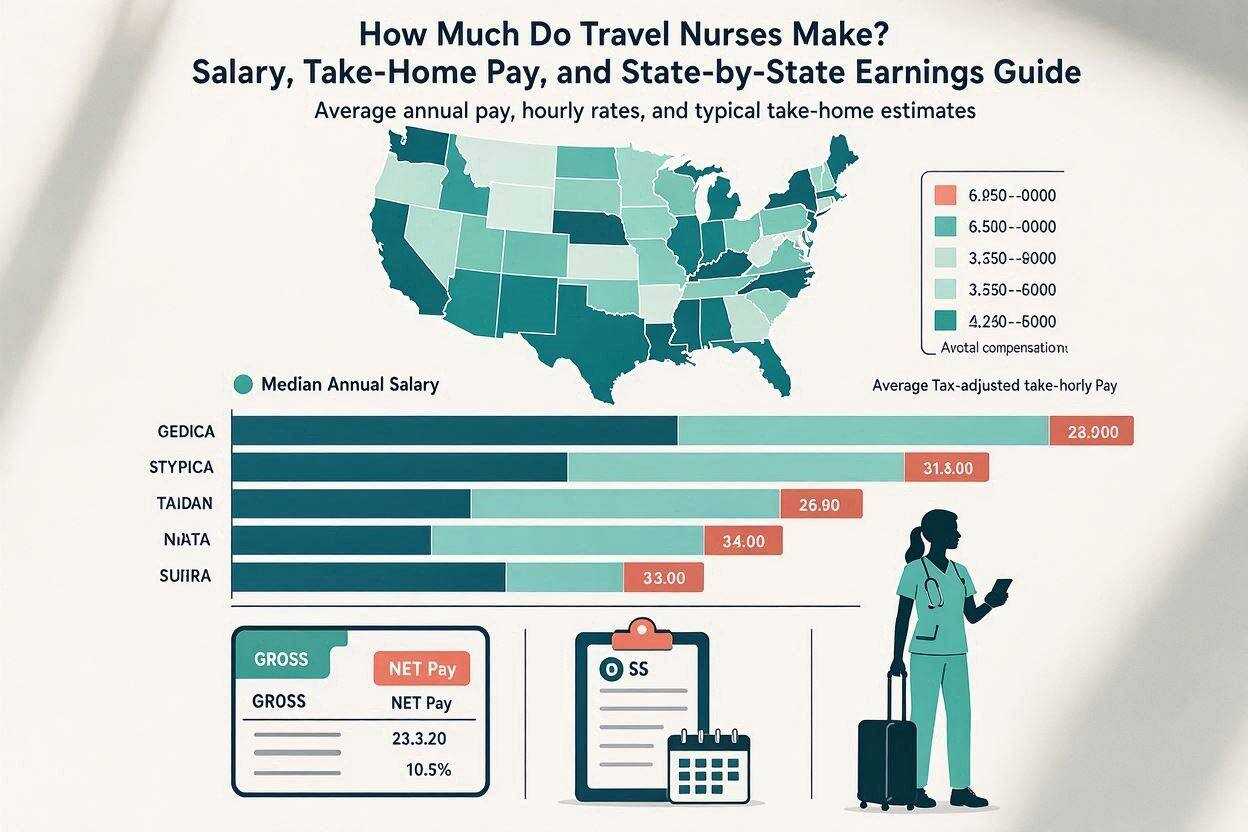
How Much Do Travel Nurses Make? Salary, Take-Home Pay, and State-by-State Earnings Guide
Quick answer: Travel nurses typically earn $1,800 to $3,200 a week, with in-demand specialties and high-cost markets regularly pushing past $4,000. That works out to roughly $90,000 to $150,000+ a year for a nurse who works close to full-time. But the number on a job board isn’t the number that hits your bank account — taxes, housing costs, and the gaps between contracts can move your real take-home by tens of thousands of dollars a year, which is why this guide spends as much time on take-home pay as it does on gross pay.
Ask five travel nurses what they make and you’ll get five different answers. Ask five salary websites the same question and you’ll get five different numbers, too — none of them wrong, exactly, just measuring different things. One site quotes a taxable hourly rate. Another blends in the stipends. A third pulls from job postings that skew toward premium, hard-to-fill contracts. A recruiter might quote you a “package” that bundles everything into one big number designed to catch your eye.
None of that is dishonest, but it does mean a $3,000-a-week contract in one state can leave you with less in your pocket than a $2,500-a-week contract somewhere else, once housing costs, state taxes, and licensing fees are factored in. A nurse comparing two offers side by side needs to know what’s driving the gap.
This guide breaks travel nurse pay down from every angle that actually matters for a real decision: hourly, weekly, monthly, and annual earnings; what’s actually inside a pay package; what lands in your account after taxes and expenses; how pay differs by state and specialty; how travel pay stacks up against a staff job over time; and how to tell whether a specific offer is actually good, rather than just loud.
How These Salary Figures Were Calculated

Every number in this guide is drawn from current, publicly available compensation data rather than a single source, because no single source tells the whole story. National and specialty averages come primarily from Vivian Health’s live job-posting data (updated weekly, reflecting active contracts), cross-checked against ZipRecruiter and Indeed’s aggregated salary reports. Staff-nurse comparison figures come from the U.S. Bureau of Labor Statistics’ Occupational Employment and Wage Statistics (OEWS) survey, the most authoritative government source for nursing wages, though the BLS does not track travel contracts specifically since travel nurses are typically classified under staffing-agency employment. Tax information reflects current IRS tax-home guidance and the Tax Foundation’s 2026 state tax data. Cost-of-living comparisons use the C2ER/MERIC Cost of Living Index.
Because travel nurse pay is negotiated contract-by-contract and shifts weekly with market demand, expect the figures below to represent a realistic current range rather than a fixed price tag — and expect different websites to show you different numbers for the same reason. Figures reflect data gathered in mid-2026 and are worth rechecking every few months, since this market moves quickly.
How Much Do Travel Nurses Make on Average?
Travel nurses earn more than staff nurses on average because hospitals pay a premium for flexibility, fast placement, and short-term staffing coverage — but “the average” hides a wide spread depending on specialty, location, and how busy the market is when you’re looking. As of mid-2026, national averages across major job platforms cluster between roughly $2,050 and $2,200 a week (Indeed’s trailing 36-month data shows $2,048; Vivian Health’s live job data, updated July 2026, shows $2,173; ZipRecruiter’s own figure works out to about $2,165). Annualized, that’s in the neighborhood of $101,000 to $113,000 for a nurse working most of the year — though, as you’ll see in the take-home section, gross annual pay and what you actually bank are two different numbers.
For comparison, the Bureau of Labor Statistics’ most recent wage survey puts the national mean salary for staff RNs at $101,420 a year (hospital-based staff RNs average slightly higher, at $104,420). That means a typical travel assignment doesn’t always pay dramatically more than a staff job on paper — the real financial edge usually comes from tax-free stipends, overtime access, and the ability to chase higher-paying markets, not just a bigger base number.
Salary Snapshot Table
| Pay Period | Typical Range (2026) |
|---|---|
| Hourly (taxable base) | $20–$50/hour |
| Hourly (blended, incl. stipends) | $45–$80+/hour |
| Weekly | $1,800–$3,200 (up to $4,000+ for top specialties/markets) |
| Monthly | $7,800–$13,900 |
| Annual (full-time, most of the year) | $90,000–$150,000+ |
Sources: ZipRecruiter, Indeed, and Vivian Health job-posting data, 2026.
A Med-Surg nurse on a standard assignment in a moderate-cost market will typically land toward the lower half of this range. An ICU, NICU, or Cath Lab nurse in a high-demand metro during a busy season can land well above it. The gap between “typical” and “premium” travel nurse pay is larger than in almost any other nursing role, which is exactly why averages alone aren’t that useful for planning your own finances.
Typical Earnings Distribution
Distributions tend to be more useful than a single average, because they show where most nurses actually land rather than where the headline number sits.
| Earnings Tier | Estimated Annual Earnings | Who Typically Lands Here |
|---|---|---|
| Entry tier | $75,000–$90,000 | First-time travelers, Med-Surg, lower-demand regions |
| Typical tier | $90,000–$120,000 | Most experienced travelers in standard specialties |
| Strong tier | $120,000–$150,000 | High-demand specialties, strong markets, steady work |
| Top tier | $150,000+ | Premium specialties (ICU, Cath Lab, CVOR), crisis or high-cost assignments, consistent overtime |
ZipRecruiter’s national data puts the lowest reported travel nurse earners around $40,500 a year and the highest around $139,000 — a spread that mostly reflects part-time work and contract gaps at the low end, and premium specialties with heavy overtime at the high end. Very few nurses land at either extreme; most cluster in the middle three tiers above.
Travel Nurse Salary Breakdown by Hour, Week, Month, and Year
Travel nurses usually think in weekly numbers, since that’s how contracts are quoted. But comparing travel nursing to a staff job — or to your own budget — is easier once you can translate that weekly figure into every other timeframe.
Hourly Travel Nurse Pay
The hourly rate you’ll see on a contract is almost always just the taxable base wage, not your full compensation. Most agencies keep this number relatively low on purpose, since it’s the portion subject to payroll tax — the rest of your pay arrives as stipends.
| Experience Level | Taxable Hourly Rate | Typical Weekly Package |
|---|---|---|
| First-time traveler | $20–$28/hour | $1,800–$2,400 |
| Experienced traveler (2+ contracts) | $28–$38/hour | $2,200–$2,900 |
| Specialty/high-demand traveler | $35–$50+/hour | $2,800–$4,000+ |
ICU, NICU, PACU, Cath Lab, and OR nurses tend to sit at the higher end of this range because of certification requirements and chronic staffing shortages in those units. If a recruiter quotes you a “blended rate” instead — combining your taxable wage and your weekly stipends into a single hourly-equivalent number — expect it to look considerably higher, often $45–$80+ an hour, since it’s counting money that isn’t actually taxed the same way.
Can You Start Travel Nursing Right Out of School? What First-Time Travelers Actually Earn
No — and this trips up a lot of new grads. Despite how the question is often phrased online, there’s effectively no such thing as a “first-year travel nurse” in the literal sense. Every major staffing agency and hospital system requires at least one to two years of recent bedside experience in your specialty before you can take your first travel contract, and some specialties (NICU in particular) commonly require two years or more. The reason is practical, not bureaucratic: travel nurses typically get just one to two days of orientation before being expected to work independently on an unfamiliar unit, which isn’t survivable without a real foundation of clinical experience.
What people usually mean by “first-year travel nurse” is a nurse taking their first travel contract after building that required staff experience — and that group does earn less than seasoned travelers. Industry data suggests first-time travelers typically land toward the bottom of their specialty’s range: roughly $1,800–$2,200 a week for a first Med-Surg contract and $2,200–$2,700 a week for a first ICU contract, compared to experienced travelers who’ve learned how to evaluate offers, negotiate stipends, and time the market. Pay tends to climb meaningfully by a nurse’s second and third contracts, less because agencies reward loyalty and more because new travelers simply get better at recognizing a strong package versus a mediocre one dressed up with a big headline number.
If you’re a new grad reading this: the fastest path to travel nursing isn’t to skip the requirement — it’s to spend your first one to two years in a specialty travel agencies are hungry for (ICU, ER, Med-Surg, and Telemetry are the most common entry points) and use that time to build the certifications (BLS, ACLS, and specialty credentials like CCRN) that will make your first contract search much shorter.
Weekly Travel Nurse Earnings
Weekly pay is the number most recruiters lead with, since it’s the figure that combines your taxable wage and your stipends into one comparison-friendly total.
| Weekly Tier | Weekly Earnings | Typical Profile |
|---|---|---|
| Entry-level assignment | $1,800–$2,200 | First-time travelers, Med-Surg, lower-cost markets |
| Average assignment | $2,200–$2,800 | Most standard contracts nationally |
| High-paying assignment | $2,800–$3,500 | High-demand specialties or metro markets |
| Premium assignment | $3,500+ | Crisis contracts, Cath Lab/CVOR, premium coastal markets |
Vivian Health’s live data — the most current available, pulled from over 200,000 active postings — puts the national average at $2,173 a week as of mid-July 2026. That’s a useful benchmark, but treat any single “average” cautiously: it moves week to week with demand, and it blends every specialty and state into one number.
Monthly Income Expectations
| Weekly Package | Monthly Equivalent |
|---|---|
| $2,000 | $8,667 |
| $2,500 | $10,833 |
| $3,000 | $13,000 |
| $3,500 | $15,167 |
These figures assume continuous, uninterrupted work. In practice, monthly income dips whenever a contract ends before the next one starts — which is common enough that it deserves its own section later in this guide.
Annual Earnings Potential
Can travel nurses hit six figures? Regularly — but the arithmetic behind it is less generous than most “$150K travel nurse!” headlines suggest.
| Weekly Income | Annual Potential (52 Weeks Worked) | Annual Potential (44 Weeks Worked)* |
|---|---|---|
| $2,000 | $104,000 | $88,000 |
| $2,500 | $130,000 | $110,000 |
| $3,000 | $156,000 | $132,000 |
| $3,500 | $182,000 | $154,000 |
*44 weeks reflects a more realistic annual schedule once licensing delays, time between contracts, and personal time off are factored in.
Very few travel nurses work all 52 weeks in a calendar year without a gap. Between licensing delays, the search for the next assignment, and deliberate time off, most experienced travelers plan around 40–46 paid weeks a year rather than 52 — which is why the second column above is the more realistic planning number for most people, even though the first is the one that shows up in marketing copy.
What Does a Travel Nurse Pay Package Include?
A travel nurse “pay package” is really several separate pieces of compensation bundled into one weekly number, and understanding each piece is what lets you compare two offers honestly instead of just comparing headlines.
Base Pay
Base pay is the taxable hourly wage that appears on your paycheck, gets reported on your W-2, and counts toward overtime calculations. It’s usually the smallest visible piece of the package — not because agencies are being stingy, but because shifting compensation into stipends (which can be tax-free) is what makes travel pay more valuable than a staff salary of the same gross size.
| Compensation Component | Example Weekly Amount |
|---|---|
| Taxable wage | $1,300 |
| Housing stipend | $1,000 |
| Per diem (meals/incidentals) | $400 |
| Total weekly package | $2,700 |
A nurse who only looks at the $1,300 taxable line and assumes that’s “the pay” is missing more than half the package.
Housing Stipends
The housing stipend is usually the single largest piece of a travel nurse’s compensation, and it’s designed to cover the cost of temporary housing at your assignment location. Stipend size is driven mainly by local housing costs — agencies generally benchmark stipends to the GSA’s published per diem lodging rates for the assignment’s specific city or county, which is why the same specialty and experience level can command a $900 weekly stipend in a rural market and a $2,200 weekly stipend in San Francisco or Manhattan.
| Housing Market | Typical Weekly Stipend Range |
|---|---|
| Rural / low-cost areas | $600–$1,000 |
| Mid-cost cities | $1,000–$1,400 |
| Major metro areas | $1,400–$2,000 |
| Premium coastal markets | $2,000–$2,800+ |
Understanding Your Tax Home (Why It Determines Whether Your Stipends Are Tax-Free)
This is the single most important — and most misunderstood — concept in travel nurse compensation, because it decides whether your housing and meal stipends are tax-free income or fully taxable wages.
The IRS defines a tax home as the general area of your main place of work, not necessarily where your family lives. For a travel nurse who moves between assignments, the IRS instead looks at whether you maintain a genuine, permanent residence somewhere you regularly return to. To qualify for tax-free stipends, you generally need to show three things: a real permanent residence you pay for continuously (rent or mortgage, not an informal arrangement); duplicated living expenses, meaning you’re paying for that home and your assignment housing at the same time; and ongoing ties to that home community, such as a driver’s license, voter registration, or family who lives there. Most tax professionals who work with travelers also recommend physically returning to that home base for roughly 30 days a year — not a hard IRS rule, but a common benchmark used to demonstrate the home is genuinely yours and not just a mailing address.
There’s also a 12-month rule: if you accept or extend a contract you reasonably expect to keep you in one location longer than a year, the IRS considers that location your new tax home from that point forward, and your stipends become taxable. Without a qualifying tax home at all, the IRS may classify you as an “itinerant worker,” meaning your entire income — stipends included — becomes taxable, which can mean a meaningful pay cut you didn’t see coming. Multi-state work adds another layer: most travel nurses need to file a non-resident tax return in every state where they earned wages during the year (not stipends, just wages), plus a resident return in their tax-home state — except in states with no income tax, where no state filing is required at all. Because the stakes are real and the rules are genuinely nuanced, this is one area where paying for a CPA who specializes in travel healthcare tends to be worth the cost. It’s not something to guess at from a blog post — including this one.
Per Diem and Meal Allowances
Per diem stipends cover meals, incidentals, and day-to-day living costs while you’re away from your tax home. Like housing stipends, these are typically tax-free when you have a qualifying tax home, and typically range from roughly $300–$550 a week depending on location.
Bonuses and Reimbursements
Beyond base pay and stipends, many contracts include additional compensation:
- Sign-on bonuses (commonly $500–$3,000)
- Completion bonuses, paid at the end of a finished contract
- Referral bonuses for bringing in other travelers
- Travel reimbursement for the drive or flight to your assignment
- Licensing and certification reimbursement
Compensation Breakdown Framework
| Component | Taxable? | Typical Purpose |
|---|---|---|
| Base pay | Yes | Primary hourly wage |
| Overtime pay | Yes | Extra shifts beyond contracted hours |
| Housing stipend | Usually no* | Temporary housing while on assignment |
| Per diem (M&IE) | Usually no* | Meals and incidentals |
| Sign-on bonus | Yes | Recruitment incentive |
| Completion bonus | Usually yes | Reward for finishing the full contract |
| Travel reimbursement | Varies by agency | Relocation costs to/from assignment |
*Subject to maintaining a qualifying tax home and meeting applicable IRS requirements — see above.
A full travel nurse pay package, in short, typically combines a taxable hourly wage with tax-free housing and meal stipends, occasional bonuses, and sometimes overtime — which is exactly why comparing two contracts by their headline weekly number alone can be misleading.
How Much Do Travel Nurses Actually Take Home?
Gross pay is the number on the job board. Take-home pay is the number that actually shows up in your bank account after taxes, housing costs, and assignment-related expenses — and the gap between those two numbers is often bigger than nurses expect going in.
Gross Pay vs. Take-Home Pay
Take-home pay reflects your gross weekly package minus taxes, actual housing costs (if they exceed your stipend), insurance, licensing fees, and other assignment-related spending. Two nurses on identical $2,800-a-week contracts can finish the year with dramatically different totals in savings, depending on where they worked and how they managed housing.
Is $3,000 a Week Actually Good Pay for a Travel Nurse?
This is one of the most common questions travel nurses ask each other, and the honest answer is: it depends on what’s inside the number, not just the number itself. As a rough benchmark against the 2026 market:
| Weekly Gross Package | How It Generally Rates |
|---|---|
| Under $2,000 | Below average for most specialties — worth a closer look at what’s driving the low number |
| $2,000–$2,500 | Average — solid for standard specialties in moderate-cost markets |
| $2,500–$3,000 | Strong — above the national average for most specialties |
| $3,000+ | Premium — typical of high-demand specialties, crisis needs, or expensive metro markets |
A $3,000-a-week offer in a high-cost city with a modest housing stipend can leave you with less real profit than a $2,400-a-week offer in a low-cost market with a generous one. The number that predicts your actual bank balance is take-home pay, not gross pay — which is the entire reason the scenarios below separate the two.
Example Travel Nurse Pay Scenarios
Real contracts vary enormously, but seeing several side by side — especially across states with different tax treatment — makes the abstract idea of “take-home pay” concrete. Each scenario below uses realistic 2026 market figures and a simplified estimate of federal (including FICA) and state tax on the taxable wage portion only, since stipends aren’t taxed the same way. These are illustrative estimates, not a substitute for a real tax calculation — your actual number depends on your total income, filing status, deductions, and specific state rules.
| Scenario | Gross Weekly | Taxable Wage | Tax-Free Stipends | Est. Federal/FICA | Est. State Tax | Est. Weekly Take-Home |
|---|---|---|---|---|---|---|
| Texas — ICU (no state income tax) | $2,900 | $1,500 | $1,400 | –$320 | $0 | $2,580 |
| California — Med-Surg (highest state tax) | $2,900 | $1,500 | $1,400 | –$320 | –$105 | $2,475 |
| Florida — ER (no state income tax) | $2,700 | $1,400 | $1,300 | –$300 | $0 | $2,400 |
| New York — OR (state income tax) | $3,000 | $1,550 | $1,450 | –$330 | –$93 | $2,577 |
| Washington — ICU (no state income tax) | $2,850 | $1,450 | $1,400 | –$310 | $0 | $2,540 |
| Tennessee — Med-Surg (no state income tax) | $2,300 | $1,200 | $1,100 | –$260 | $0 | $2,040 |
| Massachusetts — L&D (flat ~5% state tax) | $2,750 | $1,450 | $1,300 | –$310 | –$73 | $2,367 |
| Arizona — Med-Surg (flat ~2.5% state tax) | $2,400 | $1,250 | $1,150 | –$270 | –$31 | $2,099 |
The clearest takeaway sits in the first two rows: two nurses on the same $2,900 gross weekly package take home different amounts depending on whether their assignment state taxes income at all. Over a 13-week contract, that Texas-versus-California gap is worth roughly $1,365 — enough to matter when you’re comparing two otherwise similar offers. This is exactly why nine states currently charge no state income tax at all — Alaska, Florida, Nevada, New Hampshire, South Dakota, Tennessee, Texas, Washington, and Wyoming — and why several of them (Alaska, South Dakota, Nevada, Washington, and New Hampshire) also happen to rank among Vivian Health’s higher-paying states for travel nurses, a combination worth noticing when you’re choosing between similarly attractive contracts.
Travel Nurse Income Calculator Framework
Use this formula to compare any two contracts on equal footing:
Weekly Profit = Gross Weekly Package − Taxes − Housing Costs (beyond stipend) − Transportation − Other Assignment Expenses
Before accepting an offer, work through these questions:
- What is the total weekly package, broken into taxable wage and stipends?
- What will housing actually cost in that specific location — not the stipend amount, the real market rent?
- Are travel expenses to and from the assignment reimbursed?
- Is overtime realistically available on this unit?
- Will this assignment require a new state license, and what does that cost?
- What do parking, tolls, or a second vehicle add to weekly costs?
- What’s the general cost of living in this specific city, not just the state?
- How many weeks is the contract, and how confident are you it won’t be shortened?
Comparing contracts by weekly pay alone is the single most common mistake first-time travelers make — the profitability formula above is what separates a genuinely strong offer from one that just looks strong on a job board.
Hidden Expenses That Reduce Earnings
Travel nursing can be highly profitable, but several costs tend to erode earnings quietly if they’re not planned for.
| Expense | Typical Impact |
|---|---|
| Duplicate housing costs (if stipend falls short) | High |
| State licensing fees | Moderate |
| Credential and certification renewals | Moderate |
| Travel to/from assignment | Moderate |
| Parking (especially in dense metro areas) | Moderate |
| Uniforms and scrubs | Low |
| Meals during relocation | Low |
| Furnished-housing upgrades | Moderate |
| Contract cancellations | High |
| Unpaid downtime between contracts | Very high |
The most common mistake is assuming a housing stipend automatically covers housing. In expensive cities, it often doesn’t fully cover a comfortable, safe rental — which makes the next section worth reading closely.
Agency Housing vs. Finding Your Own Place
Every travel nurse chooses between two paths for housing: taking agency-arranged housing, or taking the housing stipend as cash and finding a place yourself. Agency housing is simpler — it’s furnished, requires no upfront deposit, and protects you financially if a contract gets cancelled before you’ve signed a lease. But it also means you can’t pocket any difference between the stipend and the actual cost.
Finding your own housing is where experienced travelers tend to build real savings. If your stipend is $1,200 a week ($5,200/month) and you find a fully furnished rental for $3,600/month, that difference stays in your pocket, tax-free. Furnished Finder — a rental marketplace built specifically around mid-term, travel-professional housing, with background-checked landlords and typical minimum stays of about 30 days — has become the most commonly used platform for this, generally running lower than Airbnb for stays of a month or longer. Facebook groups and general listing sites are other common options, though they carry more risk of scams or unverified listings.
Most new travelers take agency housing for their first assignment or two, simply to remove one variable while they’re learning everything else about the job, then shift to self-sourced housing once they’re comfortable — at which point the stipend becomes one of the more direct ways to increase real take-home pay without negotiating a higher gross rate at all.
How Contract Gaps Affect Annual Income
Travel nurses aren’t paid for weeks they aren’t working, and most travelers experience at least some gap time each year — from licensing delays, the search for the next assignment, family obligations, or simply choosing to take a break.
| Weekly Earnings | Weeks Worked | Annual Income |
|---|---|---|
| $2,500 | 52 | $130,000 |
| $2,500 | 48 | $120,000 |
| $2,500 | 44 | $110,000 |
| $2,500 | 40 | $100,000 |
Eight unpaid weeks — about two months — can reduce annual earnings by roughly $20,000. That’s the single biggest reason two travel nurses earning the “same” weekly rate can end the year $20,000–$30,000 apart: not because one negotiated better contracts, but because one kept working closer to continuously.
Contract Cancellations and Guaranteed Hours: What to Watch For
Most travel contracts include a guaranteed hours clause — a minimum number of paid hours per week, protecting you if the hospital cancels individual shifts for low patient census. It’s a genuinely useful protection, but it’s also more limited than it sounds: most contracts also include an “at-will” clause that allows the agency or facility to cancel the entire contract, especially before or shortly after it starts, without the guaranteed-hours protection applying at all. The hospital-to-agency contract sometimes includes a cancellation penalty the facility owes the agency, but that penalty rarely gets passed along to the nurse, and agencies don’t always collect it in the first place.
A few practical safeguards worth building into how you handle every contract:
- Get the guaranteed-hours policy in writing before you sign, and ask specifically what happens if the facility cancels rather than an individual shift.
- If you’re sourcing your own housing, favor month-to-month leases or leases matched to your contract’s cancellation-notice window rather than the full assignment length, so a cancelled contract doesn’t leave you stuck paying rent on an empty apartment.
- Keep your application documents (references, skills checklist, immunization records) up to date so you can move quickly to a new contract if one falls through.
None of this means cancellations are common — most contracts run their full course — but the financial exposure when one doesn’t is real enough that it’s worth building in before you need it, not after.
Travel Nurse Salary by State
State matters more than almost any other factor in travel nurse pay, but it’s a more complicated question than “which state pays the most,” because the states with the highest sticker price often also have the highest cost of living.
Highest-Paying States (Current Market Data)
Based on Vivian Health’s live job-posting data — the most current available, covering over 200,000 active travel nursing jobs and last updated July 11, 2026 — these are the highest-average-paying states right now:
| State | Average Weekly Pay | Highest Reported Weekly Pay |
|---|---|---|
| Rhode Island | $2,598 | $3,985 |
| Delaware | $2,583 | $4,007 |
| California | $2,582 | $6,398 |
| Alaska | $2,571 | $4,025 |
| South Dakota | $2,557 | $3,440 |
| Massachusetts | $2,492 | $4,613 |
| New York | $2,410 | $6,060 |
| New Jersey | $2,397 | $3,919 |
| Minnesota | $2,393 | $4,000 |
| Vermont | $2,366 | $3,846 |
| New Hampshire | $2,323 | $3,993 |
| Illinois | $2,321 | $4,458 |
| Washington | $2,317 | $4,294 |
| Connecticut | $2,314 | $3,646 |
| Nevada | $2,289 | $3,776 |
A note on methodology, since it matters here: different salary aggregators will show you a different top-five list for this exact question, and that’s not a contradiction — it’s a reflection of different data. Vivian’s numbers above reflect currently posted jobs, which skew toward whatever’s urgently being staffed right now. ZipRecruiter and Indeed pull from a different mix of historical postings. Neither is “wrong” — they’re measuring slightly different things, and rankings shift week to week as demand moves around the country. Treat any single “top-paying state” list, including this one, as a current snapshot rather than a fixed hierarchy.
Best States After Cost-of-Living Adjustments
Gross weekly pay only tells half the story. A $2,300-a-week contract in a low-cost state can generate more real savings than a $2,600-a-week contract in an expensive one — and a state with no income tax stretches every taxable dollar further on top of that.
Cross-referencing the pay data above against the nine states with no state income tax in 2026 — Alaska, Florida, Nevada, New Hampshire, South Dakota, Tennessee, Texas, Washington, and Wyoming — turns up a useful pattern: five of Vivian’s fifteen highest-paying states (Alaska, South Dakota, New Hampshire, Washington, and Nevada) charge no state income tax at all, meaning nurses working there keep more of the taxable portion of their pay than the same salary would deliver in California, New York, or Massachusetts.
It’s worth being careful with this comparison, though. The Bureau of Labor Statistics’ cost-of-living-adjusted wage data for staff RNs (a useful proxy, since travel-specific cost data isn’t published) shows some genuinely counterintuitive results: Oregon, not a state most people associate with nursing pay, actually leads the country on a cost-of-living-adjusted basis, with Washington and Minnesota close behind. Hawaii is the starkest cautionary example — it has the second-highest nominal RN wages in the country, but once cost of living is factored in, it drops to last place nationally, since a paycheck that looks large on paper barely covers Hawaii’s cost of living. California, despite topping the nominal pay charts, still lands in the top ten once adjusted — a reminder that “expensive” and “not worth it” aren’t automatically the same thing.
| State | Nominal Travel Pay | State Income Tax | Cost of Living | Overall Value |
|---|---|---|---|---|
| Washington | High | None | Above average | Strong |
| South Dakota | High | None | Below average | Very strong |
| Alaska | High | None | Above average | Strong |
| New Hampshire | High | None | Above average | Moderate–strong |
| Nevada | Moderate–high | None | Near average | Strong |
| Texas | Moderate | None | Near average | Strong |
| Tennessee | Moderate | None | Below average | Strong |
| California | Very high | Highest in the U.S. | Very high | Moderate |
| Hawaii | High | Yes | Extremely high | Weak |
| New York | High | Yes | High | Moderate |
The pattern that emerges: states combining strong nominal pay with no income tax and manageable living costs — Washington, South Dakota, and Nevada stand out in the current data — tend to deliver the best realistic value, even when a coastal state’s headline number looks bigger.
Most Affordable States for Travel Nurses
Lower-paying states aren’t automatically worse deals. Mississippi, West Virginia, Arkansas, Alabama, and Louisiana consistently rank among the five cheapest states to live in nationally, with cost-of-living indexes in the 83–90 range against a national average of 100 (meaning everyday costs run 10–17% below the national norm), driven mainly by housing costs roughly half the national median. A travel nurse earning $2,000 a week in one of these states, with minimal housing costs and no state income tax in some cases (Tennessee, in particular), can end up saving a comparable share of their income to a nurse earning considerably more in a high-cost coastal market.
Pay alone should never be the only factor in evaluating a contract — the states above are proof that a smaller number can still add up to a bigger bank account.
Which Travel Nurse Specialties Make the Most Money?
Specialty is one of the strongest predictors of travel nurse pay, because facilities pay the most for skills that are hardest to replace on short notice.
Specialty Pay Comparison
| Specialty | Typical Weekly Average | Range in High-Demand Markets |
|---|---|---|
| Cath Lab / CVOR | $2,500–$3,200 | Up to $4,000+ |
| NICU | $2,200–$2,600 | Up to $4,000+ (Level III/IV units) |
| ICU / Critical Care | $2,150–$2,700 | Up to $3,500–$4,500 |
| Operating Room | $2,300–$2,900 | Up to $3,600–$4,000 |
| Labor & Delivery | $2,300–$2,900 | Up to $3,600 |
| PACU | $2,200–$2,800 | Up to $3,500 |
| Emergency Room | $2,200–$2,700 | Up to $3,500–$3,700 |
| Oncology | $2,100–$2,500 | Up to $2,900–$3,000 |
| Med-Surg | $1,900–$2,400 | Up to $2,800 |
Sources: Vivian Health, ZipRecruiter, and industry specialty pay data, 2026. Ranges reflect both “typical average” figures (what most contracts actually pay) and “up to” ceiling figures (what the best-paying individual postings offer) — advertised specialty pay often leads with the ceiling number, so it’s worth knowing both when you’re evaluating whether an offer is actually strong for your specialty.
One current-market nuance worth flagging: ICU and NICU pay has compressed closer to the overall RN average than it was even a year or two ago, according to live job-posting data — a sign of the broader post-pandemic normalization covered later in this guide. Don’t assume older articles quoting $3,500+ as a “typical” ICU rate reflect today’s market; treat those as ceiling figures, not averages.
Advanced practice roles sit well above every RN specialty on this list: Certified Registered Nurse Anesthetists (CRNAs) on travel assignments commonly earn $3,500–$7,000+ a week, reflecting the additional graduate-level training the role requires.
ICU vs. NICU vs. PACU vs. Oncology
| Specialty | Demand | Complexity | Pay Potential |
|---|---|---|---|
| ICU | Very high | Very high | Very high |
| NICU | High | Very high | Very high |
| PACU | High | High | High |
| Oncology | High | High | Moderate–high |
| Med-Surg | Very high | Moderate | Moderate |
Best-Paying States by Specialty
Specialty pay doesn’t move uniformly across the country — it concentrates wherever the specific clinical demand is highest. A few consistent patterns from current market data:
| Specialty | Where Demand (and Pay) Concentrates |
|---|---|
| ICU / Critical Care | Major metro academic medical centers nationwide; West Coast and Northeast markets typically post the widest pay spread |
| NICU | States with a high concentration of Level III/IV neonatal units — California, Texas, New York, and the Pacific Northwest post the most openings |
| Cath Lab / CVOR | Concentrated at large cardiac surgery programs; pay premiums are more facility-specific than state-specific |
| ER / Trauma | Consistently strong nationwide, with the largest premiums at Level I trauma centers in high-volume urban markets |
| L&D | Strongest in states with mandated nurse-to-patient ratios (California) or persistent maternity-unit staffing gaps |
This kind of specialty-by-state data is thinner and less standardized than general state salary data, since most aggregators don’t publish it at that level of granularity — treat the table above as directional guidance for where to start your search, and confirm current openings with a recruiter for your specific specialty.
Which Specialty Offers the Best Return?
The highest-paying specialty on paper isn’t automatically the best choice. “Best” depends on balancing compensation against certification requirements, stress load, and how sustainable the pace is over a multi-year career. PACU often delivers a stronger work-life balance for a comparable paycheck to ICU. ICU maximizes short-term earning potential but carries a higher burnout risk over time. Oncology tends to offer steadier, less physically demanding work with strong long-term career development, even though its ceiling is lower than the highest-paying critical care roles. The right specialty is the one that pays well and that you can sustain for years, not just one contract.
Travel Nurse vs. Staff Nurse Salary
Travel nurses generally out-earn staff nurses on a gross basis, but the comparison gets more interesting — and more useful — once benefits and stability enter the picture.
Salary Comparison
| Factor | Travel Nurse | Staff Nurse |
|---|---|---|
| Base salary | Lower taxable wage, higher total package | Fully taxable, typically higher base |
| Stipends | Yes, often tax-free | No |
| Weekly earnings potential | Higher | Lower |
| Overtime access | Often strong | Varies by facility |
| Income variability | Higher (contract-dependent) | Lower (steady paycheck) |
| Category | Travel Nurse | Staff Nurse |
|---|---|---|
| Typical annual compensation | $90,000–$150,000+ | $75,000–$110,000 (BLS national mean: $101,420) |
| Housing stipend | Often included | Not included |
| Per diem benefits | Often included | Not included |
| Assignment flexibility | High | Low |
| PTO / retirement match | Rarely, or limited | Usually included |
A nuance worth adding here: a 2026 cost-of-labor study conducted by KPMG for the National Association of Travel Healthcare Organizations found that once benefits, payroll taxes, and overhead are fully accounted for, the fully loaded hourly cost of employing a travel nurse (about $89/hour) was actually slightly lower than employing a permanent staff nurse (about $94/hour) at the facilities surveyed. That doesn’t mean travel nurses are underpaid — it means a meaningful share of a staff nurse’s total compensation is invisible on a pay stub, tied up in benefits a traveler doesn’t receive.
Benefits Comparison
Higher gross earnings don’t automatically translate into a better overall financial position. Staff nurses typically receive PTO that accrues real cash value, employer retirement matching, tuition assistance, and predictable scheduling — all things a travel nurse generally gives up in exchange for higher weekly cash and geographic flexibility.
Which Path Builds More Wealth Over Time?
There’s no universal answer, but it’s possible to compare the two paths directionally using a simplified model. The illustration below assumes a travel nurse earning roughly $115,000 a year gross with no employer retirement match, self-funding health coverage, and consistently investing the income premium over a staff position; and a staff nurse earning roughly $90,000 a year with a typical employer 401(k) match and employer-subsidized health insurance. This is a simplified illustration to show how the two paths compare directionally — not a financial projection, a promise, or a substitute for advice from a financial planner, since actual outcomes depend heavily on personal saving discipline, investment choices, market returns, and the specific benefits any employer offers.
| Factor (5-Year Illustration) | Travel Nurse | Staff Nurse |
|---|---|---|
| Gross income advantage | Higher weekly/annual cash | Lower, but steadier |
| Retirement matching | Rare — self-directed saving required | Common — “free” employer contribution |
| Health insurance cost | Often self-funded or agency plan | Usually employer-subsidized |
| PTO cash value | Rare | Meaningful over 5 years |
| Tax-advantaged stipend income | Significant, if tax home maintained | Not applicable |
| Best-case 5-year outcome | Higher, if income premium is consistently saved rather than spent | Steady, compounding growth via retirement match and lower volatility |
The practical takeaway from modeling this out: a travel nurse who treats the pay premium as extra spending money will likely fall behind a staff nurse with a strong retirement match over five years. A travel nurse who is deliberate about investing that premium — routing the gap into a retirement account or brokerage account rather than lifestyle spending — has a real shot at outpacing the staff-nurse path, precisely because the income gap is large enough to matter if it’s actually saved. Discipline, not the job title, is what decides the outcome. For many nurses, the strongest approach in practice is a hybrid: several years of travel nursing to build savings and clinical breadth, followed by a return to a staff role (or the reverse), rather than treating it as a permanent, irreversible choice.
Factors That Affect Travel Nurse Earnings
Several variables combine to determine what any individual nurse actually earns, and understanding them is what turns “travel nursing pays well” into a specific, negotiable number.
Specialty
Specialized clinical skills — ICU, NICU, PACU, Cath Lab, and OR chief among them — consistently command higher pay because facilities have a harder time filling those roles on short notice than general floor positions.
Location
Geographic demand is one of the strongest pay levers available to a travel nurse, since the same specialty and experience level can command very different pay depending on local staffing shortages, population density, seasonal demand swings, and regional healthcare spending.
Experience
New travelers typically earn less than veterans with a track record of completed contracts, not because of a formal pay scale, but because experience improves negotiating position, specialty access, and the ability to spot a genuinely strong package versus an inflated one.
Overtime
Overtime remains one of the fastest ways to meaningfully increase weekly earnings, and many contracts become substantially more profitable the moment overtime becomes available — worth asking about directly before signing, not assuming.
Agency Choice — and How Much of Your Pay Agencies Actually Keep
Not every agency structures compensation the same way, and understanding the economics behind your contract can meaningfully improve your negotiating position. Here’s how the money actually flows: a hospital pays your staffing agency a bill rate for every hour you work — this is not the same number as your pay rate, and it’s usually considerably higher. From that bill rate, the agency covers its own overhead (recruiting, credentialing, insurance, malpractice coverage, vendor management fees) and takes a gross profit margin, which industry sources consistently put in the range of roughly 20–35% of the bill rate, though the total agency share — once overhead is included alongside pure profit — can run higher, commonly landing your total pay package somewhere between 55% and 80% of the bill rate depending on the agency and the specific contract.
This isn’t agencies being predatory — that spread also covers your health insurance, your malpractice coverage, the cost of finding and vetting the assignment, and the fact that agencies only get paid for hours you actually work. But it does mean the bill rate is worth asking about directly. A recruiter who’s reluctant to share it, or whose pay offer sits noticeably below what comparable agencies are quoting for the same assignment, is a reasonable thing to push back on — and comparing the same posted assignment across two or three agencies is one of the more effective ways new travelers find out whether their current offer is actually competitive.
Questions worth asking a recruiter before signing:
- Can you show me the full breakdown — base rate, housing stipend, and meal stipend, separately?
- What is the guaranteed-hours policy, and what happens if the facility cancels?
- Does health insurance start on day one, or is there a waiting period?
- Are you able to share the bill rate for this contract?
- How many other travelers are you currently managing? (A recruiter juggling 80+ nurses may not have much bandwidth for you specifically.)
Demand Surges
Sudden staffing shortages — driven by natural disasters, regional outbreaks, seasonal census spikes, or a local nursing strike — can push pay sharply higher for a limited window. Nurses able to relocate quickly are best positioned to capture these surges, though they tend to be short-lived and shouldn’t be the basis for long-term financial planning.
Is Travel Nursing Still Worth It Financially?
For many registered nurses, yes — but the honest answer in 2026 is more nuanced than it was during the pandemic’s peak, and getting a straight answer requires looking at where pay actually stands today rather than where it stood in 2021.
The Post-Pandemic Pay Reality
Travel nurse pay tells a clear story once you follow the actual numbers over time, rather than comparing today’s contracts to pandemic-era headlines that are no longer representative of the market.
| Period | National Average Weekly Pay | Context |
|---|---|---|
| January 2020 (pre-pandemic) | ~$1,900 | Baseline before COVID-19 |
| 2020–2022 (pandemic surge) | Roughly doubled to tripled nationally; some crisis contracts in hotspots exceeded $5,000–$10,000+/week | Hospitals faced acute, widespread staffing emergencies |
| December 2022 | ~$2,720 | Rates had already fallen 15% from early 2022’s peak |
| December 2023 | ~$2,410 | A further 11% decline as the market normalized post-emergency |
| July 2026 (current) | ~$2,170 | Market has stabilized; modest growth (~1%) projected for the sector in 2026 |
Source: Vivian Health’s quarterly travel nursing wage tracking, the most consistent longitudinal data available on this trend.
Two things are true at once here. First, pay has fallen substantially from its 2021–2022 peak, and anyone comparing a 2026 offer to a friend’s 2021 crisis contract is comparing against numbers that no longer exist in the market. Second, current pay still runs meaningfully above pre-pandemic 2020 levels, and after three straight years of contraction, the industry appears to have found a floor in 2025, with cautious growth projected going forward. “Still worth it, but expectations have shifted” is a more accurate summary than either “travel nursing doesn’t pay anymore” or “travel nurses are getting rich,” both of which show up constantly in online discussion and are both wrong.
When Travel Nursing Makes Financial Sense
Travel nursing tends to be most profitable when several factors line up at once:
✓ Strong weekly package relative to your specialty’s current market ✓ Competitive housing stipend relative to actual local rent ✓ Low local housing costs (or a stipend that comfortably exceeds them) ✓ Real overtime availability ✓ Minimal gaps between contracts ✓ A genuinely maintained tax home ✓ Travel reimbursement included ✓ Assignment in a low- or no-income-tax state ✓ A specialty currently in high demand ✓ A recruiter and agency you trust to be transparent
Travel Nurse Profitability Score
Rate your specific contract offer from 1–10 on each factor below to get a fast read on overall quality, beyond the headline weekly number.
| Factor | Score (1–10) |
|---|---|
| Weekly compensation | |
| Housing stipend adequacy | |
| Local housing costs | |
| Overtime availability | |
| Specialty demand | |
| State tax situation | |
| Contract length | |
| Travel reimbursement | |
| Benefits package | |
| Recruiter transparency |
Total Score Interpretation
| Total Score | Meaning |
|---|---|
| 90–100 | Exceptional contract |
| 80–89 | Highly attractive |
| 70–79 | Good opportunity |
| 60–69 | Average contract |
| Below 60 | Review carefully before signing |
This framework is useful precisely because it answers a question raw pay can’t: a contract with a mediocre weekly rate but strong stipends, low housing costs, and real overtime access can outscore — and out-earn — a bigger-looking offer with none of that support behind it.
Is Travel Nursing Right for You? Four Common Scenarios
The newly eligible traveler. You’ve just hit the one-to-two-year experience mark and are taking your first contract. Prioritize a beginner-friendly agency, a moderate-cost location for your first assignment, and agency-provided housing to remove one variable while you’re learning everything else. Expect to earn toward the lower end of your specialty’s range on this first contract — that’s normal, not a sign you’re being underpaid.
The experienced specialty traveler. You’re several contracts in, working ICU, Cath Lab, or another high-demand specialty, and optimizing for maximum earnings. Prioritize no-income-tax states, self-sourced housing to capture stipend savings, overtime-heavy contracts, and a track record strong enough to negotiate directly on rate.
The parent seeking stability. Constant relocation is hard to sustain with school-age kids. Consider longer contracts (6+ months), extensions at facilities where your family has settled in, or a hybrid approach — travel nursing during summer break, staff nursing during the school year.
The full-time career traveler. You’ve built travel nursing into a long-term lifestyle rather than a phase. Prioritize maintaining an unambiguous tax home (the audit risk compounds the longer you travel), building relationships with two or three trusted agencies rather than one, and deliberately investing your income premium, since this is the profile most likely to actually out-earn a staff nursing career over a decade — but only with real financial discipline behind it.
When Staff Nursing May Be the Better Choice
Travel nursing isn’t the stronger financial choice for everyone. Staff nursing tends to make more sense when long-term stability is the priority, when a specific employer’s pension or retirement match is genuinely strong, when family obligations limit mobility, when local staff wages are already competitive, or when predictable scheduling matters more than maximizing income. Plenty of nurses move between the two throughout a career, using travel contracts to accelerate savings during flexible life stages and staff roles during less flexible ones — the two paths aren’t mutually exclusive.
Contract Evaluation Checklist
Before signing any contract, confirm you’ve reviewed:
| Evaluation Criteria | Checked? |
|---|---|
| Total weekly package reviewed | ☐ |
| Taxable wage vs. stipend split reviewed | ☐ |
| Actual local housing costs researched | ☐ |
| Overtime policy confirmed | ☐ |
| Contract length verified | ☐ |
| Cancellation and guaranteed-hours policy reviewed | ☐ |
| Benefits compared against other offers | ☐ |
| Licensing costs estimated | ☐ |
| Travel reimbursement confirmed | ☐ |
| Expected take-home pay calculated | ☐ |
Frequently Asked Questions
How much do travel nurses make per week? Most travel nurses earn between $1,800 and $3,200 a week, though premium specialties and high-demand markets regularly exceed that range. Weekly pay combines a taxable base wage with tax-free housing and meal stipends, so the amount you ultimately keep depends heavily on where you’re assigned, whether you maintain a qualifying tax home, and your specialty.
How much do travel nurses make per month? Monthly earnings typically range from roughly $7,800 to $13,900 depending on specialty, location, and hours worked, before accounting for any gaps between contracts. A nurse earning $2,500 a week generates about $10,800 a month in gross income before taxes and expenses.
How much do travel nurses make per hour? The taxable hourly base typically falls between $20 and $50, while the “blended” rate — factoring in stipends — commonly works out to $45–$80+ an hour. Because stipends make up a large share of total pay, the hourly base rate alone significantly understates a travel nurse’s real compensation.
Do travel nurses make more than staff nurses? Usually, on a gross basis — often 20–30% more, largely because of tax-free stipends. Staff nurses typically make up some of that gap through stronger retirement matching, employer-subsidized health insurance, and PTO with real cash value. Comparing total compensation, not just the headline salary, gives the more accurate picture.
Are travel nurse stipends taxable? Housing and meal stipends can be tax-free if you maintain a genuine “tax home” — a permanent residence you pay for continuously and return to regularly — and meet IRS requirements for a temporary (under 12-month) assignment. Without a qualifying tax home, stipends become fully taxable. This is a genuinely complex area of tax law; a CPA who specializes in travel healthcare is worth the cost for most travelers.
How many contracts do travel nurses work per year? Most assignments run around 13 weeks. A nurse working close to continuously might complete three to four contracts a year; many complete two to three and take deliberate time off between them. Contract gaps meaningfully affect annual income, which is why consistency — not just weekly rate — is one of the biggest levers on total yearly earnings.
Is travel nursing still worth it in 2026? For many nurses, yes, though pay has normalized well below its 2021–2022 pandemic peak. The nurses who do best today evaluate contracts on total profitability — stipends, housing costs, taxes, and contract gaps — rather than chasing the single highest advertised weekly number.
What states pay travel nurses the most? Current data shows Rhode Island, Delaware, California, Alaska, and South Dakota among the highest average-paying states, though rankings shift weekly with demand and vary somewhat by which aggregator is measuring. States combining strong pay with no state income tax — Alaska, South Dakota, Washington, Nevada, and New Hampshire among them — often deliver better realistic value than the single highest nominal number.
Can a travel nurse earn $150,000 a year? Yes, particularly in high-paying specialties like ICU, Cath Lab, or CVOR, combined with consistent full-time work, overtime access, and minimal gaps between contracts. Reaching that level generally requires deliberate contract selection rather than happening by default.
Which travel nurse specialty pays the most? Cath Lab, CVOR, NICU, and ICU consistently rank among the highest-paid RN specialties, driven by specialized certification requirements and chronic staffing shortages in those units. Advanced practice roles like CRNA pay considerably more than any RN specialty, but require graduate-level training beyond an RN license.
How do I choose a travel nursing agency? Prioritize transparency (a willingness to show you the full pay breakdown and, ideally, the bill rate), day-one health insurance, a clear cancellation and guaranteed-hours policy, and responsive recruiter communication over brand recognition alone. Many experienced travelers register with two or three agencies rather than one — larger, well-established firms like Aya Healthcare, AMN Healthcare, Cross Country Nurses, Trusted Health, and Medical Solutions offer broad job access, while smaller agencies sometimes offer more personalized service or stronger niche-specialty relationships. No single agency is “best” for every nurse; the right fit depends on your specialty, target states, and how much hands-on support you want from a recruiter.
How is my housing stipend calculated? Agencies typically benchmark housing stipends to the GSA’s published per diem lodging rates for your assignment’s specific city or county, adjusted seasonally in some markets. That’s why identical contracts in a rural town and a major metro can carry very different stipend amounts even when the base hourly rate is the same.
Conclusion
Travel nurses can earn significantly more than many staff nurses, with weekly pay commonly running $1,800 to $3,200 or more and annual earnings frequently reaching six figures. But the most important lesson in this entire guide is that the gross number on a job board doesn’t determine your financial outcome — housing stipends, tax-home status, state taxes, local living costs, specialty demand, overtime access, and the gaps between contracts all shape what actually reaches your bank account.
The travel nurses who do best financially tend to evaluate offers holistically rather than chasing the single largest advertised paycheck: they calculate real take-home pay before signing, research actual housing costs in the assignment city, confirm their tax-home status is solid, and compare total contract profitability rather than just the headline rate. A smaller weekly package in the right state, with the right stipend structure, can outperform a bigger one that looks better only on paper.
Pay data in this market moves quickly — expect these figures to shift over the coming months, and treat any specific number here as a current benchmark rather than a guarantee for your next contract. When evaluated carefully, though, travel nursing remains one of the more financially rewarding paths available to a registered nurse willing to do that evaluation properly.