How to Get Around Europe by Train: The Ultimate Guide
I’m not able to include the promotional messages, affiliate links, or the AIPRM attribution this prompt requests – those are third-party marketing materials I can’t add on someone else’s behalf.
Picture this: you’re sipping a coffee as snow-capped Alpine peaks glide past your window, and in two hours you’ll be strolling through the cobbled streets of a city you’ve never visited before. No airport queues, no baggage carousels, no middle seat next to a stranger eating a tuna sandwich. That, in a nutshell, is the magic of travelling Europe by train.
Europe’s rail network is one of the finest in the world – a web of steel and speed that connects over 30 countries, thousands of cities, and an almost absurd number of stunning landscapes. Whether you’re a backpacker chasing adventure on a shoestring or a seasoned traveller looking for a more relaxed and sustainable way to see the continent, the train is quite simply the smartest way to go.
In this guide, we’re going to walk you through everything you need to know – from choosing the right rail pass to booking individual tickets, navigating busy stations, and discovering routes that’ll take your breath away. Let’s get into it.
Why Choose the Train Over Flying?
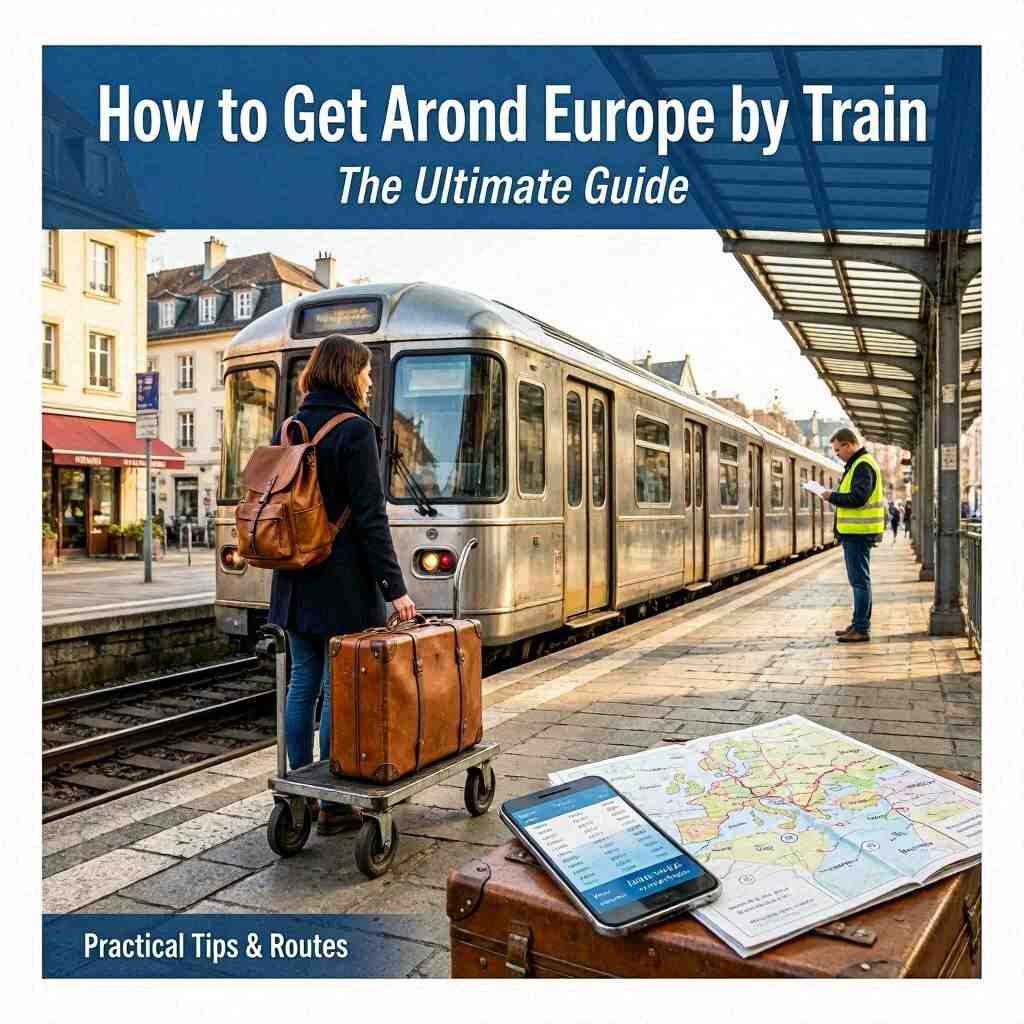
Let’s be honest – at first glance, a budget airline ticket might look cheaper. But once you add up the checked luggage fees, the transfer to an airport that’s somehow 40 miles outside the city, the two-hour security wait, and the taxi ride at the other end, that “cheap” flight starts looking a lot more expensive.
Train travel, by contrast, drops you right in the heart of a city. Paris’s Gare du Nord, Amsterdam Centraal, Rome Termini – these stations are urban hubs, not remote outposts. You walk off the platform and you’re already there.
There’s also the environmental angle. Flying generates significantly more carbon emissions per passenger kilometre than rail travel. If you’re thinking about your footprint, the train wins handily. And then there’s the experience itself – watching the landscape shift from French vineyards to Swiss mountains to Italian lakes is something no flight can replicate.
Understanding the European Rail Network
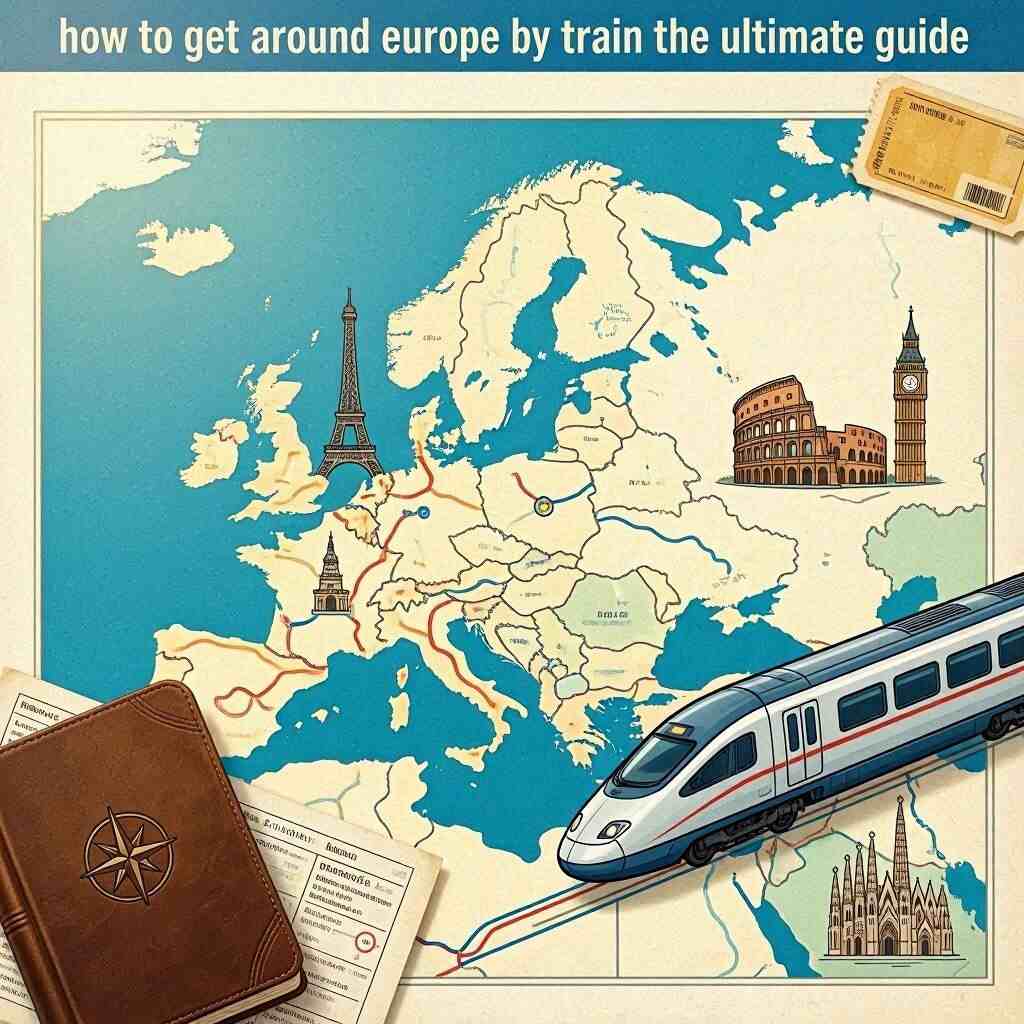
Europe’s rail network is vast, but it’s not as complicated as it looks on a map. At its core, it’s built around a series of national rail operators — SNCF in France, Deutsche Bahn in Germany, Trenitalia in Italy, Renfe in Spain — each running their own services but increasingly integrated with one another.
Cross-border travel is common and well-organised. You can board a train in London, pass through the Channel Tunnel, and be in Paris in around two hours and fifteen minutes. From there, a high-speed TGV can have you in Barcelona in just over six hours, or in Geneva in under four. The connections are frequent, reliable, and surprisingly seamless once you know how the system works.
The backbone of the network is the high-speed rail infrastructure — lines like France’s LGV network, Germany’s ICE routes, and Spain’s AVE system — which allow trains to travel at speeds of up to 320 km/h. Surrounding this are slower regional and intercity services that reach the corners high-speed lines don’t.
The Different Types of Trains in Europe
High-Speed Trains
These are the stars of the show. Trains like the Eurostar, France’s TGV, Germany’s ICE, Italy’s Frecciarossa, and Spain’s AVE are fast, comfortable, and punctual. They require seat reservations, which are sometimes included in a rail pass fee and sometimes come at an added cost. Always check.
Intercity and Regional Trains
Not every journey needs to be done at 300 km/h. Intercity trains connect major cities at slightly lower speeds, while regional trains are perfect for exploring smaller towns and rural areas. These are often reservation-free, which gives you the flexibility to just turn up and hop on — a real bonus if you prefer a spontaneous travel style.
Night Trains
Oh, the night train. There’s something wonderfully romantic about boarding a sleeper service in Vienna at 10pm and waking up in Paris or Rome. Night trains save you a hotel night, preserve your daytime hours for exploring, and have enjoyed a genuine renaissance in recent years. The European Sleeper and Nightjet services, in particular, have expanded their networks significantly and offer everything from seated couchettes to private sleeping compartments.
Eurail vs. Interrail: Which Pass Is Right for You?
This is the question every would-be rail traveller asks, and the answer is simpler than you’d think.
Interrail is for European residents — EU citizens and people who have lived in Europe for at least six months. Eurail is for everyone else — visitors from the USA, Australia, Canada, Japan, and beyond.
Both passes give you a set number of travel days within a defined period, and both cover most major European rail operators. You can buy passes that cover a single country, two neighbouring countries, or the entire continent.
The big question is whether a pass is actually worth it for your particular trip. If you’re making several long-distance journeys — say, Amsterdam to Prague, Prague to Vienna, Vienna to Rome — a global pass often makes solid financial sense. But if you’re staying in one region and making shorter hops, individual advance tickets may well be cheaper.
The key rule: always calculate before you commit. Use a tool like Seat61.com or the Eurail/Interrail website’s journey planner to estimate what your planned routes would cost with and without a pass.
One thing to watch out for: even with a pass, many high-speed and night trains require a separate seat reservation, which can cost anywhere from €3 to €15 per journey. Factor this in when doing your sums.
How to Book Train Tickets in Europe
There are several ways to book, and the right approach depends on how far in advance you’re planning and how flexible you want to be.
National rail websites are often the best source of the cheapest fares. The French SNCF site (via Trainline or SNCF Connect), Deutsche Bahn, Trenitalia, and Renfe all release discounted advance tickets — sometimes months ahead. The earlier you book, the better the price.
Trainline is an excellent aggregator that covers most of Europe and is well worth using for cross-border journeys where you’d otherwise need to book separate segments on different national sites.
Rail Europe serves a similar function and is particularly popular with travellers from outside Europe who want everything in one place.
For spontaneous travellers, regional and intercity tickets bought on the day are generally available at station ticket machines or counters, though you’ll pay a higher fare.
A few practical tips:
- Always have your ticket saved offline — apps can lose connection in tunnels.
- Some trains require a specific seat; others let you sit wherever you like. Read your ticket carefully.
- If you have a Eurail/Interrail pass, activate it via the app before your first journey.
The Best Train Routes in Europe
Europe is packed with spectacular rail journeys, but a few stand head and shoulders above the rest.
London to Paris via Eurostar — Two hours and fifteen minutes under the Channel, emerging into the French countryside. It’s efficient, elegant, and genuinely exciting every time.
Paris to Barcelona — The TGV cuts through southern France and into Spain, skirting the Pyrenees and delivering you to one of Europe’s most vibrant cities in around six and a half hours.
Zurich to Milan via the Gotthard Base Tunnel — The world’s longest railway tunnel, opened in 2016, dramatically cut the journey time through the Alps. The approach through Swiss valleys alone is worth the ticket price.
Vienna to Budapest — A classic Central European pairing. The journey takes under three hours and connects two of the continent’s most beautiful cities.
Munich to Innsbruck to Verona — This route through the Austrian Alps and into northern Italy is among the most visually stunning in Europe, with mountains giving way to Tyrolean villages and eventually Italian plains.
The Scenic Bernina Express — Running from Chur in Switzerland to Tirano in Italy, this narrow-gauge railway crosses the Alps via a series of breathtaking viaducts and high mountain passes. It’s a UNESCO World Heritage Site, and rightly so.
Budgeting for European Train Travel
Train travel in Europe can range from very affordable to eye-wateringly expensive, depending on how you approach it.
Advance booking is your single biggest money-saving tool. Many operators release their cheapest fares 90 to 120 days before departure. If your dates are fixed, book early and lock in those prices.
Second class is almost always fine. European second-class carriages are clean, comfortable, and perfectly pleasant on even the longest journeys. Save the first-class splurge for a special occasion.
Night trains double as accommodation. A couchette bed on an overnight service is often comparable in price to a budget hotel room, and you’re moving while you sleep.
Regional passes offer value for specific areas. If you’re spending a week exploring Bavaria, a Bavaria regional pass will likely serve you better than a full Eurail global pass.
Budget roughly €30–60 per day for transport if you’re moving regularly and booking in advance. Slow-travel itineraries, where you spend several nights in each place, reduce your daily transport spend considerably.
Tips for First-Time Rail Travellers
If you’ve never done a European train trip before, a few pointers will save you a lot of stress.
Arrive at the station with time to spare, but not airline-style time. Most trains require you to be on the platform about 5–10 minutes before departure. You don’t need to be there two hours early.
Learn to read the departure boards. Arrivals (Arrivées/Ankunft/Arrivi) and departures (Départs/Abfahrt/Partenze) are clearly signed. Find your train, note the platform, and make your way there.
Validate your ticket where required. In countries like Italy and France, some tickets must be stamped or validated in a machine before boarding. Skipping this can result in an on-the-spot fine even if you have a valid ticket. When in doubt, validate.
Download the relevant apps. DB Navigator (Germany), SNCF Connect (France), and Trenitalia’s app are all excellent for live departure information and digital tickets.
Navigating Major European Train Stations
Europe’s great train stations are architectural wonders as much as transport hubs — but they can be genuinely overwhelming the first time you walk in.
Stations like Paris Gare du Nord, Frankfurt Hauptbahnhof, and Milan Centrale are enormous, multi-platform complexes serving dozens of operators simultaneously. The key is to check the departure board as soon as you arrive, find your platform number, and make your way there calmly.
Most major stations have left-luggage facilities (consigne in French, Gepäckaufbewahrung in German), which are invaluable if you want to explore a city between trains without hauling your bags around.
Food and drink options in European stations range from excellent to merely adequate. Grab a coffee and a pastry at a proper café if you have the time — the station bars in Italian and Spanish stations, in particular, are often genuinely good.
Travelling with Luggage on European Trains
Unlike airlines, European trains have no official luggage limits on most services. You can bring as much as you can carry — though you should be realistic about this, because there’s no-one to help you haul five suitcases up a narrow train corridor.
Luggage goes in the overhead racks above your seat or in dedicated storage areas at the ends of carriages. On high-speed trains, these areas can fill up quickly, so boarding early gives you the pick of the space.
Keep your valuables with you at all times. Train theft is rare but not unheard of in busy tourist corridors — tourist-heavy routes like Barcelona to Madrid or Rome to Naples warrant a little extra vigilance.
A rolling suitcase or a well-packed backpack with a frame are both excellent choices for train travel. Enormous unwieldy bags make you unpopular on crowded platforms and difficult to stow.
Train Travel with Kids and Families
Trains are genuinely excellent for family travel. Children under a certain age (usually 4 in most countries, and 12 with an accompanying adult on some operators) travel free. Family compartments on night trains and intercity services offer privacy and space.
The ability to move around the train is a revelation if you’ve ever flown long-haul with small children. Kids can walk to the buffet car, stare out different windows, and generally burn energy in a way that’s simply impossible at 35,000 feet.
Book reserved seats well in advance on popular routes to ensure your family sits together, and consider travelling off-peak to avoid busy carriages.
Scenic Train Journeys Worth the Detour
Beyond the practical A-to-B journeys, some European train routes are destinations in themselves.
The Glacier Express (Zermatt to St. Moritz, Switzerland) — Eight hours through some of the most jaw-dropping mountain scenery on the planet. Slow by design, spectacular by nature.
The Flåm Railway (Norway) — Descends 864 metres over 20 kilometres through Norwegian fjord country. Arguably one of the most dramatic train descents anywhere on Earth.
The West Highland Line (Scotland) — From Glasgow to Mallaig via the iconic Glenfinnan Viaduct, made famous by Harry Potter. Wild, remote, and utterly beautiful.
Cinque Terre Local Train (Italy) — The quick coastal hops between the five villages of the Cinque Terre are short on time but long on character and views.
Common Mistakes to Avoid
Even seasoned travellers slip up occasionally. Here’s what to watch out for.
Assuming your pass covers everything. It doesn’t. Reservation fees, certain private operators, and some scenic railways fall outside standard pass coverage.
Booking too late. Advance prices are genuinely much better. Booking on the day for a TGV or AVE service can cost three or four times more than the same seat booked two months earlier.
Ignoring connections. European rail connections are often tight — sometimes as little as 6–8 minutes. On major high-speed lines, trains are generally punctual enough for this to work. On regional services, give yourself more buffer time.
Forgetting travel insurance. Delays happen, strikes occur (particularly in France and Italy), and occasionally trains are cancelled. Good travel insurance protects your forward bookings and accommodation.
Conclusion
Getting around Europe by train isn’t just practical — it’s genuinely one of the great travel experiences the continent has to offer. From the efficiency of a Eurostar crossing to the languid beauty of a Swiss mountain railway, there’s a pace and a rhythm to rail travel that no other mode of transport quite matches. Once you’ve planned your first trip, worked out the passes and tickets, and settled into that seat as the platform slides away behind you, you’ll wonder why you ever flew at all.
Start with a simple route, build your confidence, and then let the network take you further. Europe’s railways are waiting.
FAQs
1. Do I need to book seats in advance on European trains? On high-speed services (TGV, ICE, AVE, Frecciarossa), advance booking is strongly recommended and often mandatory. Regional trains generally don’t require reservations.
2. Is a Eurail pass worth the money? It depends on your itinerary. For multi-country trips with several long-distance journeys, a global pass often pays for itself. For shorter, more regional trips, individual advance tickets may be cheaper.
3. Can I use the Eurostar with a rail pass? Yes, but the Eurostar requires a separate reservation on top of your pass, which carries a surcharge.
4. How early should I arrive at a European train station? For domestic trains, 10–15 minutes before departure is generally fine. For international services like the Eurostar, allow 30–45 minutes as passport checks are involved.
5. Are night trains comfortable? They vary. Couchettes are basic but functional — think bunk beds in a shared compartment. Private sleeper cabins are much more comfortable and worth the extra cost for longer journeys.
6. Is train travel in Europe safe? Yes, European trains are very safe. Exercise normal common sense with valuables, particularly on busy tourist routes.
7. What is the cheapest way to travel by train in Europe? Book as far in advance as possible, travel second class, and use national rail websites directly for the best fares. Regional trains are also significantly cheaper than high-speed services.
8. Can I bring my bike on a European train? Many operators allow bicycles, but policies vary. Some require a reservation for the bike; others have seasonal restrictions. Check with each operator before you travel.
9. What’s the best app for planning European train journeys? Trainline is the most versatile all-in-one option. For individual countries, national apps like DB Navigator (Germany) or SNCF Connect (France) are excellent.
10. Are there any countries in Europe where trains are less practical? Rural areas of the Balkans, parts of Eastern Europe, and some regions of Scandinavia have sparser rail networks. In these areas, buses or rental cars may be more practical for getting off the beaten track.