
What Is Osnovno Učilište? Meaning, Age, Grades, and School System Explained
Osnovno učilište (also written without diacritics as osnovno uciliste) is the primary education stage in North Macedonia. It is a compulsory nine-year school that children attend from around age six to around age fifteen, combining what English speakers would separately call “elementary school” and “middle school” into a single, continuous institution.
If you’ve come across the term in a school record, an immigration document, or a conversation about relocating, the confusion is understandable — there is no single English word that maps onto it perfectly. The closest equivalents are:
- Elementary school (United States), though osnovno učilište runs two to three years longer
- Primary school (United Kingdom), though the UK version ends earlier and hands off to a separate secondary school sooner
This guide explains what osnovno učilište means, who attends it, how many grades it covers, what students study, whether it’s mandatory, how it compares grade-by-grade with US and UK schools, how the system is governed and graded, how it performs on international assessments like PISA and TIMSS, and what happens after a student finishes it.
What Does Osnovno Učilište Mean?
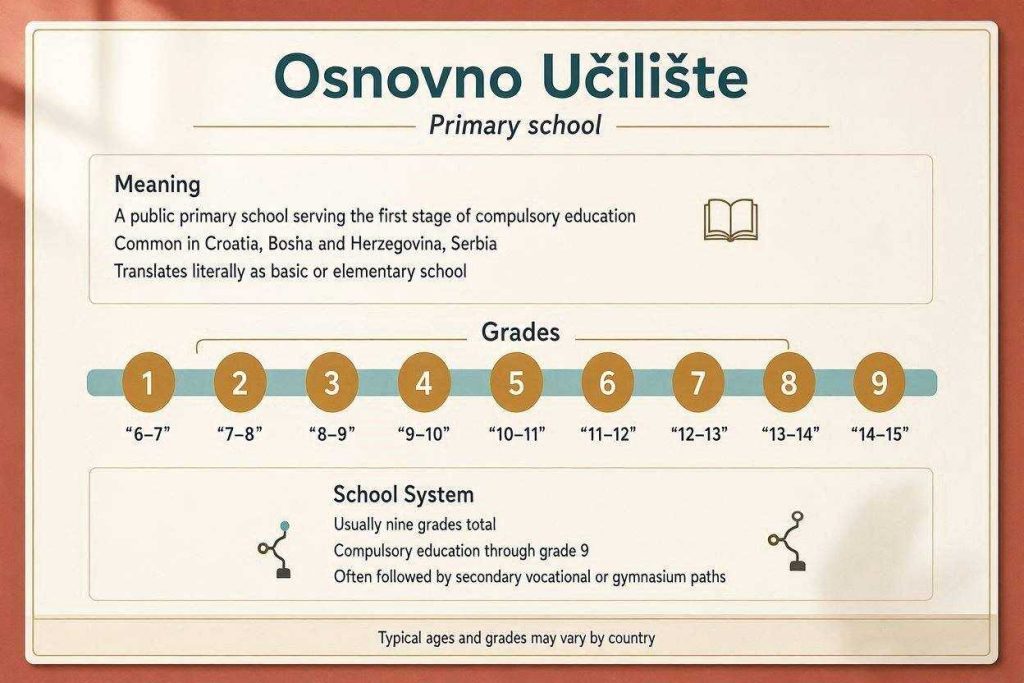
Osnovno učilište translates roughly to “basic school,” and in practice it refers to compulsory primary education — the nine-year block of schooling that every child in North Macedonia is legally required to complete before moving on to secondary school.
Literal Translation of Osnovno Učilište
“Osnovno” means basic or fundamental, and “učilište” means school or place of learning. Put together, the phrase describes exactly what the institution is: the foundational school every student passes through before anything else.
Key Facts
- Refers to compulsory basic education
- Begins in the calendar year a child turns six
- Covers grades 1 through 9 in a single, unified institution
- Assessed descriptively in the first three grades, then on a numeric 1–5 scale from Grade 4 onward
- Forms the legal and academic foundation for everything that follows
- Leads directly into secondary school — gimnazija, vocational, or art/specialized education
- Managed day-to-day by municipalities, within a national curriculum framework set by the Ministry of Education and Science
Where the Term Comes From
Primary education in North Macedonia has its roots in the unified school system of the former Yugoslavia, when education was organized as a standardized, state-run, and free entitlement across the federation’s republics. After North Macedonia’s independence in 1991, the country retained the same basic structure — nine years of compulsory primary schooling — while gradually adapting curricula, language policy, and school governance to reflect its own national institutions rather than a federal one. What has changed most across the decades since is subject content, teaching methods, and inclusion policy; the six-to-fifteen age structure itself has stayed remarkably consistent.
How the System Is Governed Today
Primary education is regulated nationally through the Law on Primary Education and an official framework document known as the Concept for Nine-Year Primary Education, both issued by the Ministry of Education and Science. Day-to-day management, however, is decentralized: individual municipalities run their local primary schools, which gives regions some flexibility over staffing and facilities while the Ministry keeps curriculum content standardized nationwide. Two further bodies handle oversight from the center — the State Educational Inspectorate monitors legal and regulatory compliance and evaluates school quality, while curriculum content, textbooks, and school projects are reviewed and approved through the Ministry’s Pedagogical Service. In practice, this division means the core curriculum a child follows is the same regardless of which municipality they live in, even though the specific school building, staffing, and daily administration are handled locally.
Is Osnovno Učilište Mandatory?
Yes. Attendance is a legal requirement, not a choice. Under North Macedonia’s Law on Primary Education, every child from age six to fifteen must complete all nine grades, and the state provides this education free of charge in public schools, regardless of a child’s gender, religion, nationality, or the language of instruction their school uses. Parents who fail to enroll a child of compulsory school age can face legal consequences, and schools are required to track attendance and follow up on unexplained absences. This is one of the clearest differences from preschool education, which precedes osnovno učilište but carries no legal enrollment requirement.
What Type of School Is It?
Osnovno učilište is not a university-preparatory institution, a vocational college, or a secondary school. It is the first mandatory stage of formal education, positioned between early childhood preschool and secondary school.
Education Level Comparison
| Education Level | North Macedonia Term | Mandatory? |
| Early childhood | Preschool (predučilišno obrazovanie) | No |
| Primary education | Osnovno učilište (Grades 1–9) | Yes |
| Secondary education | Sredno učilište (Gimnazija or vocational) | Yes |
| Higher education | Fakultet / Univerzitet | No |
What Age Do Children Attend Osnovno Učilište?
Children enroll in osnovno učilište in the calendar year they turn six, and they typically finish the ninth and final grade around age fifteen. That six-to-fifteen span is set by national law, so the starting age doesn’t vary by region or by individual school discretion the way it sometimes does in other countries.
Typical Enrollment Age
Families relocating to North Macedonia often ask when a child is expected to start. The answer is straightforward: enrollment happens in the year the child turns six, which places North Macedonia in line with most of continental Europe and slightly ahead of the informal norm in the United States, where a child might start first grade at six but often spends a prior year in kindergarten.
Student Age by Grade
| Grade | Typical Age |
| Grade 1 | 6–7 |
| Grade 2 | 7–8 |
| Grade 3 | 8–9 |
| Grade 4 | 9–10 |
| Grade 5 | 10–11 |
| Grade 6 | 11–12 |
| Grade 7 | 12–13 |
| Grade 8 | 13–14 |
| Grade 9 | 14–15 |
Grade Equivalency: Osnovno Učilište vs US and UK Grades
Because North Macedonia and the US both begin Grade 1 around age six, the grade numbers line up almost exactly. The UK system starts a year earlier (Reception at age four to five), so its Year numbers run one ahead of the equivalent North Macedonian grade.
| Osnovno Grade | Typical Age | Closest US Equivalent | Closest UK Equivalent |
| Grade 1 | 6–7 | Grade 1 | Year 2 |
| Grade 2 | 7–8 | Grade 2 | Year 3 |
| Grade 3 | 8–9 | Grade 3 | Year 4 |
| Grade 4 | 9–10 | Grade 4 | Year 5 |
| Grade 5 | 10–11 | Grade 5 | Year 6 |
| Grade 6 | 11–12 | Grade 6 | Year 7 |
| Grade 7 | 12–13 | Grade 7 | Year 8 |
| Grade 8 | 13–14 | Grade 8 | Year 9 |
| Grade 9 | 14–15 | Grade 9 (Freshman year) | Year 10 |
Two things follow directly from this table. First, a family moving from the US can generally enroll a child in the same numbered grade without adjustment. Second, a family moving from the UK should generally expect their child to be placed one grade number lower than their UK Year, since UK schooling starts a year earlier.
Public vs. Private Primary Education
Public osnovno učilište is free of charge, and it’s the path the vast majority of children in North Macedonia follow — the country has roughly 363 primary schools nationwide, the large majority of them public, according to the most recently published Eurydice statistics. A small number of private primary schools also operate, but they cater mainly to children of foreign nationals rather than the general population, and they sit outside the country’s officially recognized public primary system rather than functioning as a state-accredited alternative to it. In practice, this means that for the overwhelming majority of families — and virtually all Macedonian nationals — osnovno učilište refers specifically to the public system described throughout this guide. Families considering a private option should confirm directly with that school how its program relates to the standard nine-year public curriculum, since this can vary from school to school.
What Parents Should Know Before Enrolling
Enrollment in a public osnovno učilište is handled at the municipal level, and the school assigned typically corresponds to a family’s registered residential address. Parents relocating to North Macedonia, or moving between municipalities within the country, generally need to provide the child’s birth certificate, proof of address, and previous school records if the child has already started their education elsewhere. Where a child has attended school in another country, the receiving school will usually review those records to decide which grade is the appropriate placement — age is the starting point, but prior coursework can shift the decision up or down by a year in either direction. Language of instruction is the other major factor families weigh: most public schools teach in Macedonian, but schools or class sections operating in Albanian, Turkish, and Serbian exist in areas where those communities are concentrated, and this affects which specific school a family should target rather than whether the child attends osnovno učilište at all. For families arriving mid-year rather than at the start of a school year, it’s worth contacting the target school directly, since mid-year transfers are accommodated but require the school to confirm space and appropriate grade placement before the transfer is finalized.
Parent Enrollment Checklist
✓ Confirm the child’s age eligibility for the target grade
✓ Gather birth certificate and residency documents
✓ Obtain prior school records if transferring from another country or school
✓ Identify the language of instruction offered at nearby schools
✓ Confirm grade placement with the receiving school before the transfer
✓ Check the municipal enrollment deadline for the upcoming school year
✓ Review transportation arrangements to and from the school
✓ Ask about extracurricular and after-school programs
✓ Review the curriculum outline for the assigned grade
✓ Confirm the transition pathway into secondary school for later planning
How Many Grades Are in Osnovno Učilište?
Osnovno učilište covers nine grades. Some general descriptions simplify this span into two broad phases — lower grades and upper grades — but North Macedonia’s own curriculum framework defines three specific three-year cycles, which give a more precise picture of how learning actually progresses. This three-cycle structure is how the Ministry of Education and Science frames the curriculum progression.
Cycle I (Grades 1–3)
The first cycle focuses on foundational literacy and numeracy: learning to read and write, basic arithmetic, and early social and behavioral skills like working in a classroom group. One teacher generally leads the classroom across most subjects during this cycle.
Cycle II (Grades 4–6)
The second cycle introduces more subject differentiation — science, more formal language instruction, and the beginning of subject-specific teaching for some classes — while retaining a more integrated classroom experience than the final cycle.
Cycle III (Grades 7–9)
The third cycle is fully subject-based, with dedicated teachers for mathematics, science, languages, history, geography, and other subjects. This cycle also carries the heaviest weight in preparing students for secondary school entrance, since final grades and, in some tracks, entrance assessments factor into which secondary school a student can attend.
Teacher Structure and Learning Focus by Cycle
| Cycle | Grades | Ages | Teacher Structure | Learning Focus |
| Cycle I | 1–3 | 6–9 | Single homeroom teacher for most subjects | Literacy, numeracy, classroom routines |
| Cycle II | 4–6 | 9–12 | Homeroom teacher plus early subject specialists | Expanded subjects, first formal sciences |
| Cycle III | 7–9 | 12–15 | Fully subject-specific teachers | Exam preparation, secondary-school readiness |
This cycle-based approach, with a single teacher in the early years and a gradual shift to subject specialists, is common across much of continental Europe and is one of the more direct comparison points with the US elementary-to-middle-school split.
Grading, Promotion, and Academic Support
Osnovno učilište doesn’t assign numeric grades from day one. Cycle I students receive descriptive, narrative-style feedback rather than a number, reflecting the cycle’s focus on literacy and classroom habits over scored performance. Starting in Grade 4, schools switch to a numeric five-point scale that stays in place through the rest of primary school and into secondary education.
Numeric Grading Scale (Grades 4–9)
| Mark | Meaning |
| 5 | Excellent |
| 4 | Very Good |
| 3 | Good |
| 2 | Satisfactory |
| 1 | Unsatisfactory (failing) |
A student who doesn’t meet the requirements to advance can generally repeat that same grade, though national policy typically allows a given grade to be repeated only once during a student’s primary schooling. Schools are also expected to offer regular remedial lessons in core subjects, including mathematics and science, for students who need additional instruction and individual attention before falling behind becomes a bigger problem.
Class Size and the Two-Shift School Day
Because school buildings are concentrated in a relatively small number of central locations, roughly two-thirds of central-area schools in North Macedonia run two shifts, according to a UNICEF review of school capacity — one group of students attending in the morning and a second group in the afternoon, rather than a single shared school day for everyone. That same 2022 UNICEF review found individual classes in Skopje commonly running close to 30 students, with some of the most crowded schools operating in two or more shifts simply to fit enrollment into available classroom space. For families relocating to North Macedonia, this is worth asking about directly when choosing a school, since morning and afternoon shift assignments affect everything from a family’s daily schedule to after-school activity planning.
Daily School Life: Uniforms, Meals, Class Size, and Technology
Beyond curriculum and grading, families relocating to North Macedonia usually want the practical, day-to-day details — the things a national law summary doesn’t cover. Here’s what typically holds true across public osnovno učilište:
- No national uniform requirement. Most public primary schools do not require uniforms; a small number of individual schools choose to introduce one locally, so this varies school by school rather than by national policy.
- No centrally provided school meals. Unlike some Western European systems, North Macedonia’s public primary schools generally do not supply school lunches, so students typically bring food from home or return home to eat, especially in single-shift schools.
- Class sizes commonly run 25 to 34 students per class, though this varies by municipality and by how crowded a given school building is.
- Most primary schools have at least a basic computer lab, though the number of machines (commonly cited around 10 to 15 per lab) is often modest relative to enrollment, and access is typically scheduled through informatics classes rather than open all day.
- Students with disabilities are generally supported through inclusion in mainstream classrooms, with a smaller number of dedicated special primary schools available in cases requiring more specialized support.
None of this is codified the same way attendance and grading are, so the honest answer for a relocating family is: confirm uniform policy, meal arrangements, and shift assignment directly with the specific school a child will attend, since these details are set locally rather than by the Ministry of Education and Science.
What Does “ООУ” Mean on a Macedonian School’s Name?
If you’ve seen a Macedonian primary school listed with the prefix “ООУ” (OOU) before its name — for example, “ООУ Гоце Делчев” — that’s simply the Cyrillic abbreviation for основно училиште, the Macedonian-script spelling of osnovno učilište. It functions the same way “P.S.” (Public School) or “Elementary” does in front of a US school’s name, and it’s the format used on official signage, enrollment documents, and the Ministry of Education and Science’s own school directories.
How Literacy Outcomes Reflect the System
One way to see the long-run impact of nearly universal osnovno učilište attendance is North Macedonia’s overall adult literacy rate, which stood at 97.8 percent as of the most recently published census figures, with a smaller gap between male literacy (98.8 percent) and female literacy (96.8 percent). That gap, while modest at the national level, tends to concentrate in specific communities and among older generations who had less consistent access to primary schooling before the current compulsory framework was fully established — a reminder that “compulsory” and “universally completed” aren’t always the same thing in practice, even where the legal framework is clear.
Is Osnovno Učilište the Same as Elementary School?
For most international readers, the answer is yes — with some differences. Osnovno učilište serves the same core purpose as elementary or primary education (foundational, compulsory schooling before secondary school), but it does so in a single nine-year institution rather than splitting the years across separate elementary and middle schools the way the US typically does.
Comparison With US Elementary Schools
In the US, elementary school generally runs from kindergarten through grade 5 or 6, after which students move to a separate middle school for grades 6 through 8, and then high school for grades 9 through 12. Osnovno učilište keeps students in one institution for all nine years covering that same age range, so there’s no mid-childhood school change — the equivalent of switching from elementary to middle school simply doesn’t happen structurally in North Macedonia.
Comparison With UK Primary Schools
The UK primary system runs from Reception through Year 6, after which students move directly to secondary school at around age eleven. Osnovno učilište extends three years further, through what would be UK Year 9 equivalent, before its own transition to secondary school around age fifteen rather than age eleven.
Osnovno Učilište vs US vs UK: Full Comparison
| Feature | Osnovno Učilište | US System | UK System |
| Starting age | 6 | 5–6 (kindergarten/Grade 1) | 4–5 (Reception) |
| Ending age | 15 | 10–11 (end of elementary) | 10–11 (end of Year 6) |
| Total years covered | 9 | 5–6 (elementary only) | 6–7 (Reception–Year 6) |
| Number of institutions for this stage | 1 | 2 (elementary + middle school) | 1 |
| Mandatory | Yes | Yes | Yes |
| Grade numbering style | Grade 1–9 | Kindergarten, Grade 1–5/6 | Reception, Year 1–6 |
| Grading scale | Descriptive (Grades 1–3), then numeric 1–5 (Grades 4–9) | Letter grades (A–F) in most states | Numeric levels/marks, varies by school |
| Teacher model, early years | Single homeroom teacher | Single homeroom teacher | Single class teacher |
| Teacher model, later years | Subject specialists (Grades 7–9) | Subject specialists (middle school) | Subject specialists (secondary) |
| Mid-stage school change | None | Elementary to middle school, around age 11 | None |
| Transition point to secondary | Around age 15 | Around age 14 (high school) | Around age 11 (secondary school) |
| Core subjects, early years | Literacy, numeracy, basic science | Reading, math, basic science | Literacy, numeracy, basic science |
| Core subjects, later years | Math, science, languages, history, geography | Math, science, English, social studies | Math, science, English, humanities |
| Foreign language instruction | English introduced from Grade 1 | Often optional or introduced later | Often introduced in later primary years |
| Governing authority | Ministry of Education and Science (curriculum); municipalities (daily management) | State education departments (decentralized) | Department for Education (England) |
| Leads to | Gimnazija, vocational, or art secondary school | High school | Secondary school |
Which US grade does a given osnovno grade correspond to? Because both systems start Grade 1 at roughly age six, the grade numbers themselves are the fastest way to compare: North Macedonia’s Grade 4 lines up with US Grade 4, its Grade 8 with US Grade 8, and so on — the grade equivalency table earlier in this guide covers this exactly. Which UK Year does a given osnovno grade correspond to? Since UK schooling starts a year earlier, add one to the North Macedonian grade number to get the matching UK Year — Grade 5 matches Year 6, Grade 9 matches Year 10, and so on.
The clearest practical difference, though, isn’t the exact age math — it’s the single-institution model. A child in North Macedonia doesn’t experience the elementary-to-middle-school transition that’s built into the US system, which some educators consider a meaningful reduction in the number of disruptive school changes a child goes through before adolescence.
How the North Macedonian Education System Works
The education system runs in four stages — preschool, primary (osnovno učilište), secondary, and higher education — with two compulsory stages, primary and secondary, sitting in the middle.
Preschool Education
Preschool covers early childhood education before formal schooling begins, generally serving children from infancy through age five or six depending on family choice and local availability. Unlike osnovno učilište, preschool attendance is not a legal requirement, so participation depends on family preference and access to a place, particularly in denser urban areas where demand for spots can outpace availability. Preschool’s main function is developmental and social preparation — building the routines, language exposure, and early social skills that make the transition into Grade 1 smoother, rather than delivering the kind of formal academic curriculum osnovno učilište introduces.
Primary Education (Osnovno Učilište)
This is the compulsory nine-year foundation stage detailed throughout this guide. Students move through three three-year cycles, from early literacy and numeracy in Cycle I through fully subject-specific instruction in Cycle III, before completing Grade 9 and becoming eligible for secondary school. Because it’s the only stage of North Macedonian education that’s both compulsory and universal — reaching children regardless of where they live, what language they speak at home, or their family’s economic situation — osnovno učilište functions as the single common educational experience nearly every North Macedonian adult shares.
Secondary Education
After completing Grade 9, students choose one of three main secondary tracks, each leading to a different outcome:
- General secondary (gimnazija): A four-year academic track ending in the state matura exam, which is the standard pathway toward university admission.
- Vocational secondary: Programs ranging from two to four years depending on the qualification level, combining academic subjects with occupation-specific training for direct workforce entry.
- Art and specialized secondary schools: Four-year tracks similar in structure to gimnazija but focused on a specific discipline such as music or visual arts, generally also ending in a matura-equivalent qualification.
Secondary education, like primary education, is compulsory in North Macedonia, but the choice of which track to pursue is the student’s — usually guided by Grade 9 results, personal interest, and the entry requirements of the chosen track.
Higher Education
Graduates of gimnazija or an art secondary school generally have the most direct path into university, since the matura is designed as a university entrance qualification. Vocational secondary graduates can also continue to higher education, though the pathway sometimes involves additional bridging requirements depending on the specific university program.
Education Pathway Summary
| Stage | Typical Age | Purpose | Outcome |
| Preschool | Under 6 | Early social and developmental preparation | School readiness (not mandatory) |
| Osnovno učilište | 6–15 | Compulsory foundational academic education | Primary school completion certificate |
| Secondary school | 15–18/19 | Specialized academic or vocational preparation | Matura diploma or vocational qualification |
| Higher education | 18+ | Specialized professional or academic training | University degree or professional certification |
What Subjects Are Taught in Osnovno Učilište?
The curriculum broadens substantially across the three cycles, moving from basic literacy and numeracy toward a full subject-based course load by Grade 7.
Core Subjects by Stage
| Subject Area | Cycle I Focus (Grades 1–3) | Cycle III Focus (Grades 7–9) |
| Language and literacy | Reading, writing, basic grammar | Literature analysis, formal composition |
| Mathematics | Counting, basic operations | Algebra, geometry |
| Science | Nature and environment (integrated) | Biology, physics, and chemistry as separate subjects |
| Social studies | Community and civic basics | History, geography as distinct subjects |
| Arts and physical education | Introductory creative and physical activity | Continued, often with more structured assessment |
| Foreign language | English introduced from Grade 1 | Continued English, sometimes a second foreign language |
The shift from one combined science subject to three separate ones — biology, physics, and chemistry — typically takes hold in the later years of Cycle II and is fully in place by Cycle III, mirroring the same point at which teaching itself moves from a single homeroom teacher to subject specialists.
Language of Instruction
North Macedonia doesn’t run a single, uniform language track nationwide. Most public schools teach in Macedonian, the country’s official language, written in Cyrillic script. Under Article 7 of the Constitution of North Macedonia, any language spoken by at least 20 percent of the population also holds official status, and all recognized national communities are constitutionally entitled to primary and secondary education in their own language. In practice, this means schools or dedicated class sections also operate in Albanian, Turkish, and Serbian, and in some municipalities Bosniak, depending on the composition of the local community. English is introduced as a foreign language starting in Grade 1, earlier than the norm in many neighboring countries and reflecting a national push toward earlier foreign-language proficiency. For a family choosing between schools, language of instruction is usually the single biggest factor in deciding which specific osnovno učilište is the right fit — more so than any difference in the underlying national curriculum, which is set centrally regardless of the language a given school teaches in.
Elective Subjects
Beyond the core curriculum, individual schools can offer additional electives depending on local resources and community needs — this might include supplementary language options, informatics, or expanded arts programs, though availability varies more by school and municipality than it does by any national rule.
How Well Does Osnovno Učilište Perform? What International Data Shows
North Macedonia takes part in several international assessments that let researchers and parents compare student outcomes across countries, offering a more concrete picture of the system’s real-world results than curriculum descriptions alone.
PISA Results
The OECD’s Programme for International Student Assessment (PISA) tests 15-year-olds in mathematics, reading, and science — an age that typically falls right around the end of osnovno učilište or the very start of secondary school. North Macedonia has taken part since the early 2000s, most recently in 2022, alongside earlier rounds in 2015 and 2018. In the 2022 results, 15-year-olds in North Macedonia scored 389 points in mathematics (ranking 61st of 81 participating countries and economies), 359 points in reading (71st), and 380 points in science (68th) — each below the OECD average. The Ministry of Education and Science attributed part of the decline compared to earlier cycles to the broader, pandemic-era drop in learning outcomes that PISA recorded across most participating countries in 2022, not a trend unique to North Macedonia.
TIMSS Results
The Trends in International Mathematics and Science Study (TIMSS) tests students specifically in Grade 4 and Grade 8, making it a more direct measure of primary-level learning than PISA’s fixed age-15 sample. North Macedonia participates at both grade levels. In the 2023 cycle, only 3 percent of North Macedonian fourth-graders reached TIMSS’s Advanced international benchmark in mathematics — a share that rose to 7 percent when the same group of students was retested a year later in fifth grade, as part of TIMSS’s longitudinal follow-up study.
Ongoing Reforms and Improvement Programs
North Macedonia has run several targeted efforts to strengthen primary-level outcomes over the past two decades. A USAID-funded Primary Educational Project operated from 2006 to 2011, focused specifically on improving mathematics and science teaching and building students’ critical-thinking skills. UNICEF separately supported a teacher-training programme on early literacy and numeracy for Grades 1 through 3 between 2009 and 2015. More recently, the Ministry’s Concept for Nine-Year Primary Education has pushed toward a competency-based curriculum designed to build reasoning and problem-solving skills rather than rote memorization, and a World Bank–supported pilot of a “Whole Day Schooling” model has tested extending the school day and adding more comprehensive student support services in a number of schools. Taken together, these efforts reflect an education system that recognizes where its international performance falls short and has been actively experimenting with ways to close that gap, rather than one that has stood still.
Which Countries Use the Term Osnovno Učilište?
The term is specific to North Macedonia, but closely related terms describing the same nine-year compulsory-primary-school concept are used across most of the former Yugoslav region, a reflection of the shared educational structure those countries inherited and then adapted independently after 1991.
North Macedonia
North Macedonia is the primary reference point for the term “osnovno učilište” specifically, and it remains the country’s official name for the institution today, used in law, in the Ministry of Education and Science’s own documentation, and on school certificates.
Former Yugoslav Context
The term itself, and the nine-year structure behind it, trace back to the unified education policy of the former Yugoslavia, when primary schooling was standardized across the federation’s six republics as a free, compulsory entitlement. When Yugoslavia dissolved in the early 1990s, each successor state kept the same underlying nine-year primary model but began adapting it independently — updating curricula, governance, and language policy to fit its own national context rather than a shared federal one. That’s why the core structure feels so familiar across the region today, even as the specific laws, ministries, and day-to-day details have diverged.
Regional Variations
| Country | Local Term | Structure Notes |
| North Macedonia | Osnovno učilište | Nine years, three cycles, ages 6–15 |
| Serbia | Osnovna škola | Nine years, similar age range and structure |
| Bosnia and Herzegovina | Osnovna škola | Nine years, though curriculum and governance vary by entity and canton |
| Croatia | Osnovna škola | Eight years historically, moving toward a longer structure under ongoing reform |
| Montenegro | Osnovna škola | Nine years, similar structure to North Macedonia and Serbia |
What differs from country to country today is mostly governance — how curriculum decisions get made, and by which level of government — rather than the basic age range or grade count, which have stayed close to the original nine-year model across most of the region.
Frequently Asked Questions About Osnovno Učilište
What does osnovno učilište mean?
Osnovno učilište means “basic school” and refers to North Macedonia’s compulsory nine-year primary education system, covering Grades 1 through 9 for children roughly ages six to fifteen.
What age do children start osnovno učilište?
Children start in the calendar year they turn six and typically finish Grade 9 around age fifteen.
Is osnovno učilište mandatory?
Yes. It is a legal requirement under the Law on Primary Education, and the state provides it free of charge in public schools.
How many grades are in osnovno učilište?
Nine grades, split into three three-year cycles: Grades 1–3, 4–6, and 7–9.
Is osnovno učilište the same as elementary school?
It covers the same age range as elementary plus middle school combined in the US, or primary plus the first three years of secondary school in the UK, all within a single institution rather than two or more separate schools.
What comes after osnovno učilište?
Students move into one of three secondary tracks — general (gimnazija), vocational, or art/specialized — before optionally continuing to university or another form of higher education.
What language is osnovno učilište taught in?
Most schools teach in Macedonian, with schools or class sections in Albanian, Turkish, Serbian, and in some areas Bosniak, available depending on the local community. English is introduced as a foreign language from Grade 1.
Can a child transfer into osnovno učilište from another country’s school system?
Yes. The receiving school reviews the child’s age and prior school records to confirm grade placement, which is usually close to age-based placement but can shift by a grade depending on completed coursework.
Is osnovno učilište free? Are there private primary schools?
Yes, public osnovno učilište is free of charge, and it’s what the vast majority of children in North Macedonia attend. A small number of private primary schools also exist, mainly serving children of foreign nationals, but they sit outside the country’s officially recognized public system.
What grading scale does osnovno učilište use?
Grades 1 through 3 use descriptive, narrative feedback rather than numbers. From Grade 4 onward, schools switch to a numeric 1–5 scale, where 5 means excellent and 1 means unsatisfactory.
How does North Macedonia perform on international assessments like PISA and TIMSS?
In PISA 2022, 15-year-olds in North Macedonia scored below the OECD average in mathematics, reading, and science. TIMSS 2023 data showed a similarly small share of fourth-graders reaching the most advanced international benchmark in mathematics, though the country has run several USAID-, UNICEF-, and World Bank-supported programs over the past two decades aimed at improving these outcomes.
Which countries use the term osnovno učilište?
The exact term is used in North Macedonia. Closely related terms — such as “osnovna škola” — describe the same nine-year compulsory structure in Serbia, Bosnia and Herzegovina, Croatia, and Montenegro.
Do students wear uniforms at osnovno učilište, and are meals provided?
Generally no to both, though there are exceptions. Most public primary schools don’t require a uniform, and school lunches aren’t centrally provided the way they are in some other countries, so students commonly bring food from home. Individual schools can set their own local policy on uniforms, so it’s worth checking directly with a specific school.
What does “ООУ” mean in front of a Macedonian school’s name?
“ООУ” is the Cyrillic abbreviation for основно училиште (osnovno učilište) and appears before a school’s proper name on signage and official records, similar to how “P.S.” or “Elementary” precedes a US school’s name.
What is North Macedonia’s literacy rate, and how does it relate to osnovno učilište?
North Macedonia’s overall literacy rate is 97.8 percent, according to the most recently published census data, reflecting decades of near-universal compulsory primary education, though the rate is marginally higher among men (98.8 percent) than women (96.8 percent).
Conclusion
Osnovno učilište is North Macedonia’s compulsory nine-year primary school, covering ages six to fifteen in a single institution rather than the separate elementary and middle schools common in the US, or the earlier secondary-school handoff typical in the UK. For a family comparing systems, the fastest reference point is the grade equivalency table earlier in this guide: North Macedonia’s grade numbers match US grades almost exactly, while UK Year numbers run one ahead. The system is far from perfect — its most recent international test results sit below the OECD average, and its schools are still working through capacity pressures like two-shift scheduling in some cities — but it is also actively reforming, with a competency-based curriculum and pilot programs aimed at closing those gaps. Whatever a family’s starting point, the underlying goal of osnovno učilište is the same one shared by primary and elementary systems everywhere: building the literacy, numeracy, and foundational knowledge a student needs before moving into secondary school and, eventually, into an independent academic or vocational path of their own choosing.
