
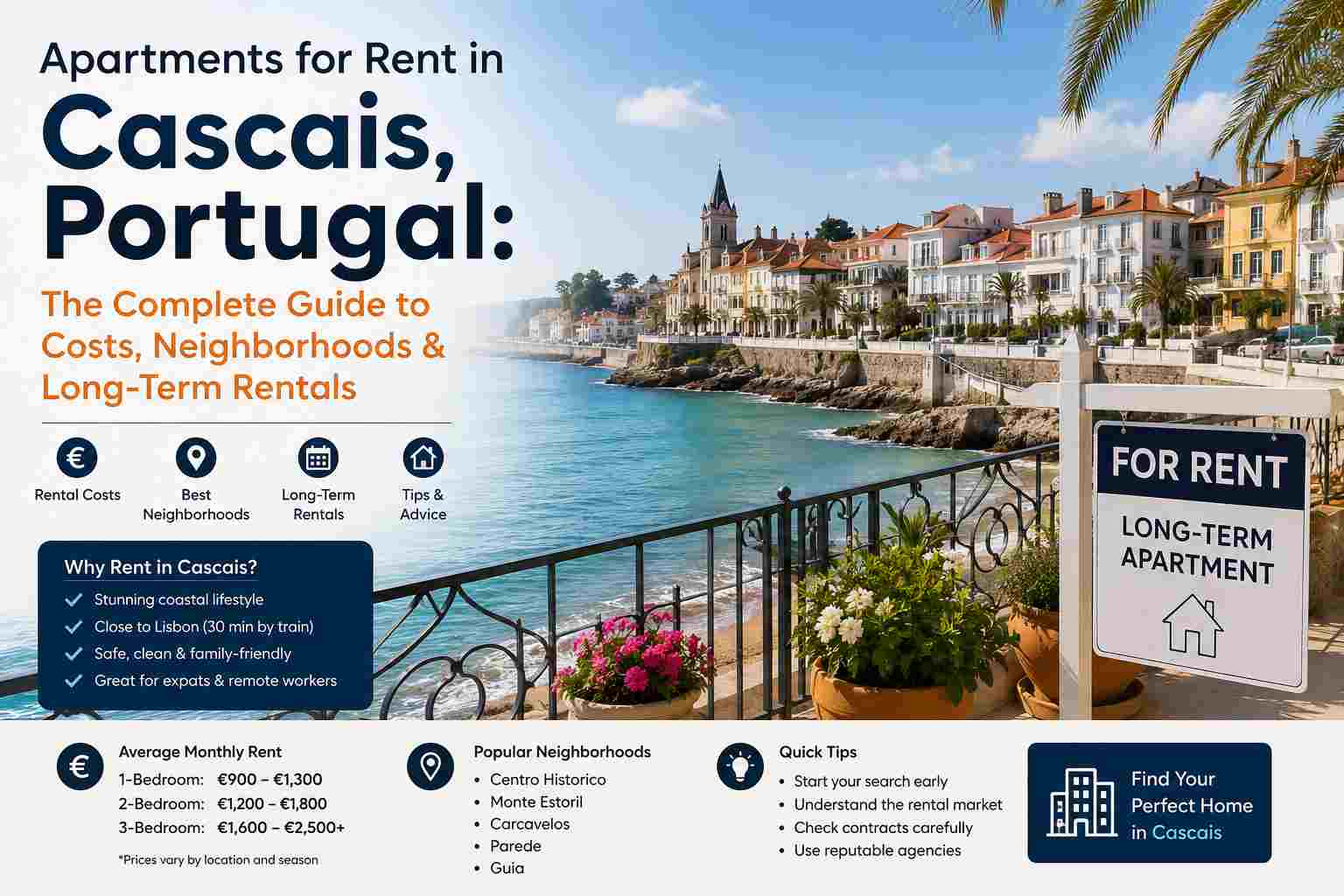
Apartments For Rent In Cascais, Portugal: Guide To Costs, Neighborhoods & Long-Term Rentals
Finding the right apartment in Cascais can feel exciting and overwhelming in equal measure. One website shows hundreds of listings, another specializes in luxury properties, and a third focuses entirely on furnished rentals for expats. Prices vary widely, every neighborhood has its own personality, and if you’re new to Portugal’s rental market, it’s easy to feel unsure of where to even start.
This guide is designed to help you make informed decisions before you start contacting landlords or scrolling through listings. Rather than simply showing you available properties, it explains how the Cascais rental market actually works, what you can realistically expect to pay, which neighborhoods suit which lifestyles, and how to navigate the rental process with confidence.
Whether you’re relocating for work, planning a retirement by the Atlantic, moving with your family, studying nearby, or just looking for a long-term change of scenery, understanding the local market can save you time, money, and a fair amount of stress.
By the end of this guide, you’ll understand:
- How the Cascais rental market works
- Typical apartment rental costs
- The best neighborhoods for different lifestyles
- The differences between furnished and unfurnished rentals
- How Portuguese rental agreements generally work
- Which documents you’ll typically need before renting
- Common mistakes to avoid
- Trusted places to begin your apartment search
Rather than competing with property listing sites, this guide complements them — giving you the knowledge to evaluate listings confidently and choose a home that fits both your budget and your lifestyle.
Understanding the Cascais Rental Market
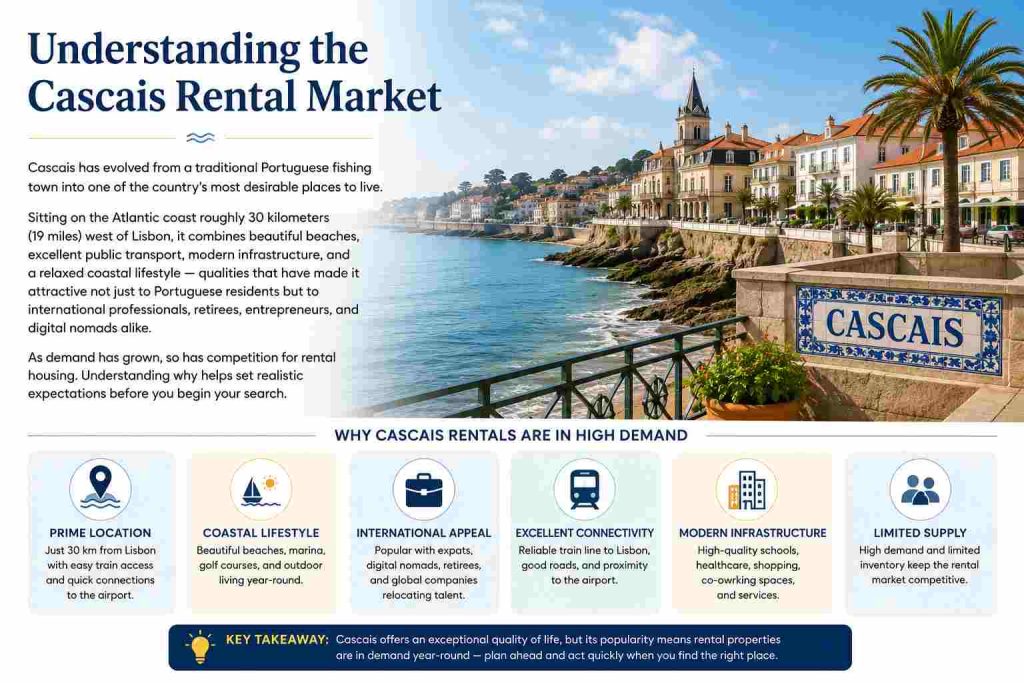
Cascais has evolved from a traditional Portuguese fishing town into one of the country’s most desirable places to live. Sitting on the Atlantic coast roughly 30 kilometers (19 miles) west of Lisbon, it combines beautiful beaches, excellent public transport, modern infrastructure, and a relaxed coastal lifestyle — qualities that have made it attractive not just to Portuguese residents but to international professionals, retirees, entrepreneurs, and digital nomads alike.
As demand has grown, so has competition for rental housing. Understanding why helps set realistic expectations before you begin your search.
Why Cascais Is One of Portugal’s Most Popular Rental Markets
Excellent location. Cascais offers coastal living without sacrificing access to Portugal’s capital. Regular train services connect Cascais to Lisbon, letting many residents enjoy seaside living while commuting to work in the city — a balance between career opportunities and quality of life that’s hard to find elsewhere.
High quality of life. Beyond the beaches, residents are drawn to clean, well-maintained public spaces, a mild climate for much of the year, modern healthcare facilities, international schools, walking and cycling paths, and a lively restaurant and café culture. For many people relocating from abroad, these everyday lifestyle factors matter just as much as the apartment itself.
An established international community. Unlike some smaller Portuguese towns, Cascais has a long-standing international population. English is widely spoken in businesses, restaurants, and real estate agencies, which eases the transition for newcomers — and has, in turn, increased demand for furnished apartments and long-term rentals.
Limited supply meeting strong demand. Demand comes from Portuguese professionals, families relocating from Lisbon, international companies, digital nomads, retirees, students, and long-term expatriates. The supply of quality long-term apartments hasn’t kept pace, so well-priced properties in desirable neighborhoods often attract significant interest within days of hitting the market. Renters should be prepared to act quickly once they find something suitable.
Key takeaway: Cascais is highly sought after because it combines coastal living, modern amenities, and easy access to Lisbon. Strong demand paired with limited housing supply means good apartments rent fast.
Who Typically Rents in Cascais?
Understanding who the market serves can help you gauge whether it fits your own needs.
International professionals, many employed by multinational companies based in the Lisbon area, often choose Cascais for its quieter environment while keeping an easy commute to the capital. They typically prioritize reliable public transport, modern apartments, fast internet, secure neighborhoods, and convenient local services.
Digital nomads and remote workers have driven demand for apartments with dedicated workspace, high-speed internet, and walkable access to cafés and coworking spaces. Since they aren’t tied to a daily commute, they tend to focus more on lifestyle than proximity to Lisbon’s business districts.
Families look well beyond apartment size, weighing nearby schools, safety, parks, healthcare, public transport, and community atmosphere. For most families, neighborhood choice ends up mattering more than shaving a little off the rent.
Retirees are drawn by the climate, healthcare services, and relaxed pace of life. Many prioritize ground-floor or elevator-access apartments, quiet neighborhoods, and easy access to supermarkets, medical facilities, and coastal walking routes.
Students mostly gravitate toward Lisbon, but some choose Cascais for its educational institutions in the surrounding region or its quieter atmosphere — with budget playing a bigger role in the decision.
Types of Rental Properties Available
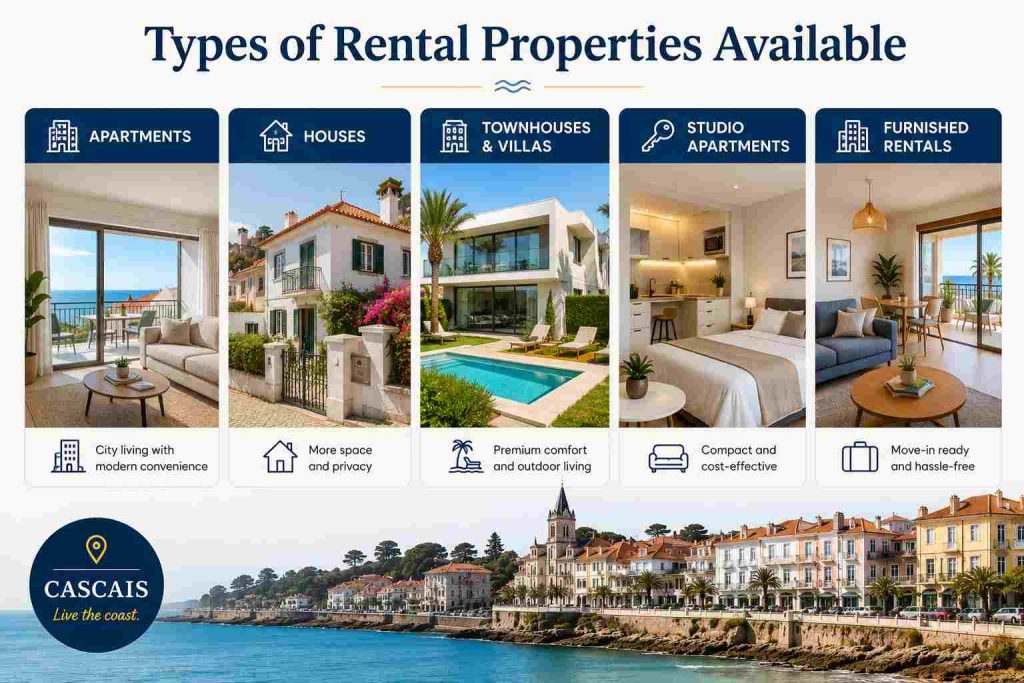
The Cascais rental market offers several housing options, each suited to a different lifestyle and budget.
Apartments are by far the most common choice, ranging from studios to one-, two-, and three-bedroom units, up to luxury penthouses. Most international renters start here, since apartments offer the widest range of prices and locations.
Houses — detached or semi-detached — are available throughout Cascais but generally cost more than apartments. They appeal to larger families, long-term residents, renters who need private outdoor space, and anyone with pets.
Furnished apartments are especially popular with expats, remote workers, professionals on temporary assignments, and students. Monthly rent tends to run higher, but furnished units can significantly reduce the upfront cost of moving by eliminating the need to buy furniture and household essentials.
Unfurnished apartments are usually preferred by long-term residents. They often come with lower monthly rent and greater freedom to personalize the space, but you’ll need to factor in the cost of furniture, appliances, and other essentials.
What to Expect When Searching for an Apartment
If you’re moving from another country, approach the search with realistic expectations. Unlike tourist accommodation, long-term rentals typically require documentation, proof of income, and a careful read of the lease terms before approval — and it’s common for desirable apartments to draw interest from several prospective tenants at once, especially in popular neighborhoods.
Being prepared before you start — knowing your budget, identifying preferred neighborhoods, and gathering the right documents — can meaningfully improve your odds of landing the right apartment.
Expert tip: Don’t start by asking, “Which apartment should I rent?” Start with, “Which neighborhood fits my lifestyle and budget?” Once you’ve answered that, choosing the apartment becomes far easier.
How Much Does It Cost to Rent an Apartment in Cascais?
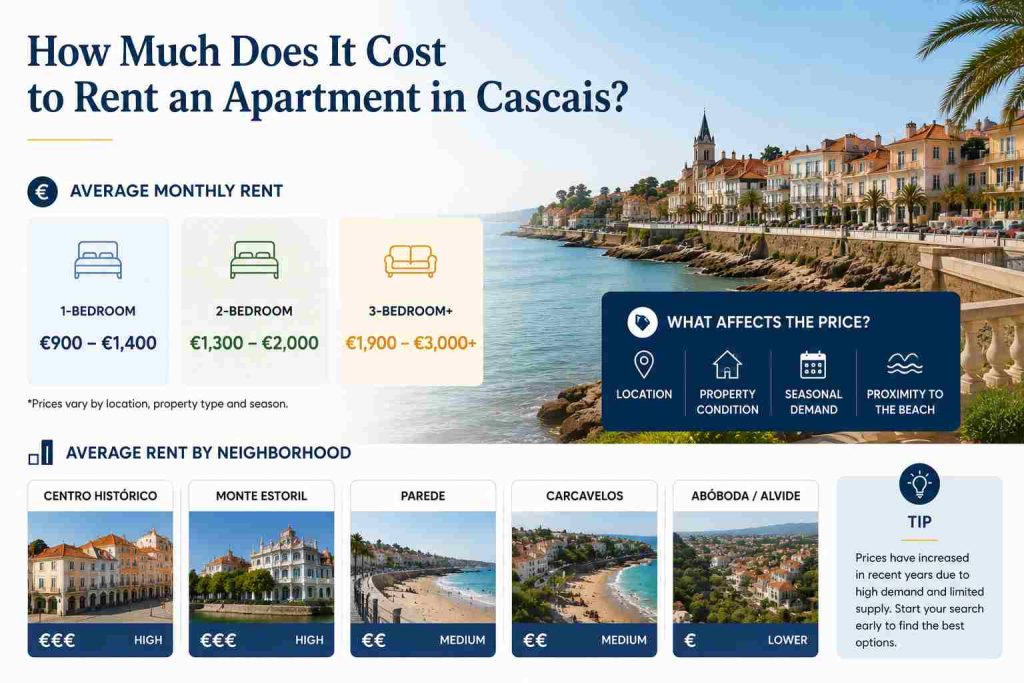
For most people planning a move to Cascais, this is the question that determines everything else: can I realistically afford to live here?
The answer depends on more than the rent advertised in a listing. Apartment size, location, furnishing, building condition, proximity to the beach, and lease length all shape the final cost. On top of that, expenses like security deposits, utilities, internet, and transportation can add up quickly.
Understanding these costs before you contact a single landlord will help you narrow your search to properties that genuinely fit your budget.
Average Apartment Rental Prices in Cascais
Rental prices vary considerably by neighborhood and property type. Apartments close to the coastline, Cascais Marina, or the historic center generally command higher rents than those farther inland.
The table below is a general comparison of rental categories rather than fixed prices, since market conditions shift frequently.
| Apartment Type | Typical Cost Level | Best For |
|---|---|---|
| Studio | Lower | Students, solo professionals |
| One-bedroom | Moderate | Couples, remote workers |
| Two-bedroom | Moderate to high | Small families |
| Three-bedroom | High | Larger families |
| Luxury apartment or penthouse | Premium | Executives, luxury lifestyle seekers |
Studios may look like the cheapest option on paper, but they aren’t always the most economical choice long-term. Limited space, minimal storage, and shared facilities can offset some of the savings for certain renters.
What Affects Apartment Rental Prices?
Two apartments with the same number of bedrooms can carry very different price tags. Here’s what usually explains the gap.
1. Location within Cascais. Properties near Cascais Marina, the historic center, the beaches, train stations, or popular shopping districts typically cost more, thanks to the convenience and lifestyle benefits they offer. Apartments farther from the coastline often deliver better value while still keeping good access to public transport.
2. Apartment size. Larger apartments naturally cost more, but price doesn’t scale in a straight line. A well-designed one-bedroom in a prime location may cost more than a bigger apartment in a quieter residential area — so think about how much space you actually need, not just square footage.
3. Furnished vs. unfurnished. Furnished apartments usually include beds, sofas, dining furniture, kitchen appliances, a washing machine, and other basics — conveniences that push up monthly rent but cut your upfront moving costs. Unfurnished units tend to cost less each month, give you more freedom to personalize the space, and often deliver better value if you’re staying long-term.
4. Building amenities. Underground parking, swimming pools, security systems, elevators, fitness facilities, private gardens, and concierge services all add to the price. Before paying a premium for any of these, ask yourself honestly whether you’ll actually use them.
5. Lease length. Landlords generally prefer longer leases because they provide stable income, so long-term agreements often come with better pricing and greater stability. Shorter arrangements — especially furnished ones — tend to cost more per month in exchange for flexibility.
Hidden Costs Many Renters Forget
One of the biggest budgeting mistakes is focusing only on the advertised rent. Your actual monthly housing cost is almost always higher.
- Security deposit: Most landlords require one upfront, intended to cover damage beyond normal wear and tear. It’s generally refunded at the end of the tenancy if the property is left in good condition and the lease terms are met. Before paying anything, read the lease carefully, request written confirmation of payment, and clarify the conditions for its return.
- Utility bills: Electricity, water, gas, and waste collection may or may not be included, depending on the property. Never assume — always confirm before signing.
- Internet: Ask whether it’s already installed, which provider serves the property, and whether installation fees apply. This matters most for remote workers, freelancers, students, and anyone running an online business.
- Parking: If you own a car, ask whether private parking is included, whether street parking is realistic, and whether permits or extra monthly fees apply.
- Agency fees: If you’re renting through an agency, clarify upfront whether service fees apply and who’s responsible for paying them.
Understanding all of these costs in advance prevents unpleasant surprises later.
Building a Realistic Monthly Budget
Every renter’s situation is different, but sketching out a full budget — not just rent — before you start apartment hunting will save you from choosing based on the wrong number.
A single professional typically needs to plan for rent, utilities, internet and mobile, groceries, public transport, entertainment, and a cushion for emergency savings.
A family usually has additional line items: a larger apartment, school-related costs, transportation, childcare, healthcare, and household supplies. Choosing a slightly less central neighborhood can sometimes deliver better overall value without sacrificing quality of life.
A remote worker may reasonably prioritize high-speed internet, a dedicated workspace, walkability, quiet surroundings, and nearby cafés or coworking spaces — priorities that can justify paying a bit more if they genuinely improve daily productivity.
Should You Choose the Cheapest Apartment?
Not necessarily. The lowest advertised rent doesn’t always represent the best overall value. Before deciding, ask yourself: How much time will commuting add each week? Will you need a car? Are supermarkets nearby? Is the neighborhood safe at night? Does the apartment get natural light? Are utilities included? How old is the building? Will you need to buy furniture?
Sometimes paying a little more each month results in lower overall living costs — and a noticeably better quality of life.
Budgeting tip: A successful move isn’t about finding the cheapest apartment. It’s about finding a home that fits your income, lifestyle, and long-term plans without creating unnecessary financial stress.
Common Budgeting Mistakes to Avoid
First-time renters routinely underestimate the true cost of moving to Cascais. Watch out for:
- Budgeting only for monthly rent
- Forgetting the security deposit
- Assuming utilities are included
- Ignoring internet installation or service costs
- Choosing an apartment without factoring in commuting expenses
- Focusing on price alone instead of overall value
- Skipping an emergency fund for unexpected costs
Avoiding these pitfalls will make your transition smoother and keep your rental affordable well beyond the first month.
Best Neighborhoods in Cascais for Renting
Choosing the right neighborhood matters just as much as choosing the right apartment. Two units with similar rents can offer completely different living experiences depending on their surroundings, commute, nearby amenities, and community feel.
Rather than asking, “Where is the cheapest apartment?” — a better question is: “Which neighborhood best matches my lifestyle, budget, and long-term plans?”
What Should You Consider Before Choosing a Neighborhood?
Every renter has different priorities, so before comparing neighborhoods, get clear on your own. Will you commute to Lisbon daily? Do you want to walk to the beach? Are good schools essential? Will you rely on public transport, or do you own a car? Do you prefer nightlife or quiet residential streets? Is walkability important? Do you need coworking spaces or cafés nearby?
There’s no universal “best” neighborhood — only the one that fits how you actually live.
Neighborhood Comparison at a Glance
| Neighborhood Type | Rent Level | Commute to Lisbon | Beach Access | Family Friendly | Nightlife | Best For |
|---|---|---|---|---|---|---|
| Historic Centre | Premium | Excellent | Excellent | Moderate | Excellent | Professionals, tourists, couples |
| Marina & Coastal Areas | Premium | Excellent | Excellent | Good | Excellent | Luxury renters |
| Residential Cascais | Moderate–high | Good | Good | Excellent | Moderate | Families |
| Estoril | Moderate–high | Excellent | Excellent | Excellent | Moderate | Families, commuters |
| Inland Residential Areas | Moderate | Good | Moderate | Excellent | Limited | Budget-conscious renters |
Rental prices and availability shift over time — treat this as a lifestyle comparison, not a pricing guide.
Cascais Historic Centre
Often the first area newcomers explore, and for good reason. Narrow streets, traditional Portuguese architecture, cafés, restaurants, and easy access to the waterfront create an atmosphere that’s hard to replicate elsewhere.
You’ll find walking-distance beaches, excellent restaurants, a vibrant atmosphere, easy train access, and high walkability — often without needing a car at all. The trade-off is that properties here tend to be smaller, older, more expensive, and in high demand, with noise picking up during tourist season.
Best for: young professionals, couples, remote workers, and anyone who enjoys an active, walkable, socially engaged lifestyle.
Marina & Coastal Areas
Apartments near Cascais Marina and the coastline are among the most desirable in the area, often featuring ocean views, easy beach access, modern buildings, and premium amenities — which is exactly why they command the highest rents.
The upside is a scenic, high-quality lifestyle with excellent recreational opportunities and beautiful walking routes. The downside is higher rent, stiffer competition, and limited availability. If your budget allows it, though, this is one of Portugal’s most attractive coastal living experiences.
Best for: executives, luxury renters, retirees, couples, and remote-working professionals.
Residential Cascais
Away from the busiest tourist areas, residential neighborhoods offer a quieter daily lifestyle while staying close to the town’s services — often striking an excellent balance between convenience and comfort. Expect larger apartments, family-oriented communities, parks, schools, supermarkets, and easier parking.
The trade-off: you may need a bicycle, public transport, or a short drive to reach some beaches or entertainment areas.
Best for: families, long-term residents, retirees, and professionals who want quieter surroundings.
Estoril
Technically separate from Cascais but part of the same urban area, Estoril is worth considering alongside it. It offers a beautiful coastline, historic character, well-established residential neighborhoods, an easy rail connection to Lisbon, and a strong international community — plus good schools and beach access.
Popular parts of Estoril see strong rental demand, so if this is your preferred area, start your search early.
Best for: families, commuters, professionals, and international residents.
Inland Residential Areas
Neighborhoods farther from the coastline tend to offer more affordable rents. You’ll trade immediate beach access for larger apartments, more parking, less tourist activity, and quieter streets — but reaching the beach or the train station may require public transport, cycling, or driving.
Best for: budget-conscious renters, families, long-term residents, and anyone who owns a car.
Which Neighborhood Fits Which Renter?
| Renter Type | Recommended Area | Why |
|---|---|---|
| Digital nomad | Historic Centre, Marina | Walkability, cafés, coworking, lifestyle |
| Family | Residential Cascais, Estoril | Schools, parks, quieter environment |
| Student | Residential areas | Better affordability |
| Retiree | Marina, Residential Cascais | Healthcare, quiet surroundings, accessibility |
| Professional commuting to Lisbon | Estoril, Central Cascais | Convenient train access |
| Luxury lifestyle | Marina & Coastal Areas | Premium amenities and ocean views |
These are general starting points — your own budget, commute, and family needs may lead you somewhere different.
Safety and Daily Convenience
Safety is often one of the first things people ask about when relocating internationally. Rather than fixating on crime statistics, pay attention to how comfortable daily life actually feels: are streets well lit, can you walk home comfortably in the evening, are supermarkets and pharmacies close by, and is the neighborhood active throughout the day? Visiting an area at different times — morning, afternoon, and evening — tells you more than any online description can.
Walkability vs. Driving
One of Cascais’ strengths is that many neighborhoods are highly walkable, though this varies considerably. If you’d rather not own a car, prioritize areas with groceries, restaurants, and healthcare within walking distance, plus easy access to train stations and beaches. If you already own a vehicle, parking availability may matter more than walkability.
Schools and Healthcare
Families should look beyond apartment size to distance from schools, access to childcare, healthcare facilities, parks, and quiet streets. A slightly more expensive neighborhood with better services often delivers more long-term value than the lowest-rent apartment.
Common Mistakes When Choosing a Neighborhood
- Choosing solely based on the lowest rent
- Ignoring commuting time
- Skipping a visit to the neighborhood before signing
- Overlooking access to supermarkets and public transport
- Underestimating parking needs
- Prioritizing beach proximity over everyday convenience
- Assuming all of Cascais offers the same lifestyle
A neighborhood that fits your daily routine is usually worth more than one that simply photographs well.
Selection tip: If possible, shortlist two or three neighborhoods before you start apartment hunting. This gives you more flexibility, widens the pool of suitable listings, and improves your chances of finding a home that fits both budget and lifestyle.
The apartment itself is only one part of the decision. A comfortable home in a neighborhood that matches your lifestyle will almost always beat a “perfect” apartment in an area that doesn’t fit your daily needs. Once you know which neighborhoods work for you, the next step is deciding what type of property to look for.
Apartment Types: Which Rental Option Is Right for You?
Many first-time renters focus almost entirely on monthly rent, but that’s only one piece of the puzzle. A cheaper apartment might mean buying furniture from scratch, while a slightly pricier furnished unit could save you thousands in upfront moving costs. A spacious house might look appealing until you factor in the extra maintenance and higher utility bills.
Apartment vs. House
Apartments are the most common — and generally the easiest to find — rental option in Cascais. They typically mean lower maintenance, easier access to public transport, better walkability, and a wider range of budgets to choose from, often with shared amenities like elevators, secure entrances, or gardens. The trade-off is less private outdoor space, shared walls, limited storage, and smaller living areas overall.
Houses are less common but appeal to renters who want more indoor space, a private garden or courtyard, extra bedrooms, and greater privacy — particularly families planning to stay for several years or anyone with pets. Expect higher rent, bigger utility bills, and more responsibility for cleaning, garden upkeep, and repairs, depending on the lease.
| Feature | Apartment | House |
|---|---|---|
| Monthly rent | Usually lower | Usually higher |
| Maintenance | Lower | Higher |
| Outdoor space | Limited | Private garden or patio |
| Privacy | Moderate | Higher |
| Suitable for families | Good | Excellent |
| Suitable for singles | Excellent | Moderate |
| Pet-friendly potential | Varies | Often better |
| Utilities | Generally lower | Often higher |
Furnished vs. Unfurnished
The right choice here largely comes down to how long you plan to stay.
A furnished apartment typically comes with a bed, sofa, dining table and chairs, kitchen appliances, a washing machine, wardrobes, and basic kitchen equipment — though the exact inventory varies, so always confirm what’s included before signing. This option suits digital nomads, expats, international professionals, students, and anyone relocating on short notice, since it means a faster move-in and lower upfront costs. The trade-off is higher monthly rent — though that premium can still work out cheaper than buying furniture if you’re only staying a year or two.
An unfurnished apartment usually means an empty living space (sometimes with kitchen appliances included), and tends to suit renters planning to stay for several years. Monthly rent is generally lower and you get full freedom to decorate, but budget for beds, a sofa, dining furniture, kitchen equipment, curtains, and other essentials — plus delivery and assembly — before deciding this is the cheaper route.
| Factor | Furnished | Unfurnished |
|---|---|---|
| Monthly rent | Higher | Lower |
| Upfront costs | Lower | Higher |
| Move-in speed | Immediate | Slower |
| Flexibility | Moderate | High |
| Best for | Short- to medium-term stays | Long-term residents |
Choosing the Right Size
Studios combine bedroom, living area, and kitchen into one open space — a good fit for students, solo professionals, frequent travelers, and budget-conscious renters who want a simpler lifestyle and lower utility costs.
One-bedroom apartments remain one of the most popular choices in Cascais, offering a separate sleeping area, more privacy, better potential for working from home, and a comfortable setup for couples. For many relocating professionals, this is the sweet spot between affordability and comfort.
Two- and three-bedroom apartments add extra bedrooms, room for a dedicated home office, space for guests, and more storage. They suit families, couples planning a long-term stay, and remote workers who need separate workspaces — and sharing the cost with another adult can bring the per-person price down considerably.
Long-Term vs. Monthly Rentals
Long-term leases generally mean lower monthly rent, greater stability, and a stronger sense of permanence — ideal if you’re relocating for good or planning to stay at least a year.
Monthly rentals trade some of that stability for flexibility, which suits temporary work assignments, exploring Cascais before committing to a neighborhood, or bridging the gap while you wait for permanent housing. That flexibility usually comes at a higher monthly cost.
| Your Situation | Recommended Option |
|---|---|
| Digital nomad | Furnished one-bedroom apartment |
| Student | Studio or shared apartment |
| Young professional | One-bedroom apartment |
| Couple | One- or two-bedroom apartment |
| Family | Two- or three-bedroom apartment or house |
| Retiree | Quiet apartment or house near essential services |
These are general starting points — your own budget, preferences, and daily routine should guide the final call.
Questions to Ask Before Choosing Any Apartment
Is it furnished exactly as shown? Are utilities included? What internet is available? Is parking included? Are pets permitted? Is there an elevator? What’s the minimum lease length? Who handles maintenance? Are there building rules that could affect daily life? Getting clear answers before you sign can save both time and money.
Common Mistakes When Choosing a Rental Property
- Choosing the cheapest apartment without considering total living costs
- Renting more space than you actually need
- Paying extra for furniture you won’t use
- Ignoring storage requirements
- Assuming all furnished apartments include the same items
- Forgetting to ask about maintenance responsibilities
- Prioritizing appearance over location and convenience
Decision tip: If you’re torn between furnished and unfurnished, estimate the total cost over your planned stay rather than comparing monthly rent alone. Looking at the bigger financial picture usually leads to a better decision.
The right rental isn’t necessarily the newest, the biggest, or the cheapest — it’s the one that fits how you live, work, commute, and plan for the future. Once you’ve settled on a property type, the next step is understanding how the rental process actually works in Cascais.
How to Rent an Apartment in Cascais
Finding an apartment you like is only the beginning. Before you get the keys, you’ll typically need to provide documentation, communicate with the landlord or agency, review the lease carefully, and work through a handful of administrative steps. If you’re moving from abroad, the process may feel unfamiliar at first — but preparing in advance makes it far smoother.
Step 1: Define your budget before contacting landlords. Calculate your maximum monthly rent, expected utilities, internet, transportation, food and daily living expenses, emergency savings, and initial move-in costs. A realistic budget lets you eliminate unsuitable properties immediately and focus only on what you can comfortably afford.
Step 2: Choose your preferred neighborhoods. Rather than fixating on one area, identify two or three that meet your priorities around commute, schools, healthcare, supermarkets, walkability, beach access, parking, and safety.
Step 3: Prepare your documents. Requirements vary by landlord and property, so confirm exactly what’s needed — but commonly requested documents include a passport or national ID, proof of income, an employment contract, recent bank statements, a Tax Identification Number (NIF) where applicable, and references from a previous landlord. Having these ready before you contact anyone signals that you’re organized and can speed up approval.
Rental document checklist:
- Valid passport or identification
- Proof of income
- Employment confirmation (if applicable)
- Recent bank statements
- Contact details for references
- Tax Identification Number (NIF), if required
Keep digital copies stored securely so you can send them quickly when asked.
Step 4: Search using trusted rental platforms. Read the entire listing, check whether the apartment is furnished, confirm the lease length, look closely at the photos, verify the location, and compare several similar apartments before reaching out. Never assume every listing includes the same conditions.
Step 5: Contact the landlord or agency. Introduce yourself professionally — who you are, when you plan to move, how long you intend to stay, and why the property interests you. Clear, polite communication tends to create a strong first impression, even across a language barrier.
Step 6: Schedule a viewing. Photographs rarely tell the whole story. During the visit, check the interior condition — walls, floors, windows, doors, kitchen appliances, bathrooms — and visit at different times of day if possible, since a bright afternoon apartment might get very little morning light. Spend a few minutes just listening for traffic, construction, nearby restaurants, or noisy neighbors. Ask about internet providers and installation, and, if you own a car, confirm parking arrangements.
Apartment viewing checklist:
| Check | Completed |
|---|---|
| Building condition | ☐ |
| Kitchen appliances | ☐ |
| Bathroom condition | ☐ |
| Windows and ventilation | ☐ |
| Water pressure | ☐ |
| Internet availability | ☐ |
| Mobile signal | ☐ |
| Parking | ☐ |
| Noise levels | ☐ |
| Natural light | ☐ |
| Storage space | ☐ |
Using the same checklist for every apartment makes comparisons much easier later.
Step 7: Review the lease agreement carefully. Never rush this step. Pay close attention to lease duration, monthly rent, payment dates, the security deposit, maintenance responsibilities, notice periods, pet rules, and utility responsibilities. If anything discussed verbally doesn’t appear in writing, ask before signing — a lease should accurately reflect everything you agreed on.
On the security deposit specifically, clarify how much is required, when it’s due, under what conditions it’s returned, and how the refund will be processed. Always get written confirmation of any payment.
Step 8: Prepare for move-in. Once the lease is signed, arrange utilities, confirm internet installation, update your address where necessary, organize transportation for your belongings, and buy any household essentials you’ll need immediately.
Move-in checklist:
- Signed lease agreement
- Deposit payment receipt
- Apartment keys
- Utility arrangements
- Internet setup
- Emergency contact numbers
- Inventory record, if provided
Agency vs. Private Landlord
| Agency | Private Landlord |
|---|---|
| Structured process | More direct communication |
| Professional documentation | Greater flexibility in some situations |
| Established procedures | Personal relationship with owner |
| Multiple listings | Individual property focus |
Neither option is automatically better — choose whichever gives you clear communication, transparent documentation, and confidence throughout the process.
Common Mistakes During the Rental Process
- Applying without preparing documents
- Paying a deposit before verifying the property
- Rushing to sign the lease
- Skipping the inspection
- Assuming utilities are included
- Ignoring internet availability
- Not reading every clause of the lease
- Forgetting to keep copies of important documents
Expert tip: The strongest rental application isn’t necessarily the first one submitted — it’s the one that’s complete, well organized, and backed by the right documentation.
Renting an apartment in Cascais doesn’t need to be complicated. Prepare your budget, organize your paperwork, choose neighborhoods carefully, inspect properties thoroughly, and understand your lease before signing — and you’ll be in a strong position to secure a home that fits your needs.
Avoiding Rental Scams & Costly Mistakes
Most landlords and real estate professionals in Cascais operate honestly, but as in any competitive rental market, fraudulent listings and costly misunderstandings can happen. Fortunately, most problems are avoidable with a bit of patience and healthy caution.
Why Rental Scams Happen
Scammers tend to target renters who are relocating from another country, need housing quickly, can’t view the apartment in person, are unfamiliar with Portuguese rental practices, or feel pressure because of limited availability. That urgency is exactly what leads people to overlook warning signs — which makes recognizing common tactics your best defense.
Common Warning Signs
The rent seems too good to be true. If an apartment is priced well below similar properties in the same neighborhood, ask why. Occasional bargains exist, but an unusually low price should prompt more investigation, not immediate payment.
Pressure to pay immediately. Be wary of anyone insisting you transfer a deposit before viewing the property, or pushing you to pay quickly because “many others are interested.” High demand is real in Cascais, but legitimate landlords generally understand that renters need time to review agreements and ask questions.
Limited property information. A trustworthy listing includes clear details on location, size, bedrooms, photographs, and rental conditions. Be cautious if key details are missing, photos look inconsistent, or your questions get vague answers.
Refusal to arrange a viewing. View the apartment whenever possible. If you’re relocating internationally and an in-person visit isn’t practical, ask for a live virtual viewing — and be cautious if someone refuses both without a reasonable explanation.
Poor communication. Contradictory information, frequently changing terms, avoided questions, and requests made only through informal messaging (with no supporting documentation) are all warning signs. Professional landlords and agencies typically communicate clearly and consistently.
How to Verify a Listing
Compare several similar apartments in the neighborhood to see whether the asking rent and photos look realistic. Look closely at the images for consistent room layouts, natural lighting, and building condition — and ask for more photos if anything looks incomplete. Instead of asking only whether the apartment is available, ask detailed questions: Is it furnished exactly as shown? Are utilities included? What internet is available? What lease lengths are accepted? Are pets permitted? Clear, specific answers are usually a good sign.
During the viewing itself, pay as much attention to the surrounding neighborhood as to the apartment — street cleanliness, nearby supermarkets, public transport access, building maintenance, noise, and general atmosphere. Visiting at different times of day helps, since a neighborhood can feel very different on a quiet weekday morning than on a busy weekend night.
Before signing anything, read the lease carefully — lease duration, rent, payment schedule, security deposit, notice period, maintenance and utility responsibilities, and any rules on alterations or pets. And once you’ve signed, keep organized copies of the lease, payment receipts, deposit confirmation, correspondence, and the apartment inventory if one was provided.
Costly Mistakes That Aren’t Scams
Plenty of rental problems come down to avoidable mistakes rather than fraud:
- Choosing based only on price — without weighing transportation costs, utilities, commuting time, or building condition
- Ignoring hidden costs like utilities, internet, parking, and building fees
- Rushing into a decision under the pressure of a competitive market, instead of comparing options and sleeping on it
- Skipping the inspection — even attractive photos can’t substitute for checking doors, windows, plumbing, heating, and signs of moisture in person
- Not asking enough questions about repairs, maintenance requests, what’s included in rent, and early lease termination
Rental Scam Prevention Checklist
Before paying any money, you should be able to answer “yes” to each of the following:
- I have compared similar listings.
- I understand the lease terms.
- I know exactly what is included in the rent.
- I have viewed the property or completed a satisfactory virtual viewing.
- I have received clear answers to my questions.
- I have copies of important documents.
- I feel comfortable with the communication throughout the process.
If any answer is “no,” it’s worth slowing down and gathering more information before you proceed.
Expert tip: A legitimate landlord or agency should never object to reasonable questions. Asking about lease terms, deposits, maintenance, or utilities is simply part of making an informed decision.
The safest renters are rarely the luckiest — they’re usually the most prepared. Research neighborhoods, compare listings, inspect apartments carefully, ask detailed questions, and read every part of the lease, and you’ll dramatically reduce the risk of a costly mistake. Once the apartment and the paperwork are sorted, it’s worth stepping back and asking a bigger question: is everyday life in Cascais actually what you’re looking for?
Living in Cascais: Is It the Right Place for You?
Renting an apartment is only one part of relocating. The more important question is whether Cascais offers the lifestyle you’re actually looking for, once the excitement of moving wears off.
Some people fall for Cascais because of its beaches and relaxed atmosphere. Others value its transport links to Lisbon, international community, and overall quality of life. It isn’t the perfect fit for everyone, though — housing costs run higher than in many other Portuguese towns, and the pace of life is noticeably quieter than in central Lisbon.
What Makes Cascais So Popular?
Cascais attracts both Portuguese residents and international newcomers because it offers something rare: a combination of city access and coastal living, rather than a choice between the two. Its biggest draws include a beautiful Atlantic coastline, well-maintained public spaces, an easy train connection to Lisbon, an international community, excellent restaurants and cafés, modern healthcare, a family-friendly environment, and an outdoor lifestyle for much of the year. For many people, these qualities justify the higher rent compared with other parts of Portugal.
Daily Life in Cascais
Life here generally moves at a slower pace than in Lisbon. It’s an active town with plenty to do, but daily life often feels more relaxed — a walk to a local café, an afternoon at the beach, an evening by the marina. Many residents appreciate being able to run everyday errands on foot, particularly in the central neighborhoods.
Is Cascais Good for Families?
Families are drawn to the combination of residential comfort and convenient access to schools, parks, and healthcare — quiet neighborhoods, green space, family-friendly beaches, sports facilities, and reliable public transport. Beyond apartment size, it’s worth weighing school location, commuting time, healthcare access, grocery shopping, and outdoor recreation. A neighborhood that supports your family’s daily routine makes an enormous difference.
Is Cascais Good for Remote Workers?
Remote workers have become an increasingly visible part of Cascais’ international community, drawn by fast internet in many neighborhoods, comfortable cafés, coworking spaces, and a strong work-life balance. Instead of commuting, many finish work and head straight to the beach or a coastal walking path. If you’re working remotely, prioritize reliable internet, quiet surroundings, a comfortable workspace, natural light, and walkability when apartment hunting.
Is Cascais Suitable for Retirees?
Retirees are typically drawn by the mild climate, easy healthcare access, walkable neighborhoods, coastal scenery, and slower pace of life. For this group, features like elevator access, nearby supermarkets, and proximity to healthcare often matter more than living close to nightlife.
Commuting to Lisbon
One of Cascais’ biggest strengths is that coastal living doesn’t mean giving up access to the capital. Many professionals commute by train. Before renting, consider distance to the nearest station, walking time, parking availability, your daily schedule, and overall transportation costs — even if you only travel to Lisbon occasionally.
Climate and Cost of Living
Cascais enjoys a coastal climate moderated by the Atlantic, without the extreme winters or summers found elsewhere — good news for anyone who wants to walk, cycle, dine outdoors, or hit the beach for much of the year.
Rent is usually your biggest housing expense, but it’s far from the only one. Budget realistically for groceries, electricity, water, internet, mobile service, transportation, entertainment, healthcare, and household supplies — rather than judging affordability by rent alone.
Weighing the Trade-Offs
| Advantages | Considerations |
|---|---|
| Beautiful coastline | Higher rental costs than many Portuguese towns |
| High quality of life | Strong competition for desirable apartments |
| Good public transport | Premium neighborhoods can be expensive |
| International community | Some areas are quieter than Lisbon |
| Outdoor lifestyle | Parking may be limited in certain locations |
| Modern amenities | Popular rentals often move quickly |
For many residents, the lifestyle benefits outweigh the higher housing costs. For others — especially those on a tighter budget, or who prefer dense, city-center living — another location may be a better fit. Cascais tends to suit people who value coastal living, safety, outdoor recreation, good infrastructure, work-life balance, an international community, and easy access to Lisbon. It may be less suitable if you need the lowest possible housing costs, prefer dense urban environments, depend on late-night entertainment, or need daily access to Lisbon without any commute at all.
Lifestyle tip: Before committing to a long-term lease, spend a few days exploring your preferred neighborhood on foot — walk to the supermarket, the train station, the pharmacy, local cafés, and nearby parks. Experiencing an area as a resident, not a visitor, tells you far more than any listing can about whether it truly fits your daily routine.
The right apartment should support the life you actually want to build, not just provide a place to sleep. Once your budget, lifestyle, and neighborhood priorities are lined up with the apartment itself, the next step is turning your plans into a smooth, well-organized move.
Planning Your Move to Cascais
Finding the right apartment is a major milestone, but a successful relocation involves much more than signing a lease. Good preparation in the weeks beforehand reduces stress and helps you settle in far more quickly.
Build a Relocation Timeline
Four to eight weeks before moving: finalize your housing budget, confirm your preferred neighborhoods, gather your documents, research transportation options, set aside funds for deposits and moving costs, and start comparing apartments.
Two to four weeks before moving: once your apartment is secured, confirm your move-in date, arrange transportation, organize your belongings, notify relevant organizations of your address change, and plan for utility activation.
Your first week after moving: check the apartment thoroughly, confirm utilities are working, test your internet connection, and start exploring — nearby supermarkets, pharmacies, healthcare facilities, and public transport routes.
Keep Essential Documents Accessible
Rather than packing paperwork into storage boxes, keep a separate folder handy throughout the move with your passport or ID, lease agreement, deposit receipt, apartment inventory (if provided), employment documents, bank information, insurance details, and emergency contacts. Digital backups are worth keeping too.
Budget for the Move Itself, Not Just Rent
Beyond rent and the deposit, plan for transporting your belongings, cleaning supplies, household essentials, kitchen equipment, bedding, furniture if you’re renting unfurnished, utility setup, internet installation, and possibly temporary accommodation if your move-in date doesn’t line up perfectly.
Utilities and Connectivity
Confirm with your landlord which services — electricity, water, gas, waste collection — are already active, which accounts need transferring, and who’s responsible for activation. On the internet side, confirm whether it’s already installed, which providers serve the building, expected installation time for a new connection, and available speeds. It’s also worth checking mobile signal strength inside the apartment, particularly in older buildings.
Furnishing an Unfurnished Apartment
Start with the essentials — bed and mattress, dining table and chairs, basic kitchen equipment, a refrigerator and washing machine if not already provided, lighting, and storage — and add decorative touches gradually once you’ve settled in. If your apartment is furnished, inspect everything included and note any existing wear before you move your own things in.
Getting to Know Your New Neighborhood
Before your first full week begins, spend time exploring on foot. Locate the supermarkets, pharmacies, banks, cafés, public transport stops, parks, fitness centers, and medical clinics nearby. Even if you don’t own a car, get familiar with walking routes, train stations, bus stops, and cycling paths — and if you’ll be commuting to Lisbon regularly, practice the journey before your first working day.
Set Aside an Emergency Fund
Unexpected expenses come up during almost every move — replacement household items, minor repairs, extra transportation costs, internet delays, or unexpected administrative fees. A small emergency cushion goes a long way toward peace of mind during your first few months.
Relocation Checklist
Before move-in: lease signed, deposit paid, moving date confirmed, documents organized, budget prepared, apartment inspected.
During the move: keys collected, apartment inventory checked, utilities confirmed, internet arranged, emergency contacts saved.
After move-in: neighborhood explored, address changes registered, healthcare facilities located, appliances tested, smoke detectors and locks checked, building management met (if applicable).
Common Relocation Mistakes
- Leaving packing until the last few days
- Skipping the apartment inspection before moving furniture in
- Ignoring internet setup until after arrival
- Underestimating moving expenses
- Buying unnecessary furniture immediately
- Forgetting to keep copies of important documents
- Delaying learning public transportation routes
Relocation tip: Don’t try to organize every detail in your first few days. Focus on essential services, learn your neighborhood gradually, and give yourself time to adjust. A successful relocation is usually a series of small, well-planned steps rather than one perfectly executed day.
Moving to Cascais isn’t just a change of address — it’s the start of becoming part of a new community. Visiting local markets, trying neighborhood cafés, walking the coastline, and learning the quickest routes to essential services all help a new place feel familiar sooner than you’d expect. Once you’re settled, the final piece of the puzzle is knowing exactly where to search for that apartment in the first place.
Where to Find Apartments for Rent in Cascais
There isn’t a single website that always has the best apartment. Many landlords advertise across multiple platforms, while others work exclusively with local agencies — so using several trusted sources, and comparing listings carefully, will usually give you the best results.
Online property portals are typically where renters start, letting you filter hundreds of listings by rent, apartment type, bedrooms, furnishing, neighborhood, size, parking, and pet policy — a quick way to focus only on what matches your requirements.
Real estate agencies offer professional communication, help navigating lease documentation, access to additional listings, and local market knowledge — particularly useful for international renters unfamiliar with the Portuguese market. Just confirm upfront whether any agency fees apply.
Long-term rental specialists focus on furnished apartments and extended stays, appealing to digital nomads, corporate employees, expats, and relocating professionals. Their properties often come fully furnished with utility packages and flexible lease options — convenient, but worth comparing against traditional long-term rentals to see which delivers better overall value.
Local property networks matter too — not every apartment gets listed online. Some landlords rely on local real estate offices, community recommendations, and neighborhood advertising, so if you’re already in Cascais, talking to local agencies and residents can surface opportunities you won’t find on the major portals.
Should You Use Multiple Platforms?
Yes. Searching a single website risks missing suitable apartments. A better approach: shortlist your preferred neighborhoods, search several reputable platforms, compare similar apartments, save promising listings, and contact landlords or agencies promptly once something suitable appears.
Comparing Listings Properly
Before scheduling a viewing, look beyond monthly rent to apartment size, bedrooms, furnishing, building age, parking, outdoor space, public transport access, lease length, and utility arrangements. A slightly pricier apartment may deliver considerably better value if it reduces your monthly costs or improves your daily quality of life elsewhere.
Useful questions before you schedule a viewing: Is the apartment still available? Is it furnished exactly as shown? What lease lengths are available? Are utilities included? Is parking available? Are pets permitted? When can you view it? What documents are required to apply? Clear, specific answers early on are usually a good sign of a well-managed rental.
Keep Your Search Organized
A simple comparison table makes it much easier to evaluate options objectively rather than relying on memory:
| Property | Neighborhood | Monthly Rent | Furnished | Bedrooms | Parking | Status |
|---|---|---|---|---|---|---|
| Apartment A | ||||||
| Apartment B | ||||||
| Apartment C |
And don’t judge an apartment by its photos alone. Professional images highlight a property’s strongest features but rarely reveal natural lighting throughout the day, noise levels, storage space, building maintenance, neighborhood atmosphere, internet quality, or parking conditions. Whenever possible, pair online research with an in-person or live virtual viewing before you commit.
| Your Priority | Best Search Approach |
|---|---|
| Largest selection | Search multiple property portals |
| Professional assistance | Work with a real estate agency |
| Ready-to-move-in accommodation | Furnished rental specialists |
| Long-term family home | Combine agencies with online listings |
| Budget-conscious search | Compare multiple platforms before applying |
Common Mistakes When Searching Online
- Limiting your search to one website
- Ignoring nearby neighborhoods
- Applying before reading the full listing
- Focusing only on monthly rent
- Waiting too long to contact the landlord after finding a suitable property
- Skipping comparisons between similar listings
- Assuming photographs tell the whole story
Apartment Search Checklist
- Compared similar apartments
- Reviewed the neighborhood
- Confirmed the lease length
- Asked about utilities
- Verified parking availability
- Prepared your documents
- Reviewed your monthly budget
- Arranged a viewing where possible
Search tip: The goal isn’t simply to find an available apartment — it’s to find one that fits your budget, lifestyle, commute, and long-term plans. A little extra time comparing options now can save you from costly compromises later.
Choosing an apartment in Cascais comes down to balancing your budget, preferred neighborhood, apartment type, daily commute, lifestyle priorities, and long-term plans. An apartment that looks perfect on paper won’t necessarily suit your routine, while one that seems less impressive at first could turn out to be the better long-term choice. Use everything you’ve learned here to evaluate properties carefully, ask informed questions, and decide based on your actual needs rather than urgency.
Quick Reference Guide Before You Rent
Use this section whenever you’re comparing apartments or getting ready to sign a lease.
Budget: Calculated your maximum monthly housing budget · included utilities in the estimate · accounted for internet costs · planned for transportation · reserved money for the deposit · set aside emergency savings.
Neighborhood: Compared several neighborhoods · considered commuting time · checked public transport access · located nearby supermarkets · reviewed healthcare facilities · evaluated walkability · considered parking.
Apartment: Chosen the right size · decided between furnished or unfurnished · compared multiple listings · reviewed photographs carefully · scheduled a viewing where possible · confirmed available amenities.
Rental process: Gathered required documents · reviewed lease conditions · asked about the security deposit · confirmed utility responsibilities · clarified maintenance obligations · understood lease duration.
Apartment Comparison Worksheet
| Factor | Apartment A | Apartment B | Apartment C |
|---|---|---|---|
| Monthly rent | |||
| Neighborhood | |||
| Bedrooms | |||
| Furnished | |||
| Utilities included | |||
| Parking | |||
| Public transport | |||
| Internet availability | |||
| Walking distance to shops | |||
| Overall impression |
Monthly Budget Planner
| Monthly Expense | Planned Amount |
|---|---|
| Rent | |
| Electricity | |
| Water | |
| Gas | |
| Internet | |
| Mobile phone | |
| Groceries | |
| Transportation | |
| Entertainment | |
| Emergency savings | |
| Miscellaneous |
Reviewing your entire monthly budget before signing a lease helps prevent financial surprises later — rather than choosing the apartment with the most amenities, choose the one that genuinely supports your daily life.
Common Mistakes to Avoid Before Signing
- Choosing an apartment based only on price
- Ignoring neighborhood suitability
- Forgetting to include utility costs in your budget
- Skipping a careful inspection
- Rushing because you’re worried someone else will rent the property
- Not asking enough questions
- Assuming every furnished apartment includes the same items
- Overlooking commuting time
- Forgetting to keep copies of important documents
- Signing a lease before fully understanding its terms
Taking a little extra time now can prevent significant headaches later.
Frequently Asked Questions
How much does it cost to rent an apartment in Cascais?
Rental costs vary depending on the neighborhood, apartment size, building condition, furnishings, and proximity to the coast. Apartments in central Cascais and waterfront areas generally command higher rents than those farther inland. Comparing multiple listings is the best way to understand current market prices.
Is Cascais expensive to live in?
Compared with many other Portuguese towns, Cascais is generally considered one of the more expensive places to rent, thanks to its coastal location, quality of life, and strong demand. Actual living costs still vary depending on your housing choice, lifestyle, and daily spending habits.
Can foreigners rent apartments in Cascais?
Yes. Many international residents successfully rent apartments in Cascais every year. Landlords or agencies may request documentation such as proof of identity, income, and other supporting information during the application process.
What documents are usually required?
Requirements vary between landlords, but commonly requested documents include a passport or ID, proof of income, employment documentation, recent bank statements, a Tax Identification Number (NIF) where applicable, and references from previous landlords. Preparing these before you start searching speeds up the application process.
Are furnished apartments worth it?
It depends on how long you plan to stay. Furnished apartments are usually more convenient for shorter stays or international relocations, since they cut upfront furniture costs. Unfurnished apartments tend to offer better long-term value if you’re staying in Cascais for several years.
Are utilities included in the rent?
Some properties include certain utilities; others require tenants to arrange and pay separately. Always confirm electricity, water, gas, internet, and waste collection before signing — knowing exactly what’s included helps you budget accurately.
How much security deposit is usually required?
Deposit arrangements vary between landlords and agreements. Before paying, confirm the amount required, the payment method, the conditions for its return, and when it will be refunded after the tenancy ends — and request written confirmation of any payment.
Which neighborhoods are best?
There’s no single “best” neighborhood. Your ideal location depends on your budget, commuting needs, family requirements, walkability preferences, lifestyle, and access to public transport. A neighborhood that supports your daily routine usually matters more than one that’s simply popular.
How can I avoid rental scams?
Compare multiple listings, use reputable platforms and established agencies, view the apartment whenever possible, read the lease carefully, ask questions if anything is unclear, keep copies of all documents and receipts, and stay cautious of unusual payment requests or pressure to transfer money quickly.
Can I commute to Lisbon from Cascais?
Yes. Many residents commute between Cascais and Lisbon by public transportation. When choosing an apartment, consider how close it is to transport connections and how the daily journey fits your work schedule.
Conclusion
Finding the right apartment in Cascais involves far more than browsing property listings. The best rental decisions come from understanding the local market, setting a realistic budget, choosing a neighborhood that matches your lifestyle, comparing apartment types, preparing the right documents, and approaching the process with confidence rather than urgency.
Whether you’re relocating for work, retirement, study, or simply a fresh start by Portugal’s Atlantic coast, thoughtful planning will make your move significantly smoother. Use the checklists, comparison tables, and decision frameworks throughout this guide as practical tools during your search — and remember that the right apartment isn’t simply the one that’s available. It’s the one that supports the way you actually want to live.