
Day Trip to Cascais from Lisbon: The Complete Planning Guide
Just 35 to 45 minutes west of Lisbon sits one of Portugal’s most beautiful seaside towns. Cascais pairs sandy beaches, elegant streets, a lively marina, and dramatic coastal cliffs with a relaxed atmosphere that feels worlds away from the capital. Once a small fishing village and later a royal summer retreat, it has grown into one of the country’s most rewarding day-trip destinations.
For most travelers, the challenge isn’t deciding whether Cascais is worth visiting — it’s figuring out how to make the most of a single day. Should you go independently or join a guided tour? Can you combine Cascais with Sintra? Which attractions deserve your time, and which can you skip if your schedule is tight?
Knowing what exists in Cascais is only half the job. A great day depends on choosing the right transportation, visiting places in a logical order, understanding realistic travel times, and matching your itinerary to your own travel style. That’s exactly what this guide is built to help you do — whether you’re traveling as a couple, with family, solo, or visiting Portugal for the first time — so you spend less time worrying about logistics and more time enjoying one of the most charming towns on Portugal’s Atlantic coast.
Is a Day Trip to Cascais Worth It?
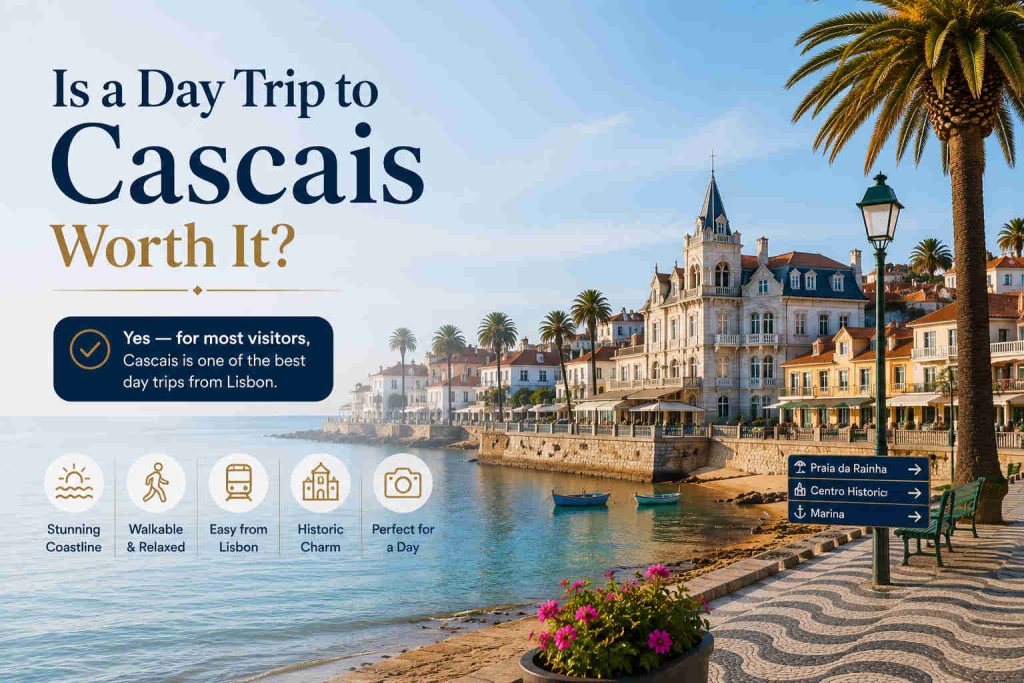
Yes — for most visitors, Cascais is one of the best day trips you can take from Lisbon. Its combination of coastal scenery, walkable streets, excellent public transport, historic landmarks, and relaxed atmosphere makes it an ideal destination for travelers who want a change of pace without spending hours on the road.
Unlike many European day trips that demand multiple transport connections, reaching Cascais is refreshingly simple. Frequent trains leave Lisbon’s Cais do Sodé Station and arrive at Cascais Railway Station in around 35 to 45 minutes. From there, most major attractions are within comfortable walking distance, so you spend your day exploring rather than navigating unfamiliar transport systems.
Cascais also strikes a rare balance: enough attractions to fill a full day, yet compact enough that a well-planned visit never feels rushed. You can wander the historic center in the morning, enjoy fresh seafood overlooking the marina at lunch, relax on a sandy beach in the afternoon, and finish watching waves crash against the cliffs of Boca do Inferno before heading back to Lisbon in the evening.
Rather than overwhelming visitors with an endless checklist, Cascais rewards slower travel. Cafés spill onto pedestrian streets, fishing boats share the harbor with sailboats, and coastal promenades invite leisurely walks between viewpoints — the relaxed rhythm that makes the town so appealing.
What Makes Cascais Different from Lisbon?
Although the two are close geographically, they offer very different experiences. Lisbon is energetic, historic, and urban — its steep hills, vintage trams, and famous viewpoints reward travelers who love exploring a bustling capital. Cascais feels calmer and more open: wide coastal promenades replace steep streets, beaches replace city squares, and ocean views accompany much of your walk through town. It’s a destination where sightseeing and genuine relaxation coexist comfortably. If Lisbon gives you Portugal’s cultural heartbeat, Cascais gives you its Atlantic coastline at its most inviting.
Why So Many Travelers Choose Cascais
No single attraction defines Cascais — visitors are drawn by the sheer variety packed into a small area. A single day here can include:
- Walking through the colorful historic center
- Relaxing on beautiful beaches
- Visiting the scenic Cascais Marina
- Exploring coastal viewpoints and the famous Boca do Inferno sea cliffs
- Enjoying fresh seafood at waterfront restaurants
- Strolling the Atlantic promenade
- Visiting museums or historic buildings, time allowing
Because these experiences sit close together, you spend less time commuting and more time actually enjoying the destination.
Planning Tip: Cascais isn’t about checking off the highest number of attractions. The best day trips balance sightseeing with time to enjoy the town’s relaxed atmosphere — an unplanned coffee stop or a leisurely seaside walk often becomes the most memorable part of the day.
Is One Day Enough?
For most visitors, yes. A well-planned day gives you time to experience Cascais’ highlights without feeling rushed. You won’t see absolutely everything — every museum, beach, and surrounding attraction — but you can comfortably enjoy the places that make the town special, including:
- Exploring the historic center
- Visiting the marina
- Walking to Boca do Inferno
- Relaxing at one or two beaches
- Enjoying lunch by the sea
- Shopping or browsing local boutiques
- Taking photographs along the waterfront
Travelers who want extended museum time, longer beach days, coastal cycling, or a side trip to Cabo da Roca may prefer a longer visit or a return trip — but a single day is more than enough for a rewarding introduction.
Who Will Enjoy a Day Trip Most?
Cascais appeals to nearly every kind of traveler, though a few groups get particular value from it.
Couples: Cascais is one of Portugal’s most romantic coastal towns. Scenic waterfront walks, charming cafés, seafood restaurants, and sunset viewpoints suit couples who’d rather wander old streets and settle into an Atlantic-view dinner than rush between monuments.
Families: The compact, relatively flat layout makes Cascais easier to navigate with children than larger cities. Beaches are easy to reach, most attractions are outdoors, and parks and open promenades give kids room to burn energy between sightseeing stops.
Solo travelers: Reliable public transport, walkable streets, and a welcoming atmosphere make Cascais one of the easiest destinations to explore independently, even for first-time visitors to Portugal.
Photography enthusiasts: From colorful fishing boats and tiled streets to dramatic Atlantic cliffs, Cascais offers strong photo opportunities all day — soft morning light in the historic center, and warm late-afternoon light near Boca do Inferno and the marina.
Beach lovers: Several beaches sit within easy walking distance of the town center, so you can combine sightseeing with real time in the sand and water.
When Cascais Might Not Be the Best Choice
Cascais isn’t the ideal fit for every traveler. If you’re most interested in grand palaces, medieval castles, or mountain scenery, Sintra is the better match — and hikers will find more extensive trail networks nearby, particularly within the Sintra-Cascais Natural Park. Visitors with only a few spare hours in Lisbon may struggle to see Cascais properly; a half-day visit is possible, but you’ll need to prioritize carefully and accept missing some highlights. And travelers chasing nightlife or a fast-paced city atmosphere are usually better off staying in Lisbon. For everyone else looking for a relaxed, easily reached coastal escape, Cascais consistently delivers one of Portugal’s most rewarding day trips.
Can You Really Do Cascais in One Day?
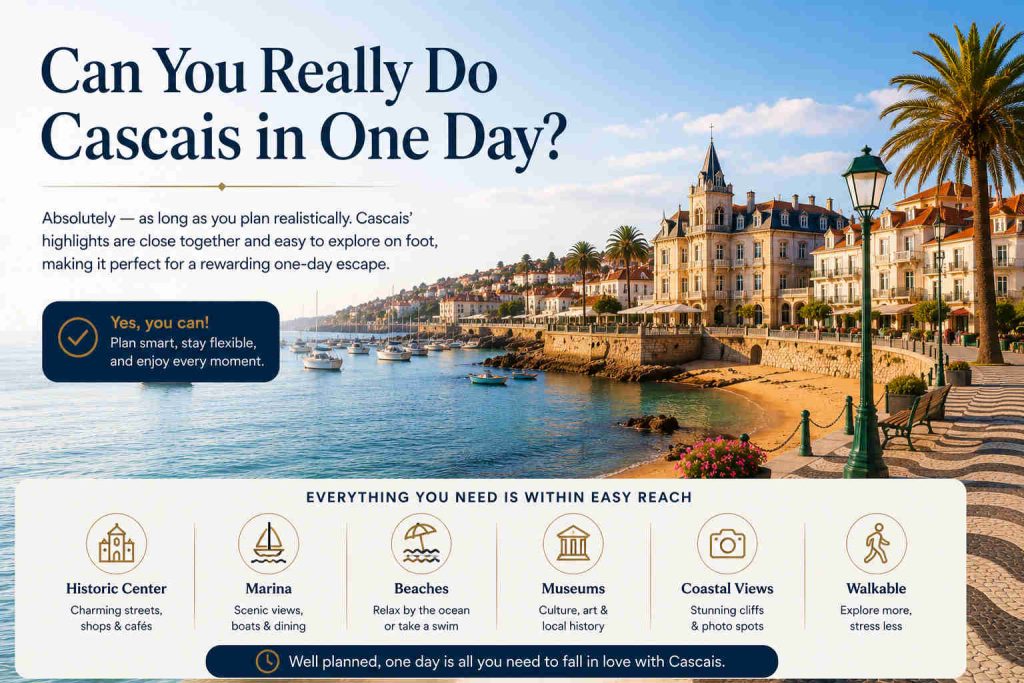
Absolutely — as long as you plan realistically. One of Cascais’ biggest advantages is that its highlights sit within a compact, walkable area. Unlike destinations where attractions are spread across long distances, you can move comfortably between the historic center, marina, beaches, museums, and coastal viewpoints on foot.
The goal isn’t seeing everything; it’s choosing the experiences that match your travel style and giving yourself enough time to enjoy them. A successful day should leave you relaxed rather than exhausted, so treat your itinerary as a balance between sightseeing and simply soaking in the coastal atmosphere. Leaving Lisbon early gives you the greatest flexibility, letting you explore the historic center while it’s quiet before spending the afternoon along the coast.
Quick Answer: A full day — around 8 to 10 hours including travel — is ideal for first-time visitors. It’s enough time to explore the historic center, visit the marina, walk to Boca do Inferno, enjoy a leisurely lunch, relax at one or two beaches, and still return comfortably to Lisbon in the evening.
Half-Day vs. Full-Day: Which Should You Choose?
A half-day visit is technically possible, but it forces difficult trade-offs. A full day offers a far more complete experience.
| Half-Day Visit | Full-Day Visit | |
| Best for | Travelers with very limited time | First-time visitors |
| Focus | Historic center and one or two highlights | All major attractions, comfortably |
| Beach time | Little to none | Real time for beaches, sightseeing, and dining |
| Pace | Fast, with less flexibility | Relaxed, with room for spontaneous stops |
| Cafés and shopping | Limited opportunity | Plenty of time to enjoy the atmosphere |
A shorter visit still makes sense if you’re already staying in Lisbon with only a few free hours, if your main goal is the coastline rather than every attraction, if you’re pairing Cascais with another destination the same day, or if you’ve visited before and simply want to revisit a favorite beach or restaurant. In that case, prioritize the historic center, the marina, and a coastal walk before heading back.
Most travelers, though, quickly discover that Cascais rewards a slower pace — streets invite wandering, cafés tempt you to linger, and ocean views make it easy to lose track of time. A full day lets you explore without watching the clock, stop for lunch overlooking the Atlantic, spend real time at the beach, and enjoy scenic walks between landmarks instead of shortcuts. You’ll leave feeling like you’ve genuinely experienced Cascais, not just covered it.
How Much Walking Should You Expect?
Walkability is one of Cascais’ biggest strengths. From the railway station, the historic center is just a few minutes away, and the marina, beaches, museums, and most cafés connect via pleasant, pedestrian-friendly streets. The walk to Boca do Inferno is longer but enjoyable, following the coastline with sea views and several places to pause along the way.
A typical day includes a short walk from the station to the historic center, an easy stroll between the old town, marina, and nearby beaches, a moderate coastal walk to Boca do Inferno, and a return along the same promenade or nearby streets. Most visitors cover 8 to 12 kilometers (5 to 7.5 miles) over a full day of sightseeing and beach walks — not strenuous for a reasonably active traveler, but comfortable footwear makes a real difference.
Is Cascais Suitable for Seniors?
For many older travelers, yes. Compared with Lisbon’s steep hills, Cascais is relatively flat and easier to navigate, with benches along the waterfront and frequent cafés for rest stops. Some historic streets use traditional Portuguese cobblestones, which can be uneven in places, so a slower pace and supportive shoes go a long way.
Is Cascais Good for Families?
Families often find Cascais easier to manage than larger cities. Children tend to enjoy watching fishing boats and yachts in the marina, playing on the beaches, walking the waterfront promenade, and spotting seabirds along the coast. Because most attractions are outdoors and close together, you’ll rely far less on repeated public transport throughout the day.
Accessibility Considerations
Travelers with reduced mobility should know that while much of Cascais is reasonably accessible, not every route is equally convenient. Some sidewalks use traditional cobblestones, beach access varies by location, and certain historic buildings have limited accessibility; the coastal promenade generally offers smoother walking than the older streets. Planning your route in advance helps minimize unnecessary detours.
How Much Time Should You Spend at Each Attraction?
One of the most common first-time-visitor mistakes is misjudging how long to spend at each stop. Here’s a realistic planning guide:
| Attraction | Recommended Time |
| Historic Center | 60–90 minutes |
| Cascais Marina | 30–45 minutes |
| Lunch | 60–90 minutes |
| Beach time | 60–120 minutes |
| Boca do Inferno | 30–45 minutes |
| Coastal walk | 45–60 minutes |
| Shopping and cafés | Flexible |
These are guidelines, not rules. Some travelers happily spend two hours on the beach; others prefer museums or photographing the coastline. Build a balanced itinerary around your own interests rather than trying to fit in every possible attraction.
Planning Tip: Leave at least one hour of unplanned time in your itinerary. An unexpected viewpoint, a café with ocean views, or simply staying longer at your favorite beach often becomes the highlight of the trip. With a realistic schedule, comfortable shoes, and an early start from Lisbon, one day is more than enough to see why Cascais has become one of Portugal’s most loved coastal destinations.
How to Get from Lisbon to Cascais
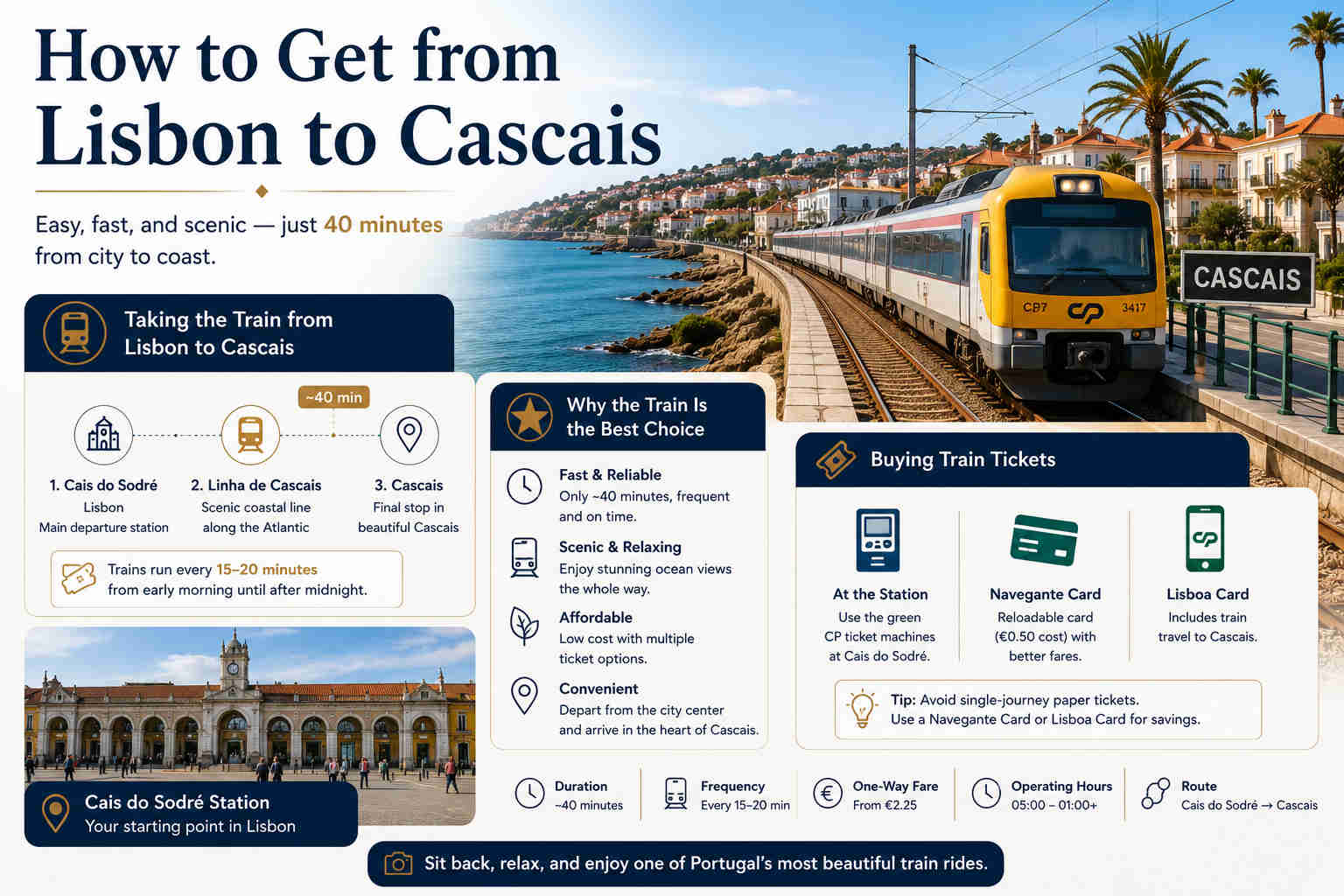
Getting to Cascais is refreshingly simple. Unlike many popular day trips that require multiple train changes or long drives, Cascais sits on a direct railway line from the capital, making it one of the easiest destinations to visit independently.
For most travelers, the train is the best option — affordable, frequent, free of traffic, and a short walk from the town’s main attractions. Unless you have specific plans, such as visiting several remote coastal spots in one day or traveling with significant mobility needs, a rental car offers few advantages. That said, the right choice depends on your priorities: some travelers value flexibility, while others prefer a guided tour that handles the logistics for them. Here’s how each option compares.
Taking the Train from Lisbon to Cascais
The train is the transportation method most visitors choose, and for good reason. Trains depart from Cais do Sodé Station, one of Lisbon’s main railway terminals, and run directly to Cascais Railway Station without any transfers.
The journey generally takes 35 to 45 minutes, with frequent service throughout the day. Because the route follows much of the Atlantic coastline, the ride itself becomes part of the experience, offering glimpses of beaches, marinas, and seaside neighborhoods as you leave the city behind.
For first-time visitors, the process is simple:
- Travel to Cais do Sodé Station in Lisbon.
- Buy your ticket using the appropriate transport card or a ticket machine.
- Board the next Cascais-bound train.
- Relax during the coastal journey.
- Exit at Cascais Railway Station and start exploring on foot.
Because the railway station sits close to the historic center, there’s no need to arrange further transportation on arrival. Within a few minutes you’ll be surrounded by cafés, shops, and pedestrian streets leading toward the waterfront.
Why the Train Is the Best Choice
Reliable: unlike driving, train schedules aren’t affected by road traffic, especially on busy weekends.
Affordable: rail travel typically costs far less than taxis or a single-day car rental.
Stress-free: no parking to find, no unfamiliar road rules, no navigation.
Walkable on arrival: because Cascais is compact, the station drops you close to everything you’ll likely want to see.
Lower environmental impact: rail travel generally has a smaller footprint than driving, a plus for travelers looking to reduce theirs.
Travel Tip: Take an earlier morning train if you can. Arriving before late morning lets you explore the historic center while it’s quieter and gives you more flexibility for the rest of the day.
Buying Train Tickets
Purchasing tickets is usually straightforward: buy before departure at ticket machines or staffed counters where available, and allow a little extra time during busy periods to avoid queues. If you already use Lisbon’s public transport system, check which transport card applies to the Cascais line and make sure it has enough credit loaded before boarding. Keep your ticket or card accessible for the full journey, as inspections can happen en route.
What the Journey Is Like
The Lisbon–Cascais line is one of Portugal’s most scenic commuter routes. As the train leaves the city, urban neighborhoods give way to coastal landscapes, and depending on where you’re seated, you may catch glimpses of beaches, sailing clubs, marinas, and stretches of open Atlantic before arriving in Cascais. It isn’t marketed as a sightseeing railway, but many visitors find it enjoyable enough to feel like part of the day rather than just transportation — comfortable enough to relax, review your itinerary, or simply watch the scenery change.
Arriving in Cascais
One of the biggest advantages of traveling independently is how easy arrival feels. You won’t need a bus or taxi to reach the main attractions — within a short walk of the station you’ll find the historic center, Cascais Marina, local cafés, beaches, tourist information services, and waterfront promenades. If you’ve planned your itinerary well, you’ll spend more time exploring and less time figuring out transport.
Train vs. Car vs. Guided Tour
Although the train suits most visitors, it’s worth comparing all three major options before deciding.
| Feature | Train | Rental Car | Guided Tour |
| Convenience | Excellent | Good | Excellent |
| Cost | Low | Moderate to high | Moderate |
| Flexibility | Good | Excellent | Limited |
| Parking required | No | Yes | No |
| Best for first-time visitors | Excellent | Fair | Excellent |
| Scenic journey | Good | Fair | Depends on route |
| Stress level | Low | Moderate | Very low |
The train is the right call if you’re visiting Cascais for the first time, want the simplest travel experience, would rather not drive abroad, plan to stay within Cascais itself, enjoy walking between attractions, or want the most budget-friendly option — which covers the vast majority of independent travelers.
Renting a car makes more sense if your plans extend beyond Cascais: continuing to Cabo da Roca, exploring quieter beaches outside town, visiting several coastal locations, traveling with heavy luggage, or wanting a fully flexible schedule independent of train times. Just weigh that flexibility against parking availability, traffic near popular sites, and the responsibility of unfamiliar roads — if your whole day stays within Cascais, those trade-offs usually outweigh the benefit.
A guided tour appeals to travelers who value convenience over independence — first-time visitors to Portugal, those with limited planning time, anyone who wants transportation arranged in advance or commentary from a knowledgeable guide, and travelers combining multiple destinations such as Cascais and Sintra. The trade-off is flexibility: you’ll typically get a fixed amount of time at each stop, with less room to linger where you’d like to.
Independent Travel or Guided Tour?
The right choice comes down to the kind of day you want. Choose independent travel if you enjoy exploring at your own pace, want the flexibility to change plans, prefer longer beach visits, like discovering cafés and side streets spontaneously, and are comfortable using public transport. Choose a guided tour if your time is very limited, you prefer a structured itinerary with local commentary, you don’t want to arrange transportation yourself, or you’re combining several destinations in one excursion. Neither option is universally better — it depends entirely on your travel style.
Quick Recommendation: For most travelers, the train offers the best balance of convenience, affordability, flexibility, and ease of use. Guided tours suit those seeking a stress-free experience, while rental cars add the most value for travelers planning to explore beyond Cascais itself.
The Perfect Day Trip to Cascais Itinerary
A successful day trip isn’t about seeing the greatest number of attractions — it’s about experiencing Cascais without feeling rushed. The town rewards travelers who slow down, enjoy the scenery, and leave room for spontaneous discoveries, whether that’s a seaside café, a quiet viewpoint, or an inviting beach.
The itinerary below is built for first-time visitors arriving by train from Lisbon. It balances sightseeing with relaxation and keeps walking efficient by following a logical route instead of doubling back between attractions.
Quick overview:
- 8:00–9:00 AM — Depart Lisbon
- 9:00–11:00 AM — Historic Center
- 11:00 AM–12:30 PM — Marina and Lighthouse Area
- 12:30–2:00 PM — Lunch
- 2:00–4:30 PM — Beaches and Coastal Walk
- 4:30–5:30 PM — Boca do Inferno
- 5:30–7:00 PM — Coffee, Shopping, and Return Train
Morning: Arrive Early and Explore the Historic Center
Starting early has real advantages: quieter streets, cooler temperatures in warmer months, and more flexibility later in the day. From the railway station, walk toward the historic center — within minutes you’ll feel Lisbon’s busy pace give way to Cascais’ relaxed atmosphere.
Spend the morning wandering narrow cobblestone streets, whitewashed buildings with colorful details, traditional Portuguese mosaic pavements, small boutiques, local bakeries, and outdoor cafés. Rather than following a strict route, give yourself time to explore side streets — some of Cascais’ most charming corners are everyday scenes of local life rather than marked landmarks. If photography is on your list, morning light is especially flattering here before the crowds build.
Many visitors walk through the old town in under half an hour and miss much of what makes it special. Instead, pause in the small squares, browse independent shops, enjoy a coffee at a local café, and notice the architectural details. The historic center isn’t a box to check — it’s where the town’s character is most apparent.
Late Morning: Visit the Marina and Waterfront
From the old town, continue toward Cascais Marina, which offers a different perspective on the town — fishing boats sharing the harbor with sailing yachts, waterfront restaurants overlooking the Atlantic, and a promenade with wide coastal views. Take time to enjoy the atmosphere rather than only taking photographs; nearby you’ll also find public art, sculptures, and scenic viewpoints worth a short break. If museums interest you, this is also a convenient time to visit the Santa Marta Lighthouse area or the Museu Condes de Castro Guimarães. Plan on 30 to 45 minutes for the marina itself, longer if you add a museum or a relaxed waterfront walk.
Lunch: Enjoy Fresh Seafood by the Coast
By midday you’ve earned a break. Cascais has an excellent reputation for seafood, alongside Portuguese classics, international cuisine, and lighter lunch options throughout town. Rather than settling for the first restaurant near the station, wander a little further — moving away from the busiest tourist streets often means more choice and a more relaxed meal. Look for outdoor seating, marina or ocean views, seasonal seafood, and traditional Portuguese dishes, and treat lunch as part of the experience rather than a stop between attractions.
Planning Tip: During summer or on weekends, waterfront restaurants get busy around lunchtime. Eating slightly earlier or later than peak hours can save you a wait.
Afternoon: Relax at the Beach
One of Cascais’ biggest advantages over many other Lisbon day trips is how easily it combines sightseeing with real beach time. Several beaches sit within walking distance of the center, so you can spend an hour — or several — by the Atlantic before continuing your day.
For convenience, choose a beach close to the historic center: ideal if your time is limited, you want easy café access, or you’d rather not walk far. For more space, walk a little further along the coast, where you’ll usually find quieter surroundings, broader views, and fewer crowds. If swimming is the priority, check local conditions before entering the water, since Atlantic beaches vary with weather, tides, and season.
Walk Along the Coastal Promenade
After the beach, continue west along Cascais’ coastal promenade — one of the highlights of the entire day. The walk combines Atlantic views, sea breeze, coastal cliffs, small viewpoints, gardens, public art, and rest areas. Unlike many sightseeing routes, the journey itself is just as rewarding as the destination, so take your time, stop for photographs, and watch the waves. This slower pace is part of what makes Cascais feel so different from Lisbon.
Late Afternoon: Visit Boca do Inferno
The coastal walk eventually brings you to Boca do Inferno, one of Cascais’ most famous natural landmarks. Its name translates to “Hell’s Mouth,” referring to the dramatic sea cave where Atlantic waves crash into rugged cliffs before surging back toward the ocean. Photographs capture its shape, but seeing the waves in person is a different experience entirely — a steady rhythm on calm days, and a far more dramatic show of spray and sound during rough weather. Because conditions change through the year, every visit feels a little different.
Most visitors spend 30 to 45 minutes here, enough time to admire the cliffs, walk the nearby viewpoints, take photographs, and enjoy the coastal scenery. Landscape photographers may want to linger longer, particularly as the afternoon light begins to soften.
Return Toward Town
After Boca do Inferno, make your way back toward central Cascais. Rather than heading straight to the station, use your remaining time on whatever interested you most during the day — revisiting a favorite beach, enjoying coffee overlooking the ocean, browsing local boutiques, buying Portuguese souvenirs, or simply relaxing by the marina. Ending the day at a slower pace usually feels more satisfying than squeezing in one last attraction.
Sample Itineraries by Traveler Type
Every traveler experiences Cascais differently, and the itinerary above can flex to match your interests.
Family-friendly: prioritize easy walking, beach time, parks, a relaxed lunch, and frequent breaks. Spend less time in museums and more in open spaces where kids can play.
Couples: prioritize the historic streets, the marina, a long seaside walk, a scenic lunch, sunset views, and waterfront cafés. A slower pace often beats trying to see everything.
Photography: focus on early morning streets, marina reflections, the lighthouse area, the coastal promenade, Boca do Inferno, and late-afternoon ocean light. Allow extra time at viewpoints rather than shopping.
Beach-focused: sightsee in the morning, spend a long afternoon at the beach, keep Boca do Inferno brief, and finish with a relaxed dinner or coffee — especially rewarding in warmer months.
Fast-paced sightseeing: prioritize the historic center, marina, lighthouse, Boca do Inferno, and coastal walk, keeping beach time and lunch brief to fit in more.
There’s no single “perfect” itinerary for Cascais. The best day trip is the one that matches your interests, energy level, and travel style — focus on your priorities rather than trying to see everything, and you’re far more likely to leave satisfied, and perhaps already planning your next visit.
The Best Things to Do During Your Day Trip to Cascais
Not every landmark offers the same value on a one-day visit, and one of the biggest mistakes first-time visitors make is trying to see every attraction simply because it’s on a list. Cascais is best enjoyed at a relaxed pace, so it pays to focus on what genuinely matches your interests. Here’s how the highlights stack up by priority.
| Priority | Attraction | Recommended Time | Best For |
| Must-see | Historic Center | 60–90 min | Everyone |
| Must-see | Boca do Inferno | 30–45 min | First-time visitors |
| Must-see | Cascais Marina | 30–45 min | Couples, photographers |
| Recommended | Praia da Rainha | 45–90 min | Beach lovers |
| Recommended | Santa Marta Lighthouse | 20–40 min | Photography, history |
| Recommended | Marechal Carmona Park | 30–45 min | Families |
| Optional | Museums | 45–60 min | History enthusiasts |
| Optional | Shopping streets | Flexible | Leisure travelers |
Explore the Historic Center
If Cascais has a heart, this is it. Much of the town’s character can be discovered simply by wandering its streets — traditional Portuguese architecture, whitewashed buildings, decorative tiled façades, small independent shops, outdoor cafés, mosaic-paved squares, and quiet residential lanes. Skip the strict route and give yourself permission to get a little lost; some of the town’s most memorable moments come from a hidden courtyard, an inviting bakery, or a peaceful side street overlooking the Atlantic. It’s also the natural place to begin your day, since it connects easily to most of the other highlights.
Visit Boca do Inferno
Few natural landmarks near Lisbon are as recognizable as Boca do Inferno, or “Hell’s Mouth.” Over thousands of years, Atlantic waves have carved a dramatic opening into the coastal cliffs, and depending on sea conditions, they crash into the rock chamber before exploding upward in spectacular sprays. Even on calmer days, the scenery is impressive, and wooden walkways and viewing platforms let you admire the coastline from several angles. Late afternoon is often the best time to visit — the light is softer for photography, and returning from the historic center along the coastal promenade creates a natural flow to your day. If you’re shooting with a camera, a wide-angle lens helps capture the scale of the cliffs and ocean.
Walk Around Cascais Marina
The marina blends elegance with everyday coastal life: luxury yachts sit alongside sailing boats, restaurants overlook the harbor, and wide promenades offer uninterrupted ocean views. You don’t need long here, but it’s worth slowing down to enjoy the atmosphere — it’s one of the best spots for lunch, waterfront photographs, watching boats come and go, or simply relaxing with a coffee before continuing your walk.
Relax at Praia da Rainha
Among Cascais’ central beaches, Praia da Rainha is one of the most photographed — a small sandy cove backed by golden cliffs and clear water, just a short walk from the historic center. Its convenient location means it can get busy in warmer months, but it remains an excellent choice for a quick swim or scenic photographs. If you’d rather have more space, continue exploring other beaches along the coastline.
| Beach | Best For | Facilities | Walking Distance from Center |
| Praia da Rainha | Scenic views, couples | Good | Very short |
| Praia da Conceição | Families | Excellent | Short |
| Praia da Duquesa | Relaxation | Good | Short |
| Other nearby beaches | Quieter atmosphere | Varies | Moderate |
Each beach offers a slightly different experience, so pick based on how you’d like to spend your afternoon rather than assuming one is objectively “best.”
Visit the Santa Marta Lighthouse
The blue-and-white Santa Marta Lighthouse is one of Cascais’ most recognizable landmarks, combining maritime history with striking architecture that photographers love. The surrounding area offers attractive coastal viewpoints on its own, making it worthwhile even if you skip the nearby cultural attractions — a welcome bit of variety in a day otherwise centered on beaches and coastal scenery.
Stroll Through Marechal Carmona Park
For a quieter escape from the waterfront, Marechal Carmona Park offers shaded paths, ponds, gardens, and open lawns — especially appealing for families with children, travelers wanting a picnic, or anyone needing a break from busier streets. In warm weather, the shade from mature trees makes it a pleasant place to rest before continuing your exploration.
Visit a Museum, If It Matches Your Interests
Unlike destinations where museums are the main draw, Cascais’ museums work best as optional additions to a broader day. If history, architecture, or art interests you, consider the Museu Condes de Castro Guimarães, Casa de Santa Maria, or Casa das Histórias Paula Rego — each offers a different angle on the town’s cultural heritage. But if your priority is the coastline, beaches, and relaxed atmosphere, don’t feel obligated to include them.
Enjoy the Coastal Promenade
One attraction that often surprises first-time visitors isn’t a building at all — it’s the walk connecting many of Cascais’ highlights. The coastal promenade links beaches, viewpoints, cafés, gardens, and Boca do Inferno along an enjoyable seaside route. Treat it as an experience in its own right rather than mere transportation, and take in the ocean views, fresh Atlantic air, coastal vegetation, public art, and changing perspectives along the shoreline. Many visitors remember this walk as vividly as any single landmark.
Hidden Gems Worth Discovering
Beyond the well-known sights, Cascais rewards travelers willing to explore a little further — quiet residential streets with traditional architecture, small independent cafés tucked away from the busiest squares, local bakeries, scenic benches overlooking the Atlantic, and lesser-known viewpoints between the marina and Boca do Inferno. These places rarely make “top 10” lists, yet they often provide the most authentic moments of the day.
Local Planning Tip: If your itinerary feels too full, don’t cut time from the historic center or the coastal walk — shorten museum visits or shopping time instead. The atmosphere of Cascais is one of its greatest attractions, and giving yourself room to simply enjoy it often creates the most memorable day.
What Should You Skip If You’re Short on Time?
With only a few hours, prioritize experiences over quantity. Focus on the historic center, Cascais Marina, Boca do Inferno, one beach, and the coastal promenade. Consider skipping multiple museums, extended shopping, long restaurant meals, and visiting every beach. Four or five meaningful experiences, done well, will always beat a rushed checklist.
Sintra vs. Cascais: Which Day Trip Should You Choose?
If you’re planning your time around Lisbon, this question almost always comes up. The answer depends less on which destination is “better” and more on the experience you’re after. Sintra is famous for fairy-tale palaces, forested hills, and historic estates; Cascais is known for its Atlantic coastline, sandy beaches, elegant marina, and relaxed seaside lifestyle. Rather than competing, the two complement each other well.
Quick Answer: Choose Cascais for beaches, coastal scenery, relaxed walking, and a slower pace. Choose Sintra for castles, palaces, gardens, and mountain landscapes. With enough time — and a willingness to keep a busy schedule — you can visit both in one day, though each deserves more time than most combined tours allow.
| Category | Cascais | Sintra |
| Best known for | Beaches and coastline | Palaces and castles |
| Atmosphere | Relaxed seaside town | Historic mountain town |
| Walking difficulty | Mostly flat | Steep hills and stairs |
| Ideal visit length | Full day | Full day |
| Family friendly | Excellent | Very good |
| Photography | Ocean and coastal views | Architecture and gardens |
| Beaches | Yes | No |
| Historic architecture | Moderate | Extensive |
| Relaxation | Excellent | Moderate |
| Outdoor dining | Excellent | Very good |
The comparison makes one thing clear: neither destination replaces the other. Each simply appeals to a different travel style.
Choose Cascais If…
Cascais suits you if your ideal day balances sightseeing with relaxation — walking beside the Atlantic, spending time on beautiful beaches, enjoying seafood by the marina, exploring without climbing steep hills, taking a slower and more flexible approach, combining history with coastal scenery, and moving around easily on foot. Many visitors are surprised by how relaxing Cascais feels compared with Lisbon; even in busier months, the town encourages a pace that makes lingering over lunch or sitting by the sea feel like part of the itinerary rather than a delay.
Choose Sintra If…
Sintra is often the better choice for travelers fascinated by architecture, history, and dramatic landscapes — fairytale palaces, historic castles, royal estates, romantic gardens, mountain scenery, UNESCO World Heritage architecture, and rich Portuguese history. Instead of beaches and promenades, expect winding roads, forested hillsides, and some of Portugal’s most recognizable monuments, with much of the day revolving around historic buildings and panoramic viewpoints.
Walking Difficulty
One of the biggest practical differences is the physical effort required. Walking in Cascais is generally comfortable — most major attractions connect via relatively level streets or coastal promenades, suitable for families and older travelers alike, even though you’ll still cover several kilometers over the day. Sintra demands considerably more: steeper streets, hills, staircases, and longer climbs between attractions mean many visitors rely on buses, taxis, or tuk-tuks to get around, especially in warmer months. If mobility or comfort matters to your day, Cascais is usually the easier experience.
Which Is Better for Families?
Both destinations welcome families, but differently. Cascais offers beaches, parks, flat walking routes, open promenades, easy restaurant access, and a relaxed atmosphere, giving children plenty of room to move without long stretches inside museums. Sintra can be unforgettable for families drawn to castles and fairy-tale architecture, though younger children sometimes tire from the steep hills, longer walking distances, and queues at popular sites. If your kids enjoy beaches and outdoor play, Cascais is usually the simpler choice.
Which Is Better for Photography?
Both offer outstanding photo opportunities, just with different subjects. Cascais is ideal for ocean views, coastal cliffs, beaches, boats, sunsets, waterfront cafés, and Atlantic landscapes. Sintra is ideal for colorful palaces, historic towers, gardens, misty forests, architectural details, and elevated viewpoints. Landscape photographers tend to enjoy both, for entirely different reasons.
Which Is Better for Relaxation?
If slowing down is the goal, Cascais has a clear advantage. The town naturally encourages long seaside walks, coffee breaks, beach time, outdoor dining, and watching boats in the marina. Sintra, while beautiful, often feels busier, since visitors move between several major attractions throughout the day. For many travelers, Cascais feels like a holiday, while Sintra feels more like sightseeing.
Can You Visit Sintra and Cascais in One Day?
Technically, yes — whether you should is a separate question. Many organized tours combine both destinations, often adding Cabo da Roca as well, letting visitors sample several highlights in a single day at the cost of more time traveling and less time enjoying each stop. That trade-off works fine for a brief regional introduction, but if you want to properly experience Cascais — walking its historic streets, relaxing on the beach, enjoying lunch without rushing, and taking in the coastline — dedicating a full day to Cascais alone usually creates a more satisfying visit.
A combined itinerary suits travelers with only a few days in Portugal, no plans to return soon, comfort with a fast-paced schedule, a guided tour handling transportation, or a preference for highlights over depth. Spend the entire day in Cascais instead if you want a relaxed itinerary, plan to swim or spend real time on the beach, enjoy photography, prefer cafés and coastal walks, or like discovering places at your own pace — many visitors later say they wish they’d allowed more time rather than trying to fit everything in.
Planning Recommendation: If your schedule allows, visit Sintra and Cascais on separate days. Each has enough character and scenery to justify a dedicated visit, and exploring them independently means experiencing both without constantly watching the clock.
Best Time to Take a Day Trip to Cascais
Cascais changes with the seasons without losing its appeal. Summer draws visitors chasing sunshine and beaches, spring and autumn offer a strong balance of pleasant weather and lighter crowds, and even winter has its charm for travelers who enjoy coastal walks, dramatic Atlantic scenery, and a slower pace. Rather than asking when the “best” time to visit is, it’s more useful to ask what kind of day trip you want — the answer will point you to the right season.
Spring (March to May)
Spring is widely considered one of the best times to visit. Temperatures are comfortable, flowers are in bloom, and outdoor activities are enjoyable without midsummer heat — excellent for walking the coastline, exploring the historic center, outdoor cafés, photography, family day trips, and cycling the waterfront. Beaches are usually quieter than in summer, so if your trip leans more toward exploring than swimming, spring offers one of the most balanced experiences of the year.
Summer (June to August)
Summer is Cascais’ busiest season. Warm weather, long daylight hours, and inviting beaches attract both international visitors and Portuguese holidaymakers, so if your ideal day includes swimming, sand, and outdoor dining late into the evening, summer delivers. The trade-off is popularity: busier trains, more crowded streets and beaches, longer restaurant waits, and higher overnight accommodation prices. To manage it, take an earlier morning train, visit the historic center before the beach, reserve restaurants on weekends or holidays, and carry sunscreen, water, and a hat.
Autumn (September to November)
Many experienced travelers consider early autumn one of the best times to visit. The Atlantic often stays warm enough for beach visits while crowds thin out after the busiest summer weeks, giving you a more relaxed atmosphere without sacrificing good weather — well suited to coastal walks, outdoor dining, photography, and relaxed sightseeing at mild temperatures. You’ll generally find it easier to enjoy popular attractions without feeling rushed or surrounded by crowds.
Winter (December to February)
Winter offers a different but still worthwhile experience. Swimming loses its appeal for most visitors, but Cascais remains attractive for its coastal scenery, cafés, and historic streets. Winter visitors tend to spend more time walking the promenade, visiting museums, enjoying seafood restaurants, photographing dramatic Atlantic waves, and exploring the old town — stormy weather can even make Boca do Inferno particularly impressive as larger waves crash against the cliffs. The main consideration is shorter daylight hours, so an early start from Lisbon matters even more.
Winter’s advantages: fewer tourists, easier restaurant reservations, quieter beaches, a relaxed atmosphere, and comfortable sightseeing temperatures on many days.
Weekday vs. Weekend
The day you visit shapes your experience almost as much as the season.
| Weekdays | Weekends |
| Quieter trains | Busier public transport |
| Fewer visitors | More local day-trippers |
| Easier restaurant seating | Longer waiting times |
| More relaxed beaches | Popular beaches become crowded |
| Better photography opportunities | Livelier atmosphere |
If your schedule allows, weekdays give you the calmer experience; weekend visits are still enjoyable, but arriving early matters even more.
| Season | Crowds | Weather | Beaches | Walking | Best For |
| Spring | Moderate | Mild | Good | Excellent | Sightseeing, photography |
| Summer | High | Warm | Excellent | Good (early/late day) | Beach lovers |
| Autumn | Moderate | Pleasant | Very good | Excellent | Balanced day trips |
| Winter | Low | Cooler | Limited | Good | Quiet exploration |
Choose spring if you prefer comfortable temperatures, love walking, enjoy photography, and want fewer crowds. Choose summer if you plan to swim, want lively cafés and beaches, don’t mind busy attractions, and want long daylight hours. Choose autumn if you want pleasant weather with fewer visitors and a slower pace that still allows for beaches and sightseeing. Choose winter if you want a peaceful atmosphere, prefer coastal scenery over beach time, enjoy photography during dramatic weather, and like exploring without large crowds.
Planning Tip: No matter which season you visit, arriving in Cascais before late morning gives you the greatest flexibility — quieter streets, more restaurant choices, and room to adjust your plans around weather and crowds.
How Much Does a Day Trip to Cascais Cost?
One of the best things about Cascais is that it doesn’t have to be expensive. Whether you’re on a tight budget or want a more indulgent day by the coast, you can tailor your spending without losing the quality of the experience. Unlike destinations where major attractions carry steep admission fees, many of Cascais’ greatest draws — its beaches, historic streets, marina, and coastal walks — cost nothing, so your main expenses come down to transportation, food, optional museum admissions, guided tours if you choose one, and shopping or souvenirs.
| Expense | Budget Traveler | Mid-Range Traveler | Premium Traveler |
| Transportation | Low | Moderate | Moderate |
| Food and drinks | Low–Moderate | Moderate | High |
| Optional attractions | Minimal | Moderate | Higher |
| Shopping | Optional | Moderate | Flexible |
| Overall daily spending | Budget-friendly | Comfortable | Premium experience |
Rather than fixating on exact figures, which shift over time, it’s more useful to understand where your money is likely to go.
Budget Traveler
Cascais is a strong destination for cost-conscious travelers: take the train from Lisbon, walk everywhere instead of taking taxis, opt for a beachside picnic or an affordable local café, spend most of the day on free attractions, and keep souvenirs minimal. Because so much of Cascais’ appeal comes from its scenery and atmosphere, spending less doesn’t mean experiencing less.
Mid-Range Traveler
Most visitors fall into this category, with a comfortable day that includes train travel, a leisurely seafood lunch, coffee and pastries in the afternoon, an optional museum visit, ice cream or refreshments by the marina, and a few locally made souvenirs — a solid balance of value and comfort without feeling extravagant.
Premium Traveler
Travelers wanting a more luxurious day can easily upgrade with private transportation or a taxi, waterfront fine dining, boutique shopping, guided experiences, and premium cafés overlooking the Atlantic. Cascais has long been associated with elegant seaside living, so a more refined day is easy to arrange if your budget allows.
Where You Can Save Money
Some of the most memorable Cascais experiences cost nothing at all — the historic center, Cascais Marina, Boca do Inferno, coastal promenades, beaches, public gardens, and ocean viewpoints form the heart of most visitors’ itineraries. If you’re on a budget, put more of your spending toward a quality lunch and let the free outdoor experiences fill the rest of the day.
Where Spending More Adds Value
Not every extra expense adds equal value. If you’re planning to splurge, prioritize a memorable seafood lunch, a guided walking tour if local history interests you, a scenic boat excursion if you’re staying more than one day, or high-quality local products and artisan souvenirs. Upgraded transportation, on the other hand, usually adds little, since the train is already efficient and convenient.
Budget Tip: Put your budget toward experiences rather than transportation. A relaxed waterfront meal or a locally made souvenir tends to create a stronger memory than paying extra just to shorten an already easy journey.
Practical Tips for a Smooth Day Trip
Good planning doesn’t stop once you’ve settled on transportation and an itinerary. A few practical preparations — grounded in the realities of a day spent mostly outdoors in a coastal town — make the difference between a relaxed day and one interrupted by avoidable inconveniences.
What to Pack
Packing light makes exploring Cascais far more enjoyable. Bring comfortable walking shoes, a reusable water bottle, sunglasses, sunscreen, a lightweight jacket or sweater outside summer, a portable phone charger, swimwear and a towel if you’re visiting the beach, and a small daypack rather than a large bag. Since you’ll likely walk for several hours, carrying only what you need makes a real difference.
Wear Comfortable Footwear
Even though Cascais is flatter than Lisbon, you’ll still cover surprising ground between the historic streets, beaches, marina, coastal promenade, and Boca do Inferno. Supportive walking shoes beat fashion footwear here, especially since many older streets use traditional Portuguese cobblestones.
Carry Both Cards and Some Cash
Most restaurants, cafés, and shops accept cards, but a small amount of cash is still useful for small independent businesses, market stalls, and minor purchases where cards may not always work. Carrying both gives you flexibility without needing to hold large amounts of cash.
Plan Around the Weather
Because Cascais sits directly on the Atlantic, conditions can shift faster than visitors expect, and sea breezes can make the coastline feel cooler than inland Lisbon even on sunny days. Before leaving your accommodation, check the forecast, bring an extra layer outside summer, pack sun protection in warmer months, and factor in wind if you’re planning extended beach time.
Traveling With Children
Families often find Cascais one of the easiest destinations near Lisbon. Schedule regular snack breaks, leave extra time at the beach, avoid trying to see every attraction, choose restaurants with outdoor seating where possible, and carry sun protection through the warmer months — children generally enjoy the open spaces and waterfront more than rushing between landmarks.
Traveling as a Solo Visitor
Cascais is particularly welcoming for solo travelers. Its compact layout makes independent navigation easy, while cafés, promenades, and beaches offer plenty of places to relax without feeling out of place — and the freedom to adjust your itinerary around the weather or simply linger longer wherever you like.
Tips for Senior Travelers
Older visitors often find Cascais easier to explore than Lisbon thanks to its flatter terrain. Start early to avoid midday heat, wear supportive footwear, take regular breaks at cafés or benches along the promenade, and pace the day rather than trying to see every attraction — extra time between stops makes for a far more enjoyable visit.
Stay Flexible
Perhaps the most valuable advice is also the simplest: don’t schedule every minute. Some of the most memorable moments in Cascais come from unexpected discoveries — a quiet viewpoint over the Atlantic, a family-run café down a side street, street musicians near the marina, or watching fishing boats return to the harbor. Leaving room for these moments often turns a good itinerary into a memorable one.
Common Mistakes to Avoid
Even though Cascais is one of Portugal’s easiest day trips to plan, a handful of common mistakes can make the day feel rushed or less enjoyable. Fortunately, all of them are easy to avoid once you know what to expect.
Mistake 1: Trying to See Everything
Assuming you need to visit every beach, museum, viewpoint, and landmark in one day is one of the most common first-time mistakes. Cascais is compact, but there’s still more here than most people can comfortably fit into a single visit — travel guides often list attractions without helping readers decide which deserve priority. Instead, choose quality over quantity: for most travelers, that means the historic center, Cascais Marina, one or two beaches, Boca do Inferno, and the coastal promenade, with everything else treated as optional. An extra half hour at the marina or the beach usually creates better memories than squeezing in three more stops just to check them off.
Mistake 2: Arriving Too Late
Because Cascais is so easy to reach, many travelers assume they can leave whenever they like — but a midday arrival means busier beaches, longer restaurant waits, more crowded streets, and less time for unexpected discoveries. Aim to arrive in the morning instead: you’ll get cooler temperatures, better photography light, more restaurant choices, and greater flexibility throughout the day. Even if you slow down later, having extra time is almost always better than wishing you had more.
Mistake 3: Choosing the Wrong Transportation
Some visitors rent a car assuming it offers the most flexibility, but for a day spent entirely within Cascais that’s usually unnecessary — driving adds parking, navigation, traffic, and extra cost, while the train delivers you directly to a town center where nearly everything is within walking distance. Unless you’re continuing to Cabo da Roca or exploring more remote stretches of coastline, the train remains the simplest, most practical choice.
Mistake 4: Ignoring the Weather
Atlantic weather can be unpredictable — a sunny morning doesn’t guarantee warm conditions later, and strong sea breezes can make pleasant temperatures feel noticeably cooler. Check the forecast before leaving Lisbon, pack a light layer, bring sun protection, and carry water in warmer months. These small preparations make a noticeable difference to your comfort.
Mistake 5: Underestimating the Walking
Cascais is much flatter than Lisbon, but you’ll likely walk farther than expected between the historic center, marina, beaches, Boca do Inferno, cafés, and shopping streets — easily several kilometers without realizing it. Wear comfortable walking shoes from the start of the day; comfort will serve you better than style.
Mistake 6: Spending Too Long at Lower-Priority Attractions
Museums, shopping, and long lunches are all enjoyable, but they become a problem when they eat into the time you’d planned for Cascais’ signature experiences. Many visitors later realize they missed Boca do Inferno or barely spent time by the ocean because they lingered too long elsewhere. Experience the coastline first — you can always return to cafés or shops later if time allows, since the Atlantic scenery is what makes Cascais unique.
Mistake 7: Not Leaving Time to Simply Enjoy the Town
The easiest mistake to make is treating Cascais like a checklist. Its greatest appeal isn’t a single attraction — it’s the atmosphere: watching fishing boats return to the marina, enjoying coffee in a quiet square, walking beside the ocean without checking your watch, listening to the waves along the promenade. These simple moments are often what travelers remember long after returning home. Leave at least an hour of unscheduled time so you can follow your curiosity instead of your timetable.
A successful day trip isn’t measured by how many attractions you visit — it’s measured by whether you leave feeling relaxed, inspired, and satisfied that you experienced Cascais rather than simply passed through it.
Quick Planning Checklist Before You Go
Before leaving Lisbon, take a few minutes to make sure everything is ready.
Before you leave:
- Check the weather forecast
- Confirm your train schedule
- Charge your phone or camera
- Bring a portable charger if you’ll be taking lots of photos
- Wear comfortable walking shoes
- Pack sunglasses and sunscreen during warmer months
- Carry a reusable water bottle
- Bring a light jacket outside the summer season
- Carry both a payment card and a small amount of cash
- Download offline maps if you expect limited internet access
If you’re planning beach time:
- Swimsuit
- Towel
- Flip-flops
- Hat
- Sunscreen
- Change of clothes (optional)
Before returning to Lisbon:
- Double-check your train departure time
- Make any last souvenir purchases
- Enjoy one final walk along the waterfront
- Take a last look at the Atlantic — you’ll probably wish you had a little more time
Frequently Asked Questions
Is Cascais worth a day trip from Lisbon?
Yes. Cascais combines beaches, coastal scenery, historic streets, excellent restaurants, and easy train access from Lisbon, making it one of Portugal’s most enjoyable and accessible day trips for most visitors.
Is one day enough in Cascais?
For most first-time visitors, yes. A full day allows enough time to explore the historic center, visit Boca do Inferno, enjoy the marina, spend time at the beach, and experience the town’s relaxed atmosphere without feeling rushed.
Can I visit Cascais without a car?
Absolutely. The direct train from Lisbon makes visiting without a car simple and convenient, and once you arrive, the town is highly walkable, with most major attractions reachable on foot.
Is the train from Lisbon to Cascais easy?
Yes. The journey is direct, frequent, and one of the simplest day trips from Lisbon, with the Cascais railway station conveniently located near the historic center.
Should I choose Cascais or Sintra?
It depends on your interests. Choose Cascais for beaches, ocean views, and a relaxed atmosphere; choose Sintra for palaces, castles, and mountain scenery. If your schedule allows, visiting each on a separate day gives the most rewarding experience.
Can I combine Sintra and Cascais in one day?
Yes, but expect a busy schedule with more time traveling and less time enjoying each destination. This can work well for travelers with only a short stay in Portugal, while those with more flexibility usually benefit from dedicating a full day to each.
Which beach is best in Cascais?
There’s no single “best” beach — some suit convenience, others families, and some offer a quieter atmosphere or better photography. Choose based on your travel style and the time you have available.
Is Boca do Inferno free to visit?
Yes. The viewing areas around Boca do Inferno are generally accessible without an admission fee, making it one of the best-value highlights of a Cascais day trip.
Is Cascais suitable for families?
Very much so. Its walkable layout, beaches, parks, and relaxed pace make it one of the easiest destinations near Lisbon for families traveling with children.
What is the best month to visit Cascais?
There isn’t a single best month for everyone. Spring and early autumn offer an excellent balance of pleasant weather and lighter crowds, while summer suits beach lovers who don’t mind a livelier atmosphere.
Conclusion
A day trip to Cascais is about far more than visiting another coastal town near Lisbon. It’s a chance to experience a different side of Portugal — one where historic streets meet the Atlantic Ocean, relaxed cafés replace busy city squares, and coastal walks are just as memorable as the famous landmarks.
With thoughtful planning, one day is enough to explore the historic center, admire the marina, walk to Boca do Inferno, enjoy the beaches, and still leave time to slow down and appreciate the town’s atmosphere. The key isn’t trying to see everything — it’s prioritizing the experiences that matter most to you, choosing transportation that keeps the day stress-free, and leaving room for the unexpected moments that often become the highlights of any trip.
Whether you’re visiting Portugal for the first time or returning to discover more beyond Lisbon, Cascais rewards travelers who embrace its slower pace. Start early, explore thoughtfully, and let the Atlantic coastline set the rhythm for a memorable day you’ll likely want to repeat.