Musical Term NYT Crossword Clue: Answers, Meanings, and Solving Tips
If a music-related clue has ever blocked your entire NYT crossword, you’re not alone — and you’ve probably noticed the same handful of answers keep coming up. That’s not a coincidence. The New York Times crossword draws from a deliberately small, repeated vocabulary for musical clues, and once you map it, this category shifts from frustrating to one of the most predictable in the grid.
This guide covers every major musical answer category — Italian tempo markings, vocal ranges, opera terms, instruments, composer names, and the double-meaning traps that fool even experienced solvers — along with a verified list of real clue phrasings pulled from recent NYT puzzles.
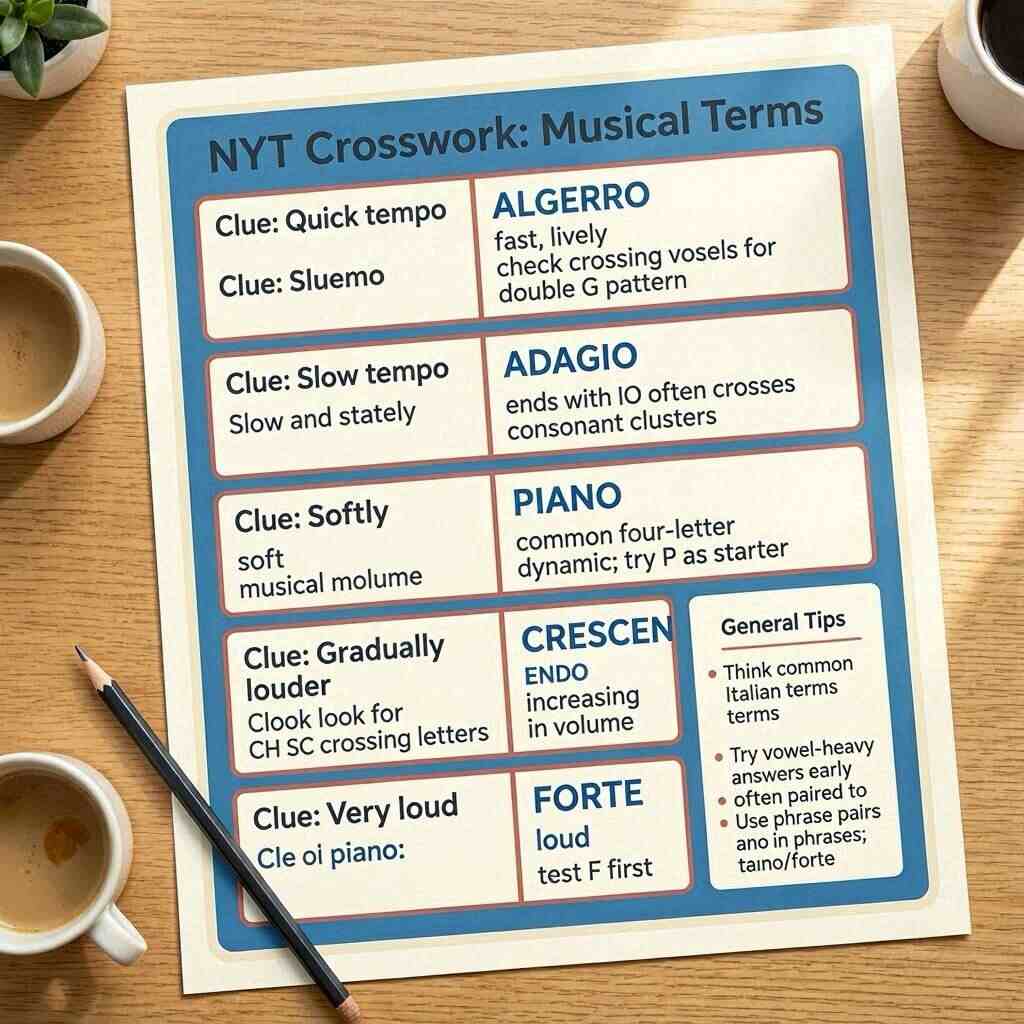
Quick Answer: The Most Common Musical Term Crossword Answers
| Answer | Letters | Category | Meaning |
|---|---|---|---|
| ARIA | 4 | Opera | Operatic solo |
| CODA | 4 | Structure | Musical ending |
| OBOE | 4 | Instrument | Double-reed woodwind |
| ALTO | 4 | Vocal range | Low female voice |
| BASS | 4 | Vocal range | Lowest voice |
| TEMPO | 5 | Tempo | Speed of music |
| LARGO | 5 | Tempo | Very slow |
| FORTE | 5 | Dynamics | Loud / personal strength |
| TENOR | 5 | Vocal range | High male voice |
| ADAGIO | 6 | Tempo | Slow, leisurely |
| PRESTO | 6 | Tempo | Very fast |
The three things that determine the correct answer every time: letter count, crossing letters already confirmed, and which sub-category the clue is targeting — opera, tempo, instrument, vocal range, composer, or music notation.
Why the Same Musical Answers Keep Appearing
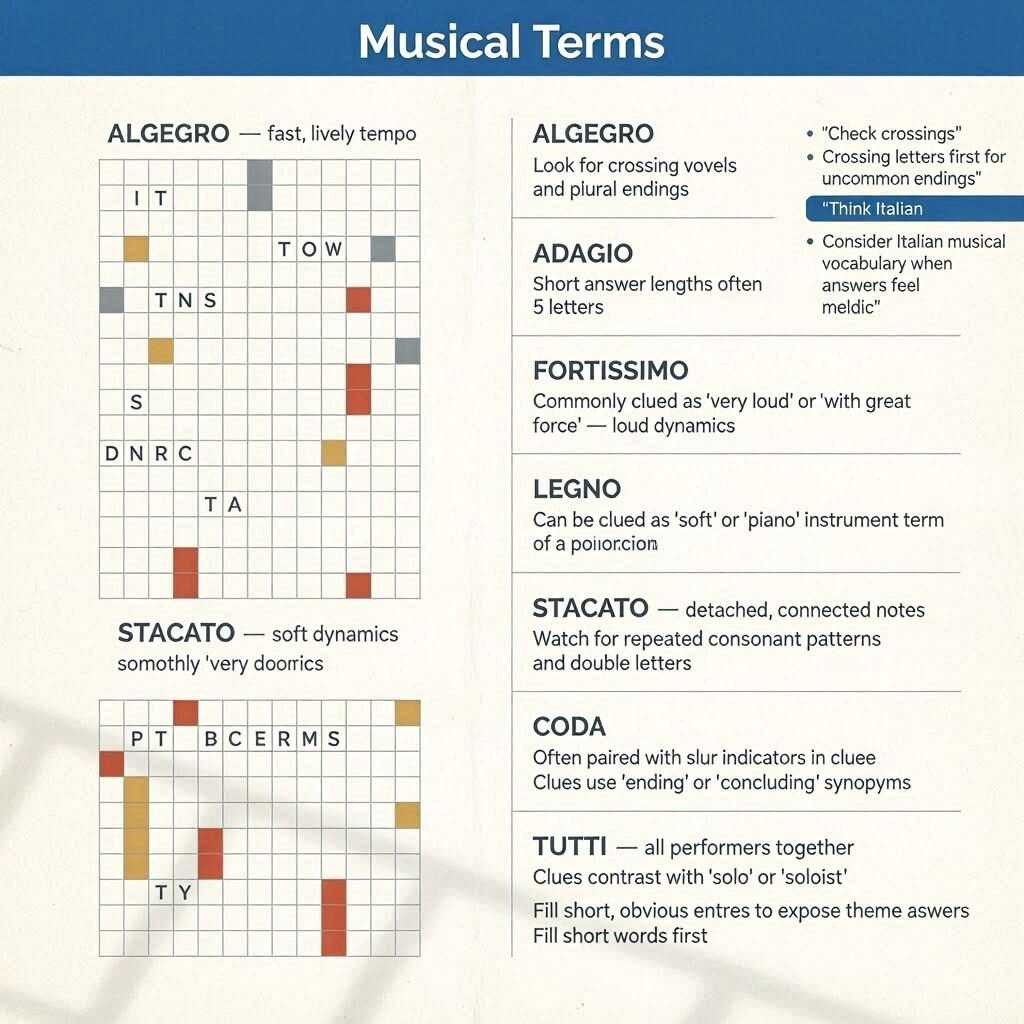
NYT crossword constructors engineer grids around words that interlock cleanly. That means prioritising short, vowel-heavy words with flexible letter combinations — and musical terminology, particularly Italian, fits that requirement better than almost any other subject area.
Italian became the international language of classical music during the 17th and 18th centuries. Every musician globally reads terms like adagio, forte, and presto, making them both recognisable and fair game for clues. More importantly for crossword construction, Italian words are structurally ideal:
- Multiple vowels create easy interlocking with crossing entries
- Alternating consonant-vowel patterns avoid awkward letter clusters
- Short length fits tight grid sections
- Cultural familiarity means solvers recognise them even without musical training
This is why ARIA appears in hundreds of NYT puzzles while sforzando — an equally valid musical term — almost never does. Sforzando’s consonant-heavy structure creates grid construction problems that make it impractical. Understanding this logic tells you immediately which answers to expect and which to eliminate.
The Complete Musical Answer Reference, by Letter Count
4-Letter Musical Answers (Most Frequent Category)
| Answer | Category | Meaning | Confirmed Clue Phrasings |
|---|---|---|---|
| ARIA | Opera | Operatic solo | “Singer’s showcase,” “Met performance,” “Puccini piece,” “Opera excerpt,” “O mio babbino caro, e.g.,” “Habanera, for one,” “Diva’s number,” “Tchaikovsky’s Letter Scene, e.g.” |
| CODA | Structure | Musical ending | “Piece finale,” “Composition’s close,” “Final passage,” “Song wrap-up,” “Ending section” |
| OBOE | Instrument | Double-reed woodwind | “Slender orchestra woodwind,” “Double-reed woodwind,” “Orchestral woodwind instrument,” “Instrument with only one consonant in its name” |
| ALTO | Vocal range | Low female voice | “Below soprano,” “Choir section,” “Low female voice,” “Contralto’s kin” |
| BASS | Vocal/fish | Lowest voice | “Deep singer,” “Low voice,” “Choir section, perhaps,” “Fishing catch” |
| NOTE | Notation | Musical tone | “Scale unit,” “Staff marking,” “Brief memo,” “It may be flat” |
| REST | Notation | Musical silence | “Pause in a score,” “Score symbol,” “Take a break,” “Silence, in music” |
| CLEF | Notation | Staff symbol | “Treble ___,” “Bass ___,” “Key symbol,” “Staff marker” |
| LUTE | Instrument | Plucked string | “Medieval string instrument,” “Plucked instrument,” “Troubadour’s instrument” |
| LYRE | Instrument | Ancient plucked string | “Ancient string instrument,” “Greek instrument,” “Apollo’s instrument” |
| FIFE | Instrument | Small flute | “Military flute,” “Drum and ___ corps,” “Small flute” |
| TUBA | Instrument | Low brass | “Low brass instrument,” “Oompah instrument,” “Band’s low horn” |
| VIOL | Instrument | Early bowed string | “Early violin,” “Renaissance string instrument,” “Bow instrument, old style” |
| BACH | Composer | J.S. Bach | “Baroque composer,” “Brandenburg concerto composer,” “Well-Tempered Clavier composer” |
| LIED | Vocal form | German art song | “German art song,” “Schubert piece,” “Romantic vocal work” |
5-Letter Musical Answers
| Answer | Category | Meaning | Confirmed Clue Phrasings |
|---|---|---|---|
| TEMPO | Tempo | Musical speed | “Conductor’s concern,” “Rhythmic pace,” “Musical pace,” “Beats per minute, informally” |
| LARGO | Tempo | Very slow | “Slowly, in music,” “Broad movement,” “Very slow, musically,” “Handel largo” |
| LENTO | Tempo | Slow | “Slowly, in scores,” “Slow movement direction,” “Leisurely, in music” |
| FORTE | Dynamics | Loud / strength | “Strong point?,” “Musical dynamic,” “Personal specialty,” “Loud, in music” |
| TENOR | Vocal range | High male voice | “Opera role,” “Pavarotti’s voice type,” “High male voice,” “Puccini hero, often” |
| OPERA | Genre | Musical drama | “La Bohème, for one,” “Met offering,” “Verdi work,” “Theatrical music genre” |
| PIANO | Dynamics/instrument | Soft / keyboard | “Quiet musical direction,” “Grand or upright,” “Soft, in music” |
| ETUDE | Study piece | Musical exercise | “Chopin composition,” “Musical study,” “Pianist’s practice piece,” “Musical term from the French for ‘study'” |
| VERDI | Composer | Giuseppe Verdi | “Aida composer,” “Italian opera master,” “Otello composer” |
| BIZET | Composer | Georges Bizet | “Carmen composer,” “French opera composer” |
| ELGAR | Composer | Edward Elgar | “Pomp and Circumstance composer,” “British composer” |
| LISZT | Composer | Franz Liszt | “Romantic pianist-composer,” “Hungarian composer” |
| CELLO | Instrument | Bowed string | “Yo-Yo Ma’s instrument,” “Orchestral string,” “Low string instrument” |
| FLUTE | Instrument | Woodwind | “Orchestral woodwind,” “High-pitched woodwind,” “Champagne glass shape” |
| ORGAN | Instrument | Keyboard/pipe | “Church instrument,” “Pipe ___,” “Cathedral sound” |
| VIOLA | Instrument | Mid-range string | “Violin’s cousin,” “Orchestral string,” “Alto string instrument” |
| BANJO | Instrument | Plucked string | “Bluegrass instrument,” “Folk string instrument,” “Appalachian instrument” |
| CHORD | Harmony | Multiple notes | “Harmonic combination,” “Guitar player’s concern,” “Musical combination” |
6-Letter Musical Answers
| Answer | Category | Meaning | Confirmed Clue Phrasings |
|---|---|---|---|
| ADAGIO | Tempo | Slow, leisurely | “Leisurely pace,” “Slow movement,” “Slowly, musically (6),” “Albinoni work” |
| PRESTO | Tempo | Very fast | “Rapidly, in music,” “Speedy direction,” “Quick, in music” |
| VIVACE | Tempo | Lively, brisk | “Briskly played,” “Lively direction,” “With energy, musically” |
| HANDEL | Composer | G.F. Handel | “Messiah composer,” “Baroque composer,” “Water Music composer” |
| SONATA | Form | Instrumental piece | “Piano composition,” “Three-movement work,” “Classical form” |
| OCTAVE | Interval | 8-note span | “Scale span,” “Musical interval,” “Do to do” |
Rarer-But-Real: Second-Tier Crossword Answers (Confirmed 2025–2026)
These appear less often than the core list but have verified recent NYT appearances. Knowing them prevents you from drawing a blank on a Thursday or Saturday.
| Answer | Meaning | Confirmed Clue | Puzzle / Date |
|---|---|---|---|
| ARCO | With the bow (string direction) | “Direction to bow, in music” | NYT Crossword, May 14, 2026 |
| CONBRIO | With vigor (Italian direction) | “Musical notation that means ‘with vigor'” | NYT Crossword, May 20, 2026 |
| MENOMOSSO | Less motion (slower) | “Slower, musically” | NYT Crossword, Sept 20, 2025 |
| LENTO | Slow | “Slowly, in scores” | NYT Crossword, March 12, 2026 |
| TACET | Be silent (musical direction) | “Music term” / “Orchestra direction” | Various |
| ANDANTE | Moderate walking pace | “Moderate tempo,” “Walking pace, musically” | Various |
The Most Important Insight: OBOE Is the Single Most Common Instrument
Most musical crossword guides focus entirely on tempo markings and vocal terms. They’re missing one of the biggest categories entirely: instruments.
The NYT itself confirmed in a December 2025 Mini crossword clue that OBOE has over 800 appearances in New York Times crosswords — making it the most common musical instrument in crossword history. It appears far more than any other instrument for a specific structural reason: O-B-O-E alternates vowels and consonants perfectly, creating maximum interlocking flexibility in any grid direction.
As a result, when you see an instrument-related clue with four letters, OBOE should be your first guess before any other instrument.
Musical Instrument Answers by Letter Count
4-letter instruments (most frequent):
| Answer | Clue Type | Key Indicator |
|---|---|---|
| OBOE | “Woodwind,” “Double-reed,” “Orchestral” | Most common 4-letter instrument by far |
| LUTE | “Medieval,” “Plucked,” “Troubadour” | Historical / Renaissance context |
| LYRE | “Ancient,” “Greek,” “Apollo” | Mythology or ancient history context |
| FIFE | “Military,” “Drum and ___” | Military music context |
| TUBA | “Brass,” “Oompah,” “Low horn” | Low brass / band context |
| VIOL | “Early,” “Renaissance,” “Baroque” | Pre-violin historical context |
5-letter instruments:
| Answer | Clue Type | Key Indicator |
|---|---|---|
| CELLO | “Yo-Yo Ma,” “Orchestral string,” “Low string” | Orchestra / classical context |
| FLUTE | “Woodwind,” “High-pitched,” “Orchestral” | Orchestra context; also champagne glass |
| ORGAN | “Church,” “Pipe ___,” “Cathedral” | Religious / classical context |
| VIOLA | “Violin’s cousin,” “Alto string” | Orchestra context |
| BANJO | “Bluegrass,” “Folk,” “Appalachian” | American folk / country context |
Quick instrument rule: When a clue mentions an orchestra, think OBOE, CELLO, VIOLA, or FLUTE before anything else. When it mentions a church, think ORGAN. When it mentions medieval or ancient times, think LUTE or LYRE.
Words That Trap Solvers: Musical Terms With Everyday Double Meanings
This is the section most guides skip entirely — and it’s responsible for more wrong answers than any other factor. Many of the most common musical crossword answers also exist as ordinary English words with completely different meanings. NYT constructors exploit this deliberately, especially on Wednesday through Saturday.
When a clue sounds like it has nothing to do with music, the answer may still be a musical term.
| Answer | Musical Meaning | Everyday Meaning | Misdirection Clue Example |
|---|---|---|---|
| FORTE | Loud (dynamic marking) | Personal strength / specialty | “Strong suit?” / “Personal best?” |
| BASS | Lowest vocal range | Type of freshwater fish | “Fishing catch” / “Low voice?” |
| REST | Silence between notes | To relax / the remainder | “Take five” / “Remainder” |
| KEY | Tonal centre of a piece | Physical key / important factor | “Major concern?” / “Lock opener” |
| FLAT | Half-step below natural | Level surface / disappointing | “Not sharp?” / “Apartment, in London” |
| SHARP | Half-step above natural | Intelligent / pointed | “Mentally acute” / “Well-dressed” |
| NOTE | Musical tone | Written message / to observe | “Brief memo” / “Pay attention” |
| SCALE | Sequence of pitches | Weight measurement / fish covering | “Measure” / “Weigh” |
| MEASURE | Bar of music | To quantify | “Take stock of” / “Ruler’s job” |
| BRIDGE | Transitional song section | Card game / structure over water | “Card game move” / “River crosser” |
| PITCH | Musical frequency | Sales presentation / throw | “Sales talk” / “Baseball action” |
| BEAT | Rhythmic pulse | To defeat / police patrol | “Rhythm unit” / “Cop’s territory” |
How to use this table: When a clue sounds completely non-musical on a harder puzzle day (Wednesday–Saturday), run through this list mentally. If the answer fits the grid and is on this list, trust it. The non-musical reading is the misdirection; the musical reading is the answer.
Composer Names: The Missing Musical Category
Composer names appear regularly in NYT crosswords and are completely ignored by every other guide. Because many famous composers have short, vowel-friendly names, they integrate cleanly into grids and are clued in predictable, recognisable ways.
| Answer | Composer | Letters | Most Common Clue Phrasing |
|---|---|---|---|
| BACH | Johann Sebastian Bach | 4 | “Baroque composer,” “Brandenburg Concerto composer,” “Well-Tempered Clavier composer” |
| VERDI | Giuseppe Verdi | 5 | “Aida composer,” “Italian opera master,” “Otello composer,” “Nabucco composer” |
| BIZET | Georges Bizet | 5 | “Carmen composer,” “French opera composer” |
| ELGAR | Edward Elgar | 5 | “Pomp and Circumstance composer,” “British composer,” “Enigma Variations composer” |
| LISZT | Franz Liszt | 5 | “Romantic pianist-composer,” “Hungarian composer,” “Transcendental Étude composer” |
| HANDEL | George Frideric Handel | 6 | “Messiah composer,” “Water Music composer,” “Baroque composer” |
How to identify composer clues: Look for a nationality combined with a genre (“Italian opera composer”), a specific famous work (“Aida composer”), or a time period (“Baroque composer”). The answer will almost always be one of the names in the table above.
Shortcut: If the clue mentions Aida → VERDI. Carmen → BIZET. Messiah → HANDEL. Brandenburg → BACH. These pairings are essentially fixed.
Clue Signals and What They Predict
Reading clue signals — specific words or phrases that reliably narrow the answer — is faster than analysing every clue from scratch. Once you’ve seen enough NYT puzzles, certain signal words become nearly automatic triggers.
Opera and Vocal Signals
| Clue Signal | Most Likely Answer | Why |
|---|---|---|
| “Met” / “Puccini” / “Diva” / “Opera” | ARIA | The standard operatic solo answer |
| “High male voice” / “Tenor role” / “Pavarotti” | TENOR | Only high male voice answer that fits commonly |
| “Low female voice” / “Contralto” | ALTO | Below mezzo-soprano |
| “Deep voice” / “Lowest singer” | BASS | Lowest of all vocal ranges |
| “Highest voice” / “Soprano role” | SOPRANO | Less common due to length; worth knowing |
Tempo Signals
| Clue Signal | Answer (Letters) | Differentiator |
|---|---|---|
| “Slow” / “Broadly” — 5 letters | LARGO | Count the squares |
| “Slow” / “Leisurely” — 6 letters | ADAGIO | Count the squares |
| “Slow” — 5 letters, alternate | LENTO | Less frequent but confirmed |
| “Fast” / “Rapidly” — 6 letters | PRESTO | The standard fast-tempo answer |
| “Lively” / “Briskly” | VIVACE | Usually 6 letters |
| “Musical speed” / “Conductor’s concern” | TEMPO | Generic tempo reference |
The LARGO vs. ADAGIO rule is the single most useful disambiguation in musical crosswords. Both mean slow. Letter count is the only reliable way to choose between them without crossing letters.
Instrument Signals
| Clue Signal | Most Likely Answer |
|---|---|
| “Double-reed” / “Woodwind” (4 letters) | OBOE |
| “Orchestral woodwind” / “Slender woodwind” | OBOE |
| “Medieval string” / “Plucked” | LUTE |
| “Ancient / Greek string” | LYRE |
| “Yo-Yo Ma” / “Low string” | CELLO |
| “Church” / “Pipe ___” | ORGAN |
| “Bluegrass” / “Folk string” | BANJO |
Notation and Structure Signals
| Clue Signal | Most Likely Answer |
|---|---|
| “Musical ending” / “Final passage” | CODA |
| “Staff symbol” / “Treble ___” | CLEF |
| “Score silence” / “Musical pause” | REST |
| “Musical tone” / “Scale unit” | NOTE |
| “Musical study” / “Chopin piece” | ETUDE |
| “Tonal centre” / “Major ___” | KEY |
Composer Signals
| Clue Signal | Answer |
|---|---|
| “Aida composer” | VERDI |
| “Carmen composer” | BIZET |
| “Messiah composer” | HANDEL |
| “Brandenburg composer” | BACH |
| “Pomp and Circumstance composer” | ELGAR |
NYT Mini vs. Midi vs. Full Crossword: How Musical Answers Differ
Most guides treat the NYT crossword as a single product. It is actually three separate puzzles with different difficulty levels, grid sizes, and musical answer pools. Knowing which format you’re solving changes which answers to prioritise.
The NYT Mini (5×5 Grid, Free)
The Mini is a 10-clue puzzle that resets at 10pm ET. Because the grid is tiny, answers must be short and extremely familiar. In the Mini, musical clues almost always resolve to the most recognisable, core-vocabulary answers:
- ARIA, CODA, ALTO, BASS, NOTE, REST — the dominant 4-letter answers
- OBOE appears frequently (confirmed: December 23, 2025 Mini)
- OPERA, TEMPO appear regularly in the 5-letter slots
- Clue phrasing is direct and unambiguous
Mini strategy: Trust the most obvious answer immediately. The Mini rarely misdirects.
The NYT Midi (7×7 Grid, Paid, Newer Format)
The Midi sits between the Mini and Full in difficulty. Musical clues begin incorporating second-tier vocabulary:
- ARCO (confirmed: NYT Midi, April 22, 2026 — “Slender orchestra woodwind” → OBOE; “Direction to bow” → ARCO)
- ETUDE, LENTO, VIVACE appear alongside core answers
- Some wordplay and misdirection begins here
The Full NYT Crossword (15×15 Weekdays, 21×21 Sunday, Paid)
The full crossword uses the complete musical answer range. By Thursday–Saturday, clues regularly exploit double meanings, indirect references, and rarely-seen-but-valid answers like CONBRIO, MENOMOSSO, TACET, and OSTINATO.
Full crossword strategy: Apply the letter-count filter first, then check whether the clue could have a double meaning before committing.
Difficulty by Day: How Musical Clues Change Across the Week
The NYT crossword increases in difficulty from Monday through Saturday. The answers to musical clues often stay in the same core vocabulary — what changes is how they’re clued.
| Day | Clue Approach | Musical Example |
|---|---|---|
| Monday | Direct definition | “Opera solo” → ARIA |
| Tuesday | Slightly indirect | “Singer’s showcase” → ARIA |
| Wednesday | Double meaning introduced | “Strong suit?” → FORTE |
| Thursday | Indirect or misleading phrasing | “Low voice?” → BASS (fish misdirection) |
| Friday | Heavy misdirection, no music reference in clue | “Pause” → REST |
| Saturday | Maximum indirection | “One concluding matters musically?” → CODA |
Key insight for advanced solving: On Friday and Saturday, a clue that sounds entirely unrelated to music may still resolve to a musical answer. If you’ve exhausted non-musical possibilities and the crossing letters fit a musical term, trust the music answer.
Terms That Almost Never Appear (Eliminate These First)
Knowing what to eliminate is as valuable as knowing what to guess. These are legitimate musical terms that construct poorly in crossword grids and appear rarely or never:
| Term | Why It Rarely Appears |
|---|---|
| SFORZANDO | Consonant-heavy; limited crossing flexibility |
| GLISSANDO | Awkward letter structure; poor interlocking |
| MELISMA | Uncommon consonant pattern; limited crossings |
| PIZZICATO | Too long; awkward structure |
| DIMINUENDO | Excessive length; construction nightmare |
| RUBATO | Occasional appearance but rare; unusual pattern |
| LEITMOTIF | Too long; obscure enough to be unfair |
Practical rule: If you’re choosing between ARIA and any term from this list, it’s ARIA. The NYT does not increase difficulty by reaching for obscure technical vocabulary — it reaches for familiar answers clued in unfamiliar ways.
Step-by-Step Solving Method for Musical Clues
Step 1 — Count the letter spaces before reading the clue. This eliminates the majority of wrong answers before analysis begins. Four squares → prioritise ARIA, CODA, OBOE, ALTO, BASS, LUTE. Five squares → prioritise TEMPO, LARGO, FORTE, TENOR, LENTO, VERDI. Six squares → try ADAGIO, PRESTO, VIVACE, HANDEL.
Step 2 — Identify the sub-category. Is the clue pointing at opera? Tempo? Instruments? Composers? Structure? Each sub-category has a short, predictable answer list. Identifying the category immediately cuts options dramatically.
Step 3 — Check for double-meaning misdirection. If the clue sounds non-musical, scan the double-meaning table: FORTE, BASS, REST, KEY, FLAT, SHARP, NOTE, SCALE, BRIDGE, PITCH, BEAT. On Wednesday–Saturday puzzles, this check saves enormous time.
Step 4 — Fill crossing clues first. Even one confirmed crossing letter transforms a difficult musical clue. The second letter of ARIA confirmed as R eliminates every other 4-letter opera answer. Never force a musical clue when crossing letters are available.
Step 5 — Apply probability-first thinking. Ask not “what could this answer be?” but “what does the NYT use here most often?” The high-frequency answer — ARIA, CODA, OBOE, TEMPO — is correct far more often than any alternative.
Step 6 — Make a tentative early entry. Experienced solvers pencil in the high-probability answer before crossing confirmation. Iteration is faster than hesitation. Guess, fill crosses, confirm, adjust.
The 3 Mistakes That Keep Solvers Stuck on Musical Clues
Mistake 1: Assuming difficult clues require obscure answers. The NYT raises difficulty through clue wording, not vocabulary rarity. A clue like “Strong suit?” feels tricky — the answer is the extremely common FORTE. The difficulty is in the misdirection, not the answer.
Mistake 2: Ignoring the instrument category. Most solvers focus entirely on tempo markings and vocal terms, because that’s all existing guides cover. But instruments — especially OBOE — are a major recurring answer category. A 4-letter orchestral clue is as likely to be OBOE as ALTO.
Mistake 3: Treating every puzzle as a fresh start. The NYT reuses the same answers across hundreds of puzzles. Solvers who track which answers repeat and which clue phrasings recur build an automatic-recognition advantage that compounds with every puzzle solved.
Long-Term Fluency: Building Your Musical Crossword Vocabulary
Phase 1 — Core 15 answers (Week 1): ARIA, CODA, OBOE, ALTO, BASS, TEMPO, LARGO, FORTE, TENOR, ADAGIO, PRESTO, NOTE, REST, CLEF, OPERA.
These answers cover the overwhelming majority of NYT musical clues. Learn them in order of frequency, not alphabetically.
Phase 2 — Composer and instrument expansion (Month 1): Add BACH, VERDI, BIZET, ELGAR, LUTE, LYRE, CELLO, FLUTE, ORGAN, ETUDE, LENTO, VIVACE.
Phase 3 — Double-meaning mastery (Month 2–3): Deliberately study the full double-meaning table: FORTE/BASS/REST/KEY/FLAT/SHARP/NOTE/SCALE/BRIDGE/PITCH/BEAT. Run through this list whenever a clue seems non-musical on a harder puzzle day.
Phase 4 — Second-tier crosswordese (Month 3+): Add ARCO, CONBRIO, MENOMOSSO, TACET, ANDANTE, SONATA, OSTINATO. These appear less frequently but will stop being surprises once you know them.
Daily practice habit: After solving any puzzle, spend two minutes reviewing every musical clue you encountered. Write down the answer and the clue phrasing. After 30 puzzles, patterns become automatic.
Frequently Asked Questions
What is the most common musical term answer in NYT crosswords? ARIA is the most commonly clued musical term. For musical instruments, OBOE has the highest confirmed appearance count — over 800 NYT appearances — making it arguably the single most important musical answer in crossword history.
What is the most common instrument in NYT crosswords? OBOE, by a significant margin. The NYT itself confirmed this in a December 2025 Mini clue: “Most common instrument in New York Times crosswords, with over 800 appearances” — answer: OBOE. Its vowel-consonant pattern (O-B-O-E) makes it exceptionally grid-friendly.
Do I need music knowledge to solve musical crossword clues? No. Pattern recognition and vocabulary familiarity matter far more than formal music education. The NYT relies on the same repeating answer pool across hundreds of puzzles. Learning that pool, and the clue phrasings that map to it, is all you need.
What’s the difference between LARGO and ADAGIO? Both mean slow. The only reliable differentiator without crossing letters is the letter count: LARGO is 5 letters, ADAGIO is 6. Always count the squares before choosing between them.
Why does the NYT use Italian musical terms? Italian became the global standard for classical music notation in the 17th–18th centuries. Beyond cultural familiarity, Italian words tend to be vowel-rich, which makes them structurally useful for crossword grids. They interlock cleanly, avoid awkward consonant clusters, and work from any direction.
Are musical clues harder in the NYT Mini? No — the Mini is actually where musical clues are most straightforward. ARIA, OBOE, NOTE, and OPERA appear in the Mini with direct clue phrasing and minimal misdirection. The full crossword and Midi introduce double meanings and indirect references.
What does FORTE mean in a crossword? It depends on how it’s clued. Musically, FORTE means “loud” (a dynamic marking). In everyday English, it means “personal strength” or “specialty.” The NYT exploits this dual meaning frequently, especially on Wednesday–Thursday puzzles. “Strong point?” and “Personal specialty” both point to FORTE.
What music terms almost never appear in crosswords? SFORZANDO, GLISSANDO, MELISMA, PIZZICATO, DIMINUENDO, and LEITMOTIF are all legitimate musical terms that appear rarely or never in NYT crosswords because their letter structures create grid construction problems. If you’re tempted to guess one of these, default to the shorter, more familiar answer instead.
How quickly can a beginner improve at musical crossword clues? Most solvers recognise ARIA and CODA reliably within one week of focused attention. The core 15 answers become familiar within a month. Double-meaning pattern recognition — the key to harder puzzle days — develops within two to three months of consistent daily solving.
Summary: What Separates Fast Solvers From Slow Ones on Musical Clues
Fast solvers do three things that slow solvers don’t:
They know the full answer map, not just the top five. ARIA and CODA are not enough. OBOE, BACH, ETUDE, ARCO, and the double-meaning words (FORTE, BASS, REST, KEY) are equally important for solving harder puzzles.
They read clue signals before overthinking definitions. The word “Met” in a clue means ARIA. “Aida composer” means VERDI. “Double-reed” means OBOE. These signals are essentially fixed. Recognising them bypasses the need to analyse the clue from scratch.
They know what the clue is actually testing. On Monday, a musical clue tests whether you know what the word means. On Saturday, it tests whether you can recognise a familiar answer through misdirection. The answer is often the same — the test is different.
Musical crossword clues only seem random until you’ve mapped the system behind them. After that, they’re among the most solvable and most satisfying fills in the grid.