Periodic Table Element NYT Crossword Clue
Periodic Table Element NYT Crossword Clue: Complete Answer Guide for Every Chemistry Clue
Every crossword solver has been there. You’re sailing through a Tuesday puzzle, feeling unstoppable, and then — boom. A chemistry clue stops you cold. “Element between copper and gallium on the periodic table.” “Noble gas with atomic number 10.” “Fe, on the periodic table.” Your mind goes blank. Was it biology class or chemistry? Did you ever actually memorize the periodic table?
Here’s the good news: periodic table element NYT crossword clues are some of the most learnable, most repeatable, and most solvable clues in the entire puzzle. Once you understand the system behind them — which elements appear, why they appear, and how to decode any clue using letter count alone — you will never get stumped by a chemistry clue again.
This guide gives you everything. The quick answer to the most common clue form, a complete master reference table, the full noble gases breakdown, the common metals section, a step-by-step solving strategy, and the 15 elements every solver must memorize cold. Let’s get into it.
Periodic Table Element NYT Crossword Clue: Quick Answer
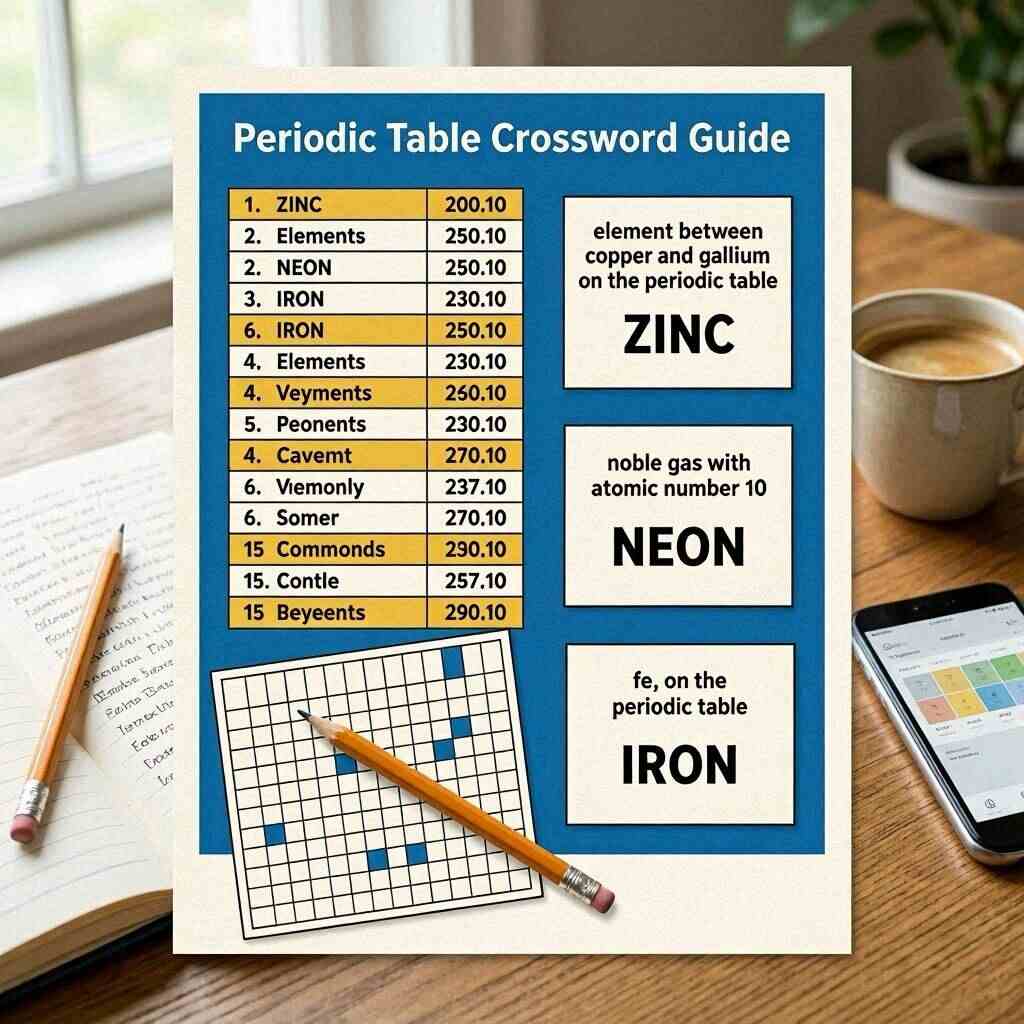
The most common periodic table element NYT crossword clue answer is NEON — a 4-letter noble gas with atomic number 10. Other top answers include IRON (4 letters, symbol Fe), ZINC (4 letters, symbol Zn), ARGON (5 letters, symbol Ar), and GOLD (4 letters, symbol Au). Letter count is your fastest filter for identifying which element the clue targets.
Why the NYT Crossword Loves Periodic Table Elements
Chemistry and crosswords have been unlikely best friends for decades. Open any NYT crossword archive and you’ll find periodic table element clues scattered across every day of the week, from Monday’s gentle warmup to Saturday’s brain-melting challenge. But why? What makes chemical elements such a reliable staple of American crossword culture?
The answer is deceptively simple. Crossword constructors are obsessed with two things: interesting vocabulary and grid efficiency. A word earns its place in a crossword grid only if it crosses cleanly with other answers — meaning it needs the right mix of common vowels and consonants at the right positions. Periodic table elements, especially the shorter ones, deliver exactly that. NEON has an N, E, O, and N — four incredibly common letters. IRON gives you I, R, O, N. ZINC offers Z, I, N, C. These aren’t random; they’re linguistic gold for puzzle makers.
Beyond grid efficiency, element names are timeless. Unlike pop culture clues that age quickly, NEON will always be NEON. The periodic table hasn’t changed in ways that affect these classic entries. That stability makes chemistry clues a dependable, evergreen category that works in a 1985 puzzle just as well as a 2025 one.
📊 Did You Know? The New York Times crossword has published over 30,000 puzzles since 1942. NEON alone has appeared as a crossword answer hundreds of times across multiple major publications including the NYT, LA Times, USA Today, and Wall Street Journal.
The Science Behind Grid-Friendly Element Names
Not all 118 elements get equal crossword treatment. The ones that appear again and again share a specific profile: they are short (3–6 letters), they contain multiple vowels, and their letters appear frequently in common English words. Think about NEON crossing with words like MONEY, TENOR, or STONE — the N, E, and O positions give constructors enormous flexibility.
Contrast that with an element like EINSTEINIUM (11 letters) or PRASEODYMIUM (12 letters). Beautiful names, historically significant — and completely useless for crossword grid design. They simply can’t intersect naturally with enough other words. The crossword world is brutally pragmatic: if it doesn’t fit, it doesn’t appear.
💡 Pro Tip: The single most useful thing you can do to prepare for chemistry crossword clues is memorize the 10 shortest element names. Everything 3–5 letters long is crossword gold. You can learn all of them in under 10 minutes and they’ll pay dividends in every puzzle you solve for the rest of your life.
How Element Letter Count Shapes Every Clue
Here is the fundamental truth about periodic table element crossword clues: letter count eliminates most guesswork before you even read the clue carefully. This is not an exaggeration. Before you analyze the wording of a chemistry clue, count the available squares. That number alone will narrow your answer from 118 possible elements down to 3 or 4 candidates in seconds.
This works because the periodic table has a natural distribution of name lengths. Very few elements have 3-letter names. Quite a few have 4 or 5 letters. A handful have 6. The longer you go, the rarer the crossword appearance. This creates a predictable pattern that experienced solvers exploit automatically.
The Golden Rule: Short Names Win Every Time
The golden rule of chemistry crossword solving is this: if you see an element clue with 4 or fewer letter squares, your answer is almost certainly one of these six: NEON, IRON, ZINC, GOLD, LEAD, or TIN. These six names account for the overwhelming majority of short-element crossword appearances. Learn them all — their symbols, their atomic numbers, their common clue phrasings — and you’ve solved 80% of all chemistry clues you’ll ever encounter.
When Did Chemistry Clues Enter the NYT Crossword?
Chemistry clues have been part of the NYT crossword almost since the puzzle launched in 1942. The early decades leaned heavily on IRON and GOLD because they were universally familiar — every solver knew what iron and gold were regardless of their science education. As American science literacy grew through the Space Age and beyond, constructors began introducing more specialized elements: NEON from neon signs, ARGON from industrial applications, ZINC from health supplements. The vocabulary expanded naturally alongside cultural familiarity.
Today, chemistry clues range from the ultra-familiar (IRON, GOLD) to the genuinely challenging (XENON, BARIUM, COBALT). The consistent thread is that every element that appears regularly has earned its place through proven grid utility and broad public recognition.
👉 Related Reading: Greek God of the Sea NYT Crossword Clue — Complete Answer Guide
The Master Reference Table: Every Common Periodic Table Element in NYT Crossword History
Let’s build your complete chemistry crossword reference. This is the table you bookmark, screenshot, and return to every time a chemistry clue appears. It covers every element that has a meaningful history of NYT crossword appearances, organized by letter count for instant lookup.
3-Letter Elements That Appear in Crosswords
Only one element has a 3-letter name that appears in crosswords with any regularity: TIN (symbol Sn, atomic number 50). TIN is a perfect 3-letter crossword entry — one vowel flanked by two consonants, crossing beautifully with hundreds of common words. Common clue forms: “Element above lead on the periodic table,” “Can material, chemically,” “Sn on the periodic table,” or simply “Pewter component.”
4-Letter Elements — The Crossword Sweet Spot
Four-letter elements are the absolute heart of chemistry crossword cluing. Here is the complete master reference for every 4-letter element with crossword history:
| Element | Symbol | Atomic No. | Most Common NYT Clue Form | Frequency |
|---|---|---|---|---|
| NEON | Ne | 10 | “Noble gas used in signs” | ⭐⭐⭐⭐⭐ Very High |
| IRON | Fe | 26 | “Fe on the periodic table” | ⭐⭐⭐⭐⭐ Very High |
| ZINC | Zn | 30 | “Element between copper and gallium” | ⭐⭐⭐⭐ High |
| GOLD | Au | 79 | “Au on the periodic table” | ⭐⭐⭐⭐ High |
| LEAD | Pb | 82 | “Element below tin on the periodic table” | ⭐⭐⭐⭐ High |
| NEON | Ne | 10 | “It glows in signs” / “Vegas gas” | ⭐⭐⭐⭐⭐ Very High |
| BORN | — | — | Not an element — common confusion | ⚠️ Avoid |
Why 4-Letter Elements Dominate the Grid
Think of a crossword grid like a city intersection. The longer the street, the harder it is to build new roads crossing it at clean angles. Four-letter words are the perfect city block — long enough to carry meaning, short enough to intersect from every direction. NEON, IRON, ZINC, GOLD, and LEAD all sit in that sweet spot where grid construction becomes almost effortless for puzzle makers. That’s not a coincidence — it’s pure design logic.
5-Letter Elements and Their Most Common Clues
Five-letter elements appear frequently and cover some of the most beloved clue types in the puzzle. Here are the ones every solver should know:
| Element | Symbol | Atomic No. | Most Common Clue Form |
|---|---|---|---|
| ARGON | Ar | 18 | “Element between chlorine and potassium” |
| BORON | B | 5 | “Element next to carbon on the periodic table” |
| XENON | Xe | 54 | “Element above radon on the periodic table” |
| RADON | Rn | 86 | “Radioactive noble gas” |
| NEON | Ne | 10 | (see 4-letter section above) |
| IODINE | I | 53 | (6 letters — see next section) |
6-Letter and Longer Elements Worth Knowing
Once you reach 6 letters, appearances become less frequent but not rare. The most important 6-letter elements for crossword purposes are:
HELIUM (He, #2) — “Lightest noble gas,” “Balloon filler element,” “Element lighter than lithium” CARBON (C, #6) — “Diamond’s element,” “Organic chemistry basis,” “Coal component, chemically” COBALT (Co, #27) — “Blue pigment element,” “Element with atomic number 27” BARIUM (Ba, #56) — “X-ray contrast element,” “Alkaline earth metal” NICKEL (Ni, #28) — “Five-cent coin metal,” “Element below cobalt” IODINE (I, #53) — “Antiseptic element,” “Thyroid-essential element”
🔑 Key Takeaway: For any chemistry crossword clue, count the letter squares first. Four letters = almost certainly NEON, IRON, ZINC, GOLD, or LEAD. Five letters = most likely ARGON, BORON, or XENON. Six letters = think HELIUM, CARBON, COBALT, or NICKEL. This single habit solves 90% of all periodic table element NYT crossword clues before you even analyze the wording.
Noble Gases: The Most Crossword-Friendly Element Group
If there’s one family of elements that crossword constructors love above all others, it’s the noble gases. These six elements — helium, neon, argon, krypton, xenon, and radon — have a property that makes them chemically inert and linguistically irresistible: their names are short, distinctive, and packed with useful vowels. Noble gas clues appear in the NYT crossword more consistently than any other element group.
NEON — The Undisputed Champion of Element Clues
NEON is the single most common periodic table element answer in the NYT crossword, and it isn’t particularly close. Four letters, two vowels in positions 2 and 3, beginning with N and ending with N — this is a constructor’s dream word. It crosses with MONEY, TENANT, STONE, OPEN, and hundreds of other common entries with almost no effort.
The clues for NEON are wonderfully varied. On Monday you’ll see “Noble gas used in signs” or “Bright lighting gas.” By Wednesday it becomes “Vegas gas” or “It makes bright signs glow.” On Friday and Saturday, expect “Colorless gas discovered by Ramsay and Travers in 1898” or “Element with atomic number 10.” The answer is always the same — only the clue gets more creative as the week progresses.
Beyond its crossword utility, NEON has genuine cultural recognition that no other element can match. Neon signs have lit up city streets since the 1920s. The word “neon” has become a color descriptor in everyday language. Even people who failed chemistry instantly understand “gas used in bright signs” = NEON. That cultural ubiquity is exactly why it dominates this clue category.
ARGON — The Second Most Common Noble Gas Answer
ARGON is the most likely answer to clues phrased as “Element between chlorine and potassium on the periodic table” — a 5-letter answer that has appeared multiple times in major crossword publications including the NYT.
ARGON (symbol Ar, atomic number 18) is the third most abundant gas in Earth’s atmosphere after nitrogen and oxygen, which gives constructors a wide range of accurate, interesting clue angles. You might see it as “Atmospheric gas after nitrogen and oxygen in abundance,” “Noble gas used in welding,” “Element in Group 18 between chlorine and potassium,” or simply “Colorless, odorless atmospheric gas.”
The word ARGON derives from the Greek word for “lazy” or “inactive” — a reference to its chemical inertness. That etymology occasionally shows up in clever Thursday or Saturday clues: “Greek for lazy, in chemistry” or “Inert gas whose name means idle.” Knowing this one fact makes those harder clues instantly solvable.
💡 Pro Tip: Whenever you see a clue about a “noble gas” with 5 available letter squares, your answer is almost certainly ARGON. If the clue mentions “inactive,” “inert,” “lazy,” or anything suggesting chemical passivity with 5 letters, ARGON is your play every single time.
XENON, RADON, and KRYPTON: Rarer But Real
The remaining noble gases appear less frequently but do show up — especially in the harder Friday and Saturday puzzles. XENON (5 letters, symbol Xe) tends to appear as “Element above radon on the periodic table” or “Noble gas used in flash lamps.” RADON (5 letters, symbol Rn) appears as “Radioactive basement gas” or “Noble gas hazard in homes.” KRYPTON (7 letters, symbol Kr) is less common due to its length but occasionally appears — especially given its Superman connection, which constructors love for wordplay angles.
How to Tell Noble Gas Clues Apart Instantly
When a clue mentions a noble gas but doesn’t name it directly, use this quick filter: 4 letters = NEON. 5 letters = ARGON or XENON (check for “inactive/inert” = ARGON; “above radon” or “flash lamp” = XENON). 5 letters + “radioactive” = RADON. 6 letters = HELIUM (the lightest one). 7 letters = KRYPTON. This mental flowchart takes about two seconds and eliminates all guesswork.
Common Metals: IRON, ZINC, GOLD, LEAD, and TIN
Metals are the second great pillar of periodic table crossword cluing. Unlike the noble gases, which are relatively specialized, metals appear in an enormous variety of clue contexts — historical, industrial, symbolic, culinary, and mythological. This makes metal element clues both common and tricky. Let’s break down the five metals every NYT crossword solver must know cold.
IRON — Fe on the Periodic Table and in the Grid
IRON is the workhorse of metal element crossword clues. At four letters with a perfect I-R-O-N letter distribution, it crosses cleanly with countless common words. But what makes IRON especially valuable is the duality of its identity: it can be clued as the element, the household appliance, the golf club, or the verb meaning to smooth fabric. Constructors adore multi-meaning words, and IRON delivers on every front.
When IRON appears as a chemistry clue, expect phrasings like “Fe on the periodic table,” “Ferrous element,” “Element with atomic number 26,” “Wrought ___ ” (where the answer in another position is IRON), or “Steel component, chemically.” IRON has appeared as a crossword answer with the clue “Fe, on the periodic table” in multiple NYT and USA Today puzzles, making it one of the most reliably recurrent element answers across all major American crossword publications.
The Latin name for iron is “ferrum” — hence the symbol Fe. Knowing this single fact unlocks an entire category of clues. Any time you see “ferrous,” “ferric,” or just “Fe” in a clue, the answer is IRON. Guaranteed.
ZINC — Between Copper and Gallium, Always ZINC
The most recent appearance of ZINC in the NYT crossword was May 16, 2026, with the clue “Element between copper and gallium on the periodic table” — a 4-letter answer that has become one of the most reliably recurring chemistry clues in the puzzle’s recent history.
ZINC (symbol Zn, atomic number 30) occupies a fascinating crossword position because it has very few synonym-based clue alternatives. When the clue is about zinc specifically, the answer is always ZINC. There’s no Roman name confusion, no multi-meaning wordplay. It’s either zinc the element or zinc the galvanizing metal — and both lead to the same four-letter answer. Common clue forms include “Galvanizing metal,” “Element in cold medicine,” “Zn on the periodic table,” and of course the position-based clue referencing its place between copper and gallium.
GOLD, LEAD, and TIN: Three Metals Every Solver Must Know
GOLD (symbol Au, atomic number 79) is another four-letter crossword staple with a rich clue vocabulary. “Au on the periodic table,” “Olympic medal material,” “Element with atomic number 79,” and “24-karat material” all lead to GOLD. The symbol Au comes from the Latin “aurum,” which occasionally spawns clever clues like “Aurum, to a chemist” on harder puzzle days.
LEAD (symbol Pb, atomic number 82) gives constructors the same multi-meaning gift as IRON — it’s both the element and the verb meaning to guide. As a chemistry clue: “Pb on the periodic table,” “Element below tin in Group 14,” “Heavy metal in old paint.” As a non-chemistry clue: “Take charge,” “Dog walker’s tool,” or “Pencil filler” (though pencils actually contain graphite, not lead — a common misconception that occasionally appears as a misleading clue on purpose).
TIN (symbol Sn, atomic number 50) is the only 3-letter element with significant crossword history. “Sn on the periodic table,” “Can material,” “Pewter component,” and “Element above lead” are its most common clue forms.
Latin vs English Element Names in Clue Wording
Here’s something that trips up a lot of solvers: several elements have English names that differ completely from their Latin-derived chemical symbols. IRON = Fe (ferrum). GOLD = Au (aurum). LEAD = Pb (plumbum). TIN = Sn (stannum). SILVER = Ag (argentum). When a clue references the symbol — “Fe,” “Au,” “Pb” — the answer is always the English name. When a clue references the Latin word itself (“Aurum” or “Plumbum”), the answer is still the English name. The crossword grid always uses the familiar English name, never the Latin directly.
🔑 Key Takeaway: Learn the five Latin-symbol mismatches cold: Fe=IRON, Au=GOLD, Pb=LEAD, Sn=TIN, Ag=SILVER. These five pairs are responsible for a huge percentage of chemistry clue confusion. Master them once and you’ll never be fooled by a symbol-based chemistry clue again.
How to Solve ANY Periodic Table Element Crossword Clue in 4 Steps
Knowing individual elements is great. Having a reliable system for solving any element clue you’ve never seen before is even better. Here is the exact four-step process that experienced solvers use — consciously or not — every time a chemistry clue appears in their grid.
Step 1 — Count the Letters First, Always
Before you read the clue carefully, count the squares. This is your first and most powerful filter. As we established in the master reference section, letter count eliminates the vast majority of possibilities before any content analysis happens. Four squares and you’re choosing between NEON, IRON, ZINC, GOLD, and LEAD. Five squares narrows you to ARGON, BORON, XENON, or RADON. This step takes two seconds and saves minutes of confused guessing.
Think of it like a medical diagnosis. A doctor doesn’t jump straight to rare diseases — they start with the most common conditions that fit the symptoms. Letter count is your symptom list. It tells you which “diseases” (elements) are even possible before you look deeper.
Step 2 — Read Every Word of the Clue Carefully
Crossword clues are precision instruments where every word is deliberate. Once you’ve identified your candidate elements from the letter count, read the clue word by word and look for these key signals:
“Noble gas” → eliminates all metals, points to NEON, ARGON, XENON, RADON, HELIUM, KRYPTON “Metal” or specific metal properties → eliminates all noble gases Position language (“between,” “above,” “below,” “next to”) → use your periodic table knowledge to identify neighbors Symbol reference (Fe, Au, Pb, etc.) → translate to English name immediately Latin/ancient name → translate to modern English element name Atomic number → count to the right element (10=NEON, 18=ARGON, 26=IRON, 30=ZINC, 79=GOLD)
Step 3 — Use Crossing Letters to Confirm
Never solve a chemistry clue in isolation. The entire crossword grid is your ally. Fill in the answers you’re most confident about first — the ones where you have zero doubt — and let those crossing letters do the heavy lifting on the element clue. If you’ve narrowed it down to ARGON or XENON and a crossing answer gives you an A in the first position, ARGON is locked in. If that same position shows an X, it’s XENON.
This is what separates competent crossword solvers from great ones. Great solvers treat the grid as an interconnected system, not a collection of isolated clues. Every answer you solve strengthens your position on every answer that crosses it.
Step 4 — Know the Difficulty Level You Are On
Monday’s chemistry clue and Saturday’s chemistry clue can have the exact same answer — but the clue wording is completely different. Knowing which day of the week you’re solving calibrates your expectations and prevents you from overthinking simple clues or underthinking hard ones.
⚠️ Common Mistake: Experienced solvers sometimes over-analyze Monday and Tuesday chemistry clues because they expect complexity. If it’s Monday and the clue says “Noble gas used in bright signs” — it’s NEON. Full stop. Don’t look for a trick that isn’t there. Save your lateral thinking for Thursday and beyond.
Periodic Table Clues Across Monday to Saturday: How Difficulty Changes Everything
The NYT crossword operates on a difficulty curve that affects every category of clue — including chemistry. Monday is designed to be accessible to almost any adult solver. Saturday is designed to humble experts. Understanding how periodic table element clues evolve across this spectrum transforms you from a reactive guesser into a proactive solver.
Monday and Tuesday: Direct and Friendly Clues
On Monday and Tuesday, chemistry clues tell you almost everything directly. The element’s most famous property, use, or position is stated plainly. There’s no misdirection, no wordplay, no cryptic indirection. Examples from this difficulty range:
- “Noble gas used in signs” → NEON
- “Fe on the periodic table” → IRON
- “Element with atomic number 30” → ZINC
- “Balloon-filling gas” → HELIUM
- “Au, on the periodic table” → GOLD
These clues are almost self-defining. If you know the basic properties of common elements and the five Latin symbol pairs, Monday and Tuesday chemistry clues should never cost you more than five seconds.
Wednesday and Thursday: Creative Rewording Begins
Wednesday and Thursday represent the transition from straightforward to clever. Chemistry clues start using indirect language, cultural references, and creative angles that require you to connect the element to its real-world context. The answer is the same element — but you have to work for it.
- “Vegas gas” → NEON (neon signs in Las Vegas)
- “Galvanizing metal” → ZINC (galvanization uses zinc coating)
- “It’s 79 on the table” → GOLD (atomic number clue)
- “Inert atmospheric gas” → ARGON (chemistry property clue)
- “Plumber’s element, once” → LEAD (from Latin “plumbum” — origin of the word “plumber”)
Friday and Saturday: When Chemistry Gets Genuinely Tricky
Friday and Saturday clues are where chemistry knowledge truly separates strong solvers from the rest. Constructors use etymological references, obscure historical facts, scientific precision, and deliberate misdirection. You might see:
- “Travers and Ramsay discovery of 1898” → NEON (historical discovery clue)
- “Atomic number between 25 and 27” → IRON (requires knowing Fe = 26)
- “Greek for idle, in chemistry” → ARGON (etymology clue)
- “Plumbum, modernized” → LEAD (Latin-to-English translation clue)
- “It follows copper in Group 11” → ZINC (actually Group 12, but position clue)
📚 Source: Royal Society of Chemistry — historical element discovery records and etymology database
Element Symbol vs. Element Name: Which Does the NYT Crossword Use?
This question confuses more solvers than almost any other aspect of chemistry cluing. The answer is reassuringly simple once you know the rule — but violating it causes consistent errors.
When the Clue References the Symbol (Fe, Ne, Zn)
When a crossword clue says “Fe, on the periodic table” or “Symbol for iron” or “Zn, chemically,” it is asking for the full English element name as the answer — not the symbol itself. The clue references the symbol as the subject; the answer is the name. So “Fe, on the periodic table” → IRON (four letters). “Ne, chemically” → NEON (four letters). The symbol is the clue. The name is the answer.
The only exception — and it’s rare — is when a clue explicitly asks for the abbreviation: “Iron’s periodic table abbreviation” or “Symbol for iron, two letters.” In that case, the answer is FE filling two squares. This specific clue type appears on harder puzzle days and is always clearly worded to avoid ambiguity.
When the Answer Is Always the Full Name
In virtually every other context, the answer is the full English element name. “Noble gas with atomic number 10” → NEON, not NE. “Element between copper and gallium” → ZINC, not ZN. “Radioactive basement hazard” → RADON, not RN. The NYT crossword is written in English, for English-speaking solvers, and defaults to English names for all element answers unless the clue is specifically and explicitly asking for the chemical symbol.
👉 Related Reading: How to Solve NYT Crossword Chemistry, Science, and STEM Clues — Complete Guide
People Also Ask: Periodic Table Element NYT Crossword Questions Answered
What is the most common periodic table element answer in the NYT crossword?
NEON is the single most common periodic table element answer in the NYT crossword. Its four-letter structure, double vowels, and universal cultural recognition through neon signs make it the default noble gas answer. IRON ranks a close second due to its multi-meaning versatility — it can be clued as the element, a household appliance, a golf club, or a verb. Between NEON and IRON, these two elements likely account for 40% of all periodic table element clue appearances in the puzzle’s history.
What 4-letter elements appear most often in NYT crossword puzzles?
The most frequently appearing 4-letter elements are NEON, IRON, ZINC, GOLD, and LEAD — in roughly that order of frequency. All five have ideal letter distributions for crossword grid construction, appearing as both Across and Down entries with ease. TIN (3 letters) also qualifies as a high-frequency short element. If your grid shows a 4-letter chemistry answer, one of these five is your answer at least 95% of the time.
What noble gas is the most common NYT crossword answer?
NEON dominates the noble gas category by a wide margin. At 4 letters with two common vowels and two of the most-used consonants, NEON is structurally perfect for crossword grid design. ARGON is the second most common noble gas answer at 5 letters, frequently clued through its position on the periodic table between chlorine and potassium. XENON, RADON, and KRYPTON appear occasionally in harder puzzles but cannot match NEON’s frequency.
How do I solve a periodic table element crossword clue by letter count?
Count the squares first. Three letters = TIN. Four letters = NEON, IRON, ZINC, GOLD, or LEAD. Five letters = ARGON, BORON, XENON, or RADON. Six letters = HELIUM, CARBON, COBALT, NICKEL, BARIUM, or IODINE. Seven letters = KRYPTON, CALCIUM, SILICON, MERCURY, URANIUM. Then read the clue to narrow it further — “noble gas” eliminates metals, “metal” eliminates noble gases, position language identifies neighbors. Crossing letters confirm your final answer.
Why do short element names appear more in NYT crossword puzzles?
Short element names appear more because crossword grids demand words that intersect cleanly with other entries. A four-letter word has four crossing opportunities; a twelve-letter word has twelve — but most of those positions need to work with completely different answers simultaneously. Short, vowel-rich names like NEON, IRON, and ZINC can intersect naturally with hundreds of common English words. Long names like EINSTEINIUM or BERKELIUM cannot — their letter combinations create grid construction nightmares that no constructor willingly accepts.
Expert Tips: Build a Chemistry Crossword Vocabulary That Lasts Forever
Knowing how to solve a chemistry clue today is good. Building a permanent mental vocabulary that makes every future chemistry clue feel obvious is far better. The good news is that the crossword chemistry vocabulary is genuinely finite. There are only about 15 elements you truly need to know deeply, and you can learn them all in a single focused session.
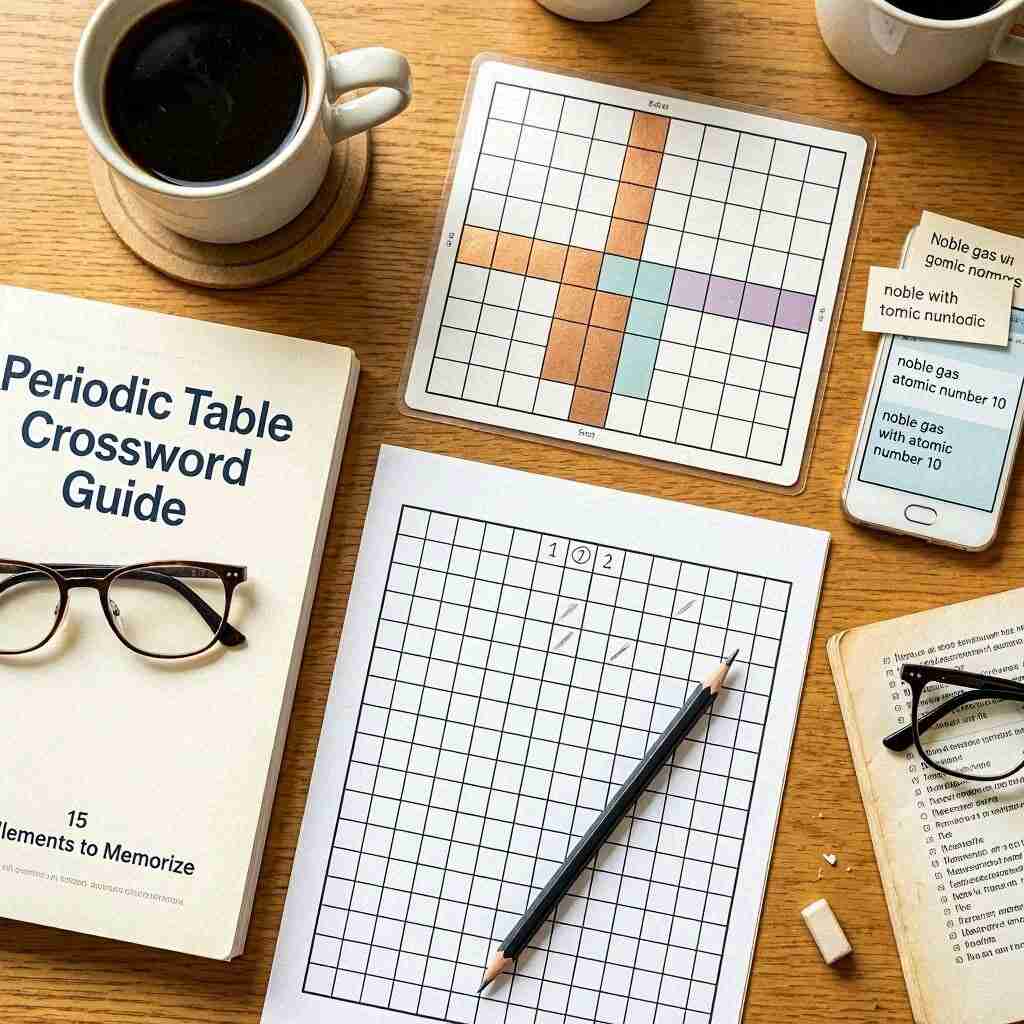
The 15 Elements Every NYT Crossword Solver Must Memorize
Here is your definitive, prioritized list. Learn these 15 elements — their names, symbols, atomic numbers, and one memorable property each — and you will be prepared for virtually every periodic table element crossword clue the NYT will ever publish:
| Priority | Element | Symbol | No. | Key Fact to Remember |
|---|---|---|---|---|
| 1 | NEON | Ne | 10 | Bright signs, noble gas, most common crossword element |
| 2 | IRON | Fe | 26 | Fe from Latin ferrum; steel’s main component |
| 3 | ZINC | Zn | 30 | Between copper and gallium; galvanizing metal |
| 4 | GOLD | Au | 79 | Au from Latin aurum; atomic number 79 |
| 5 | LEAD | Pb | 82 | Pb from Latin plumbum; origin of the word “plumber” |
| 6 | ARGON | Ar | 18 | Between chlorine and potassium; Greek for “lazy” |
| 7 | TIN | Sn | 50 | Sn from Latin stannum; only 3-letter crossword element |
| 8 | HELIUM | He | 2 | Lightest noble gas; balloon filler |
| 9 | BORON | B | 5 | Next to carbon; used in glass and detergents |
| 10 | XENON | Xe | 54 | Above radon; used in flash lamps and anesthesia |
| 11 | RADON | Rn | 86 | Radioactive noble gas; basement hazard |
| 12 | CARBON | C | 6 | Basis of organic chemistry; diamond is pure carbon |
| 13 | COBALT | Co | 27 | Deep blue pigment; atomic number 27 |
| 14 | SILVER | Ag | 47 | Ag from Latin argentum; best electrical conductor |
| 15 | NICKEL | Ni | 28 | Five-cent coin; element below cobalt |
How to Remember Element Clues Using Real-World Connections
The secret to permanent element memorization is not rote repetition — it’s associative connection. Your brain remembers stories and images far better than lists of facts. Here’s how to make each element unforgettable:
NEON — Picture a glowing Las Vegas strip sign. Every neon sign you ever see now reminds you: four letters, noble gas, NYT crossword’s favorite element.
IRON — Think of a blacksmith hammering iron. The symbol Fe comes from “ferrum” — same root as “ferrous” and “ferro.” Ferrous = iron. Always.
ZINC — Imagine a galvanized fence — that silver-grey coating that prevents rust. That coating is zinc. “Galvanizing” = zinc. Every time.
ARGON — Picture a lazy, inactive person doing absolutely nothing. Argon is chemically “lazy” — it reacts with almost nothing. Greek “argos” = idle. Five letters, noble gas, wedged between chlorine and potassium.
LEAD — Remember that plumbers use lead pipes (historically). “Plumbum” → plumber → LEAD. Pb. The heaviest common metal in crosswords.
These mental images take seconds to create and last for years. That’s not memorization — that’s understanding. And understanding beats memorization in a crossword grid every single time.
💡 Pro Tip: Create a “chemistry cheat sheet” with just these 15 elements — name, symbol, atomic number, one memorable fact. Review it once a week for a month. After that, every periodic table element NYT crossword clue will feel like a gift rather than a challenge.
Conclusion
The periodic table element NYT crossword clue category sounds intimidating until you realize it’s actually one of the most learnable, most predictable, and most rewarding clue types in the entire puzzle. The elements that appear follow clear patterns. The clue wordings evolve predictably across the week’s difficulty curve. The letter count gives you a powerful filter before you analyze a single word of the clue. And the 15 core elements you need to know can be mastered in one sitting.
What makes chemistry crossword clues genuinely satisfying — more than almost any other category — is that getting them right feels like proof that you know something real. Not trivia. Not pop culture ephemera. Something enduring. NEON has been NEON since 1898. IRON has been Fe since Mendeleev organized the periodic table. These answers will be just as correct in 2050 as they are today.
The next time a periodic table element NYT crossword clue stops you mid-puzzle, run the four-step system: count the letters, read every word of the clue, check your crossing answers, and match the difficulty level. With the master reference table in your mental library and those 15 core elements memorized cold, you’ll move through chemistry clues with the same confidence you bring to geography, mythology, or literature.
🔑 Key Takeaway: Master these 15 elements — NEON, IRON, ZINC, GOLD, LEAD, ARGON, TIN, HELIUM, BORON, XENON, RADON, CARBON, COBALT, SILVER, and NICKEL — and you will have a permanent, complete answer system for every periodic table element NYT crossword clue you will ever encounter.
Chemistry class is finally paying off. Now go finish that puzzle.
Frequently Asked Questions
FAQ 1: What is the most common 4-letter periodic table element in NYT crossword puzzles? NEON is the most common 4-letter periodic table element in the NYT crossword by a significant margin. Its chemical symbol Ne, its atomic number 10, and its universal recognition through neon signs give puzzle constructors endless creative clue angles. IRON is a very close second — also 4 letters — benefiting from its multi-meaning nature as both an element and a common English verb. Between these two, they dominate the 4-letter chemistry clue category completely.
FAQ 2: What does ARGON mean and why does it appear in crossword clues so often? ARGON derives from the Greek word “argos” meaning idle or inactive — a reference to its chemical inertness. It appears frequently in crossword clues because it is a 5-letter noble gas with good vowel distribution, commonly positioned between chlorine and potassium on the periodic table. Constructors love ARGON because it can be clued through chemistry, history, etymology, atmospheric science, and industrial applications, giving them tremendous flexibility across difficulty levels.
FAQ 3: How do I know if a crossword clue wants the element symbol or the full element name? In nearly all cases, the crossword answer is the full English element name — IRON, not FE; NEON, not NE; ZINC, not ZN. The clue may reference the symbol (“Fe on the periodic table”) but the answer filling the grid squares is always the full name. The only exception is when a clue specifically asks for the abbreviation (“Iron’s two-letter periodic table symbol”), in which case FE fills exactly two squares. This exception is rare and always clearly signaled by the clue’s wording.
FAQ 4: What is the periodic table element NYT crossword answer for clues about a basement gas hazard? The answer is RADON — a 5-letter radioactive noble gas with symbol Rn and atomic number 86. RADON is a naturally occurring gas produced by the decay of uranium in soil and rock, and it’s a well-known household health concern because it can accumulate in basements. Common clue forms include “Radioactive basement gas,” “Noble gas health hazard,” “Home inspection concern, chemically,” and “Element above oganesson in Group 18.”
FAQ 5: Which periodic table elements have Latin-based symbols that differ from their English names? Five elements have commonly tested Latin-symbol mismatches in crossword clues: IRON (Fe from ferrum), GOLD (Au from aurum), LEAD (Pb from plumbum), TIN (Sn from stannum), and SILVER (Ag from argentum). A sixth, MERCURY (Hg from hydrargyrum), occasionally appears in longer crossword entries. Memorizing these five primary pairs — Fe/IRON, Au/GOLD, Pb/LEAD, Sn/TIN, Ag/SILVER — eliminates one of the most common chemistry clue confusion points entirely.
FAQ 6: What NYT crossword clue most recently featured ZINC as the answer? ZINC most recently appeared in the NYT crossword on May 16, 2026, with the clue “Element between copper and gallium on the periodic table.” This position-based clue format — identifying an element by its neighbors on the periodic table — is one of the most common styles for ZINC clues. Other recurring ZINC clues include “Galvanizing metal,” “Zn on the periodic table,” “Element with atomic number 30,” and “Cold remedy mineral.”
FAQ 7: How do Saturday NYT crossword chemistry clues differ from Monday chemistry clues? Monday chemistry clues are direct and property-based: “Noble gas used in signs” (NEON), “Fe on the periodic table” (IRON). Saturday clues use historical, etymological, and oblique angles: “Travers and Ramsay discovery of 1898” (NEON), “Greek for lazy, in chemistry” (ARGON), “Plumbum, in modern terms” (LEAD). The answer is always the same element — what changes dramatically is how much chemistry, history, and linguistic knowledge you need to decode the clue wording.
FAQ 8: What is COBALT’s most common NYT crossword clue form? COBALT (symbol Co, atomic number 27, 6 letters) most commonly appears with clues referencing its distinctive deep blue color or its position on the periodic table. Common clue forms include “Deep blue pigment element,” “Blue paint ingredient, chemically,” “Element with atomic number 27,” and “Nickel neighbor on the periodic table.” COBALT BLUE is one of the most historically significant pigments in art history, giving constructors culturally rich clue material beyond pure chemistry.
FAQ 9: Can a periodic table element NYT crossword answer ever be longer than 8 letters? Yes, but rarely — and almost exclusively in Sunday puzzles or specially themed puzzles. Elements like URANIUM (7 letters), CALCIUM (7 letters), SILICON (7 letters), PLATINUM (8 letters), CHROMIUM (8 letters), and TITANIUM (8 letters) all appear occasionally. Beyond 8 letters, appearances become extremely rare. MANGANESE (9 letters) has appeared as “Element next to iron on the periodic table.” Elements over 10 letters almost never appear in standard American crossword grids because their length makes grid construction prohibitively difficult.
FAQ 10: Is it true that pencils contain the element LEAD — and does this misconception appear in crossword clues? This is one of the most persistent chemistry misconceptions in popular culture — and yes, crossword constructors occasionally exploit it. Modern pencil “lead” actually contains graphite (a form of carbon) mixed with clay, not the element lead at all. However, clues like “Pencil filler, informally” or “What’s in a pencil, people think” may point to LEAD as the answer because the constructor is playing on the common misconception rather than scientific accuracy. When in doubt, count the letters and check your crossing answers — the grid will tell you if LEAD or CARBON is the intended answer.