
50 Things on the Argo NYT: Guide to the Famous Crossword Clue
Introduction: What Is the Argo?
Have you ever been cruising through the New York Times crossword puzzle — feeling unstoppable, pen in hand, smug grin on your face — and then hit a clue that completely stops you in your tracks? Something like “50 things on the Argo” can send even seasoned solvers reaching for Google. Don’t worry, you’re not alone. This clue has stumped thousands of puzzle enthusiasts, and today we’re going to break it all the way down.
But here’s the thing: this isn’t just a crossword answer. It’s a doorway into one of the most thrilling myths in all of ancient Greek history. The Argo wasn’t just a boat. It was a legendary ship crewed by heroes, steered through impossible odds, and immortalized for centuries in literature, art, and — eventually — a Saturday morning NYT puzzle. So buckle up, because we’re going on a little voyage of our own.
The NYT Crossword Connection
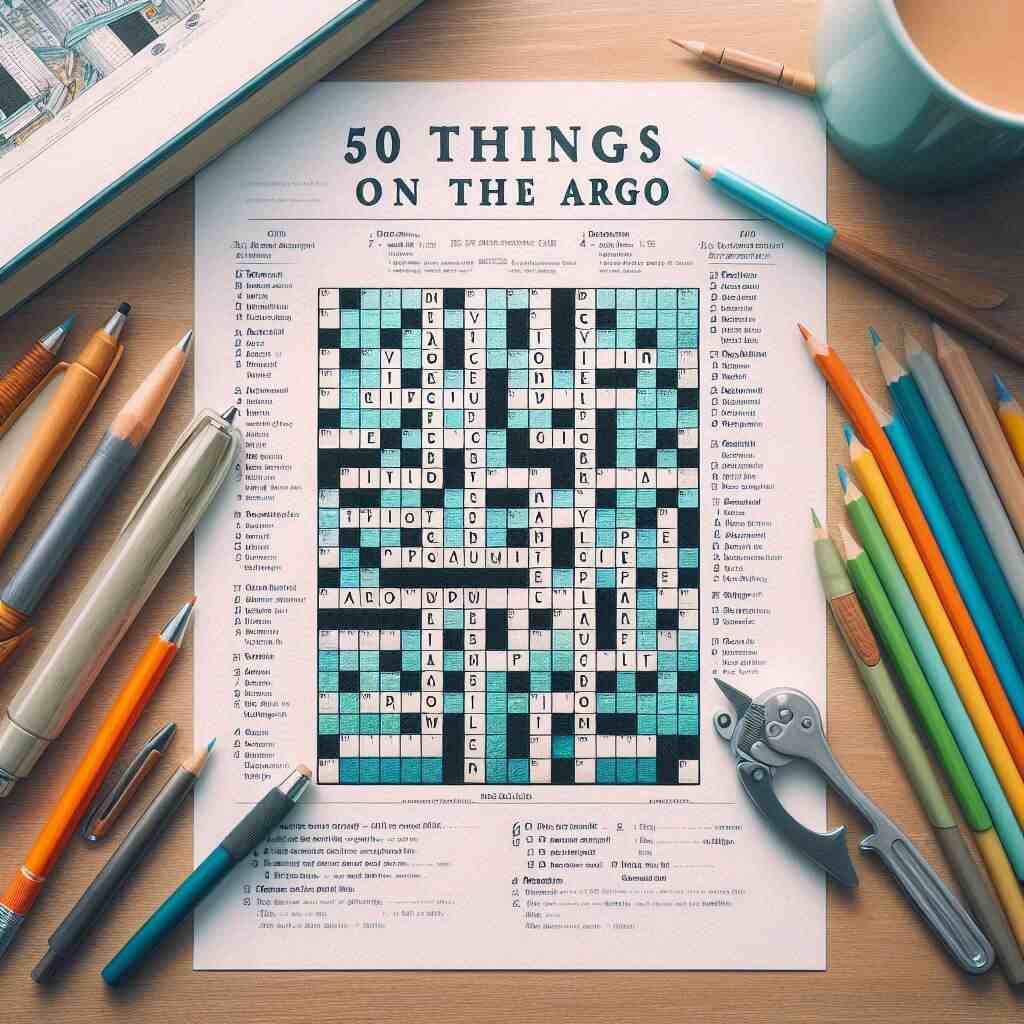
The New York Times crossword puzzle has been a staple of American culture since 1942. It runs Monday through Sunday, with each day’s puzzle increasing in difficulty. By the time you hit Thursday, Friday, or Saturday, you’re dealing with clues that are deliberately cryptic, playful, or dependent on obscure knowledge — which is exactly where “50 things on the Argo” lives.
This particular clue tends to show up in mid-week to late-week puzzles, when the editors know solvers are ready for a challenge. The clue relies not on wordplay or puns, but on factual knowledge of mythology — specifically, the number of oars on the legendary ship Argo from Greek mythology.
Why This Clue Trips People Up
Let’s be honest: when you read “50 things on the Argo,” your brain might go in a dozen directions. Sailors? Heroes? Flags? Gods? That’s the brilliance of how the clue is written. It doesn’t tell you what kind of things. It leaves you guessing. And that ambiguity is exactly what makes the NYT crossword both maddening and magical. The answer, as we’ll explore in detail, is OARS — because the Argo famously had 50 oars, powered by 50 of the greatest heroes ancient Greece had ever seen.
The Myth of Jason and the Argonauts
To really understand why the number 50 matters, we need to go back — way back — to one of the oldest and most beloved myths in Western civilization. The story of Jason and the Argonauts predates even Homer’s Iliad and Odyssey, making it one of the foundational tales of Greek mythology. Think of it as the original superhero team-up movie, except instead of flying suits and vibranium shields, these heroes had divine parentage, superhuman strength, and one very legendary ship.
Who Were the Argonauts?
The Argonauts were a band of heroes assembled by Jason, the rightful king of Iolcos who had been cheated out of his throne by his uncle Pelias. To reclaim his kingship, Jason had to retrieve the Golden Fleece — a magical artifact held in the distant land of Colchis (roughly modern-day Georgia on the Black Sea coast). To undertake this impossible journey, Jason recruited the best of the best.
And we’re talking seriously impressive company. The crew allegedly included Heracles (yes, that Heracles), Orpheus the legendary musician, the Dioscuri twins Castor and Pollux, the winged son of the North Wind Calais, and Peleus — who happened to be the father of Achilles. Depending on which ancient source you read, the crew numbered anywhere from 45 to 55, but the most widely accepted tradition names exactly 50 Argonauts, each manning one oar.
That’s your crossword answer, right there. Fifty heroes. Fifty oars.
The Golden Fleece Quest
So what exactly was this Golden Fleece, and why was it worth risking your life — and the lives of 49 other mythological superstars — to retrieve it?
The Golden Fleece was the skin of a divine winged ram (Chrysomallus) that had been sacrificed and hung in a sacred grove in Colchis, guarded by a dragon that never slept. It represented power, legitimacy, and divine favor. For Jason, bringing it back was the only way to prove himself worthy of ruling and to fulfill a divine mandate.
The journey itself was riddled with trials: clashing rocks that could crush ships, sirens, harpies, bronze giants, and the incredibly complex political intrigue of the Colchian court — where Jason ultimately won the help of the princess Medea, a powerful sorceress who falls desperately in love with him. Their relationship, of course, ends in one of mythology’s most tragic arcs. But that’s a tale for another crossword.
The Answer: What Are the “50 Things”? (Oars)
Now let’s get surgical about the actual crossword answer, because this is what brought you here, after all.
Oars as the Crossword Answer
The answer the NYT crossword is looking for is OARS. The clue “50 things on the Argo” is referencing the 50 oars that powered the ship — one for each of the 50 Argonauts aboard. Ancient Greek mythology consistently depicted the Argo as a 50-oared vessel, a galley of extraordinary power built specifically for this epic voyage.
In crossword construction, this type of clue is called a factual indirect — it’s not asking you to define a word or spot a pun, it’s testing your knowledge of a specific, verifiable fact. If you know that the Argo had 50 oars, you get OARS. If you don’t — well, that’s what crossing letters are for.
It’s worth noting that “oars” is a beautifully efficient crossword answer: four letters, commonly crossing with other words, and just obscure enough to feel like a genuine challenge without being unfair. Crossword editors love answers like this because they reward genuine learning.
Ancient Greek Rowing Explained
Here’s where it gets genuinely fascinating. The ancient Greeks were masterful maritime engineers, and the ships they built — particularly their war galleys — were engineering marvels of the ancient world. The type of ship depicted in the Argo myth is essentially a penteconter (from the Greek pentekontoros, meaning “fifty-oared”), one of the oldest and most celebrated types of ancient Greek warships.
A penteconter was a single-banked galley with 25 oars on each side, making for a total of 50 oars. These ships were long, narrow, and built for speed rather than cargo. They sat low in the water and relied almost entirely on human power, making the strength and stamina of the crew absolutely critical. Picture 50 of ancient Greece’s greatest heroes, stripped to the waist, rowing in unison across the Aegean — it’s both awe-inspiring and, let’s be honest, a little exhausting just to imagine.
The penteconter was eventually superseded by the famous trireme — a three-banked galley with up to 170 oarsmen — but in the Bronze Age setting of the Argonautic myth, the 50-oared ship was the pinnacle of naval achievement.
The Argo: Design, Construction, and Mythology
The ship itself — not just the crew — is a character in this myth. The Argo isn’t just a mode of transportation; it’s imbued with divine intelligence and plays an active role in the story.
Built by Argus, Guided by Athena
According to the mythological tradition, the Argo was built by a master craftsman named Argus (from whom the ship takes its name — “Argo” meaning “swift”). But here’s the twist that makes ancient mythology so wonderfully strange: the goddess Athena herself guided Argus’s hands during the construction, and she even incorporated a piece of a sacred oak from the oracle at Dodona into the ship’s prow.
This sacred timber gave the ship the ability to speak — it could deliver prophecies and warnings to the crew. So not only was the Argo the fastest ship of its age, it was also literally prophetic. It could tell Jason when danger was coming. Try getting that feature on a modern yacht.
The ship’s construction reflects how seriously ancient Greeks took the concept of divine intervention in human affairs. Nothing great could be accomplished purely by human will — the gods had to be on your side. And in the case of Jason and his crew, they had Athena, Hera, and various other Olympians pulling strings behind the scenes.
Key Adventures Along the Argo’s Route
The voyage of the Argo wasn’t a simple A-to-B journey. It was a sprawling, episodic adventure across the ancient Mediterranean world, packed with encounters that tested the heroes at every turn.
The Island of Lemnos
One of the first stops on the Argonauts’ journey was the island of Lemnos, where all the men had been killed and the island was ruled entirely by women under Queen Hypsipyle. The Argonauts stayed — perhaps a bit too comfortably — and Jason fathered children with the queen herself. Eventually, Heracles grew impatient and urged the crew to remember their mission. It’s a scene that reads almost comically modern: a group of men getting distracted on a tropical island before the “responsible one” rounds everyone up to get back on track.
The Clashing Rocks (Symplegades)
Perhaps the most dramatic physical obstacle in the entire myth was the Symplegades — the Clashing Rocks. These were two massive rocks at the entrance to the Black Sea that smashed together randomly, crushing anything that tried to pass between them. Jason, on advice from the seer Phineas, released a dove first. The dove flew through, and the rocks clashed and clipped only its tail feathers. The Argonauts then rowed with everything they had, and the Argo made it through — losing only a piece of its stern.
After that, the rocks stood still forever, because it had been prophesied that once a ship passed through, they would never move again. The Argonauts, quite literally, changed the geography of the world.
Medea and the Dragon
When they finally reached Colchis, Jason faced a series of seemingly impossible tasks set by King Aeëtes: yoke fire-breathing bulls, plow a field with them, and then sow dragon’s teeth (which would sprout into armed warriors). Without Medea’s magical assistance — she gave him an ointment that made him invulnerable to fire and a strategy for dealing with the warriors — these tasks would have been fatal.
And then there was the dragon guarding the Fleece, which never slept. Medea sang it to sleep with her sorcery, Jason grabbed the Fleece, and the Argonauts fled into the night. It reads like a heist movie — a mythological Ocean’s Eleven, if you will.
The NYT Crossword: A Cultural Institution
Let’s come up for air from the ancient world for a moment and talk about the publication that brought all of this to your attention in the first place: the New York Times crossword puzzle.
How the Puzzle Is Constructed
The NYT crossword is not made by one editor working alone in a basement (though it might feel that way when you’re stuck on a Friday). It’s a collaborative art form. Constructors — often freelance puzzle designers — submit grids and clues to the editor. Each puzzle goes through multiple rounds of fact-checking, editorial review, and testing before it ever reaches your newspaper or your phone screen.
Clues like “50 things on the Argo” are the result of someone — a constructor who probably loves mythology and wordplay in equal measure — sitting down and thinking: what’s a clever, fair, satisfying way to clue the word OARS? The fact that they landed on a reference that requires knowledge of ancient Greek seafaring mythology tells you something about the depth and ambition of the crossword as a form.
Why Mythology Clues Are So Common
Greek and Roman mythology is one of the richest veins the crossword world mines regularly — and for good reason. Mythological names and concepts are short (important for crossword grids), vowel-heavy (great for crossing letters), and deeply embedded in Western cultural literacy. ARES, HERA, ZEUS, ARGOS, JASON — these names have been in crosswords for decades because they’re genuinely useful letter combinations that also happen to be culturally significant.
Tips for Solving Mythology Clues
If mythology is your crossword weak spot, here are some practical strategies. First, build a cheat sheet of the most commonly referenced Greek and Roman figures: the twelve Olympians, famous heroes (Heracles, Achilles, Odysseus, Perseus, Theseus, Jason), and famous mythological objects (the Golden Fleece, Pandora’s box, the Labyrinth). Second, pay attention to crossing letters — they’ll often confirm or deny your guesses. Third, don’t sleep on Roman equivalents: ARES = MARS, HERMES = MERCURY, APHRODITE = VENUS. Crosswords use both traditions liberally.
The Number 50 in Mythology and Its Significance
It’s worth pausing to appreciate how significant the number 50 is in Greek mythological tradition, because this wasn’t an arbitrary choice by ancient storytellers.
Fifty appears throughout Greek myth as a number that signifies completeness and heroic scale. There were 50 daughters of Danaus (the Danaids). There were 50 sons of Priam, king of Troy. The monster Cerberus guarded the underworld, and in some traditions, his siblings numbered in the dozens. The Hecatoncheires — the hundred-handed giants — represent a doubling of this “complete set” concept.
Fifty Argonauts wasn’t meant to be a literal headcount so much as a signal to ancient audiences: this crew represents the totality of heroic Greece. Every great hero worth the name was aboard. It’s the ancient equivalent of saying “the greatest team ever assembled” — a roster that would have resonated deeply with original audiences who knew every hero’s name and lineage.
The Argo’s Legacy in Literature and Art
The story of the Argo has never really gone away. It’s been retold, reimagined, and reinvented in virtually every era of Western cultural history.
Ancient Sources: Apollonius of Rhodes
The most complete ancient account of the Argonautic myth comes from Apollonius of Rhodes, a Greek poet who lived in the 3rd century BCE. His epic poem, the Argonautica, runs to four books and covers the entire voyage from Jason’s commissioning of the ship to the return home. It’s a remarkable work — psychologically nuanced in ways that feel surprisingly modern, especially in its treatment of Medea’s complex inner life.
Apollonius was actually a librarian at the famous Library of Alexandria, which feels almost perfect: the man who preserved one of the world’s great adventure stories spent his life surrounded by the greatest collection of knowledge the ancient world ever assembled.
Films, Books, and Pop Culture
In modern times, the Argonauts have appeared everywhere from Ray Harryhausen’s spectacular 1963 film Jason and the Argonauts (famous for its stop-motion skeleton warriors) to Rick Riordan’s Percy Jackson series, which borrows heavily from the same mythological tradition. There have been novels, video games, animated series, and — yes — countless crossword clues.
The name “Argo” itself has become cultural shorthand for an ambitious journey undertaken by a team of skilled individuals against impossible odds. NASA even named one of its projects after the Argo, and the 2012 Oscar-winning film Argo uses the name metaphorically to convey a covert operation that requires heroic audacity.
Other Possible Crossword Interpretations
Before we wrap up, it’s worth acknowledging that crossword clues sometimes have multiple interpretations depending on context — particularly the crossing letters in the grid.
Could “50 things on the Argo” ever refer to something other than OARS? In theory, if the crossing letters supported it, you might consider ROWERS (though that’s 6 letters), or CREW (4 letters, but the number 50 doesn’t apply cleanly). In practice, OARS is the only answer that precisely fits the mythology, the letter count, and the crossword tradition. The 50 oars of the Argo are firmly established in the mythological record, making OARS the unambiguous intended answer.
When you’re solving and you encounter a clue like this, the methodology is: figure out the letter count from your grid, cross-reference with any confirmed crossing letters, and then ask yourself what specific thing could appear exactly 50 times on a legendary ancient ship. The answer writes itself.
Why the NYT Crossword Rewards This Kind of Knowledge
Here’s something worth reflecting on: the NYT crossword, at its best, isn’t a vocabulary test. It’s a test of connected knowledge — the ability to draw on history, mythology, pop culture, science, wordplay, and lateral thinking all at once. A clue like “50 things on the Argo” rewards you not just for knowing the word OARS, but for knowing why there were 50 of them, who was rowing them, and where the ship was going.
That’s what makes solving the puzzle so satisfying. It’s not just “oh, I knew that word.” It’s “oh, I know that story — and now the word clicked.” There’s a genuine intellectual pleasure in that moment of recognition, the puzzle piece sliding into place not because you memorized a list, but because you understand something about the world.
And that’s exactly why mythology has been a fixture of the NYT crossword for 80+ years. These stories aren’t dusty relics — they’re living language, embedded in the words we use, the allusions we make, and yes, the puzzles we love to solve.
Conclusion
So the next time you see “50 things on the Argo” staring back at you from the NYT crossword grid, you’ll be ready. The answer is OARS — four letters that unlock an entire world of mythological adventure, ancient engineering, and heroic ambition. The Argo was a 50-oared penteconter, crewed by the greatest heroes of the ancient Greek world, on a mission to retrieve the Golden Fleece from the distant shores of Colchis. Its story has survived more than 2,000 years because it captures something fundamentally human: the desire to gather the best people you know, build the best vessel you can, and sail boldly toward something that everyone else says is impossible.
The NYT crossword, in its wonderfully roundabout way, keeps these myths alive — one four-letter answer at a time. Happy solving.
Frequently Asked Questions (FAQs)
1. What is the answer to “50 things on the Argo” in the NYT crossword? The answer is OARS. The Argo was a 50-oared ship in Greek mythology, with each of the 50 Argonauts manning one oar during the voyage to retrieve the Golden Fleece.
2. How many Argonauts were there? The most widely accepted mythological tradition names 50 Argonauts, though different ancient sources cite slightly varying numbers — typically ranging from 45 to 55. The number 50 is canonical in most traditions, matching the 50 oars of the ship.
3. What type of ship was the Argo? The Argo was a penteconter — a single-banked galley with 25 oars on each side, totaling 50 oars. It was one of the most advanced ship designs in the Bronze Age Greek world, built for speed rather than cargo capacity.
4. Who built the Argo? The Argo was built by a craftsman named Argus, with divine guidance from the goddess Athena. Athena also incorporated a piece of the sacred oak from the oracle at Dodona into the ship’s prow, giving the vessel the ability to speak and prophesy.
5. What was the Golden Fleece, and why did Jason need it? The Golden Fleece was the skin of a divine winged ram, hung in a sacred grove in Colchis and guarded by a sleepless dragon. Jason needed to retrieve it to reclaim his rightful throne from his uncle Pelias, who had set the task as a condition of stepping down.
6. Who were some of the most famous Argonauts? The crew included Heracles, Orpheus, Castor and Pollux (the Dioscuri), Calais (the winged son of the North Wind), Peleus (father of Achilles), and the seer Mopsus, among many others. It was essentially a who’s-who of ancient Greek heroism.
7. Why does the NYT crossword use so many mythology clues? Greek and Roman mythological names are ideal for crossword grids because they tend to be short, vowel-rich, and deeply embedded in Western cultural literacy. They also reward genuine learning rather than just wordplay, adding intellectual depth to the puzzle.
8. What happened to the Argo after the quest? After the successful return of the Golden Fleece, the Argo was dedicated to the god Poseidon and placed in a sacred grove. According to some traditions, Jason in his old age was sitting beneath the rotting hull of the Argo when a piece of the ship fell and killed him — a bittersweet end for a legendary vessel.
9. Is there a real-world connection to the Argonautic myth? Yes — historians believe the myth may preserve a memory of early Bronze Age trading expeditions into the Black Sea region. The land of Colchis corresponds to modern-day Georgia, which was known in antiquity for its gold-rich rivers (where locals used fleeces to trap gold dust — possibly the origin of the “Golden Fleece” imagery).
10. Are there other NYT crossword clues related to the Argo or Greek mythology? Absolutely. Greek mythology is one of the most frequently mined sources in crossword construction. Expect to see clues related to Jason, Medea, Heracles, the Symplegades, various Olympian gods, and other mythological figures regularly — especially in Thursday through Saturday puzzles where the difficulty ramps up significantly.