Type of Pasta NYT Crossword Clue: Answer, Dates and Solving Strategy
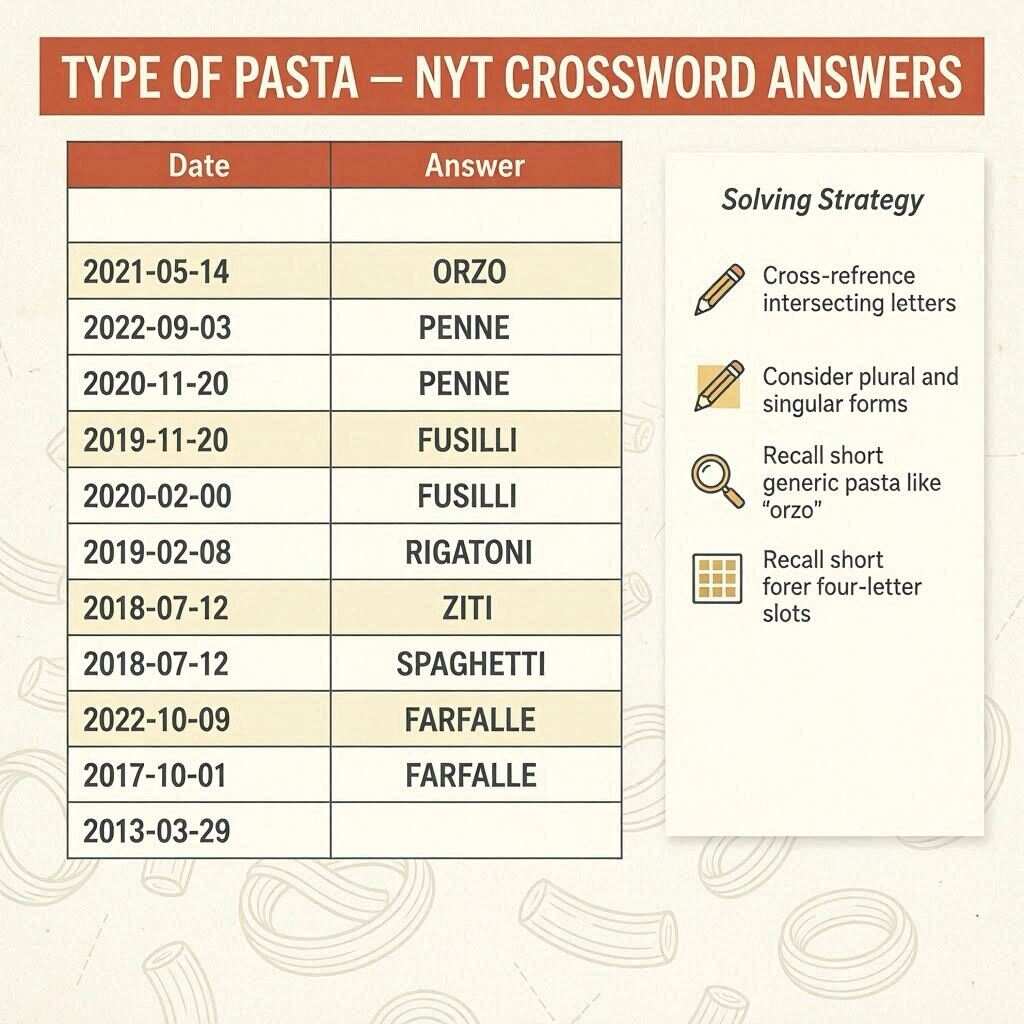
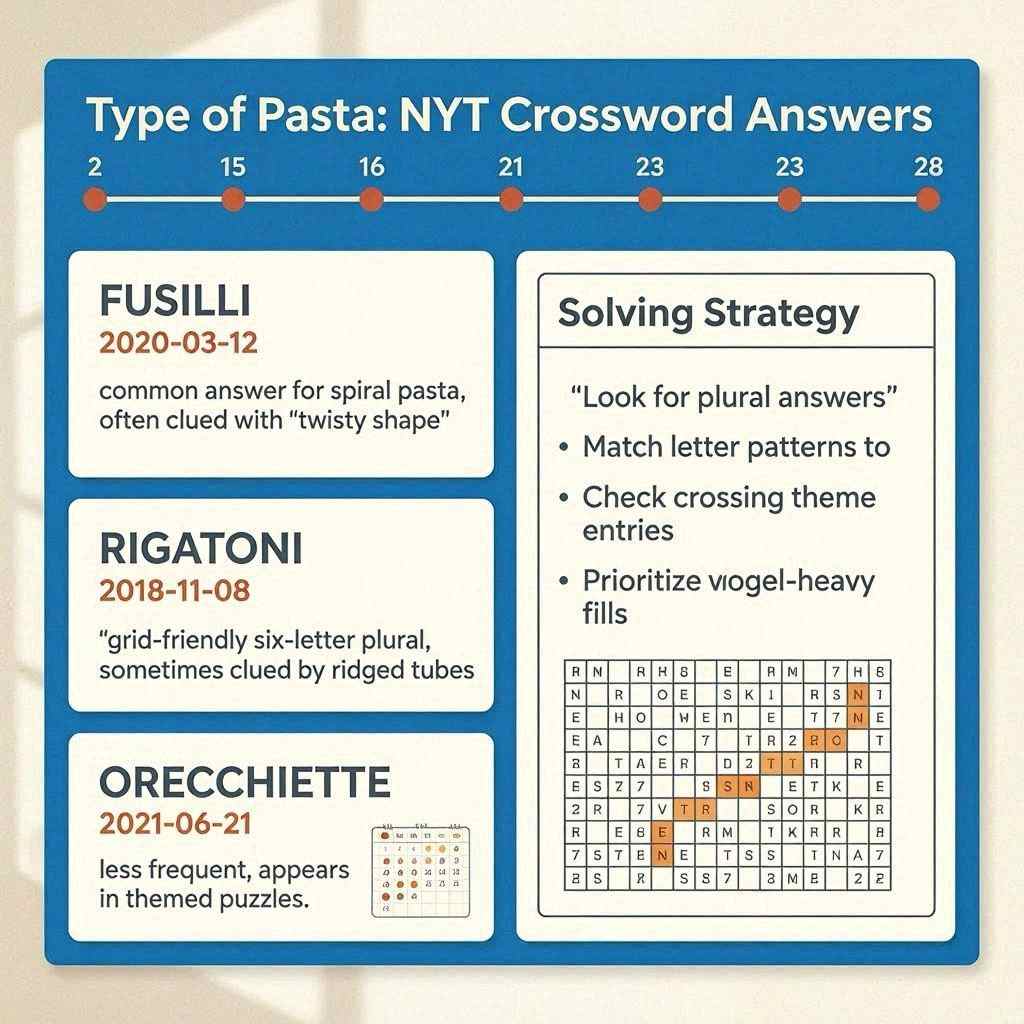
Quick Answer: The most common answers for the “type of pasta” NYT crossword clue are ORZO (4 letters), ZITI (4 letters), PENNE (5 letters), and ROTINI (6 letters). The full confirmed answer list — sorted by letter count with real puzzle dates — is in the table below.
Type of Pasta NYT Crossword Clue: All Answers by Letter Count
The correct answer depends almost entirely on how many letters the puzzle requires. Check this table first, every time.
| Letters | Answer | Common Clue Variations | Last Seen in NYT | Frequency |
|---|---|---|---|---|
| 4 | ORZO | Rice-shaped pasta, soup pasta, tiny noodle, grain-shaped pasta | March 31, 2026 | ★★★★★ Very Common |
| 4 | ZITI | Tube pasta, baked pasta, Sopranos dish, tubular noodles | 2025 | ★★★★★ Very Common |
| 4 | UDON | Japanese noodle, thick wheat noodle | 2024 | ★★★☆☆ Common |
| 4 | SOBA | Buckwheat noodle, Japanese pasta | 2024 | ★★★☆☆ Common |
| 5 | PENNE | Ridged tube pasta, pasta with angled ends, tubular noodles | November 14, 2025 | ★★★★★ Very Common |
| 5 | ELBOW | Macaroni shape, pasta type | 2024 | ★★★☆☆ Common |
| 5 | RIGATE | Ridged pasta variety | 2023 | ★★☆☆☆ Occasional |
| 6 | ROTINI | Spiral pasta, corkscrew noodle, twisted pasta | March 9, 2026 | ★★★★☆ Common |
| 6 | SHELLS | Shell-shaped pasta, pasta variety | 2024 | ★★★☆☆ Common |
| 6 | NOODLE | Pasta type, long pasta | 2023 | ★★★☆☆ Common |
| 7 | LASAGNA | Layered pasta, Italian casserole noodle | 2024 | ★★★☆☆ Common |
| 7 | RAVIOLI | Filled pockets, pasta stuffed with ricotta | October 20, 2025 | ★★★☆☆ Common |
| 7 | FUSILLI | Corkscrew pasta, spiral noodle | March 9, 2026 | ★★★☆☆ Common |
| 7 | BOWTIE | Pasta type, farfalle shape | 2023 | ★★☆☆☆ Occasional |
| 8 | LINGUINE | Flat pasta, Italian noodle | 2024 | ★★★☆☆ Common |
| 8 | RIGATONI | Large tube pasta, ribbed pasta, ridged pasta type | September 17, 2023 | ★★★☆☆ Common |
| 8 | MACARONI | Elbow pasta, mac and cheese pasta | 2023 | ★★★☆☆ Common |
| 8 | FARFALLE | Bow-tie pasta, butterfly pasta | 2024 | ★★☆☆☆ Occasional |
| 8 | FEDELINI | Very thin pasta, fine noodle | 2022 | ★★☆☆☆ Occasional |
| 9 | ANGELHAIR | Very thin pasta, delicate noodle | 2023 | ★★☆☆☆ Occasional |
| 9 | CAPELLINI | Thin pasta, angel hair alternative | 2023 | ★★☆☆☆ Occasional |
| 9 | CAVATAPPI | Corkscrew pasta, double-helix noodle | 2022 | ★★☆☆☆ Occasional |
| 10 | TORTELLINI | Ring pasta, stuffed Italian pasta | 2023 | ★★☆☆☆ Occasional |
| 10 | TAGLIATELLE | Ribbon pasta, Bologna specialty | 2022 | ★☆☆☆☆ Rare |
Key Takeaway: If you see a 4-letter pasta clue in a Monday–Wednesday NYT crossword, ORZO or ZITI will be correct the majority of the time. PENNE dominates every 5-letter pasta slot. For 7-letter answers, check whether LASAGNA, RAVIOLI, or FUSILLI fits your crossing letters first.
Today’s Most Likely Answer
Based on recent NYT puzzle patterns, these are the highest-probability answers right now:
- ORZO — Most reused 4-letter pasta answer in NYT history; last confirmed March 31, 2026
- ZITI — Second most common; appears across all difficulty levels
- PENNE — Dominant 5-letter answer; confirmed November 14, 2025
- ROTINI — Top 6-letter pasta answer; confirmed March 9, 2026
- RIGATONI — Most common 8-letter pasta answer in Sunday and themed grids
Clue Variations: Every Phrasing the NYT Uses
The exact clue text changes constantly even when the answer is the same. Here is every confirmed clue variation for each major pasta answer.
ORZO
- “Rice-shaped pasta” (most common)
- “Grain-shaped pasta”
- “Pasta that resembles rice”
- “Pasta resembling rice grains”
- “Soup pasta”
- “Tiny Italian noodle”
- “Minestrone ingredient, maybe”
- “Ricelike pasta”
- “Risotto alternative, perhaps”
- “___ salad”
ZITI
- “Baked ___” (most common)
- “Tube pasta”
- “Tubular trattoria treat”
- “Pasta in a casserole”
- “Italian-American staple pasta”
- “Wedding pasta, sometimes”
- “___ al forno”
- “Hollow pasta type”
- “Pasta used in baked dishes”
- “Sopranos meal, informally”
PENNE
- “Pasta with angled ends” (most common)
- “Ridged tube pasta”
- “Pasta with diagonal cuts”
- “Pasta shape similar to ziti”
- “All’arrabbiata pasta”
- “___ arrabbiata”
- “Tube-shaped pasta”
- “Nib pasta”
- “Tubular noodles”
ROTINI / FUSILLI
- “Spiral pasta”
- “Corkscrew-shaped pasta”
- “Corkscrew pasta”
- “Twisted pasta type”
- “Pasta salad staple”
- “Fusilli relative” (for ROTINI)
- “Rotini relative” (for FUSILLI)
RAVIOLI
- “Filled pockets”
- “Pasta often filled with ricotta”
- “Stuffed pasta squares”
- “Pasta with filling”
RIGATONI
- “Ribbed pasta”
- “Ridged pasta type”
- “Large tube pasta”
- “Type of pasta, like large penne”
- “Totally tubular pasta”
BOWTIE / FARFALLE
- “Butterfly-shaped pasta”
- “Bow-tie pasta”
- “Pasta type” (misdirection — see below)
The Misdirection Clues: When “Pasta” Isn’t About Food
This is the section most guides skip. Several pasta answers are regularly clued through their non-food meanings — especially on Thursday and Saturday puzzles where misdirection is intentional.
| Misleading Clue | Real Answer | Why It Works |
|---|---|---|
| “Dandy” | ZITI | In Southern Italian slang, zita/zito means a well-dressed young person |
| “Neckwear” | BOWTIE | A bow tie is both pasta and formal neckwear |
| “Butterfly” | FARFALLE | Farfalle means “butterflies” in Italian |
| “Knot” | FUSILLI | The word relates to twisting/knotting |
| “Barley” | ORZO | Orzo literally means “barley” in Italian |
| “Filled pockets” | RAVIOLI | Describes the pasta without naming it |
| “Tubes that go down?” | RIGATONI | Wordplay on literal tubes + pasta |
When a Thursday clue uses an unexpected noun, run it through this table before assuming a straightforward food answer.
How to Crack Any Pasta Clue in Under 10 Seconds
Step 1: Count Letters First
Most solvers read the clue first and letters second. Do the opposite. Letter count eliminates the majority of wrong answers before you process a single word. A 7-letter slot cannot be ORZO, ZITI, or PENNE — three top candidates gone in one second.
Step 2: Check Crossing Letters Immediately
Use this pattern-matching table:
| Pattern You Have | Most Likely Answer |
|---|---|
| _ R Z _ | ORZO (4) |
| _ I T _ | ZITI (4) |
| P _ N N _ | PENNE (5) |
| _ O T I N I | ROTINI (6) |
| _ A V I O L I | RAVIOLI (7) |
| _ I G A T O N I | RIGATONI (8) |
| _ N G E L H A I R | ANGELHAIR (9) |
Step 3: Apply Italian Ending Patterns
Italian pasta names follow four dominant endings. Recognize them visually before you finish reading the clue:
- -INI: ROTINI, TORTELLINI, CAPELLINI, FEDELINI
- -ONI: RIGATONI, MACARONI, CAVATAPPI (adjacent)
- -ENE / -INE: PENNE, LINGUINE, FETTUCCINE
- -OLI: RAVIOLI, CANNOLI (adjacent category)
- -ZO / -ZI: ORZO, ZITI
Step 4: Filter by Puzzle Day
| Day | Most Likely Pasta Answer | Notes |
|---|---|---|
| Monday | ORZO, ZITI, PENNE | Clues are direct, no tricks |
| Tuesday | Same pool, trickier wording | Slight misdirection begins |
| Wednesday | ROTINI, LASAGNA enter the pool | Mid-difficulty entries |
| Thursday | Any answer; check for misdirection | “Dandy” = ZITI type traps |
| Friday | Uncommon entries: CAPELLINI, FARFALLE | Pattern recognition essential |
| Saturday | Maximum difficulty; rare pasta names | CAVATAPPI, FEDELINI territory |
| Sunday | Theme-driven; any pasta possible | Check puzzle theme first |
Step 5: Check for Misdirection on Thursday+
If a clue feels too obvious for a late-week puzzle, it probably is. Ask whether the clue word has a non-food meaning. The misdirection table above covers the most common traps.
Why “Type of Pasta” Appears So Often in NYT Crosswords
The answer is structural, not culinary. Crossword construction is a geometry problem — every answer must intersect cleanly with words running in the opposite direction. Words that alternate consonants and vowels create the most flexible intersection points, and Italian pasta names are naturally built this way:
- ORZO: O-R-Z-O — 50% vowels, clean alternating rhythm
- ZITI: Z-I-T-I — 50% vowels, symmetrical structure
- PENNE: P-E-N-N-E — 60% vowels, double-consonant bridge
- ROTINI: R-O-T-I-N-I — 50% vowels, versatile -INI ending
Compare those to consonant-heavy English words like “strength” or “rhythm,” which create grid traffic jams. Constructors avoid them for exactly the same reason they reach for pasta names.
The letter Z deserves special mention. It is rare in English but appears in both ORZO and ZITI. When a constructor needs a Z at a specific grid position — which happens regularly — those two words become near-automatic choices. This single letter explains a large proportion of all pasta clue appearances.
Cultural fairness also matters. The NYT crossword editorial standard requires that answers be recognizable to the average American reader. A solver in Minneapolis or Houston may never have cooked Italian food, but they encounter PENNE, ZITI, and ORZO at every grocery store, casual restaurant, and school cafeteria. That ubiquity makes pasta names editorially “fair game” from Monday through Sunday.
Why Spaghetti Almost Never Appears
SPAGHETTI is America’s most recognized pasta name, which makes it instinctive to guess — and almost always wrong. The structural reasons:
- At 9 letters, it fits awkwardly in most grid positions
- The consonant cluster GHETT is very difficult to cross cleanly
- Double-T creates constrained intersection options
- It is too recognizable for hard puzzles (too gettable) and too long for easy ones
This is the single most common mistake beginners make on pasta clues. If you’re holding SPAGHETTI as your answer, look again.
Missing Answers Most Guides Ignore
Competing crossword databases confirm several pasta answers that frequently get overlooked:
SHELLS (6 letters) — Clued as “shell-shaped pasta” or simply “pasta variety.” Appears regularly in midweek puzzles where ROTINI is too long.
MACARONI (8 letters) — Underrated because solvers assume it only appears as “elbow” pasta. Clued directly as “macaroni” or “pasta type” multiple times in NYT history.
BOWTIE (6 letters) — Doubles as formal neckwear. Thursday constructors exploit this constantly.
CAPELLINI (9 letters) — Angel hair alternative. Appears in late-week puzzles where ANGELHAIR won’t fit.
FUSILLI (7 letters) — Often treated as synonymous with ROTINI, but both appear as independent answers. FUSILLI appeared as recently as March 9, 2026 alongside ROTINI as alternate answers to “corkscrew-shaped pasta.”
FARFALLE (8 letters) — The formal Italian name for bow-tie pasta. Less common than BOWTIE but appears in food-themed Sunday grids.
Four-Letter Pasta & Noodle Answers: Complete Reference
Four-letter answers are the most important category because they appear at every difficulty level. This is the complete list:
| Answer | Category | Common Clue | Frequency |
|---|---|---|---|
| ORZO | Italian pasta | Rice-shaped pasta | ★★★★★ |
| ZITI | Italian pasta | Baked pasta, tube pasta | ★★★★★ |
| UDON | Japanese noodle | Thick wheat noodle | ★★★★☆ |
| SOBA | Japanese noodle | Buckwheat noodle | ★★★☆☆ |
| MEIN | Chinese noodle (compound) | ___ chow (chow ___) | ★★★☆☆ |
| ROTI | Flatbread / pasta-adjacent | Indian bread type | ★★★☆☆ |
Expanding your mental category to include UDON, SOBA, and MEIN immediately closes a gap that catches many solvers who only memorize Italian pasta names.
NYT Mini Crossword Pasta Answers
The Mini crossword is a 5×5 grid — every answer is 3–5 letters. This narrows the valid pasta pool dramatically.
| Letters | Answer | Mini Frequency |
|---|---|---|
| 4 | ORZO | ★★★★★ Most Common |
| 4 | ZITI | ★★★★★ Most Common |
| 4 | UDON | ★★★☆☆ Common |
| 4 | SOBA | ★★☆☆☆ Occasional |
| 5 | PENNE | ★★★★☆ Very Common |
| 5 | ELBOW | ★★★☆☆ Common |
For the Mini specifically: guess ORZO before reading any crossing letters. It is the single most common Mini pasta answer. If the second letter is confirmed as I, switch to ZITI immediately.
This Clue Appears Beyond the NYT
The “type of pasta” clue is not exclusive to the New York Times. It appears regularly across major American puzzles:
| Publication | Documented Appearances |
|---|---|
| New York Times | 17+ confirmed appearances (going back to 1981) |
| Newsday | Multiple appearances (Nov. 2008, May/Mar. 2006) |
| The Guardian Quick | Multiple appearances (2011, 2014, 2019) |
| Penny Dell | Confirmed (Jan. 2017) |
| NY Sun | Confirmed (Dec. 2007) |
| USA Today Archive | Confirmed (Jul. 1999) |
| LA Times | Regular appearances |
If you are solving a non-NYT puzzle, the same answer pool applies. ORZO, ZITI, and PENNE dominate across all major American crossword publications, not just the NYT.
How Constructors Actually Choose Pasta Answers
The clue is always written after the answer is placed — never before. A constructor filling a difficult corner section of a 15×15 grid encounters a position needing a specific letter count and crossing structure. ORZO does not appear because it tests your Italian food knowledge. It appears because ORZO fits the intersection requirements better than other candidates.
Five criteria drive which pasta words make every professional constructor’s “rescue list”:
- Length: 4–6 letters solves the most grid positions
- Vowel distribution: alternating vowels and consonants preferred
- Rare letters: Z in ORZO and ZITI creates valuable crossing opportunities
- Cultural recognizability: must be fair for the average American solver
- Clue flexibility: the answer must support multiple distinct clue phrasings
ORZO, ZITI, and PENNE satisfy all five simultaneously. SPAGHETTI, FETTUCCINE, and other famous pasta names satisfy only criteria 4 and 5 — which is exactly why they almost never appear.
Crossword Solver Tools and Resources
When pattern recognition alone isn’t enough, these are the most useful resources for pasta clue research, ranked by reliability:
XWordInfo.com — The most comprehensive NYT crossword database available. Search by clue text to find every historical answer with frequency data going back to 1942. ORZO is among the top 200 most-used answers in NYT crossword history.
CrosswordTracker.com — Documents 17 confirmed appearances of “type of pasta” across multiple publications, with exact dates. The related-clues section surfaces alternate phrasings you may not have considered.
The-Crossword-Solver.com — 13 verified answers for this specific clue, filterable by letter count. Fast for mid-solve lookups when you know your letter count but not your answer.
NYT Games (nytimes.com/games) — The authoritative source. The archive lets you search past puzzle clues directly. For recurring clues like pasta answers, the archive reveals patterns across decades.
Pattern-based search syntax — When you have crossing letters, use this format in any solver database:
- 4 letters, second letter I:
_I__→ returns ZITI first - 4 letters, third letter Z:
__Z_→ ORZO dominates - 5 letters, double N:
_NN__→ PENNE emerges clearly - 6 letters, ending -INI:
___INI→ ROTINI leads
Frequently Asked Questions
What is the most common answer for “type of pasta” in the NYT crossword? ORZO (4 letters). It has appeared more times than any other pasta answer in NYT crossword history, most recently confirmed on March 31, 2026. When you have no crossing letters, ORZO is statistically your best first guess at 4 letters. ZITI is the second most common 4-letter answer.
What are all the 4-letter pasta answers in NYT crosswords? ORZO (rice-shaped Italian pasta), ZITI (tube pasta), UDON (Japanese wheat noodle), and SOBA (buckwheat noodle). RAMEN occasionally appears but is more commonly clued as a soup. ORZO and ZITI should always be your first two guesses before you analyze crossing letters.
What is a 5-letter pasta in the NYT crossword? PENNE is dominant. ELBOW and RIGATE appear occasionally. For the Mini crossword specifically, PENNE is the only 5-letter pasta answer you realistically need to know.
What pasta answers does the NYT Mini crossword use? Almost exclusively ORZO (4), ZITI (4), and PENNE (5). The 5×5 grid cannot accommodate longer pasta names. Treat ORZO as your default Mini pasta answer regardless of crossing information.
Why does ORZO appear in NYT crosswords so often? Three structural reasons compound each other: the rare letter Z creates valuable crossing opportunities, the O-ending connects smoothly with many English words in adjacent positions, and 4 letters fits every grid section from corner traps to center rows. No other pasta name combines all three.
Can “type of pasta” have different answers in different puzzles? Yes — and this surprises beginners more than almost anything else about crosswords. Clues are hints, not definitions. “Type of pasta” was ORZO in March 2026, PENNE in November 2025, and ROTINI in March 2026. The answer changes based entirely on the letter count and crossing requirements of that specific grid, not on which pasta is most famous.
Why does spaghetti almost never appear as a crossword answer? At 9 letters, SPAGHETTI fits awkwardly in most grid positions. The consonant cluster GHETT is extremely difficult to cross cleanly. And from an editorial standpoint, it is too recognizable for challenging puzzles while being too long for easy ones. Cultural fame works against it in crossword construction logic.
Does “type of pasta” appear in puzzles other than the NYT? Yes. CrosswordTracker documents this exact clue in Newsday, The Guardian Quick, Penny Dell, NY Sun, and USA Today going back to 1981. The same answer pool applies across all major American crossword publications.
What are the misdirection clues I should watch for? “Dandy” and “Neckwear” can both point to ZITI and BOWTIE respectively on Thursday and Saturday puzzles. “Barley” points to ORZO (its literal Italian meaning). “Filled pockets” points to RAVIOLI. “Butterfly” points to FARFALLE. Whenever a late-week clue reads like a common noun that has nothing to do with food, check whether a pasta name shares that meaning.
Is Italian food knowledge actually necessary to solve pasta clues? No. The 12 pasta answers that cover 90% of all appearances can be learned as letter patterns in under an hour with no culinary knowledge required. What matters is knowing that ORZO is a 4-letter word with a Z, not that it tastes good in Mediterranean salads. Study the patterns in this guide, not restaurant menus.
Quick Reference Card
4 letters, no crossing info: Guess ORZO. Switch to ZITI if you get an I in position 2.
5 letters, no crossing info: Guess PENNE. Confirm with double-N in position 3–4.
6 letters, no crossing info: Try ROTINI first, then SHELLS, then NOODLE.
7 letters, no crossing info: LASAGNA, RAVIOLI, or FUSILLI — check crossing vowels.
8 letters, no crossing info: RIGATONI or LINGUINE — check for G (position 3) vs L (position 1).
Clue mentions “rice” or “grain”: ORZO, every time.
Clue mentions “tube” or “tubular”: ZITI (4) or PENNE (5) depending on length.
Clue mentions “spiral” or “corkscrew”: ROTINI (6) or FUSILLI (7).
Clue mentions “stuffed” or “filled”: RAVIOLI (7) or TORTELLINI (10).