
Best Cities To Visit In Spain: The Complete Guide To Choosing The Right Destinations
Spain is one of Europe’s most rewarding travel destinations, but deciding where to go isn’t as simple as picking the country’s largest or most famous cities. One traveler might dream of Barcelona’s iconic skyline; another might find that Granada’s Moorish heritage, Valencia’s relaxed Mediterranean lifestyle, or San Sebastián’s celebrated food scene makes for a far more memorable trip. Every Spanish city tells a different story, shaped by centuries of history, regional tradition, geography, cuisine, and culture.
That diversity is one of Spain’s greatest strengths. Unlike destinations where the major cities feel broadly interchangeable, Spain offers remarkable regional variety. Traveling from Andalusia in the south to the Basque Country in the north can feel like crossing into an entirely different country, even as the warmth of Spanish hospitality stays constant throughout. Climate, architecture, local customs, food, festivals, and even language shift from one region to the next, which makes destination selection far more important than simply picking the biggest names on the map.
Most travel guides try to answer a single question:
“What are the best cities to visit in Spain?”
But that’s rarely the question travelers actually need answered. More often, what they’re really asking is:
- Which Spanish city is best for a first-time visitor?
- Which destinations fit my interests?
- How many cities should I visit?
- Which cities combine well into one itinerary?
- Should I prioritize beaches, history, museums, architecture, nightlife, or food?
- Which famous cities might actually be the wrong choice for my trip?
This guide takes a different approach. Rather than ranking cities from first to last, it’s built to help you make an informed decision. You’ll learn what makes each major Spanish destination unique, who it’s best suited for, how the cities compare with one another, and how to build an itinerary that matches your available time, travel style, and personal interests.
Instead of trying to convince you that one city is objectively “the best,” this guide helps you confidently identify the best cities in Spain for your own travel goals — whether you’re planning your first Spanish vacation, returning to explore beyond the country’s famous highlights, or torn between several outstanding destinations. The aim is simple: spend less time second-guessing your itinerary, and more time looking forward to your trip.
Why Visit Spain? Understanding What Makes Spanish Cities Unique
Spain consistently ranks among Europe’s most visited countries because it packs an extraordinary range of experiences into a single destination. On one trip, you can wander through Roman ruins, explore medieval neighborhoods, admire Moorish palaces, visit world-famous museums, relax on Mediterranean beaches, hike mountain landscapes, and work your way through one of Europe’s richest culinary traditions. Few countries offer this much cultural and geographical diversity within such short travel distances.
What truly sets Spain apart, though, is that its cities refuse to feel interchangeable. Choosing between Barcelona, Madrid, Seville, Granada, Valencia, and San Sebastián isn’t simply deciding where to sightsee — it means choosing between entirely different cultural experiences. Centuries of distinct historical influence still show up in each city’s architecture, traditions, cuisine, festivals, and daily rhythms.
Understanding those differences is the first step toward planning a trip you’ll genuinely enjoy.
Regional Map of Spain: Major Travel Regions at a Glance
| Region | Major Cities | Known For | Best For | Character |
|---|---|---|---|---|
| Catalonia | Barcelona | Gaudí architecture, Mediterranean coastline, modern culture | Architecture lovers, nightlife, first-time visitors | Cosmopolitan and creative |
| Community of Madrid | Madrid | Royal heritage, museums, shopping, vibrant urban life | Art enthusiasts, city explorers, weekend breaks | Energetic and sophisticated |
| Andalusia | Seville, Granada, Córdoba, Málaga | Flamenco, Moorish architecture, historic landmarks | History, culture, traditional Spain | Warm, historic, and passionate |
| Valencian Community | Valencia, Alicante | Beaches, paella, modern architecture | Families, beach holidays, relaxed city breaks | Coastal and contemporary |
| Basque Country | San Sebastián, Bilbao | Pintxos, Atlantic coastline, world-class gastronomy | Food lovers, scenic travel, luxury escapes | Elegant and culinary-focused |
| Galicia | Santiago de Compostela, A Coruña | Pilgrimage routes, seafood, rugged coastline | Nature lovers, spiritual journeys | Green and traditional |
This regional diversity explains why there isn’t one perfect Spanish destination. Every region delivers its own combination of experiences, which makes your personal interests a far better compass than any generic ranking.
Spain Is a Country of Distinct Regions
One of the biggest misconceptions among first-time visitors is assuming Spain has a single, uniform culture. In reality, the country is divided into 17 autonomous communities, each with its own traditions, architecture, cuisine, festivals, historical influences, and — in several regions — co-official languages alongside Spanish. These regional identities remain deeply rooted in everyday life, and they become noticeable almost as soon as you start traveling.
Consider a few examples:
- Andalusia is famous for flamenco, whitewashed villages, Moorish palaces, tapas culture, and warm southern hospitality.
- Catalonia, home to Barcelona, blends Mediterranean living with a distinctive cultural identity and Antoni Gaudí’s world-famous Modernisme architecture.
- The Basque Country has built one of Europe’s finest culinary reputations, where pintxos bars and Michelin-starred restaurants sit alongside dramatic Atlantic coastlines.
- The Valencian Community pairs golden beaches with futuristic architecture while proudly holding its title as the birthplace of traditional paella.
- The Community of Madrid serves as Spain’s political, artistic, and cultural heart, home to nationally important museums, royal landmarks, and historic plazas.
These regional identities are exactly why no single destination can represent the whole of Spain.
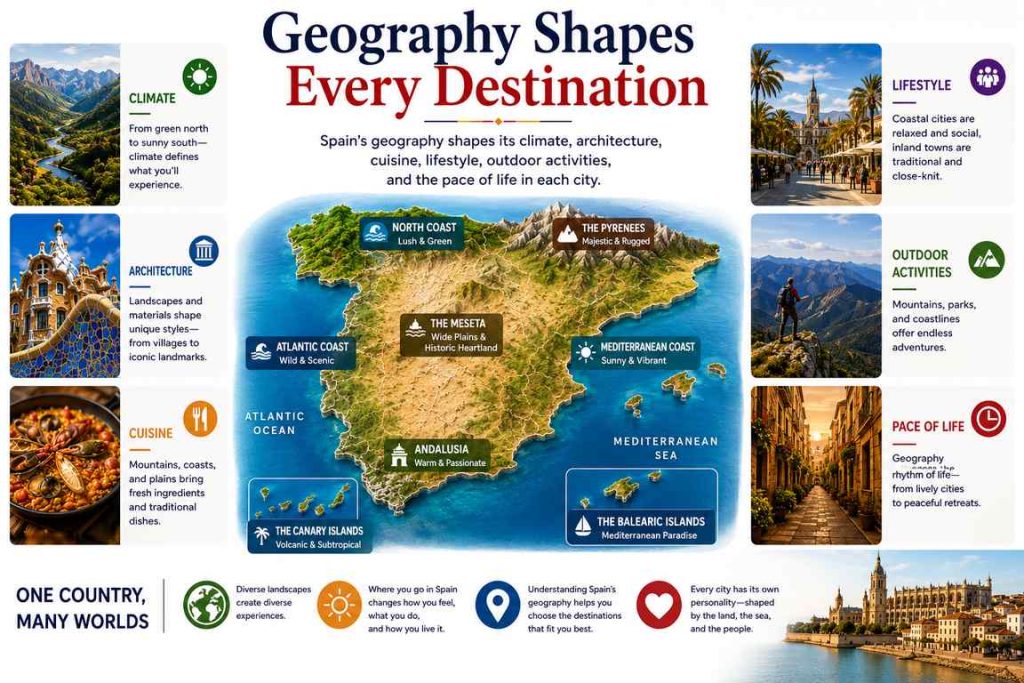
Geography Shapes Every Destination
Spain’s geography influences far more than its scenery — it shapes climate, architecture, cuisine, daily lifestyle, outdoor activities, and even the pace of life in each city.
- Barcelona and Valencia enjoy Mediterranean coastlines, sandy beaches, seafront promenades, and relatively mild winters.
- San Sebastián, on Spain’s northern Atlantic coast, experiences cooler temperatures, greener landscapes, and a noticeably different atmosphere.
- Madrid, sitting inland at the center of the country, is a capital defined by grand boulevards, museums, shopping districts, and royal landmarks.
- Granada and Seville showcase centuries of Islamic and Christian influence beneath the warm Andalusian sun.
These geographical differences ripple outward into local cuisine, architecture, weather, festivals, outdoor recreation, travel pace, and seasonal appeal. Rather than asking which city is objectively “better,” it’s far more useful to ask which environment matches the kind of vacation you actually want.
A History Written Into Every City
Spain’s cities are living museums, where every neighborhood reflects a different chapter of European history. Roman settlements, Visigothic kingdoms, Islamic dynasties, Christian monarchies, and modern architectural movements have all left their mark on the country’s urban landscapes — and each destination tends to highlight a different era.
- Barcelona combines medieval Gothic streets with Antoni Gaudí’s extraordinary Modernisme masterpieces, including the iconic Sagrada Família.
- Madrid reflects centuries of royal history through landmarks such as the Royal Palace and the Prado Museum.
- Seville blends Islamic and Christian influences, particularly at the magnificent Real Alcázar and Plaza de España.
- Granada preserves the Alhambra, one of Europe’s finest examples of Moorish architecture and a UNESCO World Heritage Site.
- Valencia contrasts its beautifully preserved Old Town with the futuristic City of Arts and Sciences.
- San Sebastián combines elegant Belle Époque architecture with one of the world’s most celebrated modern food cultures.
These historical differences often end up being one of the biggest deciding factors when travelers choose where to go.
Culture Changes from City to City
Spanish culture extends well beyond flamenco performances and traditional festivals. Every region has developed its own customs, celebrations, cuisine, music, and pace of life, and those differences shape what each city has to offer.
- Traditional flamenco performances are best experienced in Seville and elsewhere in Andalusia.
- Contemporary architecture and design draw travelers toward Barcelona.
- Classical art collections point naturally to Madrid.
- World-class gastronomy consistently leads visitors to San Sebastián.
- Mediterranean seaside living makes Valencia the natural choice for many.
Because these experiences are so deeply rooted in local tradition, they can’t simply be replicated by visiting a different city.
Food Is One of Spain’s Greatest Attractions
For many visitors, Spain’s cuisine is reason enough to explore multiple regions rather than settling into a single destination. Every area has developed signature dishes shaped by local ingredients, geography, and history: authentic paella in Valencia, pintxos throughout San Sebastián and the Basque Country, fresh seafood along both the Mediterranean and Atlantic coasts, and traditional Andalusian tapas in cities like Seville and Granada. These dishes travel well throughout the country, but tasting them where they originated adds a deeper appreciation of Spain’s regional identities.
Architecture Reflects Regional Identity
Architecture may be the easiest way to see Spain’s regional diversity in action. Rather than repeating similar skylines, each city reflects its own combination of historical influences, artistic movements, and local tradition, built up over centuries.
Barcelona is internationally recognized for Antoni Gaudí’s imaginative Modernisme architecture, with landmarks like the Sagrada Família, Park Güell, and Casa Batlló redefining what urban design can look like. Granada and Seville preserve some of Europe’s finest examples of Islamic architecture, where intricate geometric decoration, peaceful courtyards, gardens, and palaces reveal the lasting legacy of Al-Andalus — the Alhambra in Granada and the Real Alcázar in Seville remain among Spain’s most visited historical monuments.
Madrid presents a different identity altogether: wide boulevards, royal residences, elegant plazas, and nationally important museums that reflect its centuries-long role as Spain’s political and cultural capital. Valencia creates perhaps the country’s most striking contrast, placing its Gothic Silk Exchange, medieval cathedral, and historic center alongside the futuristic City of Arts and Sciences, one of Europe’s most recognizable modern architectural complexes. San Sebastián, meanwhile, combines elegant Belle Époque buildings with a stunning coastal setting, creating an atmosphere that feels both sophisticated and relaxed.
Rather than simply visiting different cities, travelers moving through Spain experience entirely different architectural traditions.
Not Every Great Spanish City Has a Beach
Many first-time visitors assume that all of Spain’s famous destinations offer beaches, but that’s far from true. Barcelona, Valencia, and San Sebastián successfully combine vibrant city life with excellent urban beaches, making them strong choices for travelers who want to balance sightseeing with time by the sea. Madrid and Granada, on the other hand, are inland destinations where the focus shifts toward museums, royal heritage, architecture, historic neighborhoods, and cultural depth rather than coastal recreation.
This distinction matters when you’re planning an itinerary. If beach time is essential, Barcelona, Valencia, or San Sebastián are naturally stronger choices. If your priorities lean toward art museums, historic monuments, palaces, or Moorish architecture, Madrid, Granada, and Seville tend to deliver a more rewarding experience. Sorting this out before booking accommodation or transportation can save you from one of the most common planning mistakes first-time visitors make.
Why There Isn’t One “Best” City
One of the biggest misconceptions about traveling in Spain is the belief that there’s a single “best” city everyone should visit. In reality, the ideal destination depends entirely on your interests, travel style, available time, and expectations.
Someone drawn to world-famous architecture may naturally rank Barcelona first. A museum enthusiast might consider Madrid the highlight of the entire trip because of institutions like the Prado Museum, Reina Sofía Museum, and Thyssen-Bornemisza National Museum. Travelers passionate about Islamic history and UNESCO World Heritage sites often place Granada at the top of their itinerary. Visitors hoping to experience traditional Andalusian culture, flamenco, orange-tree-lined plazas, and historic neighborhoods frequently choose Seville. Families looking for a balanced mix of beaches, science museums, cycling paths, and a relaxed Mediterranean atmosphere often prefer Valencia. And food lovers regularly rank San Sebastián among Europe’s finest culinary destinations thanks to its exceptional pintxos culture and concentration of Michelin-starred restaurants.
None of these choices is right or wrong — they simply reflect different priorities. The better question isn’t:
“Which city is the best?”
It’s:
“Which city is best for the kind of trip I want?”
That small shift in framing changes how you plan your entire journey. Instead of following someone else’s ranking, you start evaluating destinations against your own interests: architecture, history, beaches, gastronomy, museums, nightlife, family activities, or cultural immersion.
The rest of this guide follows that philosophy. Rather than assigning arbitrary rankings, every destination is evaluated using the same framework so you can compare cities fairly, understand their strengths and trade-offs, and confidently decide which ones belong on your itinerary.
How to Choose the Best City in Spain for Your Travel Style
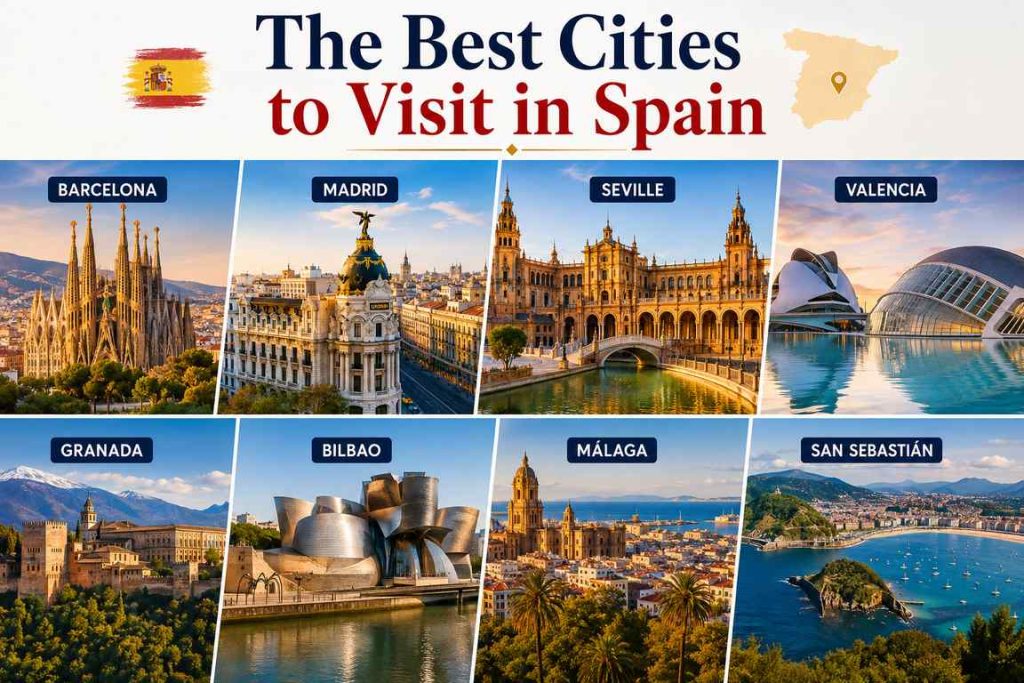
Choosing the best city to visit in Spain isn’t about finding the country’s most famous destination — it’s about finding the one that matches the trip you actually want. Barcelona, Madrid, Seville, Granada, Valencia, and San Sebastián all rank among Spain’s most rewarding cities, yet each delivers a completely different experience. Understanding those differences before booking flights or building an itinerary means more time enjoying your vacation and less time second-guessing your choices.
One of the biggest mistakes travelers make is picking cities simply because they top a “best places to visit” list. Popularity is useful for inspiration, but it shouldn’t make the decision for you. A history enthusiast may find Granada far more memorable than a beach destination, while someone craving relaxation could enjoy Valencia far more than Madrid’s fast-paced urban energy.
The best city isn’t necessarily Spain’s most famous one. It’s the one that fits your interests, travel pace, and expectations.
Destination Selection Framework
Use the framework below before locking in your itinerary. Instead of asking which city is “best,” figure out what matters most to you and let that guide the decision.
| Your Priority | Best Choice | Strong Alternative | Less Suitable If… |
|---|---|---|---|
| World-famous architecture | Barcelona | Granada | Beaches are your only priority |
| Museums and fine art | Madrid | Barcelona | You prefer smaller, quieter cities |
| Moorish history | Granada | Seville | You mainly want coastal relaxation |
| Beaches and city life | Valencia | Barcelona | Museums are your top priority |
| Food and gastronomy | San Sebastián | Valencia | You’re planning a very tight budget |
| Traditional Spanish culture | Seville | Granada | Modern nightlife is your main focus |
| Family-friendly vacation | Valencia | Barcelona | You only have a weekend to explore |
| Romantic getaway | Granada | San Sebastián | You want nonstop nightlife |
| First trip to Spain | Barcelona | Madrid | You’re specifically seeking quieter destinations |
| Slow-paced vacation | San Sebastián | Valencia | You want to see multiple major landmarks every day |
These recommendations aren’t rigid rules. They’re simply a way to narrow your options based on what you’re likely to enjoy most.
Start by Defining Your Travel Priorities
Before comparing destinations, ask yourself a simple question: what kind of experience do I want from this trip?
Most travelers gravitate toward one or more of the following: historic landmarks, world-famous architecture, museums and art, beaches, food and local cuisine, nightlife, family attractions, outdoor activities, relaxed coastal living, luxury travel, or budget-friendly sightseeing.
Once you’ve identified your priorities, choosing destinations gets much easier. If architecture is your main interest, Barcelona immediately stands out thanks to Antoni Gaudí’s masterpieces. If museums and royal heritage matter most, Madrid deserves serious consideration. If Moorish history fascinates you, Granada and Seville should move toward the top of your list. If you want beaches without giving up cultural attractions, Valencia offers one of Spain’s best balances. And if food is the highlight of every trip you take, San Sebastián is hard to overlook.
Instead of asking which city is the best, ask which city gives you more of what you enjoy. That single shift often leads to a much better itinerary.
Consider How Much Time You Have
The amount of time you have can completely reshape which cities make sense. A traveler with four or five days should usually focus on one destination, or perhaps two nearby cities — trying to cram Barcelona, Madrid, Seville, and Granada into a single week often means spending more time on trains and flights than actually exploring.
Longer trips open the door to Spain’s regional diversity. With two weeks or more, you can comfortably combine Mediterranean cities, Andalusia, central Spain, and the northern coast without feeling rushed.
| Trip Length | Recommended Number of Cities | Best Approach |
|---|---|---|
| 3–4 Days | 1 City | Explore deeply rather than rushing |
| 5–7 Days | 2 Cities | Choose destinations with good transport connections |
| 8–10 Days | 3 Cities | Combine different regions for variety |
| 11–14 Days | 3–5 Cities | Experience Spain’s regional diversity at a comfortable pace |
| More than 2 Weeks | 5+ Cities | Explore multiple regions while allowing time to slow down |
More destinations don’t automatically make for a better vacation. Wandering local neighborhoods, lingering over long meals, or stumbling onto hidden streets often becomes more memorable than rushing between famous landmarks.
Think About the Pace of Your Vacation
Not every traveler wants the same kind of trip. Some want full sightseeing days from morning until evening; others prefer long lunches, beach afternoons, and unhurried walks through historic streets. Spain accommodates both styles exceptionally well.
Ask yourself whether you’d rather spend your days in museums, relaxing on the beach, wandering historic neighborhoods without a strict schedule, sitting in local cafés, enjoying nightlife, or striking a balance between sightseeing and rest.
Madrid offers a fast-paced urban atmosphere filled with museums, shopping districts, plazas, and late-night dining. San Sebastián encourages a slower rhythm built around beaches, coastal walks, exceptional restaurants, and relaxed evenings. Valencia often sits comfortably between those extremes, combining city attractions with the chance to slow down by the Mediterranean.
Neither approach is better. The right choice depends entirely on how you like to travel.
Match Cities to Your Interests
One of the easiest ways to narrow your options is to line up destinations against the experiences you value most.
| If You Love… | Cities Worth Prioritizing | Why They Stand Out |
|---|---|---|
| Architecture | Barcelona, Granada | Gaudí’s masterpieces and Moorish palaces |
| Museums and Art | Madrid | Spain’s finest national museums |
| History | Granada, Seville | Medieval, Islamic, and royal heritage |
| Beaches | Valencia, Barcelona, San Sebastián | Excellent urban beaches and coastal scenery |
| Food | San Sebastián, Valencia, Madrid | Pintxos, paella, tapas, and fine dining |
| Traditional Culture | Seville, Granada | Flamenco, festivals, and Andalusian traditions |
| Relaxation | Valencia, San Sebastián | Slower pace and waterfront promenades |
| Modern City Life | Barcelona, Madrid | Shopping, nightlife, architecture, and entertainment |
Notice that several cities show up more than once. That’s because no destination offers just one kind of experience. Barcelona appeals to architecture enthusiasts, beach lovers, and nightlife seekers alike, while Valencia draws families, food lovers, and travelers after a more relaxed Mediterranean atmosphere.
Budget Matters — But Not Always in the Way You Expect
Travel costs vary across Spain, but choosing a destination purely because it’s the “cheapest” often leads to the wrong decision. Accommodation prices, transportation, dining costs, and attraction fees all fluctuate throughout the year, especially during summer, Easter (Semana Santa), and major local festivals.
Generally speaking, Barcelona and San Sebastián rank among Spain’s pricier destinations, particularly in peak season. Madrid offers the widest range of accommodation, which makes it easier to find something for almost any budget. Valencia strikes an excellent balance between affordability and quality, especially outside the busiest summer months. Granada and Seville can deliver outstanding value, though prices climb sharply during popular festivals and holidays.
Rather than asking which city is cheapest, it’s worth asking whether you’ll spend more on accommodation or sightseeing, whether you’re comfortable relying on public transportation, how often you plan to eat out, and whether saving money matters more than experiencing your preferred destination. Choosing the city that fits your interests often delivers better value than picking one simply because it costs less.
Don’t Assume Bigger Cities Offer Better Experiences
Many first-time visitors automatically gravitate toward Barcelona and Madrid because they’re Spain’s largest and most internationally recognized cities. There’s nothing wrong with that; both are exceptional destinations. But size doesn’t always translate into a better travel experience, and some smaller cities leave a stronger impression precisely because they offer a more focused one.
Granada is home to the Alhambra, one of Europe’s greatest palace complexes and one of Spain’s most iconic landmarks. Seville delivers an authentic blend of history, architecture, flamenco, and Andalusian culture that many travelers consider the essence of southern Spain. Valencia combines beaches, green spaces, modern architecture, and a more relaxed atmosphere than Barcelona. And San Sebastián has built an international culinary reputation despite having a fraction of the population of Spain’s largest cities.
Popularity should help you discover destinations. It shouldn’t decide your itinerary for you. The goal isn’t to visit the biggest cities; it’s to visit the ones you’ll actually enjoy the most.
Think About What You Don’t Want
Choosing where to go also means deciding what you’d rather avoid. Many travelers focus exclusively on what they want to experience, but ruling out unsuitable destinations often leads to a much better itinerary.
Ask yourself whether you dislike large crowds, whether you’re comfortable walking long distances every day, whether museums genuinely interest you, whether nightlife matters, and whether you’d rather relax than follow a packed sightseeing schedule.
If you dislike crowded tourist areas, spending your entire trip in Spain’s busiest cities may wear you down. If museums don’t particularly interest you, Madrid’s celebrated art collections may hold less appeal than Valencia’s beaches or San Sebastián’s coastal atmosphere. And if your ideal vacation involves slow mornings, seaside walks, and long lunches, a fast-paced city itinerary probably won’t deliver what you’re after. Sometimes the easiest way to choose the right city is by first ruling out the wrong one.
Consider Seasonal Differences
The time of year can dramatically change your experience in any Spanish city. A destination that feels perfect in spring may feel entirely different at the height of summer, so understanding seasonal shifts helps you set realistic expectations and choose cities that suit your travel dates.
| Season | What to Expect | Cities That Often Shine |
|---|---|---|
| Spring (March–May) | Pleasant temperatures, blooming parks, ideal sightseeing weather | Seville, Granada, Madrid, Valencia |
| Summer (June–August) | Hot inland temperatures, busy beaches, peak tourist season | Barcelona, Valencia, San Sebastián |
| Autumn (September–November) | Comfortable weather, fewer crowds, excellent cultural sightseeing | Madrid, Barcelona, Granada |
| Winter (December–February) | Cooler temperatures, festive holiday atmosphere, fewer tourists in many destinations | Madrid, Seville, Granada |
Seasonality also shapes accommodation prices, attraction queues, and overall travel pace. Southern cities like Seville and Granada can turn brutally hot during midsummer afternoons, while San Sebastián’s Atlantic climate stays generally milder, making it especially appealing in warmer months. Barcelona and Valencia combine pleasant coastal weather with beaches that peak in popularity over summer, and Madrid offers excellent museums year-round while swinging between hot summers and cool winters. Matching your city choices to both your interests and your travel season usually results in a far more enjoyable trip.
Should You Focus on One Region or Explore Several?
Another key decision is whether to immerse yourself in a single region or sample several parts of Spain in one trip. Neither approach is universally better. It comes down to your available time and priorities.
Choose one region if you want to travel at a slower pace, spend less time on transportation, dig deeper into local culture, and discover smaller towns alongside major cities. Good examples include Barcelona paired with Girona and Costa Brava, Seville with Granada and Córdoba, or San Sebastián with Bilbao and the Basque coast.
Explore multiple regions if you want to experience Spain’s cultural diversity, compare architectural styles, enjoy both coastal and inland destinations, and sample different regional cuisines. Combinations like Barcelona + Madrid + Seville, Valencia + Granada + Madrid, or San Sebastián + Bilbao + Barcelona work well here.
Travelers with a week or less generally benefit from focusing on one or two connected regions. Longer trips offer more flexibility to experience Spain’s diversity without constantly rushing between destinations.
A Simple Decision Framework
If you’re still unsure where to begin, work through these questions in order. Each answer narrows your options a little further.
Step 1: What interests you most? Architecture, history, museums, beaches, food, nightlife, relaxation, or family activities.
Step 2: How much time do you have? A long weekend, 5–7 days, 8–10 days, or two weeks or longer.
Step 3: What travel pace do you prefer? Busy sightseeing, balanced exploration, or slow travel.
Step 4: Who are you traveling with? Solo, as a couple, with family, or with friends.
Step 5: What atmosphere do you enjoy? Cosmopolitan, historic, coastal, food-focused, relaxed, or traditional.
By the time you’ve worked through these five questions, you’ll usually find that only two or three cities clearly fit what you’re after, and that’s exactly the outcome you want.
Remember: The Best City Depends on You
There isn’t a universally perfect city in Spain, because every traveler values different things. Barcelona excels in architecture, creativity, and Mediterranean energy. Madrid stands out for museums, royal heritage, shopping, and urban culture. Seville showcases iconic Andalusian traditions, flamenco, and centuries of history. Granada combines one of Europe’s greatest architectural masterpieces with a compact, walkable historic center. Valencia balances beaches, modern attractions, excellent food, and a relaxed coastal lifestyle. San Sebastián offers one of Europe’s finest culinary scenes alongside spectacular Atlantic scenery.
Each destination excels for its own reasons. Instead of asking which city deserves the top spot, ask which one best matches the vacation you actually want.
The next section evaluates Spain’s leading destinations using the same criteria: highlights, ideal travelers, atmosphere, strengths, trade-offs, and practical considerations, so you can compare them side by side and confidently choose which ones belong on your itinerary.
The Best Cities to Visit in Spain
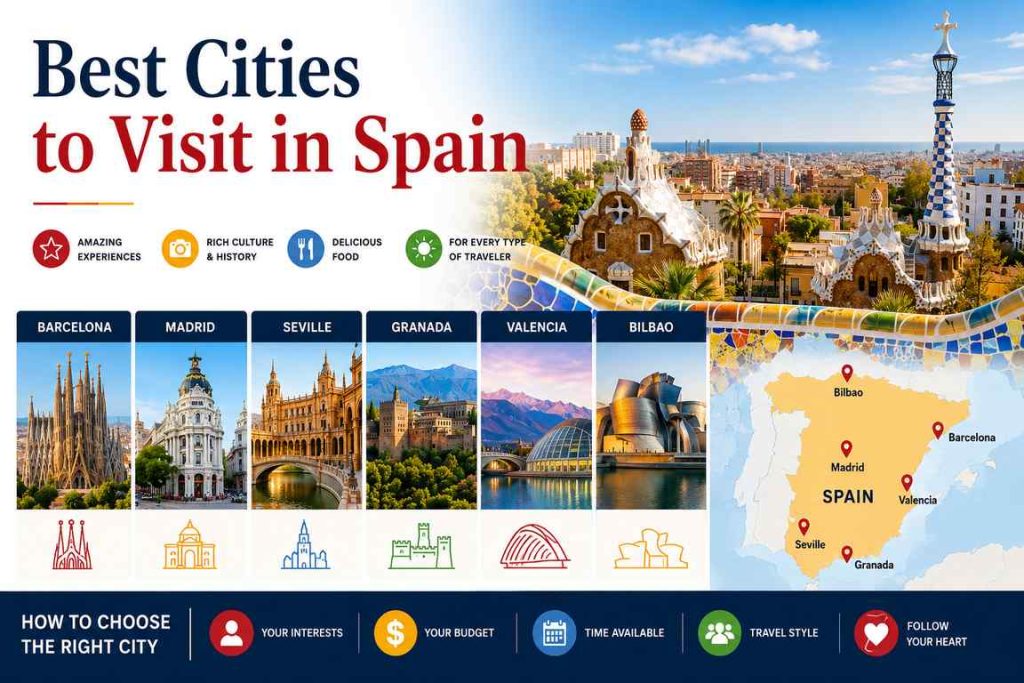
Every traveler imagines a different version of the perfect Spanish vacation. Some want to admire world-famous architecture, while others dream of relaxing on Mediterranean beaches, wandering centuries-old streets, discovering UNESCO World Heritage sites, or diving into Spain’s legendary food culture. Rather than ranking cities on popularity alone, it’s more useful to evaluate them against the same criteria so you can identify which ones genuinely fit your travel style.
The six cities below consistently rank among Spain’s most rewarding destinations because each offers its own distinctive mix of history, culture, architecture, cuisine, atmosphere, and attractions. Instead of crowning one absolute winner, this guide explains who each city is best for, what makes it special, and when it might not be the right choice.
City Comparison Summary
| City | Best For | Signature Attractions | Atmosphere | Recommended Stay | Biggest Strength | Consider Another City If… |
|---|---|---|---|---|---|---|
| Barcelona | First-time visitors, architecture lovers | Sagrada Família, Park Güell, Gothic Quarter | Cosmopolitan, creative, Mediterranean | 3–4 days | Architecture, beaches, nightlife | You prefer quieter destinations or traditional Andalusian culture |
| Madrid | Museums, art, royal heritage | Prado Museum, Royal Palace, Plaza Mayor | Energetic, sophisticated | 2–3 days | World-class museums and urban culture | Beaches are essential to your trip |
| Seville | Traditional Spanish culture | Real Alcázar, Plaza de España, Seville Cathedral | Historic, romantic, lively | 2–3 days | Flamenco and Andalusian heritage | You’re visiting during peak summer and dislike extreme heat |
| Granada | History lovers | Alhambra, Albaicín | Historic, compact, atmospheric | 2 days | Moorish architecture and UNESCO heritage | You’re mainly looking for beaches or nightlife |
| Valencia | Families, relaxed city breaks | City of Arts and Sciences, Malvarrosa Beach | Modern yet traditional | 2–3 days | Excellent balance of city life and beaches | Museums are your highest priority |
| San Sebastián | Food lovers, couples | La Concha Beach, Old Town | Elegant, relaxed | 2–3 days | World-renowned gastronomy | You’re traveling on a tight budget |
No city scores highest across every category. Each excels in different areas, which is exactly why personal priorities matter more than popularity alone.
Barcelona: Spain’s Most Iconic City for Architecture, Beaches, and First-Time Visitors
Barcelona is often the first city international travelers associate with Spain, and for good reason. Few European destinations combine world-famous architecture, Mediterranean beaches, vibrant neighborhoods, exceptional dining, and energetic nightlife as successfully as Catalonia’s capital.
The city feels simultaneously historic and modern. Medieval streets lead to cutting-edge architecture, lively markets sit alongside Michelin-starred restaurants, and relaxing beaches lie within walking distance of some of Europe’s most recognizable landmarks. For many first-time visitors, Barcelona offers the broadest introduction to Spain simply because it fits so many travel experiences into one place.
Why Visit Barcelona?
Barcelona rewards travelers looking for variety. Within a single day you can visit Antoni Gaudí’s extraordinary Sagrada Família, wander the narrow streets of the Gothic Quarter, relax at Barceloneta Beach, browse local food markets like La Boqueria, take in rooftop views over the Mediterranean, and dive into one of Europe’s liveliest dining and nightlife scenes, all without long travel times between attractions.
Top Attractions in Barcelona
Barcelona’s landmarks span more than two thousand years of history:
- Sagrada Família – Antoni Gaudí’s unfinished masterpiece and one of Europe’s most recognizable landmarks.
- Park Güell – A colorful hilltop park showcasing Gaudí’s distinctive architectural style.
- Casa Batlló and Casa Milà (La Pedrera) – Two iconic examples of Catalan Modernisme.
- The Gothic Quarter – Medieval streets, hidden squares, and centuries of history.
- La Rambla – Barcelona’s famous pedestrian boulevard connecting Plaça de Catalunya with the waterfront.
- La Boqueria Market – One of Spain’s best-known food markets.
- Barceloneta Beach – An easily accessible urban beach ideal for relaxing after sightseeing.
- Montjuïc Hill – Museums, gardens, panoramic viewpoints, and a historic castle overlooking the city.
What Makes Barcelona Unique?
Few cities combine so many strengths so effectively: UNESCO-recognized Modernisme architecture, Mediterranean beaches within city limits, an international dining scene, excellent public transportation, walkable neighborhoods, a rich cultural calendar, outstanding shopping, and vibrant nightlife. For travelers wanting a little of everything, Barcelona is hard to beat.
Who Should Visit Barcelona?
Barcelona suits first-time visitors to Spain, architecture enthusiasts, couples, friends traveling together, travelers who want both beaches and sightseeing, art and design lovers, nightlife seekers, and anyone planning a short city break. It also works well as the starting point for longer Spanish itineraries thanks to its strong international flight connections and high-speed rail links.
Potential Drawbacks
Barcelona may not be the ideal choice if you prefer quiet towns over busy international cities, want an itinerary centered on traditional Andalusian culture, dislike crowds (especially in summer), or are traveling on a tight budget during peak season. Accommodation prices and attraction queues climb considerably between June and August, particularly around landmarks like the Sagrada Família and Park Güell.
How Long Should You Stay?
Recommended stay: 3–4 days. That’s enough time to visit the major landmarks, explore several neighborhoods, spend time at the beach, dig into local food culture, and still enjoy at least one relaxed evening without feeling rushed. Travelers with extra days can add trips to Montserrat, Girona, or the Costa Brava.
Barcelona at a Glance
| Category | Rating |
|---|---|
| Architecture | ⭐⭐⭐⭐⭐ |
| Museums | ⭐⭐⭐⭐☆ |
| Beaches | ⭐⭐⭐⭐☆ |
| Food | ⭐⭐⭐⭐☆ |
| Nightlife | ⭐⭐⭐⭐⭐ |
| Family Friendly | ⭐⭐⭐⭐☆ |
| Budget Friendly | ⭐⭐⭐☆☆ |
| Walkability | ⭐⭐⭐⭐⭐ |
Should You Choose Barcelona?
Choose Barcelona if you want Spain’s most complete all-round city experience, especially on a first visit. It delivers an outstanding mix of architecture, beaches, culture, food, and nightlife that few European cities can match. But if your priorities lean toward world-class museums, royal history, or a quieter atmosphere, Madrid, Granada, or Valencia may suit you better.
Madrid: Spain’s Cultural Capital for Museums, Royal Heritage, and Urban Experiences
As Spain’s capital, Madrid offers a completely different experience from Barcelona. Where Barcelona is defined by Mediterranean beaches and Modernisme architecture, Madrid stands out for its grand boulevards, royal landmarks, internationally renowned museums, elegant parks, and vibrant urban atmosphere.
The city doesn’t rely on a single iconic attraction; its appeal comes from the depth and variety of what’s on offer. Art lovers can spend days exploring some of Europe’s greatest museums, history enthusiasts can trace centuries of royal heritage, and food lovers will find everything from traditional taverns to innovative Michelin-starred restaurants. Madrid is energetic, sophisticated, and unmistakably Spanish; if you want to experience the country’s political, artistic, and cultural heart, few destinations compare.
Why Visit Madrid?
Madrid suits travelers who enjoy culture, museums, architecture, shopping, and city life. Unlike many European capitals, it pairs monumental architecture with an approachable atmosphere: elegant plazas, leafy parks, lively markets, and pedestrian-friendly neighborhoods all encourage visitors to slow down and explore beyond the headline attractions. The city is also one of Spain’s key transportation hubs, making it an excellent base for day trips to Toledo, Segovia, or Ávila.
Top Attractions in Madrid
Madrid’s highlights reflect its royal history and cultural weight:
- Prado Museum – Home to masterpieces by Velázquez, Goya, El Greco, Rubens, and other European masters.
- Royal Palace of Madrid – One of Europe’s largest royal residences and the official palace of the Spanish monarchy.
- Plaza Mayor – Madrid’s historic central square, surrounded by traditional cafés and centuries-old buildings.
- Puerta del Sol – The symbolic center of Spain and one of the city’s busiest gathering places.
- Retiro Park – A beautiful urban park with gardens, boating lakes, sculptures, and the famous Crystal Palace.
- Reina Sofía Museum – Best known for Pablo Picasso’s Guernica alongside important modern art collections.
- Thyssen-Bornemisza National Museum – Completing Madrid’s famous “Golden Triangle of Art” with works spanning several centuries.
- Gran Vía – Madrid’s lively shopping and entertainment boulevard.
What Makes Madrid Unique?
Madrid’s greatest strength is its concentration of world-class cultural institutions. Where coastal destinations balance sightseeing with beach time, Madrid focuses squarely on museums, history, gastronomy, architecture, and urban life, backed by Spain’s finest museum collections, royal palaces, outstanding shopping, an excellent tapas culture, beautiful parks, strong rail connections to the rest of the country, and nightlife that runs well into the evening. Madrid rewards travelers who like discovering a city through its neighborhoods rather than rushing between famous landmarks.
Who Should Visit Madrid?
Madrid is a strong fit for museum enthusiasts, art lovers, history buffs, couples, solo travelers, food enthusiasts, luxury travelers, anyone drawn to Spanish royal history, and travelers exploring central Spain. It’s also an excellent choice for repeat visitors who’ve already experienced Barcelona and want a different angle on the country.
Potential Drawbacks
Madrid may not be the ideal destination if beach time or a coastal atmosphere is your priority. Some travelers also find it less visually dramatic than Barcelona, hot in midsummer, busy year-round around major attractions, and better suited to sightseeing than relaxation. If beaches are essential, Valencia or Barcelona are likely stronger choices.
How Long Should You Stay?
Recommended stay: 2–3 days. That’s enough time to visit the leading museums, tour the Royal Palace, explore historic neighborhoods, unwind in Retiro Park, and sample the city’s renowned food scene. Travelers with extra time often add day trips to Toledo, Segovia, or Ávila, all easily reached by high-speed rail.
Madrid at a Glance
| Category | Rating |
|---|---|
| Architecture | ⭐⭐⭐⭐☆ |
| Museums | ⭐⭐⭐⭐⭐ |
| History | ⭐⭐⭐⭐⭐ |
| Food | ⭐⭐⭐⭐☆ |
| Nightlife | ⭐⭐⭐⭐⭐ |
| Family Friendly | ⭐⭐⭐⭐☆ |
| Budget Friendly | ⭐⭐⭐☆☆ |
| Walkability | ⭐⭐⭐⭐☆ |
Barcelona vs Madrid: Which Should You Choose?
One of the most common questions travelers ask is whether Barcelona or Madrid deserves priority. The answer depends on the trip you want.
| Choose Barcelona If… | Choose Madrid If… |
|---|---|
| You want beaches alongside sightseeing | Museums are your highest priority |
| Architecture fascinates you | Royal history interests you |
| You enjoy Mediterranean coastal cities | You prefer grand boulevards and elegant plazas |
| Nightlife and beach culture appeal to you | Art galleries and historic neighborhoods are your focus |
| It’s your first visit to Spain | You’ve already visited Barcelona or want a more traditional capital city experience |
If you only have time for one city, Barcelona generally offers greater variety, combining architecture, beaches, nightlife, and culture. But if your interests center on museums, history, and urban exploration, Madrid may prove the richer choice.
Seville: The Heart of Andalusian Culture and Flamenco
Few cities capture the image many travelers hold of traditional Spain better than Seville. As the capital of Andalusia, it’s known for flamenco, orange-tree-lined squares, magnificent palaces, historic churches, lively tapas bars, and centuries of cultural heritage.
Walking through Seville feels quite different from exploring Barcelona or Madrid. Instead of broad boulevards and modern skylines, you’ll find winding streets, shaded courtyards, horse-drawn carriages, colorful ceramic tiles, and neighborhoods where daily life still revolves around local cafés and plazas. For travelers seeking authentic Andalusian culture, Seville is often the definitive stop.
Why Visit Seville?
Seville offers one of Spain’s richest combinations of history, architecture, gastronomy, and local tradition. It’s especially appealing if you’re drawn to flamenco performances, Moorish and Christian architecture, historic neighborhoods, traditional tapas culture, spring festivals such as Semana Santa and Feria de Abril, or simply a romantic evening walk. Unlike Spain’s larger metropolitan areas, Seville encourages a slower pace, with long evenings in plazas, riverside walks, and outdoor dining.
Top Attractions in Seville
Some of Spain’s most iconic landmarks call Seville home:
- Real Alcázar of Seville – A UNESCO World Heritage Site and one of Europe’s oldest royal palaces still in use.
- Seville Cathedral – The world’s largest Gothic cathedral, traditionally associated with the resting place of Christopher Columbus.
- La Giralda – The cathedral’s famous bell tower, originally built as a minaret during the Almohad period.
- Plaza de España – One of Spain’s most photographed public squares, known for its canals, ceramic benches, and grand architecture.
- Barrio Santa Cruz – A maze of narrow streets, flower-filled courtyards, and traditional Andalusian charm.
- Metropol Parasol (Las Setas) – A striking modern landmark with panoramic views over the historic city.
- Guadalquivir River – Perfect for scenic walks and river cruises.
What Makes Seville Unique?
Seville has an atmosphere unlike any other major Spanish city: the birthplace of many flamenco traditions, rich Moorish and Christian heritage, exceptional tapas culture, beautiful plazas and historic neighborhoods, vibrant festivals year-round, and a walkable center packed with architectural landmarks. Rather than competing with Barcelona’s beaches or Madrid’s museums, Seville wins on cultural identity alone.
Who Should Visit Seville?
Seville suits history enthusiasts, couples, culture-focused travelers, photography lovers, food enthusiasts, first-time visitors exploring Andalusia, and anyone seeking traditional Spanish experiences. It also pairs beautifully with nearby Granada and Córdoba for a deeper dive into southern Spain.
Potential Drawbacks
Seville isn’t the perfect choice for every traveler. Consider another city if you prefer beaches and coastal activities, dislike extreme heat, want to spend most of your trip in large museums, or prefer a faster-paced metropolitan atmosphere. Seville sees some of the hottest summer temperatures in Europe, with daytime highs frequently topping 40°C (104°F) in July and August, so heat-sensitive travelers should lean toward spring or autumn instead. Museum-focused travelers may find Madrid more rewarding, while those wanting to pair sightseeing with beach time may prefer Valencia or Barcelona.
How Long Should You Stay?
Recommended stay: 2–3 days. That’s enough time to explore the Real Alcázar, visit Seville Cathedral and La Giralda, wander Barrio Santa Cruz, catch authentic flamenco, sample traditional tapas bars, and spend an evening around Plaza de España and the Guadalquivir River. If you’re touring Andalusia, Seville also pairs exceptionally well with Granada and Córdoba.
Seville at a Glance
| Category | Rating |
|---|---|
| History | ⭐⭐⭐⭐⭐ |
| Architecture | ⭐⭐⭐⭐⭐ |
| Museums | ⭐⭐⭐⭐☆ |
| Food | ⭐⭐⭐⭐⭐ |
| Nightlife | ⭐⭐⭐⭐☆ |
| Beaches | ⭐⭐☆☆☆ |
| Family Friendly | ⭐⭐⭐⭐☆ |
| Romantic Atmosphere | ⭐⭐⭐⭐⭐ |
Seville vs Granada: Which Should You Choose?
Many travelers struggle to decide between Seville and Granada, since both rank among Andalusia’s most celebrated destinations. The good news: they complement each other far more than they compete.
| Choose Seville If… | Choose Granada If… |
|---|---|
| You want a larger city with more attractions | You prefer a compact, walkable historic city |
| Flamenco and Andalusian traditions are your priority | The Alhambra is at the top of your bucket list |
| You enjoy lively plazas and nightlife | You enjoy slower sightseeing and mountain scenery |
| You want several days of sightseeing | You have only one or two days available |
| Food culture and tapas are major priorities | Medieval history and Islamic architecture interest you most |
If your itinerary allows it, visiting both cities delivers one of Spain’s richest cultural experiences. They’re connected by excellent transport and together capture very different sides of Andalusia’s heritage.
Granada: Spain’s Greatest Moorish Treasure
Granada is one of Spain’s most unforgettable destinations because it preserves a chapter of history found almost nowhere else in Western Europe. Set at the foot of the Sierra Nevada mountains, the city combines spectacular Islamic architecture, medieval neighborhoods, mountain views, and a relaxed atmosphere that sets it apart from Spain’s larger metropolitan areas.
Although smaller than Barcelona, Madrid, or Seville, Granada consistently ranks among visitors’ favorite Spanish cities thanks to the extraordinary beauty of the Alhambra, one of the world’s greatest palace complexes and a UNESCO World Heritage Site. For travelers drawn to history, architecture, and cultural heritage, Granada often becomes the highlight of an entire Spanish itinerary.
Why Visit Granada?
Granada’s appeal lies in its remarkable blend of Moorish architecture, medieval streets, Christian monuments, mountain scenery, traditional tapas culture, and an unhurried pace of life. Unlike larger cities where attractions sprawl across wide urban areas, Granada’s historic center is compact and easy to explore on foot, which also creates a more intimate atmosphere, leaving you more time to enjoy the surroundings and less time navigating transportation.
Top Attractions in Granada
Granada’s attractions are deeply tied to its fascinating history:
- The Alhambra – Spain’s most famous Islamic palace complex, renowned for its intricate carvings, courtyards, gardens, and panoramic views.
- Generalife Gardens – Beautiful royal gardens that once served as the Nasrid rulers’ summer residence.
- Albaicín – Granada’s historic Moorish quarter, filled with narrow streets, whitewashed houses, and spectacular viewpoints.
- Mirador de San Nicolás – One of Spain’s most famous viewpoints, with breathtaking views of the Alhambra against the Sierra Nevada mountains.
- Granada Cathedral – A masterpiece of Spanish Renaissance architecture.
- Royal Chapel – The burial place of Queen Isabella I and King Ferdinand II, whose reign transformed Spanish history.
- Sacromonte – A hillside neighborhood known for cave dwellings, flamenco performances, and sweeping city views.
What Makes Granada Unique?
Granada preserves one of Europe’s most complete examples of Islamic civilization. Many Spanish cities carry traces of Moorish influence, but none rivals the architectural and historical weight of the Alhambra. Add in one of Spain’s most walkable historic centers, dramatic mountain scenery, a traditional tapas culture (complimentary tapas still commonly accompany drinks in many local spots), a relaxed atmosphere built for slow exploration, and a genuine blend of Christian and Islamic heritage, and it’s clear Granada isn’t defined by its size. It’s defined by the depth of its history.
Who Should Visit Granada?
Granada is particularly well suited to history enthusiasts, architecture lovers, UNESCO World Heritage travelers, couples, photographers, cultural travelers, anyone exploring Andalusia, and travelers who want a slower-paced city experience. It’s especially rewarding for those curious about Spain’s Islamic heritage and the historical transition between Muslim and Christian rule on the Iberian Peninsula.
Potential Drawbacks
Granada’s compact size is one of its strengths, but it also means fewer large museums, shopping districts, and nightlife options than Madrid or Barcelona. It may not be the best fit if you want a fast-paced metropolitan experience, plan to spend several days shopping or museum-hopping, prefer beaches within the city, or want extensive nightlife every evening. Also worth noting: the Alhambra, as Spain’s most visited monument, often sells out well in advance, particularly during spring, summer, and holidays, so booking your entry several weeks or even months ahead is strongly recommended if the palace is a priority.
How Long Should You Stay?
Recommended stay: 2 days. That’s usually enough time to explore the Alhambra and Generalife Gardens, wander through Albaicín, watch the sunset from Mirador de San Nicolás, visit Granada Cathedral and the Royal Chapel, sample traditional tapas bars, and explore Sacromonte’s unique cave district. Travelers with extra time can add day trips into the Sierra Nevada National Park or nearby white villages of Andalusia.
Granada at a Glance
| Category | Rating |
|---|---|
| History | ⭐⭐⭐⭐⭐ |
| Architecture | ⭐⭐⭐⭐⭐ |
| Museums | ⭐⭐⭐☆☆ |
| Food | ⭐⭐⭐⭐☆ |
| Beaches | ⭐☆☆☆☆ |
| Romantic Atmosphere | ⭐⭐⭐⭐⭐ |
| Family Friendly | ⭐⭐⭐⭐☆ |
| Walkability | ⭐⭐⭐⭐⭐ |
Should You Choose Granada?
Choose Granada if your ideal trip revolves around history, UNESCO World Heritage sites, Islamic architecture, and exploring one of Spain’s most atmospheric historic cities. But if you’re after beaches, a lively modern nightlife scene, or a wider variety of museums and shopping, Barcelona, Madrid, or Valencia may suit you better.
Valencia: Spain’s Perfect Balance of Beaches, Culture, and Modern Innovation
Valencia often surprises first-time visitors. Although it’s Spain’s third-largest city, it draws far fewer international tourists than Barcelona or Madrid, which lets travelers enjoy a more relaxed atmosphere without giving up major attractions.
The city successfully combines historic neighborhoods, modern architecture, long sandy beaches, outstanding food, and generous green space, arguably one of Spain’s best balances between sightseeing and relaxation, which makes it especially attractive for families, couples, and anyone who prefers a slower pace. As the birthplace of paella, it’s also essential territory for food lovers.
Why Visit Valencia?
Valencia appeals to travelers who want variety without the intensity of Spain’s busiest cities. Spend the morning exploring medieval streets, the afternoon touring one of Europe’s most impressive contemporary architectural complexes, relax on Mediterranean beaches, cycle through extensive urban parks, and finish the evening with authentic Valencian cuisine. Few Spanish cities pull all of this together so effortlessly.
Top Attractions in Valencia
Valencia offers an excellent mix of historic and modern landmarks:
- City of Arts and Sciences – A spectacular architectural complex housing museums, an aquarium, and cultural venues.
- Oceanogràfic Valencia – Europe’s largest aquarium and one of the city’s most popular family attractions.
- Valencia Cathedral – A beautiful cathedral blending Gothic, Romanesque, and Baroque architecture.
- La Lonja de la Seda (Silk Exchange) – A UNESCO World Heritage Site and one of Europe’s finest examples of Gothic civil architecture.
- Central Market (Mercado Central) – One of Europe’s largest fresh food markets.
- Turia Gardens – A former riverbed transformed into a nine-kilometer green park crossing the city.
- Malvarrosa Beach – A wide urban beach perfect for relaxing after sightseeing.
- El Cabanyal – A colorful seaside district known for traditional architecture and seafood restaurants.
What Makes Valencia Unique?
Valencia stands out because it bridges Spain’s past and future rather than choosing one over the other. Its strengths include excellent urban beaches, futuristic architecture, a historic Old Town, outstanding cycling infrastructure, a relaxed Mediterranean lifestyle, its authentic claim as the birthplace of paella, family-friendly attractions, and noticeably lower visitor density than Barcelona. That combination makes it particularly attractive for travelers after a balanced vacation.
Who Should Visit Valencia?
Valencia is especially well suited to families with children, couples, beach lovers, food enthusiasts, first-time visitors who want a less crowded destination, cyclists, travelers combining culture with relaxation, and anyone looking for good value compared with Spain’s busiest cities. Its flat terrain, efficient public transportation, and walkable neighborhoods also make it one of Spain’s easiest cities to explore.
Potential Drawbacks
Despite its diversity, Valencia may not be ideal for every traveler. Consider another city if you want Spain’s largest museum collections, prioritize world-famous architectural icons like the Sagrada Família, seek nightlife on par with Barcelona or Madrid, or want the dramatic mountain scenery found around Granada. Valencia excels through balance rather than extremes. It may not top every individual category, but it performs strongly across nearly all of them, which is exactly what makes it one of Spain’s most versatile destinations.
How Long Should You Stay?
Recommended stay: 2–3 days. That’s enough time to explore the City of Arts and Sciences, visit the historic center, walk through Turia Gardens, spend time at Malvarrosa Beach, sample authentic Valencian cuisine, and browse local markets and waterfront neighborhoods. Travelers with extra time can also visit nearby Albufera Natural Park, known for its rice fields, boat rides, and traditional paella restaurants.
Valencia at a Glance
| Category | Rating |
|---|---|
| Beaches | ⭐⭐⭐⭐⭐ |
| Architecture | ⭐⭐⭐⭐☆ |
| History | ⭐⭐⭐⭐☆ |
| Food | ⭐⭐⭐⭐⭐ |
| Museums | ⭐⭐⭐⭐☆ |
| Family Friendly | ⭐⭐⭐⭐⭐ |
| Budget Friendly | ⭐⭐⭐⭐☆ |
| Relaxation | ⭐⭐⭐⭐⭐ |
Barcelona vs Valencia: Which Should You Choose?
Barcelona and Valencia are often compared because both combine Mediterranean beaches with vibrant city life, yet they appeal to different types of travelers.
| Choose Barcelona If… | Choose Valencia If… |
|---|---|
| You want Spain’s most famous landmarks | You prefer a more relaxed atmosphere |
| Gaudí’s architecture is a priority | Beaches and family-friendly attractions matter most |
| Nightlife is important | You want fewer crowds |
| You enjoy busy cosmopolitan cities | You appreciate slower-paced coastal living |
| It’s your first trip to Spain | You’ve already visited Barcelona or want a quieter alternative |
If you’re chasing Spain’s most iconic city, Barcelona remains the stronger pick. If you want a balanced vacation combining beaches, culture, excellent food, and a gentler pace, Valencia is often the better fit.
San Sebastián: Spain’s Ultimate Destination for Food Lovers and Coastal Beauty
Nestled along the Bay of Biscay in Spain’s Basque Country, San Sebastián (Donostia in Basque) is often described as one of Europe’s finest coastal cities. It lacks the size of Madrid or the international fame of Barcelona, but it’s built a global reputation for something equally impressive: its extraordinary culinary scene.
The city is known for its elegant Belle Époque architecture, spectacular beaches, picturesque Old Town, and an exceptional concentration of Michelin-starred restaurants. Yet San Sebastián isn’t reserved for luxury travelers; its famous pintxos bars make world-class food accessible to nearly every visitor, delivering an unforgettable dining experience without a reservation at a fine-dining restaurant. If your ideal vacation pairs beautiful coastal scenery with exceptional cuisine and a relaxed atmosphere, San Sebastián deserves a spot near the top of your list.
Why Visit San Sebastián?
San Sebastián offers a travel experience built on quality over quantity. Instead of rushing between dozens of famous monuments, visitors come here for award-winning gastronomy, beautiful Atlantic beaches, elegant architecture, scenic coastal walks, relaxed evenings hopping between pintxos bars, and a refined yet welcoming atmosphere. It’s a city where slowing down becomes part of the experience itself.
Top Attractions in San Sebastián
Food may be the city’s greatest draw, but San Sebastián offers plenty beyond its culinary reputation:
- La Concha Beach – Frequently ranked among Europe’s most beautiful urban beaches, known for its golden sand and sweeping bay.
- Parte Vieja (Old Town) – The heart of the city’s famous pintxos culture, filled with lively bars, traditional restaurants, and historic streets.
- Monte Igueldo – Panoramic views over La Concha Bay, accessible via a historic funicular railway.
- Monte Urgull – A scenic hill with walking trails, historic fortifications, and spectacular viewpoints.
- Peine del Viento (Comb of the Wind) – Eduardo Chillida’s iconic seaside sculpture where art meets the Atlantic Ocean.
- San Telmo Museum – Showcasing Basque history, culture, and art.
- Zurriola Beach – Popular with surfers and visitors seeking a livelier atmosphere than La Concha.
What Makes San Sebastián Unique?
San Sebastián distinguishes itself through a rare combination of elegance, natural beauty, and culinary excellence: one of the world’s highest concentrations of Michelin-starred restaurants, a legendary pintxos culture, a beautiful Atlantic coastline, a walkable city center, a sophisticated yet relaxed atmosphere, a strong Basque cultural identity, excellent seafood, and outstanding coastal scenery. Unlike Barcelona or Madrid, San Sebastián isn’t defined by monumental landmarks. Its appeal comes from the complete experience of exceptional food, beautiful surroundings, and an enjoyable pace of life.
Who Should Visit San Sebastián?
San Sebastián is especially well suited to food lovers, couples, luxury travelers, photographers, coastal vacation enthusiasts, slow travelers, wine and gastronomy enthusiasts, and repeat visitors looking to experience a different side of Spain. It also pairs well with nearby Bilbao for anyone exploring northern Spain and the Basque Country.
Potential Drawbacks
San Sebastián isn’t the ideal destination for everyone. Consider another city if you have a limited travel budget, want numerous famous historical monuments, plan to spend several days in museums, or prefer large metropolitan cities with extensive nightlife. Accommodation and dining prices generally run higher than in many other Spanish cities, especially during the busy summer season, though most travelers find the overall experience justifies the extra cost.
How Long Should You Stay?
Recommended stay: 2–3 days. That’s enough time to relax on La Concha Beach, hop between several pintxos bars, walk both Monte Urgull and Monte Igueldo, explore the Old Town, enjoy the elegant waterfront promenade, and experience Basque cuisine beyond the famous restaurants. Travelers with extra time can explore nearby coastal villages or visit Bilbao and the renowned Guggenheim Museum.
San Sebastián at a Glance
| Category | Rating |
|---|---|
| Food | ⭐⭐⭐⭐⭐ |
| Beaches | ⭐⭐⭐⭐⭐ |
| Architecture | ⭐⭐⭐⭐☆ |
| History | ⭐⭐⭐⭐☆ |
| Museums | ⭐⭐⭐☆☆ |
| Romantic Atmosphere | ⭐⭐⭐⭐⭐ |
| Luxury Travel | ⭐⭐⭐⭐⭐ |
| Budget Friendly | ⭐⭐☆☆☆ |
Should You Choose San Sebastián?
Choose San Sebastián if food, beautiful coastal scenery, and a relaxed atmosphere top your list. It delivers one of Spain’s most refined travel experiences and consistently rewards visitors who appreciate exceptional cuisine and a slower pace of exploration. But if this is your first trip to Spain and you want to see the country’s most famous landmarks, Barcelona or Madrid may give you a more complete introduction.
Which Spanish City Is Right for You? A Side-by-Side Comparison
By now it should be clear that every major Spanish city offers something different. Instead of asking which destination ranks first overall, compare them against the experiences that matter most to you.
Quick Comparison of Spain’s Best Cities
| Category | Barcelona | Madrid | Seville | Granada | Valencia | San Sebastián |
|---|---|---|---|---|---|---|
| First-Time Visitors | ⭐⭐⭐⭐⭐ | ⭐⭐⭐⭐☆ | ⭐⭐⭐⭐☆ | ⭐⭐⭐⭐☆ | ⭐⭐⭐⭐☆ | ⭐⭐⭐☆☆ |
| Architecture | ⭐⭐⭐⭐⭐ | ⭐⭐⭐⭐☆ | ⭐⭐⭐⭐⭐ | ⭐⭐⭐⭐⭐ | ⭐⭐⭐⭐☆ | ⭐⭐⭐⭐☆ |
| Museums | ⭐⭐⭐⭐☆ | ⭐⭐⭐⭐⭐ | ⭐⭐⭐⭐☆ | ⭐⭐⭐☆☆ | ⭐⭐⭐⭐☆ | ⭐⭐⭐☆☆ |
| Beaches | ⭐⭐⭐⭐☆ | ⭐☆☆☆☆ | ⭐⭐☆☆☆ | ⭐☆☆☆☆ | ⭐⭐⭐⭐⭐ | ⭐⭐⭐⭐⭐ |
| Food | ⭐⭐⭐⭐☆ | ⭐⭐⭐⭐☆ | ⭐⭐⭐⭐⭐ | ⭐⭐⭐⭐☆ | ⭐⭐⭐⭐⭐ | ⭐⭐⭐⭐⭐ |
| Nightlife | ⭐⭐⭐⭐⭐ | ⭐⭐⭐⭐⭐ | ⭐⭐⭐⭐☆ | ⭐⭐⭐☆☆ | ⭐⭐⭐⭐☆ | ⭐⭐⭐⭐☆ |
| Family Travel | ⭐⭐⭐⭐☆ | ⭐⭐⭐⭐☆ | ⭐⭐⭐⭐☆ | ⭐⭐⭐⭐☆ | ⭐⭐⭐⭐⭐ | ⭐⭐⭐⭐☆ |
| Budget Value | ⭐⭐⭐☆☆ | ⭐⭐⭐☆☆ | ⭐⭐⭐⭐☆ | ⭐⭐⭐⭐☆ | ⭐⭐⭐⭐☆ | ⭐⭐☆☆☆ |
| Relaxed Atmosphere | ⭐⭐⭐☆☆ | ⭐⭐⭐☆☆ | ⭐⭐⭐⭐☆ | ⭐⭐⭐⭐⭐ | ⭐⭐⭐⭐⭐ | ⭐⭐⭐⭐⭐ |
| Overall Variety | ⭐⭐⭐⭐⭐ | ⭐⭐⭐⭐☆ | ⭐⭐⭐⭐☆ | ⭐⭐⭐⭐☆ | ⭐⭐⭐⭐⭐ | ⭐⭐⭐⭐☆ |
Best Cities Based on Your Travel Style
| If You’re… | Best Choice | Excellent Alternative | Why |
|---|---|---|---|
| Visiting Spain for the first time | Barcelona | Madrid | Combines iconic landmarks, beaches, food, and culture |
| Traveling as a family | Valencia | Barcelona | Family-friendly attractions, beaches, parks, and easy transport |
| Interested in history | Granada | Seville | Exceptional UNESCO sites and centuries of heritage |
| Passionate about museums | Madrid | Barcelona | Spain’s finest art collections and royal landmarks |
| A food lover | San Sebastián | Valencia | World-famous gastronomy and authentic regional cuisine |
| Looking for romance | Granada | San Sebastián | Scenic viewpoints, charming streets, and intimate atmosphere |
| Planning a beach vacation | Valencia | San Sebastián | Beautiful urban beaches with relaxed coastal lifestyles |
| Seeking traditional Spanish culture | Seville | Granada | Flamenco, Andalusian traditions, and historic neighborhoods |
| Wanting a balanced city break | Barcelona | Valencia | Excellent mix of attractions, dining, beaches, and nightlife |
| Repeat visitors | Valencia | San Sebastián | Fresh experiences beyond Spain’s most famous cities |
No single city dominates every category. Your ideal destination depends on what matters most to you.
The next section narrows things further with recommendations for different types of travelers, making it easier to build an itinerary around your own interests.
The Best Spanish Cities for Different Types of Travelers
The “best” city in Spain changes depending on who’s traveling. A couple planning a romantic getaway will likely prioritize different experiences than a family with young children, a food enthusiast, or a first-time visitor. Instead of relying on one-size-fits-all rankings, use the recommendations below to find the destinations that best match your travel style.
Best City for First-Time Visitors — Winner: Barcelona For many travelers, Barcelona offers the most complete introduction to Spain, combining world-famous architecture, Mediterranean beaches, historic neighborhoods, excellent public transportation, vibrant nightlife, outstanding restaurants, and easy international flight connections. Because it packs in so much variety, it’s often the safest choice for first-time visitors with limited time. Excellent alternative: Madrid — choose it instead if museums, royal history, and art rank as your top priorities.
Best City for History Lovers — Winner: Granada Granada offers one of Europe’s richest historical experiences. The Alhambra, Albaicín, Granada Cathedral, and Royal Chapel together tell the story of Spain’s Islamic and Christian heritage in a way few cities can match: expect UNESCO World Heritage sites, Moorish architecture, medieval streets, exceptional viewpoints, and walkable historic districts. Excellent alternative: Seville — choose it if you want equally rich history in a larger city with more nightlife, festivals, and cultural events.
Best City for Architecture Enthusiasts — Winner: Barcelona Architecture lovers could easily spend days exploring the Sagrada Família, Park Güell, Casa Batlló, Casa Milà, and the Gothic Quarter. Few cities anywhere combine medieval streets with such imaginative modern architecture. Excellent alternative: Granada — for an entirely different architectural experience centered on Islamic palaces, gardens, and traditional Andalusian design.
Best City for Food Lovers — Winner: San Sebastián San Sebastián has become one of Europe’s premier culinary destinations, drawing visitors specifically for its pintxos bars, Michelin-starred restaurants, fresh seafood, Basque cuisine, and local wines. Even travelers skipping the luxury restaurants can eat remarkably well just by exploring the Old Town. Excellent alternative: Valencia — for authentic paella, outstanding seafood, lively food markets, and excellent Mediterranean cuisine at generally lower prices.
Best City for Beaches — Winner: Valencia Valencia offers one of Spain’s best combinations of city attractions and accessible beaches: historic landmarks, modern museums, long sandy beaches, cycling paths, and waterfront restaurants, all without sacrificing cultural experiences. Excellent alternative: San Sebastián — for dramatic coastal scenery and elegant beaches, if that matters more to you than warm Mediterranean waters.
Best City for Families — Winner: Valencia Families often find Valencia the easiest major Spanish city to enjoy together, thanks to Oceanogràfic Valencia, the City of Arts and Sciences, Turia Gardens, wide beaches, safe cycling routes, and a relaxed atmosphere, plus a manageable size that cuts down on travel time between attractions. Excellent alternative: Barcelona — for more famous landmarks, though generally with larger crowds and a faster pace.
Best City for Couples — Winner: Granada Granada’s romantic atmosphere makes it especially appealing for couples, with sunset views from Mirador de San Nicolás, narrow historic streets, courtyard cafés, palace gardens, evening flamenco performances, and boutique hotels. Its smaller scale also invites leisurely exploration together. Excellent alternative: San Sebastián — for couples after luxury dining, coastal walks, and sophisticated hotels.
Best City for Nightlife — Winner: Barcelona Barcelona’s nightlife ranges from beach clubs and rooftop bars to live music venues and late-night restaurants, with an international atmosphere that offers something for almost every traveler. Excellent alternative: Madrid — for nightlife built around traditional taverns, cocktail bars, theaters, and neighborhoods that naturally stay lively late into the night.
Best City for Slow Travel — Winner: San Sebastián Slow travel is about quality over quantity, and San Sebastián supports that approach through scenic promenades, long lunches, coastal walks, local markets, and relaxed evenings spent hopping between pintxos bars, rather than racing through dozens of attractions. Excellent alternative: Valencia — for a similarly relaxed pace with the addition of beaches, gardens, and more family-friendly attractions.
Best City for Repeat Visitors — Winner: Valencia Travelers returning to Spain often look beyond Barcelona and Madrid, and Valencia delivers an excellent second or third visit thanks to authentic local culture, modern architecture, beaches, outstanding food, and fewer crowds: familiar enough to navigate easily, yet distinct from Spain’s larger tourist centers. Excellent alternative: San Sebastián — for an entirely different regional identity in northern Spain.
Best Cities by Travel Style Summary
| Travel Style | Best Choice | Strong Alternative | Why It Stands Out |
|---|---|---|---|
| First-Time Visitor | Barcelona | Madrid | Best overall introduction to Spain |
| History Lover | Granada | Seville | UNESCO heritage and remarkable historical landmarks |
| Architecture Enthusiast | Barcelona | Granada | Gaudí’s masterpieces and Moorish architecture |
| Food Lover | San Sebastián | Valencia | Pintxos, Michelin restaurants, and regional cuisine |
| Beach Vacation | Valencia | San Sebastián | Urban beaches with cultural attractions |
| Family Travel | Valencia | Barcelona | Beaches, parks, science attractions, and easy transportation |
| Romantic Getaway | Granada | San Sebastián | Historic atmosphere, scenic viewpoints, and intimate neighborhoods |
| Nightlife | Barcelona | Madrid | Diverse entertainment and vibrant evening culture |
| Slow Travel | San Sebastián | Valencia | Relaxed pace, coastal scenery, and exceptional dining |
| Repeat Visitors | Valencia | San Sebastián | Fresh experiences beyond Spain’s most famous cities |
Can You Really Choose the Wrong City?
Not necessarily. All six cities in this guide are outstanding destinations. The biggest mistake isn’t choosing Barcelona instead of Madrid, or Granada instead of Seville. It’s choosing a destination that doesn’t match the kind of vacation you actually want.
A beach lover who spends a full week in Madrid may finish the trip wishing they’d gone to Valencia instead. Someone passionate about museums could still enjoy Barcelona while feeling Madrid would have suited them better. Travelers chasing traditional Andalusian culture may remember Seville more fondly than Barcelona, despite Barcelona’s international fame. And food enthusiasts often find that San Sebastián becomes the highlight of their entire trip, even though it isn’t Spain’s largest or most famous city.
Matching your destination to your priorities will almost always produce a more satisfying trip than following generic rankings.
How Many Cities Should You Visit in One Trip?
One of the most common planning mistakes is trying to see too much in too little time. Spain’s excellent high-speed rail network and affordable domestic flights make it tempting to pack in as many cities as possible, but constantly moving between destinations often chips away at the quality of the experience.
The ideal number of cities depends less on ambition and more on how much time you actually have. A slower itinerary usually lets you appreciate each destination’s neighborhoods, food, culture, and atmosphere, rather than simply checking landmarks off a list. For most travelers, fewer cities explored well create better memories than many cities visited briefly.
Recommended Number of Cities by Trip Length
The right number depends on your available time, preferred pace, and how much transit you’re willing to accept. Spain’s high-speed rail makes moving between cities relatively painless, but every transfer still eats into sightseeing time. Use the table below as a practical planning guide.
| Trip Length | Recommended Cities | Suggested Travel Style |
|---|---|---|
| 3–4 Days | 1 City | Explore one destination in depth |
| 5–7 Days | 2 Cities | Combine two nearby cities with easy transport links |
| 8–10 Days | 3 Cities | Experience different regions without rushing |
| 11–14 Days | 3–5 Cities | Balance iconic destinations with slower exploration |
| More than 2 Weeks | 5+ Cities | Explore multiple regions while allowing rest days and day trips |
These are guidelines rather than strict rules. Travelers who enjoy museums and unhurried exploration may happily spend five days in a single city, while others prefer covering several destinations in the same window.
Best City Combinations for Different Trip Lengths
Rather than choosing cities at random, look for destinations that complement one another geographically and culturally.
Long Weekend (3–4 Days): With just a few days, pick one city and experience it thoroughly. Barcelona (architecture, beaches, nightlife, and culture), Madrid (museums, royal heritage, shopping, and gastronomy), and Valencia (beaches, modern attractions, and a relaxed atmosphere) all work well as standalone destinations. Squeezing multiple cities into a long weekend usually means spending too much of your trip in airports or train stations.
One Week (5–7 Days): A week comfortably supports two cities.
| City Combination | Best For | Why It Works |
|---|---|---|
| Barcelona + Madrid | First-time visitors | Spain’s two largest cities with contrasting personalities |
| Seville + Granada | History lovers | Exceptional Andalusian culture and Moorish heritage |
| Barcelona + Valencia | Beach lovers | Mediterranean coastline with different city atmospheres |
| Madrid + Seville | Culture enthusiasts | Royal heritage combined with traditional Andalusian charm |
Choosing cities connected by Spain’s high-speed AVE train network keeps travel time down and makes the journey more enjoyable overall.
Eight to Ten Days: This window offers enough flexibility for three distinct destinations. Popular itineraries include Barcelona → Madrid → Seville, Madrid → Granada → Seville, Barcelona → Valencia → Madrid, or Madrid → Valencia → Barcelona. These combinations introduce different regions while leaving room to actually appreciate each stop.
Two Weeks or More: With two weeks or longer, you can experience Spain’s diversity without feeling rushed. A balanced itinerary might include Barcelona, Valencia, Madrid, Seville, and Granada; travelers particularly drawn to gastronomy could add San Sebastián, while those chasing northern Spain might work in Bilbao as well. The goal isn’t to hit every famous destination; it’s to build in enough variety without sacrificing depth in any single city.
Should You Focus on One Region?
Many travelers assume they should see as much of Spain as possible, but concentrating on a single region often creates a richer experience.
Explore one region if you want to travel at a slower pace, spend less time changing hotels, discover smaller towns, dig deeper into local traditions, and avoid long transportation days. Consider Catalonia (Barcelona, Girona, Costa Brava), Andalusia (Seville, Granada, Córdoba, Málaga), or the Basque Country (San Sebastián, Bilbao, Hondarribia): each rewards a slower, more concentrated visit.
Explore multiple regions if you want to experience Spain’s cultural diversity, compare regional architecture, taste different cuisines, see both coastal and inland cities, or you’re visiting for the first time. Barcelona introduces Catalonia’s Mediterranean identity, Madrid showcases Spain’s royal and political heritage, Seville highlights traditional Andalusian culture, and San Sebastián offers an entirely different Basque perspective; together, they show why Spain can’t be understood through a single destination alone.
Common Planning Mistakes to Avoid
Many disappointing trips come from unrealistic itineraries rather than poor destination choices. Watch out for visiting too many cities in one week, underestimating travel time between destinations, booking major attractions without advance reservations, packing every day with sightseeing and no downtime, choosing cities based purely on popularity, ignoring seasonal weather differences, and skipping regional experiences in favor of famous landmarks alone. Planning realistically tends to produce a far more enjoyable trip.
Decision Guide: How Many Cities Should You Visit?
| If You… | Recommended Approach |
|---|---|
| Have only a long weekend | Choose one city and explore it thoroughly. |
| Have one week | Visit two cities with excellent transport connections. |
| Have 8–10 days | Choose three cities from different regions. |
| Have two weeks | Experience four or five destinations at a comfortable pace. |
| Prefer slow travel | Stay longer in fewer cities. |
| Want maximum variety | Combine different regions rather than similar destinations. |
There’s no perfect number of cities. The right itinerary is the one that leaves enough time to experience each destination rather than simply passing through it. A memorable trip isn’t measured by how many cities you visited, but by how deeply you experienced them.
Common Mistakes When Choosing Cities in Spain
Choosing the right cities can make the difference between an unforgettable Spanish vacation and an itinerary that feels rushed or disappointing. Many travelers don’t regret the cities they visited; they regret the ones they didn’t have enough time to enjoy. Avoiding the mistakes below will help you build a more balanced, rewarding trip.
Mistake 1: Trying to Visit Too Many Cities It’s tempting to assume more cities automatically means a better vacation. Spain’s high-speed trains and domestic flights make it easy to add destinations, but every transfer means packing, checking out, traveling to a station or airport, and checking back in somewhere new. A seven-day trip covering Barcelona, Madrid, Seville, Granada, and Valencia looks exciting on paper, but in practice you’ll spend a large chunk of your vacation in transit rather than exploring. A better approach: focus on fewer destinations and experience them more deeply.
Mistake 2: Choosing Cities Based Only on Popularity Barcelona and Madrid have earned their international reputations, but that doesn’t automatically make them right for every traveler. Food lovers may remember San Sebastián more vividly; history enthusiasts often consider Granada the highlight of their trip; families frequently appreciate Valencia’s relaxed atmosphere; and travelers chasing traditional Andalusian culture usually fall for Seville. Let popularity inspire your research; don’t let it make the decision for you.
Mistake 3: Ignoring Regional Differences Spain isn’t a country where every city delivers the same experience. Barcelona reflects Catalan culture, Seville showcases Andalusian tradition, San Sebastián introduces Basque heritage, and Valencia blends Mediterranean coastal living with its own culinary identity. Understanding these differences helps you choose destinations that genuinely match your interests.
Mistake 4: Underestimating Seasonal Weather The same itinerary can feel completely different depending on when you travel. Seville and Granada can turn extremely hot in midsummer, Mediterranean beaches get busiest between June and August, spring and autumn generally offer more comfortable sightseeing across much of Spain, and northern Spain, including San Sebastián, tends to run milder than the south in summer. Checking seasonal conditions before you plan can significantly improve the trip.
Mistake 5: Forgetting to Book Popular Attractions Early Some of Spain’s most famous attractions run on timed-entry tickets with limited daily capacity, including the Alhambra in Granada, the Sagrada Família and Park Güell in Barcelona, and the Real Alcázar in Seville. Waiting until you arrive can mean limited availability or sold-out dates, especially during peak season. Reserve tickets well in advance for anything central to your itinerary.
Mistake 6: Spending Every Day Sightseeing Enthusiasm is understandable, but constantly moving between museums, monuments, and guided tours can wear you out fast. Some of the most memorable moments in Spain happen when you slow down: a long lunch in a local plaza, a sunset walk along the beach, an unscheduled evening of tapas, a relaxed afternoon in a neighborhood café, or a leisurely stroll through historic streets. Leaving room for spontaneity often produces the memories that stick.
Mistake 7: Overlooking Nearby Day Trips Major cities make excellent bases for exploring the surrounding region, and one well-chosen day trip can enrich your itinerary without requiring another hotel change.
| Base City | Popular Day Trips |
|---|---|
| Barcelona | Montserrat, Girona, Costa Brava |
| Madrid | Toledo, Segovia, Ávila |
| Seville | Córdoba, Jerez de la Frontera |
| Granada | Sierra Nevada, Alpujarras |
| Valencia | Albufera Natural Park |
| San Sebastián | Bilbao, Hondarribia, French Basque Coast |
These excursions let you experience more of Spain while keeping a relaxed travel pace.
Mistake 8: Choosing the Wrong City for Your Travel Style Perhaps the biggest mistake of all is picking a destination that doesn’t match your personal interests. Use this quick guide before finalizing your plans:
| If Your Priority Is… | Consider Prioritizing |
|---|---|
| Architecture | Barcelona |
| Museums and Art | Madrid |
| Traditional Andalusian Culture | Seville |
| Islamic History | Granada |
| Beaches and Relaxation | Valencia |
| Food and Fine Dining | San Sebastián |
There is no universally “best” city. Only the city that’s best for your trip.
Frequently Asked Questions About the Best Cities to Visit in Spain
What is the best city to visit in Spain for first-time travelers? For most first-time visitors, Barcelona offers the most balanced introduction to Spain thanks to its combination of world-famous architecture, beaches, historic neighborhoods, excellent restaurants, and vibrant atmosphere. Travelers primarily interested in museums and royal history, however, may find Madrid a better fit.
Which city in Spain is the most beautiful? Beauty is subjective, but Granada, San Sebastián, Barcelona, and Seville are frequently considered among Spain’s most visually stunning cities. Granada is admired for the Alhambra and its mountain backdrop, San Sebastián for its elegant coastline, Barcelona for Gaudí’s architecture, and Seville for its historic plazas and Andalusian charm.
Which Spanish city has the best food? San Sebastián is widely regarded as Spain’s premier culinary destination thanks to its famous pintxos culture, exceptional seafood, and remarkable concentration of Michelin-starred restaurants. Valencia is another outstanding choice, particularly for travelers wanting authentic paella and Mediterranean cuisine.
Is Madrid or Barcelona better? Neither city is objectively better. Choose Barcelona if you want architecture, beaches, nightlife, and Mediterranean culture. Choose Madrid if you prefer museums, royal heritage, elegant boulevards, and a more traditional capital-city experience.
How many cities should I visit in Spain? For most travelers: one city for 3–4 days, two cities for 5–7 days, three cities for 8–10 days, and four or five cities for two weeks. Fewer destinations usually mean a more enjoyable, less rushed vacation.
Which Spanish city is best for families? Valencia is often the best choice for families thanks to its beaches, Turia Gardens, Oceanogràfic Valencia, City of Arts and Sciences, and relaxed atmosphere.
Which city is best for history lovers? Granada stands out for its remarkable Moorish heritage, the UNESCO-listed Alhambra, and its beautifully preserved historic neighborhoods. Seville is another excellent choice for travelers interested in Andalusian history and architecture.
Which Spanish city has the best beaches? For urban beaches, Valencia, Barcelona, and San Sebastián are the strongest choices. Valencia offers long sandy Mediterranean beaches, Barcelona combines beaches with major attractions, and San Sebastián is famous for the spectacular La Concha Beach.
Final Thoughts
Spain doesn’t have one perfect city. It has several extraordinary destinations, each offering something completely different. Barcelona impresses with iconic architecture and Mediterranean energy. Madrid excels in museums, royal heritage, and urban culture. Seville captures the spirit of Andalusia through flamenco, historic neighborhoods, and magnificent architecture. Granada preserves one of Europe’s greatest historical treasures in the Alhambra. Valencia strikes an ideal balance between beaches, modern attractions, and relaxed coastal living. San Sebastián rewards travelers with exceptional gastronomy, elegant scenery, and one of Spain’s most enjoyable city atmospheres.
The best choice ultimately depends on your interests, available time, and travel style. Instead of asking which city ranks first, ask which destination best matches the vacation you actually want to experience.
Whether you’re planning your first journey to Spain or returning to explore new regions, choosing destinations that align with your personal priorities will almost always create a more memorable trip than simply following the most popular rankings. Spain rewards curiosity, slow exploration, and thoughtful planning. Choose your cities carefully, leave enough time to truly experience each one, and you’ll understand why so many travelers keep coming back to discover another corner of this remarkably diverse country.