Poker Term NYT Crossword Clue: Common Answers, Meanings, and Expert Solving Tips
Crossword clues can look deceptively simple. Then suddenly you stare at a clue like “poker term” in the The New York Times crossword for five straight minutes wondering whether the answer is ANTE, BLUFF, CALL, FOLD, or something completely unexpected.
That’s exactly why this clue appears so often.
Poker terminology works incredibly well in crossword construction because the words are short, flexible, and deeply embedded in everyday language. Even people who never sit at a poker table still understand phrases like:
- “call their bluff”
- “all in”
- “raise the stakes”
- “poker face”
This article breaks down the most common answers for the poker term NYT crossword clue, explains why these clues appear so frequently, and shows how experienced crossword solvers decode them faster.
Featured Snippet Answer
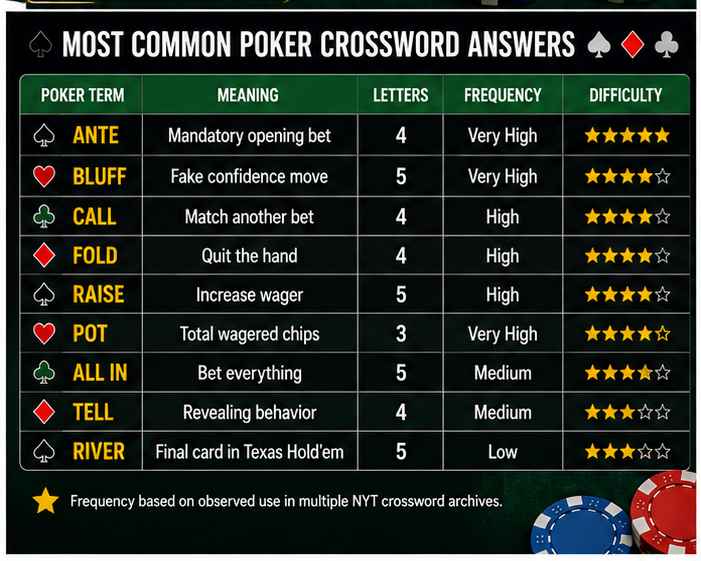
What is the answer to the poker term NYT crossword clue?
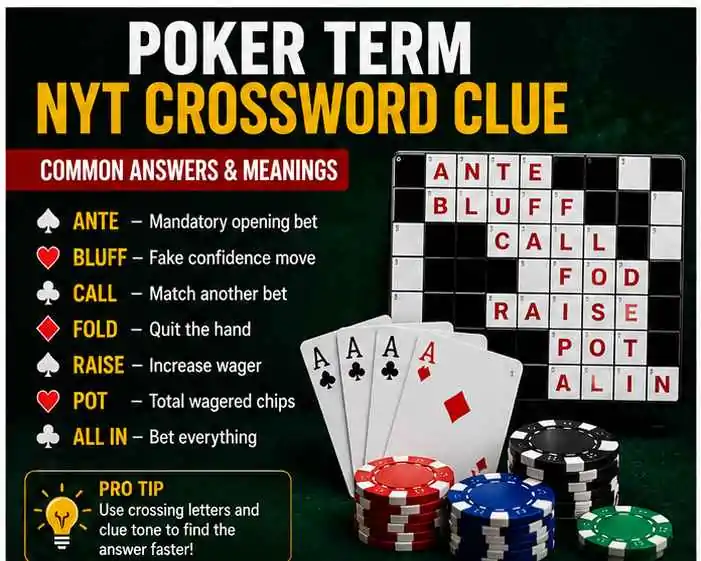
The most common answers include:
| Answer | Meaning | Letter Count |
|---|---|---|
| ANTE | Mandatory opening bet | 4 |
| BLUFF | Fake confidence move | 5 |
| CALL | Match another bet | 4 |
| FOLD | Quit the hand | 4 |
| RAISE | Increase wager | 5 |
| POT | Total wagered chips | 3 |
| ALLIN | Bet everything | 5 |
The correct answer depends on:
- puzzle date
- crossing letters
- clue wording
- puzzle theme
- answer length
Overview Answer Block
Why does the NYT crossword use poker terms so often?
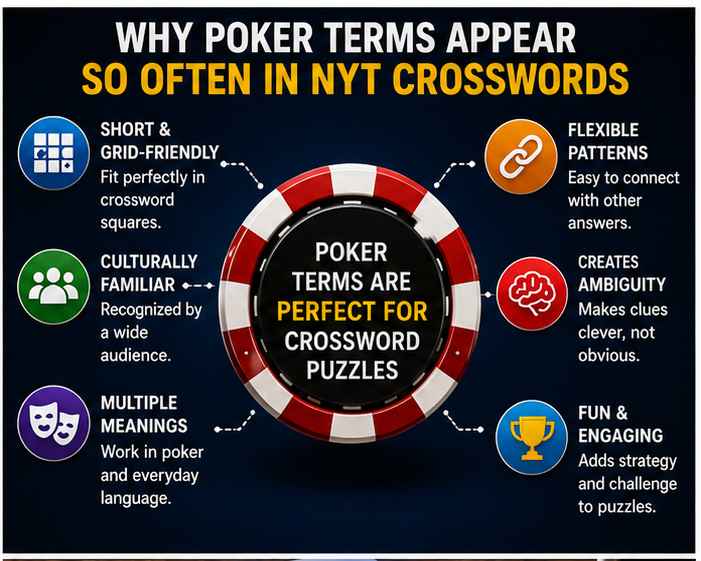
Poker terms appear frequently because they:
- fit crossword grids efficiently
- contain balanced vowels and consonants
- are culturally recognizable
- have multiple meanings
- create clever clue ambiguity
Words like CALL, FOLD, and BLUFF work especially well because they can describe both poker actions and everyday situations.
What Does the Poker Term Crossword Clue Mean?
Why the clue feels harder than expected
At first glance, the clue seems almost too easy.
That’s the trap.
The phrase “poker term” can point toward dozens of possible answers, and NYT crossword editors intentionally rely on that ambiguity. Unlike trivia-based clues that usually have one obvious direction, poker clues operate more like language puzzles.
The answer could reference:
- betting
- deception
- card dealing
- player behavior
- tournament slang
- hand rankings
- casino vocabulary
A four-letter slot instantly changes the possibilities. So does a single crossing vowel.
That’s why experienced solvers rarely guess immediately. They analyze patterns first.
How NYT crossword editors use poker language
Crossword editors love poker terminology because it behaves like linguistic Swiss Army knives. One word can carry several meanings simultaneously.
Take the word FOLD:
- fold cards
- fold paper
- fold under pressure
- fold laundry
Or consider CALL:
- call a bet
- make a phone call
- referee call
- judgment call
That semantic flexibility allows crossword creators to craft clues that feel clever rather than purely factual.
And honestly, that’s part of the addiction of solving crosswords. The clue isn’t just testing knowledge—it’s testing interpretation.
Most Common Poker Crossword Answers
ANTE
Meaning
An ante is a small mandatory bet players place before receiving cards.
Why it appears constantly
Crossword constructors absolutely love this word because:
- it contains common vowels
- it’s short
- it fits many grids
- casual audiences recognize it
You’ll often see clues like:
- Poker starter
- Initial wager
- Forced bet
- Poker contribution
Expert observation
ANTE is probably the single most common poker-related crossword answer in existence.
Not glamorous. Not dramatic. But incredibly useful for puzzle construction.
BLUFF
Meaning
A bluff happens when a player pretends to hold a stronger hand than they actually possess.
Why it works brilliantly in crosswords
The word escaped poker culture long ago.
Today, politicians bluff. Athletes bluff. Negotiators bluff. Kids bluff during playground games.
That broad cultural adoption makes the word extremely valuable in crossword design.
Common clue variations
- Poker deception
- Fake confidence move
- Misleading tactic
- High-stakes fakeout
Pro Tip Box
When you see a 5-letter poker clue involving deception, confidence, or intimidation, BLUFF should immediately enter your shortlist.
CALL
Meaning
Calling means matching another player’s wager without raising it.
Why beginners struggle with this clue
Because “call” has so many meanings outside poker.
Crossword editors exploit that ambiguity constantly.
A clue like:
“Match the bet”
might feel obvious.
But:
“Decision”
could also point toward CALL depending on surrounding answers.
That’s where crossing letters become essential.
FOLD
Meaning
To fold means surrendering your hand and leaving the betting round.
Why crossword creators love it
FOLD functions both literally and metaphorically. That versatility gives editors endless clue possibilities.
Examples include:
- Give up
- Quit the round
- Collapse under pressure
- Poker exit
And here’s something interesting: many late-week NYT puzzles intentionally disguise FOLD through metaphorical phrasing instead of direct gambling references.
RAISE
Meaning
Increasing the current wager.
Why it appears often
The phrase “raise the stakes” became deeply embedded in modern speech. Even people unfamiliar with poker instinctively understand the concept.
That mainstream familiarity increases crossword usability dramatically.
ALL IN
Meaning
Betting every remaining chip.
Why it feels memorable
Few poker expressions carry more emotional intensity than “all in.”
The phrase suggests:
- total commitment
- maximum risk
- emotional investment
- irreversible action
That dramatic energy makes it naturally memorable for crossword solvers.
Quick Comparison Table of Common Poker Crossword Answers
| Poker Answer | Letters | Crossword Difficulty | Common Usage |
|---|---|---|---|
| POT | 3 | Easy | Frequent |
| ANTE | 4 | Easy | Extremely common |
| DEAL | 4 | Easy | Frequent |
| CALL | 4 | Medium | Frequent |
| FOLD | 4 | Medium | Frequent |
| RAISE | 5 | Medium | Common |
| BLUFF | 5 | Medium | Very common |
| TELL | 4 | Hard | Occasional |
| RIVER | 5 | Hard | Advanced puzzles |
| ALLIN | 5 | Hard | Less common |
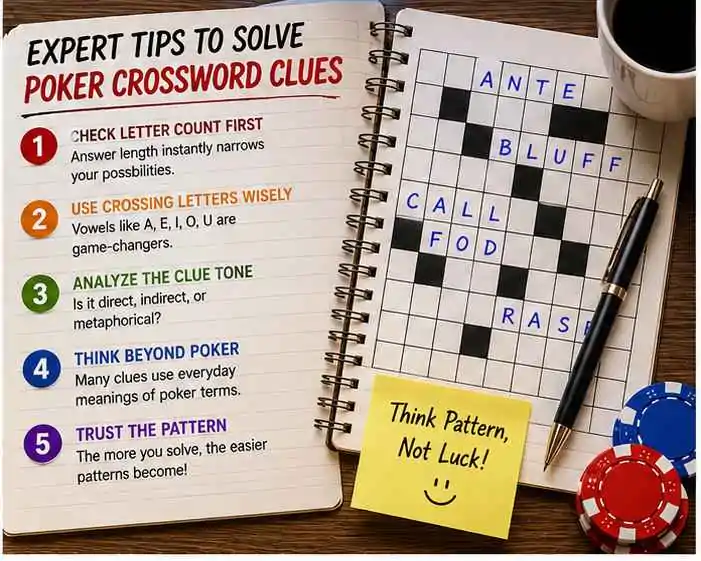
How Experts Solve Poker Clues Faster
1. Start with the letter count
Professional crossword solvers almost never guess blindly.
Instead, they:
- check answer length
- analyze clue wording
- study crossing letters
- eliminate unlikely patterns
A three-letter answer instantly narrows possibilities:
- POT
- BET
A four-letter answer opens:
- ANTE
- CALL
- DEAL
- FOLD
This simple filtering system dramatically improves solving speed.
2. Use crossing clues aggressively
Crossword solving is rarely about isolated knowledge.
It’s pattern recognition.
Imagine seeing:
_ N T E
At that point, ANTE becomes overwhelmingly likely.
Experienced solvers depend more on intersecting answers than on direct clue interpretation. That’s the hidden mechanic beginners often underestimate.
3. Study clue tone carefully
Early-week NYT puzzles usually contain straightforward clues.
Late-week puzzles become trickier, more metaphorical, and semantically layered.
Compare these examples:
Easy clue
Poker wager
Harder clue
Opening contribution
Both might produce ANTE.
The difference lies entirely in clue sophistication.
Key Takeaway Box
Expert crossword solving depends less on memorization and more on recognizing semantic patterns, clue tone, and crossing-letter probability.
Common Mistakes Solvers Make
Assuming every clue is directly gambling-related
This is one of the biggest beginner errors.
Sometimes poker clues reference:
- metaphors
- emotional behavior
- common sayings
- non-gambling meanings
For example:
“Keep composure”
could reference:
- STOIC
- CALM
- or even POKERFACE depending on the grid.
Crossword editors love indirect wording.
Ignoring pluralization
A clue may require:
- ANTES
- DEALS
- TELLS
Missing a single letter can break the entire puzzle structure.
Overthinking simple clues
Oddly enough, shorter clues are often more dangerous.
Why?
Because minimal wording creates maximum ambiguity.
A two-word clue can point toward twenty possible answers. That’s what makes NYT puzzles feel intellectually satisfying rather than mechanically solvable.
Warning Box
Never lock onto your first poker-answer guess too early. Crossword puzzles reward flexibility far more than confidence.
Why Poker Terms Work So Well in Crosswords
Balanced letter structures
Poker vocabulary contains extremely grid-friendly combinations.
Examples:
- ANTE
- DEAL
- POT
- RAISE
These words:
- connect smoothly with surrounding entries
- contain common vowels
- avoid awkward consonant clusters
For crossword constructors, that flexibility is gold.
Cultural familiarity
You don’t need to play poker professionally to recognize:
- bluff
- all in
- poker face
- raise the stakes
That cultural crossover expands clue accessibility.
And accessibility matters enormously in puzzle design.
A crossword clue should challenge solvers without becoming unfair.
Semantic flexibility
Poker language naturally extends into:
- business
- psychology
- politics
- sports
- negotiation
That gives editors tremendous creative freedom.
One word can simultaneously function as:
- literal poker terminology
- metaphorical expression
- emotional description
Very few word categories offer that level of flexibility.
Did You Know Box
The phrase “call someone’s bluff” became so culturally widespread that many people recognize it without realizing it originated from poker terminology.
Expert Insights & Hidden Crossword Patterns
Seasoned crossword solvers eventually notice recurring vocabulary ecosystems.
Poker is one of them.
Others include:
- Shakespeare references
- musical notation
- legal abbreviations
- baseball terminology
- Latin phrases
Once you identify these ecosystems, crossword solving changes dramatically.
Instead of solving clues individually, your brain starts predicting likely answer families automatically.
That’s the moment solving becomes faster—and honestly, far more enjoyable.
People Also Ask
What is the most common poker term in NYT crosswords?
The most common poker-related crossword answer is usually ANTE. Crossword constructors favor it because it is short, vowel-heavy, and easy to connect with surrounding answers in the puzzle grid. Even casual solvers recognize the word, which makes it ideal for both beginner and intermediate crossword difficulty levels.
What does “ANTE” mean in poker?
An ante is a mandatory small bet players contribute before cards are dealt. It creates an initial pot and ensures action during the game. In crossword puzzles, ANTE appears frequently because it contains useful letter combinations that fit neatly into many grid structures.
Why are poker clues common in the NYT crossword?
Poker clues are common because poker vocabulary is:
- culturally familiar
- semantically flexible
- compact
- grid-friendly
Words like CALL, FOLD, and BLUFF also work outside gambling contexts, which allows crossword editors to create layered and misleading clues without making puzzles feel unfair.
What is a poker “tell”?
A tell is a physical reaction or behavioral habit that unintentionally reveals information about a player’s hand. Professional poker players often study tells carefully to predict opponents’ actions. In crosswords, the word appears occasionally because it has multiple meanings outside poker as well.
How do experts solve poker crossword clues quickly?
Experienced solvers rely on:
- answer length
- crossing letters
- clue tone
- semantic pattern recognition
They rarely guess randomly. Instead, they narrow possibilities systematically. Even a single vowel can dramatically reduce the number of likely poker-related answers.
Advanced Crossword Solving Strategies for Poker Clues
Recognize clue difficulty by puzzle day
One subtle pattern many beginners miss involves the weekday structure of the The New York Times crossword itself.
Monday–Tuesday puzzles
Usually:
- straightforward
- definition-based
- beginner friendly
Example:
“Poker bet”
Answer:
ANTE
Wednesday–Thursday puzzles
These begin introducing:
- wordplay
- indirect references
- semantic tricks
Example:
“Opening contribution”
Answer:
ANTE
The clue becomes less literal.
Friday–Saturday puzzles
This is where things become genuinely tricky.
Clues may:
- avoid direct poker references entirely
- rely on metaphor
- use deceptive phrasing
- require cultural understanding
Example:
“Feign confidence”
Answer:
BLUFF
At this level, solving becomes more about interpretation than vocabulary.
Pattern recognition beats memorization
A surprising number of solvers think crossword mastery depends on massive trivia knowledge.
Not exactly.
High-level crossword solving resembles pattern analysis more than memorization. The brain gradually learns:
- common clue structures
- recurring answer families
- editor tendencies
- semantic traps
Poker clues become easier over time because the vocabulary repeats consistently.
Why crossing vowels matter so much
Here’s a counterintuitive insight many beginners overlook:
Consonants help.
But vowels solve puzzles.
Imagine a five-letter poker clue:
_ L U _ _
Your brain rapidly narrows possibilities:
- BLUFF becomes obvious
- alternatives disappear
This is why elite solvers aggressively work surrounding clues first. They use the puzzle grid itself as a filtering mechanism.
Pro Tip Box
If a poker clue feels impossible initially, stop focusing on the clue itself. Solve surrounding entries first and let crossing vowels narrow the answer naturally.
Real-World Crossword Scenario
Imagine solving a Saturday NYT crossword late at night.
You encounter:
“High-stakes deception”
Five letters.
At first, dozens of possibilities seem plausible.
Then crossing answers reveal:
B _ U F F
Suddenly the clue becomes effortless:
BLUFF
This illustrates something important about crossword solving psychology:
Most difficult clues only feel impossible before the crossing letters arrive.
Experienced solvers trust the process rather than forcing immediate answers.
The Psychology Behind Poker Crossword Clues
Why ambiguity feels satisfying
Crossword puzzles operate on controlled uncertainty.
If clues were too direct, solving would feel mechanical.
If clues were too obscure, solving would feel frustrating.
Poker terminology sits perfectly in the middle because it creates:
- ambiguity
- familiarity
- interpretive flexibility
That balance produces the satisfying “aha” moment solvers love.
Why poker language feels naturally memorable
Poker terms often involve:
- risk
- deception
- confidence
- pressure
- emotional tension
Humans remember emotionally charged language more easily than neutral terminology.
That’s why words like:
- bluff
- all in
- fold
- raise
stick in memory far longer than many other crossword categories.
Comparison Table — Beginner vs Advanced Poker Crossword Clues
| Puzzle Difficulty | Typical Clue Style | Example Answer |
|---|---|---|
| Monday | Direct definition | ANTE |
| Tuesday | Simple synonym | CALL |
| Wednesday | Mild wordplay | FOLD |
| Thursday | Semantic ambiguity | BLUFF |
| Friday | Indirect metaphor | TELL |
| Saturday | Heavy misdirection | RIVER |
This gradual complexity curve is one reason the NYT crossword remains so addictive over time.
Common Poker Terms Sometimes Seen in Harder NYT Puzzles
RIVER
Meaning
The final community card in Texas Hold’em.
Why it’s clever
The word has several unrelated meanings:
- body of water
- flow
- movement
- geography
That flexibility makes it ideal for deceptive crossword construction.
TELL
Meaning
A behavioral giveaway revealing player confidence or nervousness.
Why crossword editors like it
The word functions beyond poker:
- “tell me”
- narrative tell
- emotional tell
This multi-purpose quality increases clue creativity.
STRAIGHT
Meaning
A poker hand with consecutive card ranks.
Common misconception
Many casual players confuse STRAIGHT with FLUSH.
Crossword constructors occasionally exploit that confusion intentionally.
Key Takeaway Box
The hardest poker crossword clues rarely test poker expertise directly. Instead, they test semantic flexibility, pattern recognition, and contextual interpretation.
Why Poker Vocabulary Strengthens Topical Authority for Crossword Content
From an SEO perspective, poker crossword clues create strong semantic relationships with:
- NYT crossword solving
- word puzzles
- clue interpretation
- semantic analysis
- gaming terminology
That interconnected topic ecosystem helps strengthen:
- topical relevance
- entity associations
- semantic depth
- AI Overview extraction potential
This is one reason crossword websites often build entire content clusters around recurring clue categories.
FAQ
1. What is the answer to the poker term NYT crossword clue today?
The answer varies depending on the specific puzzle date and letter count. Common solutions include ANTE, CALL, BLUFF, FOLD, RAISE, and POT. Checking crossing letters is usually the fastest way to determine the correct answer accurately.
2. Why is ANTE so common in crossword puzzles?
ANTE appears frequently because it contains a balanced mix of vowels and consonants, making it highly flexible for crossword grid construction. It is also widely recognized by casual audiences, which helps puzzle accessibility.
3. Is poker knowledge necessary to solve crossword clues?
No. Most poker crossword clues rely more on language familiarity and pattern recognition than actual poker expertise. Crossing letters often reveal the answer even if the solver has limited gambling knowledge.
4. What does BLUFF mean in poker?
BLUFF refers to pretending to have a stronger hand than you actually possess in order to pressure opponents into folding. The term later became popular in everyday language, increasing its usefulness in crossword puzzles.
5. Why do crossword editors use misleading clues?
Misleading clues create intellectual challenge without making puzzles unfair. The goal is to encourage interpretation and pattern recognition rather than simple memorization. Poker terms work especially well because many have multiple meanings.
6. What is the easiest way to solve poker crossword clues?
Start with:
- letter count
- crossing vowels
- clue tone
Then eliminate impossible options systematically. This process is far more reliable than immediate guessing.
7. What does “all in” mean in poker?
ALL IN means betting every remaining chip during a hand. The phrase became culturally widespread through televised poker tournaments and now appears regularly in movies, sports commentary, and crossword puzzles.
8. Why do poker words fit crossword grids well?
Poker vocabulary tends to contain:
- short structures
- common vowels
- flexible consonants
- recognizable patterns
These qualities make the words easy to integrate into crossword construction.
9. Are poker clues harder in weekend NYT puzzles?
Yes. Friday and Saturday puzzles often use indirect wording, metaphorical clues, and semantic misdirection rather than direct definitions. This significantly increases difficulty.
10. What is a poker “river”?
The river is the final community card dealt in Texas Hold’em poker. In crossword puzzles, the word becomes useful because it also carries strong non-poker meanings related to geography and movement.
Conclusion
The poker term NYT crossword clue remains one of the most recurring crossword categories because poker vocabulary combines:
- short word structures
- semantic flexibility
- cultural familiarity
- strong grid compatibility
Words like ANTE, BLUFF, CALL, and FOLD work beautifully in crossword construction because they exist both inside and outside poker culture. That dual meaning creates the perfect balance of challenge and fairness.
And perhaps that’s the real secret behind solving these clues efficiently.
It’s not about becoming a poker expert.
It’s about recognizing patterns, understanding crossword psychology, and learning how editors think. Once that shift happens, even difficult poker clues begin feeling far less intimidating—and far more enjoyable to solve.