Best Time to Visit Yellowstone National Park: Month-by-Month Weather, Wildlife and Crowd Guide
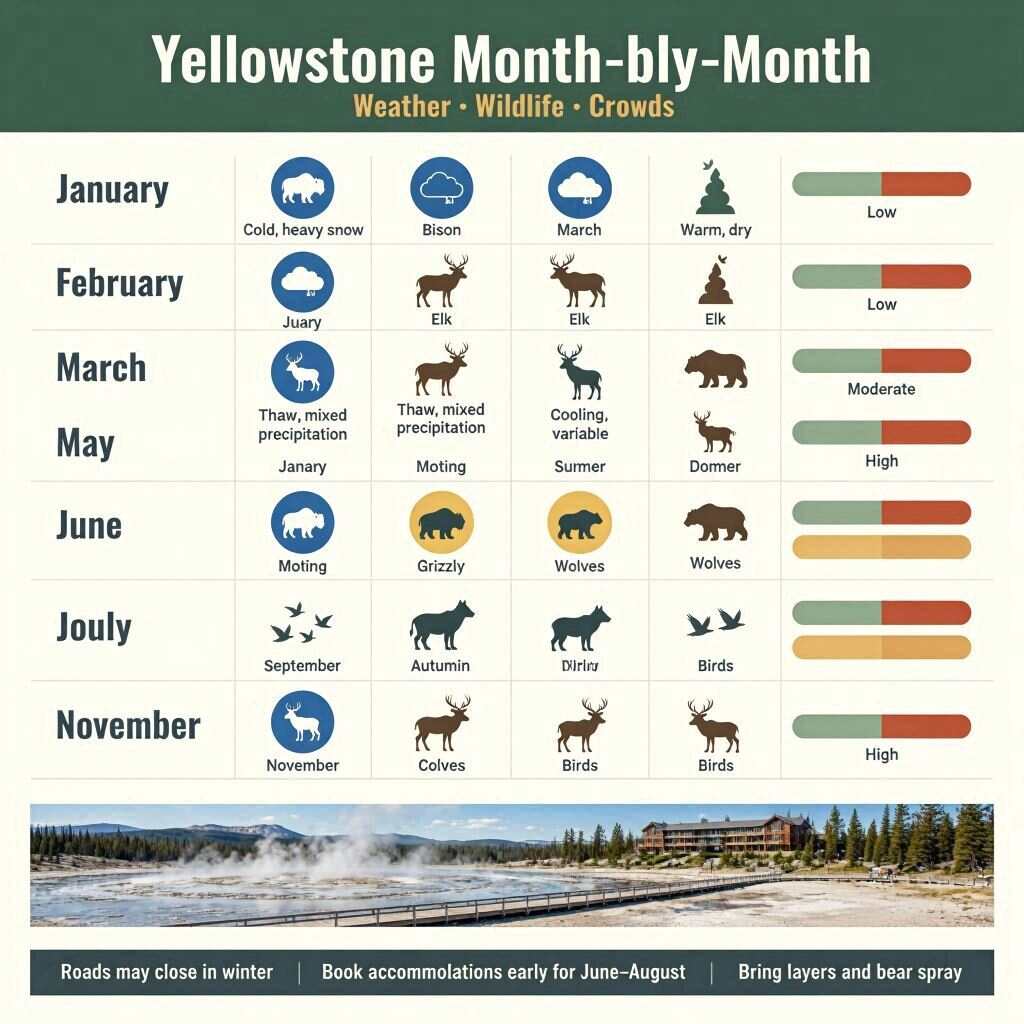
Choosing the wrong month to visit Yellowstone doesn’t just mean bad weather — it can mean closed roads, sold-out lodging you can’t fix six weeks out, and wildlife that’s already moved on. Most visitors research the best time to visit Yellowstone after picking their dates, which is exactly backwards. Interior lodging at Old Faithful Inn or Canyon Lodge routinely sells out eight to twelve months in advance. The 2026 season adds another variable: the Gardner River High Bridge construction is creating single-lane bottlenecks at one of the park’s most-used corridors. This guide integrates seasonal weather, wildlife behavior, crowd cycles, road accessibility, and operational logistics into one planning framework — so you leave knowing exactly when to go and why.
Month-by-Month Master Planning Matrix
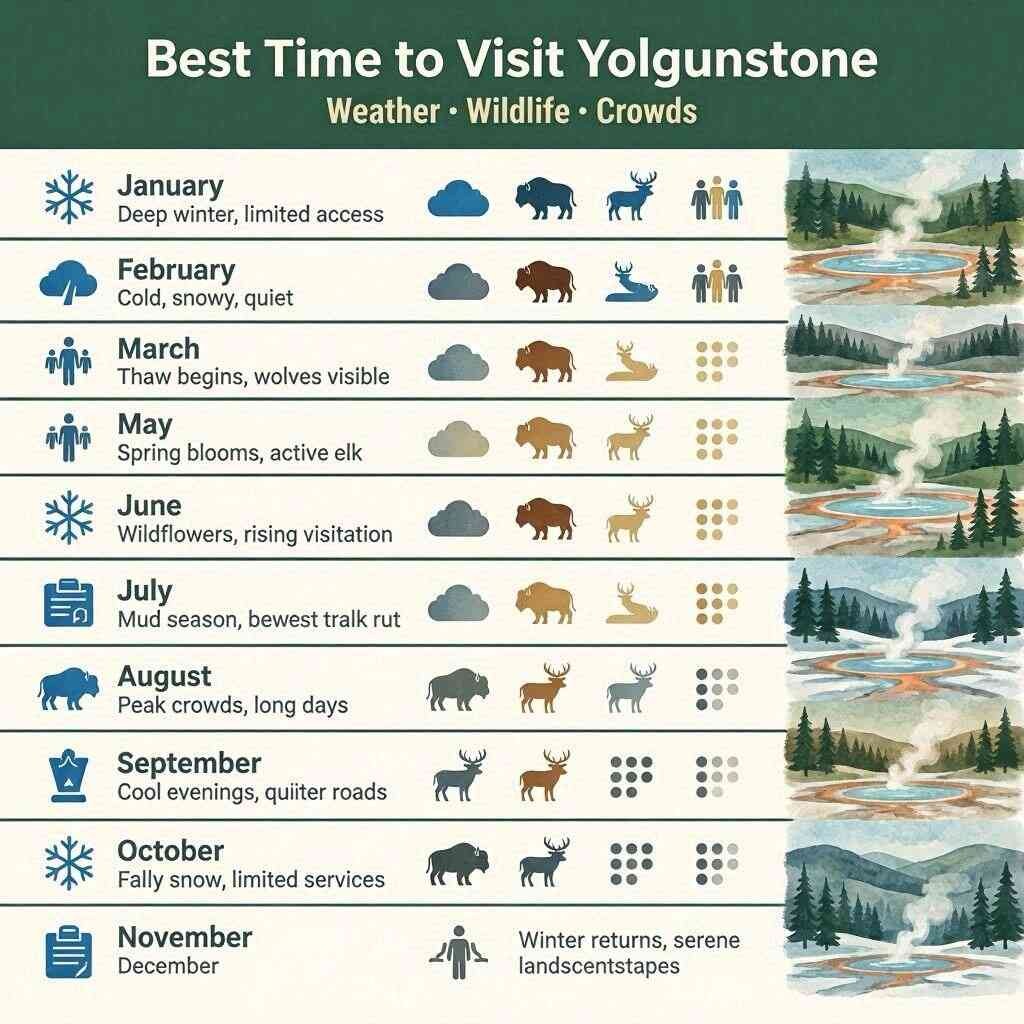
| Month | Mammoth Temp Range | Lake Village Temp Range | Road Status | Crowd Level (1–5) | Wildlife Highlight | Lodging Booking Deadline |
|---|---|---|---|---|---|---|
| January | -13°C to 3°C | -18°C to -4°C | North Entrance to Cooke City only; snowcoach interiors | 1 | Wolf packs, bison | No peak deadline |
| February | -11°C to 5°C | -16°C to -2°C | Same as January | 1 | Wolf and bison concentration | No peak deadline |
| March | -6°C to 9°C | -12°C to 2°C | Snowcoach access; roads begin thawing | 1–2 | Late wolf activity, early grizzly signs | Book April–May now |
| April | 1°C to 14°C | -4°C to 7°C | Phased openings begin mid-month; expect closures | 2 | Grizzly emergence, bison calving | 8+ months ahead for summer |
| May | 5°C to 18°C | 0°C to 12°C | Grand Loop opens in phases; snow possible at elevation | 2–3 | Bear activity, waterfowl, bison calves | Summer rooms near sold out |
| June | 10°C to 24°C | 6°C to 19°C | Full Grand Loop typically open by late June | 4 | All wildlife active; pronghorn fawns | Sold out most nights |
| July | 13°C to 28°C | 10°C to 23°C | Full access; peak season | 5 | All species visible; afternoon thunderstorms | Sold out |
| August | 12°C to 27°C | 9°C to 22°C | Full access | 5 | Excellent viewing; trout fishing peak | Sold out |
| September | 5°C to 21°C | 1°C to 16°C | Full access through Labor Day; some facilities close mid-month | 3 (post-Labor Day: 2) | Elk rut begins; early wolf activity | Book 4–6 months ahead |
| October | -2°C to 14°C | -6°C to 8°C | Facilities close; some loops close by month end | 2 | Elk rut peak; pre-winter bison movement | Book 3–4 months ahead |
| November | -8°C to 4°C | -13°C to -2°C | Grand Loop closes; North Entrance to Cooke City only | 1 | Early wolf visibility | No peak deadline |
| December | -12°C to 2°C | -17°C to -4°C | Snowcoach season begins; interior roads closed to wheeled vehicles | 1 | Wolf packs near Lamar Valley | No peak deadline |
Deconstructing Yellowstone’s Four Climatic Seasons
The best time to visit Yellowstone National Park depends less on a single preferred month and more on which combination of tradeoffs you’re willing to accept. Every season at Yellowstone involves genuine compromises — there is no perfect window. Summer delivers maximum road access but maximum crowds. Autumn brings spectacular wildlife and thin traffic but accelerating facility closures. Winter offers solitude and wolf sightings but removes most of the park from reach. Spring promises bear activity and open roads but delivers unpredictable weather and rolling access restrictions. Understanding how each season actually functions — not just what it looks like — is what separates a well-planned trip from a disappointing one.
Yellowstone’s seasonal dynamics are driven by three overlapping variables that most travel guides treat separately: road accessibility, wildlife behavioral cycles, and lodging infrastructure. These three systems interact in ways that create real planning consequences. A road that opens April 17 does not mean full park access — it means one corridor. A September visit does not automatically mean crowds have vanished — the first two weeks of September still carry significant summer-level traffic. A winter snowcoach trip is not a compromise version of a Yellowstone visit — for wolf and bison viewing, it is the premium option.
Summer Peak (June–August): Maximum Accessibility vs. Gridlock
Summer gives visitors full Grand Loop access, all major geyser basins, every trailhead, and the longest daylight hours of the year — roughly 15 hours of usable light in late June. That accessibility is the season’s primary advantage and its primary problem. The park receives more than 4 million visits annually, and the vast majority arrive between Memorial Day and Labor Day. The result is a park that operates at or beyond comfortable capacity throughout the summer peak.
Traffic bottlenecks are predictable and severe. The West Entrance near West Yellowstone regularly sees queues that extend miles outside the gate during July and August, particularly between 8:00 AM and noon. The South Entrance corridor experiences similar pressure during morning and late-afternoon windows. Hayden Valley and Lamar Valley wildlife pullouts fill within minutes of any large animal sighting, with cars double-parked along roadsides and rangers managing traffic flow.
Accommodation availability disappears entirely by late spring. Old Faithful Inn, Canyon Lodge, Lake Hotel, and the other Xanterra-managed interior properties sell out for July and August within weeks of bookings opening — typically in the preceding October or November. Visitors who begin lodging research in February for a July trip will find either nothing available inside the park or a very limited selection at premium rates.
Afternoon thunderstorms are a genuine weather reality from June through August, not a minor inconvenience. Storms typically build over the Absaroka Range by early afternoon and reach the interior by 2:00–4:00 PM. Lightning at elevation is a serious hazard — many backcountry zones and exposed thermal areas require shelter protocols. Sunrise and mid-morning represent the most reliable weather windows, which aligns well with peak wildlife activity hours.
Despite the crowds, summer has undeniable advantages. Every trail is accessible. Every geyser basin is reachable. The Grand Prismatic Spring, the Grand Canyon of the Yellowstone, Dunraven Pass, and the full Lamar Valley corridor are all within reach in a single day. For families with children or first-time visitors who want to see the park comprehensively, summer remains the most practical season — with the understanding that early arrival and patience are non-negotiable.
Autumn Shoulder (September–October): The Rut and Golden Windows
The week immediately after Labor Day marks one of the most dramatic operational transitions in Yellowstone’s calendar. Traffic volumes fall sharply — in some corridors, visitor counts drop by 30 to 40 percent within days of the holiday weekend. Roads that were gridlocked on Saturday are manageable by Tuesday. The park is still fully open, wildlife is at peak behavioral activity, and temperatures have moderated from summer highs. For visitors with flexibility, the first two weeks of September represent the highest-value travel window available at Yellowstone.
The elk rut begins in earnest in mid-September and runs through early October, with the Mammoth Hot Springs area providing some of the most accessible viewing anywhere in the park. Bull elk move through the Mammoth terraces and adjacent meadows at dawn and dusk, bugling audibly from a distance that allows safe, spectacular observation. The Gardiner area just outside the North Entrance provides additional viewing ground, with bulls sometimes crossing roads and meadow areas in full rut display. No other season offers this kind of large-mammal behavior at this proximity.
From a photography standpoint, autumn delivers qualities that summer cannot — golden grasses in Lamar Valley, aspen color in the higher elevations, dramatic morning light that arrives at more reasonable hours than midsummer’s 5:30 AM optimal window. Wildlife is visible against open terrain before vegetation senescence obscures movement patterns.
October introduces operational complications that visitors frequently underestimate. Lodging inside the park begins closing progressively through October — most interior Xanterra properties close in late October, with some facilities shutting as early as mid-month. Services thin out rapidly. Some roads become impassable without notice after early-season snowfall, which can arrive at any point in October at Dunraven Pass (elevation 2,700 meters) or in the Yellowstone Lake basin. Visitors who romanticize October based on September conditions routinely arrive to find closed facilities, restricted loops, and weather that bears no resemblance to the previous month. October is not a safer version of September — it is a transitional month with genuine access risks.
Winter Isolation (November–March): Snowcoaches and Wilderness Solitude
Winter Yellowstone is not a diminished version of summer Yellowstone — it is a fundamentally different experience. When the Grand Loop closes to wheeled vehicles in early November, interior road access shifts entirely to over-snow travel: snowcoaches and snowmobiles operating under permit. The only road remaining open to conventional vehicles runs between the North Entrance at Gardiner and the Northeast Entrance to Cooke City, passing through Mammoth Hot Springs and the Lamar Valley corridor.
That corridor happens to be the best wolf-viewing terrain in the park. Winter strips the landscape of concealing vegetation, wolf packs are highly active, and visitor numbers drop to a fraction of summer levels. Experienced wildlife photographers prioritize winter Lamar Valley specifically because viewing conditions — clear sightlines across snow-covered flats, dawn light arriving at accessible hours, low human competition at pullouts — create opportunities unavailable any other time of year. The Lamar Valley in January or February, before dawn, with a bison herd and an active wolf pack in the same field of view, represents what many regular Yellowstone visitors consider the park’s defining experience.
Temperatures at Yellowstone Lake and Canyon can reach -30°C or colder during January cold snaps. Wind chill in exposed locations makes even brief outdoor exposure dangerous without proper gear. Snowcoach access to Old Faithful and the geyser basins provides the only winter interior experience, with departures from Flagg Ranch, Mammoth, and West Yellowstone. Interior winter lodging is extremely limited — the Old Faithful Snow Lodge and Mammoth Hot Springs Hotel are the only interior options, and both require booking months in advance.
For visitors who accept winter’s constraints, the reward is a park shared with almost no one, operating under conditions that make every wildlife encounter feel earned.
Spring Awakening (April–May): Mud, Bears, and Road Openings
Spring at Yellowstone is the season most prone to visitor misunderstanding. Travelers who picture a fully accessible park emerging from winter find something more complicated: a phased, unpredictable reopening process that unfolds over six weeks and is conditional on snowmelt and road conditions. The critical point most spring visitors miss is that the Northern Corridor — the Gardiner to Cooke City stretch through Mammoth and the Lamar Valley — is the only part of the park reliably accessible through April and into early May. The interior, including Old Faithful, Hayden Valley, Yellowstone Lake, and Canyon, opens in sequence through April and May according to an official schedule that is always subject to weather-driven adjustment.
Grizzly bears emerge from their dens between late March and mid-April, initially concentrating in lower-elevation areas where they feed on winter-killed ungulates and early vegetation. Lamar Valley and the Yellowstone River drainage see early bear activity, with sightings increasing through April as more bears move into visible terrain. Bison calving begins in late April, with russet-colored calves appearing in the valley meadows alongside their mothers — one of the most photographed wildlife events in the park’s calendar.
Weather in April and May is genuinely unpredictable. Snowstorms at Mammoth Hot Springs are possible through May. At higher elevations — Dunraven Pass, the Yellowstone Lake area — significant snow is almost guaranteed at some point in May, sometimes closing roads that opened days earlier. Visitors should plan for temperature swings of 15–20 degrees Celsius within a single day and carry gear for both cold and warm conditions simultaneously.
Crowds in spring are the lowest of any accessible season. Services are limited — many restaurants, visitor centers, and gas stations inside the park remain closed through May — but the absence of summer infrastructure is offset by the absence of summer traffic. For wildlife-focused visitors willing to concentrate their experience in the northern part of the park, late April and early May offer grizzly activity, bison calving, waterfowl migration, and wolf visibility in conditions that feel genuinely uncrowded.
Yellowstone Seasonal Decision Matrix
| Season | Road Access | Wildlife Score | Crowd Score | Weather Stability | Ideal Traveler | Main Drawback |
|---|---|---|---|---|---|---|
| Summer (Jun–Aug) | 5/5 — Full Grand Loop | 4/5 — All species active | 1/5 — Peak crowds | 3/5 — Afternoon storms | First-timers; families; Grand Loop completionists | Gridlock; sold-out lodging; premium prices |
| Autumn (Sep–Oct) | 4/5 — Full access through September; declining October | 5/5 — Elk rut; wolf activity begins | 4/5 — Post-Labor Day collapse | 3/5 — Variable; early snow possible | Wildlife photographers; experienced visitors; crowd-avoiders | Facilities close October; October weather risk |
| Winter (Nov–Mar) | 1/5 — North Entrance corridor + snowcoach only | 4/5 — Wolf packs; bison concentration | 5/5 — Near solitude | 2/5 — Extreme cold; storm risk | Wildlife specialists; photographers; adventure travelers | Over-snow transport only; extreme temperatures; very limited lodging |
| Spring (Apr–May) | 2/5 — Northern Corridor reliable; interior opens in phases | 4/5 — Grizzly emergence; bison calving; wolf activity | 5/5 — Very low | 2/5 — Unpredictable; snow at any elevation | Wildlife photographers; experienced visitors; off-peak travelers | Limited services; phased access; weather volatility |
Yellowstone Weather by Month: Elevation and Microclimates
Yellowstone weather by month cannot be understood from a single temperature table. The park spans an elevation range from roughly 1,600 meters at the North Entrance near Gardiner to over 2,700 meters at Dunraven Pass — a difference of more than 1,100 meters across terrain the Grand Loop covers in a single day of driving. The practical consequence is that visitors can experience sunshine and 20°C temperatures at Mammoth Hot Springs while simultaneously encountering a snowstorm at Dunraven Pass or temperatures 10 degrees colder at Yellowstone Lake. Planning around a single “Yellowstone weather” figure is the single most common packing mistake visitors make.
Why Yellowstone Has Multiple Weather Zones
Three factors drive Yellowstone’s microclimate complexity: elevation gradients, thermal basin effects, and the freeze-thaw behavior of the Yellowstone Plateau.
The elevation gradient is the dominant driver. Cold air pools in the Yellowstone Lake basin and the lower canyon areas, while Mammoth Hot Springs — sitting nearly 500 meters lower than Lake Village — runs measurably warmer in both summer and winter. On clear nights, the temperature difference between Mammoth and Lake Village can reach 10–12°C. This is not a marginal planning consideration — it determines whether you sleep comfortably or wake up to frozen water bottles.
Thermal basin effects create localized warmth near major geyser areas. Old Faithful and the Upper Geyser Basin sit in a thermally active zone where ground temperatures and steam release maintain a microclimate slightly warmer than the surrounding plateau. This does not make geyser basins comfortable in winter, but it moderates the extremes compared to the open lake basin.
Snowpack at higher elevations persists well into June at Canyon and Dunraven Pass, with late-season snow possible through May even in lower areas. The freeze-thaw cycle that governs road opening dates is driven by this elevation-differentiated snowpack — roads at 2,700 meters require weeks more thawing time than roads at 2,000 meters, which is why the phased spring opening schedule does not move uniformly across the park.
Mammoth Hot Springs vs. Lake Village
The contrast between Mammoth Hot Springs (1,902 meters) and Lake Village (2,374 meters) illustrates the microclimate reality most clearly.
In July, Mammoth regularly sees afternoon highs of 25–30°C, while Lake Village’s highs sit 6–8 degrees lower. Summer nights at Lake Village routinely drop to 5–8°C — cold enough that sleeping bags rather than hotel blankets are the appropriate gear for car campers. Visitors who pack for Mammoth weather and drive to the lake area by afternoon find themselves underdressed by 4:00 PM.
In winter, the gap compounds. Mammoth’s thermal proximity keeps it measurably warmer than the lake basin, which sits in a cold trap that produces some of the most extreme low temperatures in the continental United States. January lows at Yellowstone Lake regularly reach -25°C to -30°C. Wind across the open lake surface amplifies wind chill to levels that require full Arctic-weight insulation for any sustained outdoor activity.
Monthly Clothing and Gear Strategy
April–May: Waterproof outer layer is mandatory — not optional. Morning temperatures at any elevation will be near or below freezing. Pack for 0°C mornings and 15°C afternoons simultaneously, with rapid weather changes possible at any point. Waterproof hiking boots are required for any trail access given snowmelt mud conditions.
June–August: Light layers for morning, sun protection for midday, and a rain shell for the daily afternoon storm window. Temperatures at elevation — Canyon, Dunraven Pass — run 8–10 degrees cooler than Mammoth on the same day. Visitors who arrive expecting consistent summer warmth and pack accordingly will be cold in the canyon and at the lake by evening.
September–October: Fleece and insulated layers become essential from the first week of September. October requires full cold-weather gear — thermal base layers, insulated mid-layer, waterproof outer shell. The first significant snowfall at elevation can arrive any time in October. Footwear should be fully waterproof.
November–March: Technical cold-weather clothing is non-negotiable. Temperatures below -20°C are possible at elevation. Multiple insulating layers, face protection, and waterproof insulated boots are the minimum standard for any outdoor exposure beyond vehicle access.
Elevation Weather Comparison Matrix
| Location | Elevation | Avg Summer High | Avg Summer Low | Snow Season Length | Weather Risk |
|---|---|---|---|---|---|
| Mammoth Hot Springs | 1,902m | 28°C | 8°C | Nov–Apr | Moderate — lowest elevation buffer |
| Old Faithful | 2,240m | 22°C | 5°C | Oct–May | Moderate-High — afternoon thunderstorms |
| Canyon Village | 2,377m | 21°C | 4°C | Oct–May | High — exposed plateau terrain |
| Lake Village | 2,374m | 20°C | 4°C | Oct–Jun | High — cold trap; wind exposure |
| Dunraven Pass | 2,700m | 14°C | 0°C | Sep–Jun | Very High — snow possible any month |
Navigating Park Congestion: Best Time to Visit Yellowstone to Avoid Crowds
The best time to visit Yellowstone to avoid crowds is the 10-day window between Labor Day and mid-September. This is not a generic September recommendation — it is a specific operational advantage that opens for a precise and predictable window. Understanding why this window works, and how to use it tactically, is the difference between competent crowd avoidance and generic advice.
Understanding Yellowstone Crowd Cycles
Visitation at Yellowstone follows a predictable annual curve. Traffic builds through June as school schedules release, reaches a plateau in July and holds through the first two weeks of August, then maintains near-peak levels through the Labor Day weekend. The relevant data point is what happens immediately after.
The week of Labor Day itself is peak-compressed — a final surge of summer traffic that fills every entrance corridor. The following Tuesday, the crowd curve breaks sharply downward. School schedules in the United States and Canada simultaneously release their grip. The family demographic, which represents the largest single visitor segment, virtually disappears from the park within days. Visitor counts in some corridors fall by 30–40 percent within a week of the holiday weekend.
What remains is the shoulder-season demographic: adults with schedule flexibility, wildlife photographers, and experienced park visitors who know exactly what this window offers. These visitors are present, but they produce fundamentally different congestion patterns. They arrive early, use pullouts correctly, and are less likely to create the stop-and-block traffic dynamics that characterize peak summer.
The Post-Labor Day Advantage
The operational advantages of the post-Labor Day window compound beyond simple traffic reduction.
Wildlife behavior shifts meaningfully in September. Bull elk begin moving into rut mode — bugling, moving more actively, and occupying terrain that overlaps with accessible roads and visitor areas. The Mammoth Hot Springs complex sees elk moving through the terraces, the hotel grounds, and the meadows around the visitor center at dawn and dusk. The Gardiner River corridor north of Mammoth becomes active with bull movement. This is wildlife behavior at maximum intensity in a crowded park that has just become significantly less crowded.
Lodging availability opens dramatically. Interior properties that showed zero availability in July will often have rooms available for the third week of September at standard or reduced rates. Gateway towns — Gardiner, West Yellowstone, Cooke City — show similar improvements. Visitors who couldn’t secure a booking for summer often find the early-September window surprisingly available if they check 90–120 days out.
The risk calculus is straightforward: most of summer’s access advantages remain intact, most of summer’s crowd disadvantages have resolved, and wildlife behavior is superior to any summer month. The September post-Labor Day window is objectively Yellowstone’s highest-value travel window for visitors who can use it.
Tactical Entry Gate Strategies
Early arrival is the single most effective crowd-avoidance technique. Entering any Yellowstone gate before 7:00 AM places you in the park before queue formation. The first wildlife sightings of the day occur at dawn and immediately after — aligning early entry with peak activity windows creates a compounding advantage.
West Entrance congestion is predictable and severe. The West Entrance from West Yellowstone is the highest-volume entry point in the park, serving visitors heading toward Old Faithful and the geyser basins. During peak season, queues at this entrance begin building before 8:00 AM and can extend several miles by 9:00. Visitors heading to this area should target a pre-7:00 AM arrival or consider the South Entrance approach from Flagg Ranch if lodging location permits.
Gardiner and the North Entrance provides a structural advantage. The North Entrance at Gardiner connects directly to Mammoth Hot Springs and the Lamar Valley corridor — the two highest-value wildlife-viewing areas in the park — without routing through the Old Faithful corridor congestion. Visitors staying in Gardiner or arriving from the north can reach Lamar Valley’s dawn activity windows without engaging peak-hour West Entrance traffic.
Afternoon strategies. Mid-afternoon (1:00–4:00 PM) is the worst time to navigate high-traffic areas — geyser basin parking lots fill, roadside pullouts reach capacity, and afternoon thunderstorm timing aligns with the period when visitors are concentrated in exposed areas. Use the afternoon for thermal area boardwalks with uncrowded access points, or for driving the less-trafficked sections of the Grand Loop between Canyon and Tower-Roosevelt.
Crowd Evasion Framework
| Travel Goal | Best Month | Best Entry Time | Recommended Gate | Expected Crowd Level |
|---|---|---|---|---|
| Maximum wildlife, low crowds | First 2 weeks post-Labor Day | Before 7:00 AM | North Entrance (Gardiner) | Low–Moderate |
| Full park access, manageable crowds | Early June (pre-peak) | Before 7:30 AM | Any — East Entrance least congested | Moderate |
| Elk rut viewing | Mid-September to early October | Before 6:30 AM | North Entrance (Gardiner) | Low |
| Wolf viewing, winter solitude | January–February | Dawn | North Entrance only (open year-round) | Very Low |
| Geyser basins without queues | Early September post-Labor Day | Before 8:00 AM | West Entrance — early only | Low–Moderate |
| Family trip, full access | Late May (after Grand Loop opens) | Flexible | South or West Entrance | Low–Moderate |
Predator Dynamics: Best Time to Visit Yellowstone for Wildlife
The best time to visit Yellowstone for wildlife is not a single month — it is a sequence of overlapping behavioral windows spread across the entire calendar year. Each major species has a distinct activity peak driven by reproductive cycles, food availability, and predator-prey dynamics. Yellowstone’s wildlife calendar is actually multiple calendars running simultaneously, and understanding which window aligns with your target species is the foundation of effective wildlife planning.
The critical gap in most wildlife timing guides is geographic specificity. It is not enough to know that grizzly bears emerge in spring — you need to know which valley, at what elevation, and during which activity window. Yellowstone’s wildlife concentrates predictably in specific geographic zones at specific times. Visitors who understand this geography encounter wildlife systematically rather than by accident.
Grizzly Bear Emergence
Grizzly bears begin emerging from their dens in late March to mid-April, with the timing varying by elevation and individual bear condition. Lower-elevation areas see the earliest emergence — the Northern Range, including Lamar Valley and the Yellowstone River drainage between Gardiner and Tower, concentrates early spring grizzly activity.
The window from late April through June is the most productive for reliable grizzly observation. Bears emerging from denning are highly motivated feeders, moving actively through daylight hours in pursuit of winter-killed ungulates and early spring vegetation. The Lamar Valley and Hayden Valley corridors provide the best viewing access — both offer wide, open terrain that allows sightings at distances that are simultaneously safe and rewarding.
Dawn and dusk are the primary activity windows. Bears that are active in open terrain at 7:00 AM are often resting in tree cover by 10:00 AM. Visitors who arrive at Lamar Valley before sunrise and set up at established pullouts will consistently outperform those who arrive mid-morning.
Wolf Viewing Opportunities
Wolf viewing at Yellowstone is a winter and early spring pursuit, and Lamar Valley is its center. The Druid Peak area, the Slough Creek drainage, and the Lamar River corridor form the core wolf territory for the park’s most visible packs. In winter, the combination of snow-covered terrain, low vegetation, and pack activity near bison concentrations creates viewing conditions unmatched anywhere else in the continental United States.
Dawn is the optimal viewing window. Pack activity — hunting, territorial movement, howling — peaks at first light and again in the late afternoon. Visitors with spotting scopes set up at the established Lamar Valley pullouts before sunrise in January or February will frequently locate wolves within the first hour. The park’s wolf-watching community, led by experienced volunteers and naturalists, concentrates at these pullouts and provides real-time sighting information.
Summer wolf viewing is possible but significantly harder. Vegetation obscures movement, packs are less concentrated around prey, and the wolves themselves tend to be more dispersed across larger territories.
Bison Calving Season
Bison calves appear in late April and early May, initially identifiable by their distinctive rust-red coloring before darkening to the adult brown-black coat over their first months. The Lamar Valley and Hayden Valley herds produce the most visible calving activity, with cow-calf groups moving through open meadow terrain that allows roadside observation.
Approaching bison on foot is not just inadvisable — it is a significant safety hazard. Bison are the most dangerous animals in the park statistically, with cow bison particularly defensive during the calving period. The standard safe viewing distance is 25 yards minimum; in practice, staying near or in your vehicle and using optics provides both better viewing and appropriate separation from the animals.
Elk Rutting Season
The elk rut peaks from mid-September through early October, with Mammoth Hot Springs functioning as the most accessible rut theater in the park. Bull elk with full racks move through the Mammoth complex — including the hotel grounds, the terraces, and the open meadows north of the visitor center — during the dawn and dusk rut activity windows. The audible bugling carries for considerable distances, often announcing elk presence before they’re visible.
Visitor safety during the rut requires the same basic discipline as bison safety: stay near your vehicle, do not position yourself between bulls and cows, and recognize that bull elk during rut are in a state of heightened aggression that makes normal approach distances insufficient. The 25-yard rule applies, and during active rut activity, more distance is better.
Month-by-Month Wildlife Behavioral Calendar
| Wildlife Event | Best Months | Peak Viewing Time | Primary Location | Visibility Rating |
|---|---|---|---|---|
| Grizzly emergence | Late April–June | Dawn, 5:30–9:00 AM | Lamar Valley, Hayden Valley | 4/5 |
| Wolf activity | January–March | Dawn, 6:00–9:00 AM; dusk | Lamar Valley, Slough Creek | 5/5 (winter) |
| Bison calving | Late April–May | Morning and evening | Lamar Valley, Hayden Valley | 4/5 |
| Elk rut | Mid-Sept–early Oct | Dawn and dusk | Mammoth Hot Springs, Gardiner area | 5/5 |
| Moose sightings | May–September | Dawn | Willow Park, Lewis River corridor | 3/5 |
| Pronghorn movement | April–October | Morning | Northern Range, Lamar Valley flats | 3/5 |
Essential 2026 Operational Logistics and Infrastructure Constraints
Any discussion of the best time of year to visit Yellowstone Park must account for the specific 2026 operational environment. This is not evergreen content — 2026 introduces infrastructure constraints, construction projects, and updated fee structures that directly affect trip planning. Visitors who rely on last year’s guides or general seasonal descriptions will encounter conditions their research did not prepare them for.
2026 Road Opening Schedule
The National Park Service releases official road opening dates each spring, but the baseline 2026 schedule follows the phased sequence established in recent years. Visitors planning April and May trips should build flexibility into their itineraries because road opening dates are conditional on snowpack conditions and can shift by days or weeks.
The April 17 phase opens the road between the North Entrance at Gardiner and the Northeast Entrance toward Cooke City to standard wheeled vehicles — this corridor is already open in winter but transitions to normal two-lane access. The May 1 phase targets the road from the West Entrance to Madison Junction and from Mammoth to Norris. The May 8 phase adds the Norris to Canyon segment and the road to Old Faithful via the Firehole Basin. The May 22 phase is the final push, typically including Dunraven Pass, the Canyon to Lake segment, and completion of the full Grand Loop.
Each phase is contingent on the preceding one — a late April snowstorm can delay the May 1 opening and cascade through the entire schedule. Visitors with reservations for early May interior lodging should verify current road status on the NPS website within 48 hours of arrival. Interior properties cannot always be reached if their access road has not yet opened.
Gardner River High Bridge Project
The Gardner River High Bridge construction represents the most significant 2026-specific infrastructure constraint for a large segment of visitors. The project involves structural work on the bridge crossing near the North Entrance corridor, which has implemented single-lane alternating traffic controlled by an automated signal system.
The practical implication for visitors is queuing time. During peak hours in the high season, the single-lane bottleneck at the bridge creates delays of 15–30 minutes for vehicles waiting for the signal to cycle. Oversized vehicles — RVs over a certain length, vehicles with trailers, and commercial tour buses — face additional restrictions and must verify current vehicle size allowances before planning this approach.
Visitors entering via Gardiner and the North Entrance should account for this delay in morning timing. The tactical response is straightforward: enter before 6:30 AM when traffic volume is low and signal cycling is nearly immediate, or plan for the queue and arrive at Lamar Valley later in the morning. The bridge project is expected to continue through the 2026 season — check the NPS Yellowstone website for any updated timeline on its completion.
Xanterra Booking Windows
The operational reality of Yellowstone interior lodging is that the booking calendar runs 12 months in advance for summer dates. Xanterra Travel Collection manages all interior Yellowstone lodging and opens reservations for the following year’s summer season approximately 12 months before the travel date.
For July and August 2026 visits, the reservation window opened in late 2025. Those dates are now largely allocated. Visitors hoping to stay inside the park for summer should immediately check current availability for any remaining inventory, and simultaneously evaluate gateway town options in Gardiner, West Yellowstone, or Cody. For September and October 2026 visits, availability improves significantly — a 90-to-120-day booking horizon covers most shoulder-season dates with options available.
Winter interior lodging — the Old Faithful Snow Lodge and Mammoth Hot Springs Hotel — is less extreme in its booking pressure but still requires advance planning. Over-snow tour packages through Xanterra or approved concessioners book out months in advance for the December through February peak wolf-viewing windows.
Fee Structure Changes
The 2026 Yellowstone entrance fee structure applies to all non-pass holders. The standard private vehicle entry fee is $35 for a 7-day pass. Annual passes — the America the Beautiful Interagency Annual Pass at $80 — cover the vehicle and all occupants for all federal fee sites for 12 months, representing substantial savings for visitors who plan more than two national park visits in a year.
International visitors should verify current fee information on the official NPS Yellowstone website before travel, as fee structures are subject to annual adjustment and any 2026-specific changes will be reflected in current official sources rather than third-party guides.
2026 Operational Readiness Checklist
| Planning Factor | Verify By | Risk if Ignored |
|---|---|---|
| Interior lodging availability | Immediately — check Xanterra | Zero availability for July–August; limited options |
| 2026 road opening schedule | NPS website 30 days before trip | Arriving to find target area inaccessible |
| Gardner River High Bridge restrictions | NPS website; confirm vehicle size limits | Unexpected delays; oversized vehicle restrictions |
| Annual pass vs. entry fee calculation | Before booking | Overpaying on repeated visits |
| Over-snow tour bookings (winter) | 4–6 months ahead | No snowcoach access to Old Faithful in winter |
| Gateway town lodging (if interior sold out) | 90–120 days ahead for shoulder season | Limited accommodation options near peak dates |
| Weather forecast for specific areas | 5–7 days before arrival | Incorrect gear for elevation conditions encountered |
| Fuel planning | Before entering park | Limited interior fuel stations; some seasonal closures |
| Food service availability by date | Xanterra seasonal calendar | Closed dining in shoulder season |
| Backup dates | At initial planning stage | Single-date plans disrupted by road or weather events |
Frequently Asked Planning Questions
What are the exact road opening dates for Yellowstone in 2026?
The National Park Service publishes official road opening dates each spring, and 2026 follows the standard phased sequence. The April 17 phase opens the North to Northeast Entrance corridor. The May 1 phase targets the West Entrance to Madison and Mammoth to Norris segments. May 8 typically adds Norris to Canyon and the Old Faithful approach. The May 22 phase completes the Grand Loop, including Dunraven Pass. All dates are conditional on snowpack and weather conditions — late-spring snow events can delay any phase by days or weeks. Always verify current status on the official NPS Yellowstone website within 48 hours of travel, as real-time road conditions are updated there and nowhere else with full accuracy.
Is September a good month to visit Yellowstone National Park?
September is the highest-value month available for visitors who can use it — but the timing within September matters significantly. The first two weeks of September still carry near-summer crowd levels, particularly the Labor Day weekend itself. The period from approximately September 8 through September 20 represents the optimal window: summer crowds have cleared, the elk rut is active in Mammoth, wolf activity is increasing in Lamar Valley, temperatures are moderate, all roads remain open, and lodging inside and outside the park is available at non-peak rates. Some facility closures begin mid-month, so verify restaurant and visitor center hours for specific dates before arrival. For the experienced visitor, September post-Labor Day is definitively the best single travel window Yellowstone offers.
What is Yellowstone weather like in September?
September weather in Yellowstone varies significantly by location and progresses through the month. Early September at Mammoth sees highs of 18–22°C and cool nights around 5–8°C. Lake Village and Canyon run 5–8 degrees colder on the same day. By late September, daytime highs at Mammoth drop into the 12–16°C range, while elevation locations — Canyon, Lake Village, Dunraven Pass — can see frost overnight and occasional light snow at the higher elevations. A layering system is essential: waterproof outer shell, insulated mid-layer, and moisture-wicking base layers cover the full September temperature range. The freeze-thaw cycle that begins in late September accelerates rapidly through October, making September the last month where weather risk is genuinely low across all accessible park areas.
Is October too late to visit Yellowstone?
October is not too late to visit, but it requires more careful planning than September and delivers a different experience than most visitors expect. The first week of October typically maintains September-like conditions in the lower elevations, with the elk rut continuing and full road access in place. From the second week onward, facilities begin closing progressively, some road sections become intermittently unavailable after snowfall, and services thin out substantially. The Yellowstone Lake area and Canyon are particularly vulnerable to early-October snowstorms that can close access roads without advance warning. Visitors who plan an October trip should concentrate their itinerary on the Northern Range — Mammoth, Lamar Valley, the Gardiner corridor — which maintains better access and services later into the fall than the interior plateau locations. October is manageable with realistic expectations; it is genuinely problematic for visitors expecting September conditions.
What is the least crowded month in Yellowstone?
January and February are the least crowded months in Yellowstone by a significant margin, with visitor counts a fraction of peak summer levels. However, most of the park is inaccessible — the Grand Loop is closed to wheeled vehicles, and access is limited to the North Entrance corridor and over-snow snowcoach travel to interior sites. Among months with meaningful road access and full interior availability, the post-Labor Day window in September — roughly September 8 through September 20 — is the least crowded period. April and May also offer very low crowds but come with phased road restrictions and limited services. For visitors willing to accept the Northern Corridor limitation, late November before snowcoach season peaks is an underappreciated low-crowd window with some of the earliest wolf visibility of the winter season.
Yellowstone Quick Decision Framework
| If Your Priority Is… | Best Time to Visit Yellowstone |
|---|---|
| Full park access and family travel | Mid-June through August |
| Lowest crowds with full road access | September 8–20 |
| Peak wildlife viewing | Late April–May and January–February |
| Elk rut photography | Mid-September through early October |
| Wolf viewing | January and February |
| Budget-friendly travel | Late April–May or October |
| Fall colors and photography | Mid-September |
| First-time Yellowstone visit | Late June or early September |
| Winter solitude | January–February |
| Best overall balance of weather, wildlife, access, and crowds | September 8–20 |
For most travelers, the best time to visit Yellowstone is the two-week period immediately after Labor Day. This window combines full Grand Loop accessibility, active wildlife behavior, comfortable temperatures, lower lodging pressure, and significantly reduced traffic compared with July and August.
Final Planning Recommendation
The best time to visit Yellowstone is the one that aligns your goals with the park’s actual operating reality — not with the idealized version most travel content describes. For maximum access and family logistics, summer works if you book interior lodging 10–12 months ahead and enter gates before 7:00 AM. For the highest-value combination of wildlife, manageable crowds, and full road access, the post-Labor Day window in September is Yellowstone’s strongest offering. For wolf viewing and genuine solitude, January and February in the Lamar Valley corridor are unmatched anywhere in North America.
The 2026 operational environment adds specific considerations: the Gardner River High Bridge bottleneck affects the North Entrance corridor, phased road openings require flexibility in April and May, and summer interior lodging is effectively unavailable for visitors who haven’t already booked. Begin your logistics planning with lodging and dates, then work backward through gear, entry strategy, and wildlife goals. Visitors who approach Yellowstone as a logistical problem to solve — rather than a destination to discover spontaneously — consistently have better experiences. For the next planning step, the Yellowstone 4-day Grand Loop itinerary and the complete Yellowstone lodging booking guide are the most useful follow-on resources once your travel window is confirmed.