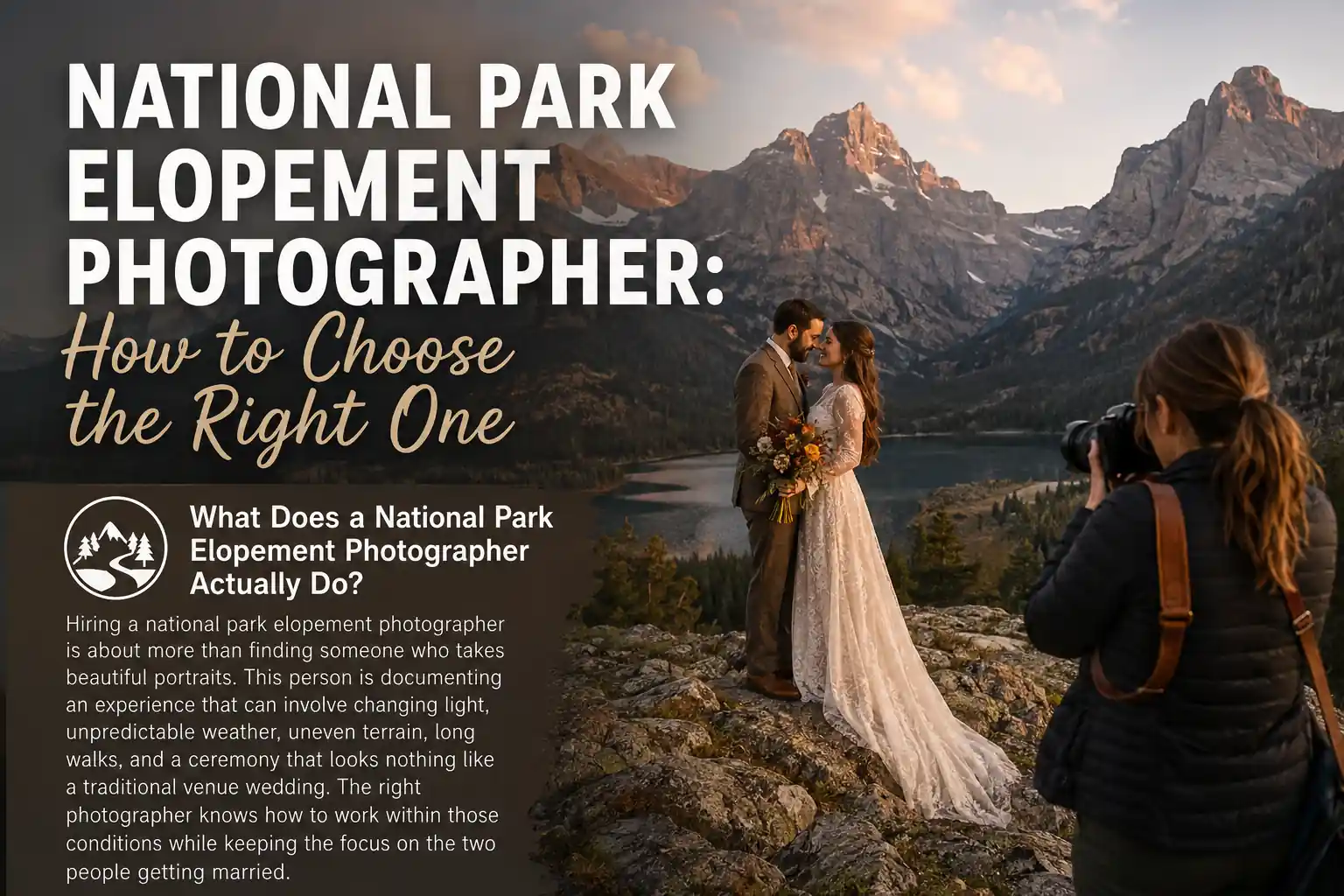
National Park Elopement Photographer: How To Choose
What Does a National Park Elopement Photographer Actually Do? Hiring a national park elopement photographer is about more than finding someone who takes beautiful portraits.
This person is documenting an experience that can involve changing light, unpredictable weather, uneven terrain, long walks, and a ceremony that looks nothing like a traditional venue wedding. The right photographer knows how to work within those conditions while keeping the focus on the two people getting married.
Photograph the Entire Elopement Story, Not Just the Ceremony
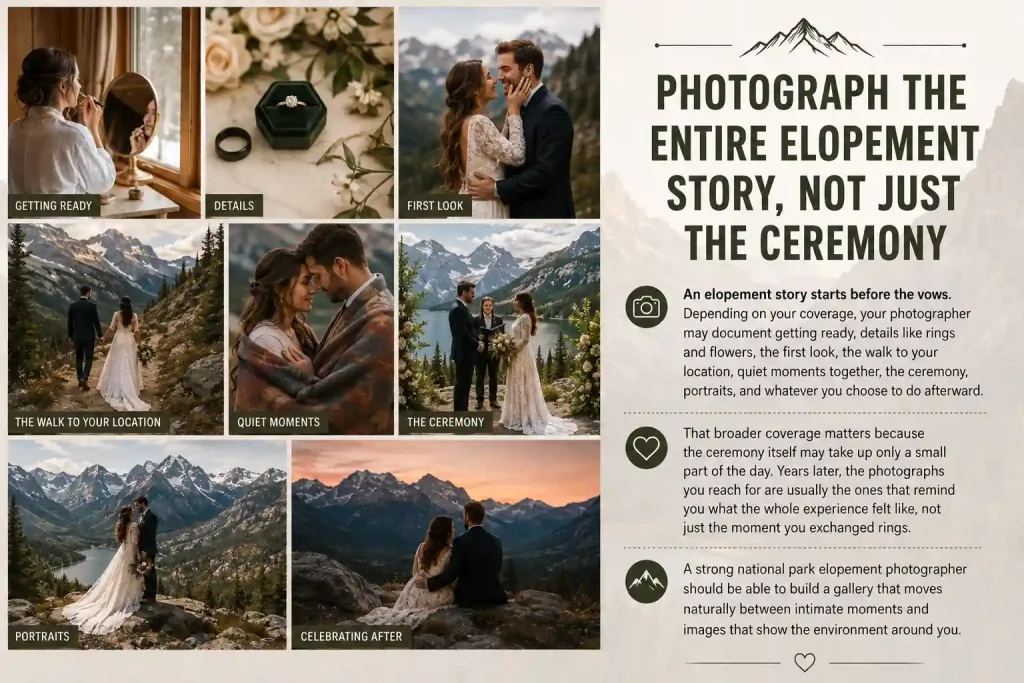
An elopement story starts before the vows. Depending on your coverage, your photographer may document getting ready, details like rings and flowers, the first look, the walk to your location, quiet moments together, the ceremony, portraits, and whatever you choose to do afterward.
That broader coverage matters because the ceremony itself may take up only a small part of the day. Years later, the photographs you reach for are usually the ones that remind you what the whole experience felt like, not just the moment you exchanged rings.
A strong national park elopement photographer should be able to build a gallery that moves naturally between intimate moments and images that show the environment around you.
Capture the Landscape Without Losing the Couple
The landscape is one of the main reasons couples choose a national park, but spectacular scenery shouldn’t turn every photograph into a landscape shot with two tiny people in it.
Your photographer should know when to step back and show the scale of a mountain range, canyon, forest, or coastline, and when to move closer for an expression, an embrace, or a quiet moment. The result should make it obvious where you were without letting the location outweigh your relationship.
Build a Photography-Friendly Timeline
Light changes throughout the day, and outdoor conditions can change even faster. A photographer who understands natural light can help you think about when portraits, the ceremony, or other photographs will look their best — for example, recommending certain shots around softer morning or evening light rather than assuming every hour will produce the same results.
They can also account for the time it takes to walk between nearby locations, leave room for you to slow down and enjoy the scenery, and avoid a schedule so rushed that nothing feels natural. This doesn’t mean your photographer should run your entire wedding timeline — it means they should help your photography expectations fit realistically inside the day you’re planning.
Help With Location and Photography Logistics
An experienced photographer may also contribute location knowledge: suggesting areas that photograph well, identifying viewpoints that work with the available light, considering accessibility, or recommending alternatives when conditions change.
The important question is what’s actually included in the service. Some photographers provide extensive location research and planning assistance; others focus primarily on photography coverage. If location guidance matters to you, ask what’s included before booking rather than assuming every adventure elopement photographer offers the same level of support.
Why Choose a Photographer Who Specializes in Elopements?
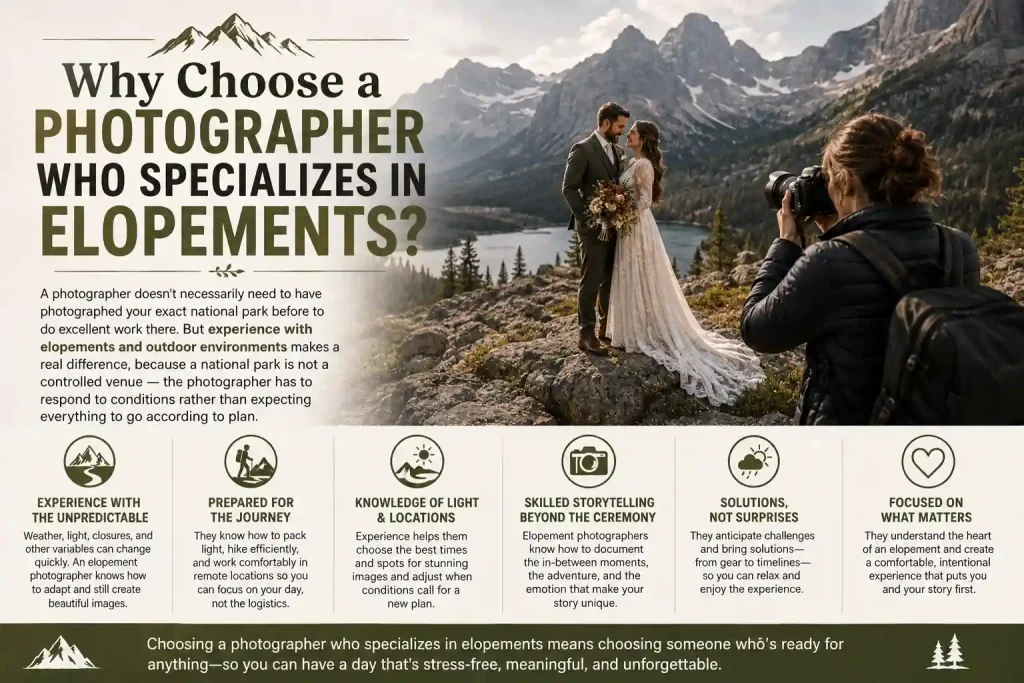
A photographer doesn’t necessarily need to have photographed your exact national park before to do excellent work there. But experience with elopements and outdoor environments makes a real difference, because a national park is not a controlled venue — the photographer has to respond to conditions rather than expecting everything to go according to plan.
They Know How to Work in Changing Outdoor Conditions
Outdoor photography can involve bright sun one moment and clouds, wind, or fog the next. Mountain environments can be especially unpredictable, forests can create challenging low light, and desert landscapes can produce strong midday contrast.
An experienced outdoor photographer adapts rather than letting a change in conditions derail the day. Ask prospective photographers whether their portfolio includes a range of lighting and weather — you want evidence they can create strong images when the day doesn’t look like their favorite portfolio shot.
They Understand Hiking, Travel Time, and Outdoor Logistics
A location that looks close on a map can take much longer to reach once you account for parking, walking, elevation, and time spent simply taking the place in. A photographer who regularly works outdoors treats that journey as part of the story rather than a delay.
They can also help you avoid a schedule that leaves you rushing from one photo stop to the next — useful if you want a relaxed day instead of a tightly packed itinerary.
They Keep the Experience More Important Than the Poses
Your wedding day shouldn’t feel like a nonstop photo session. A good elopement photographer gives you enough direction to feel comfortable while leaving room for natural interaction — encouraging you to walk, talk, explore, or simply pause at a viewpoint rather than repeatedly arranging you into the same poses.
That balance is one of the biggest differences between documenting an elopement and producing a collection of posed wedding portraits. The strongest photographs often happen when you briefly forget the camera is there.
How to Choose the Best National Park Elopement Photographer
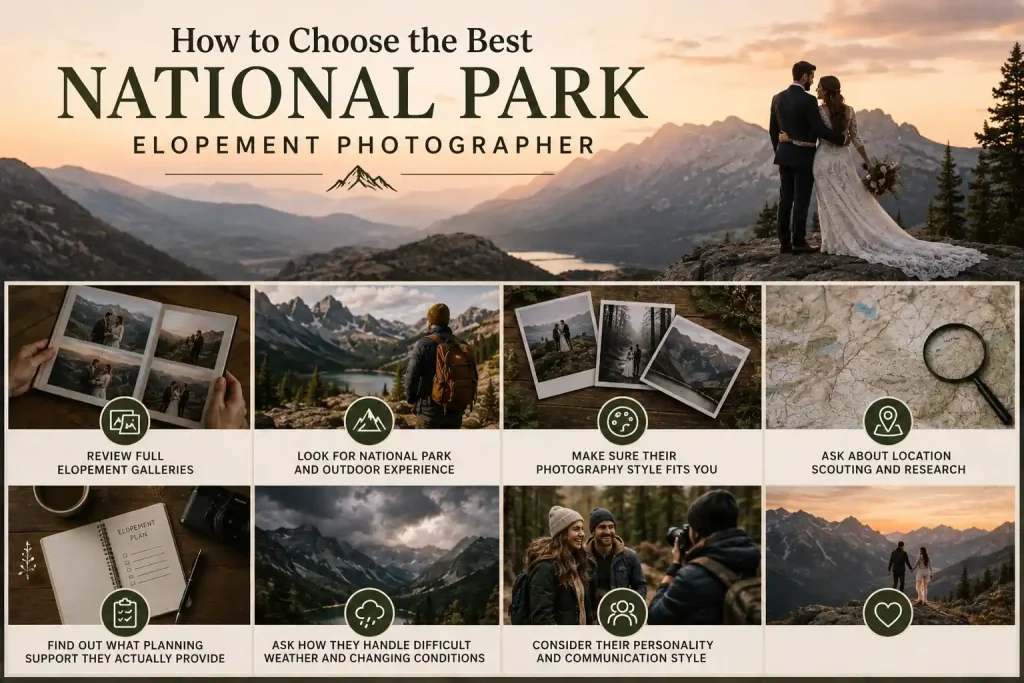
Choosing a photographer for a national park elopement isn’t simply a matter of finding the prettiest portfolio or the lowest price. You’re hiring someone to work in an environment where light, weather, access, and travel time all affect the outcome, and someone whose approach fits how you want your wedding day to feel. Before you book, look beyond individual photographs and evaluate their complete body of work, outdoor experience, planning support, communication, and ability to adapt.
Review Full Elopement Galleries, Not Just Instagram Highlights
A photographer’s social feed shows their strongest images — useful for discovering them, but not enough for judging whether they can document an entire elopement. Ask to see one or more complete galleries from real elopements, and look for a mix of getting-ready photos, details, candid moments, ceremony coverage, and wider environmental images. Pay attention to whether the photographs feel connected, telling a story from beginning to end.
A full gallery also shows how a photographer handles the ordinary moments between the dramatic portraits, since your elopement won’t consist entirely of golden-hour mountain views. If a photographer only shows a handful of highly curated images, ask why.
Look for National Park and Outdoor Experience
A photographer doesn’t need to have worked in your exact park before. What matters is whether they understand the realities of shooting outdoors — in mountains, forests, deserts, coastlines, or other environments less predictable than an indoor venue.
That experience helps a photographer anticipate problems that aren’t obvious from a location’s photos: how quickly weather changes, how much time walking between viewpoints takes, or how difficult certain light can be to shoot in. If your chosen park matters a great deal to you, ask whether they’ve worked there before, and if not, how they plan to research it.
Make Sure Their Photography Style Fits You
Two equally skilled photographers can produce completely different photographs — bright and true-to-life versus dark and moody, documentary versus editorial, landscape-forward versus couple-forward. Look through full galleries and ask yourself whether you’d be happy if your own wedding photos looked like them.
Pay attention to skin tones and editing, color and contrast, posing, candid moments, landscape composition, and overall mood. Don’t choose a style because it’s currently trending — your photographs will outlast the trend.
Ask About Location Scouting and Research
Location knowledge varies widely between photographers. Some send a list of spots; others research viewpoints, lighting, access, and seasonal conditions as part of their planning service. Ask specifically what your photographer means by location scouting: Do they research locations beforehand? Have they photographed there before? Do they account for sunrise and sunset light, walking distance, or alternatives if your preferred area is unavailable?
Photography guidance is not the same as official park information. A photographer can offer experience-based recommendations, but current rules and restrictions should still be confirmed with the park.
Find Out What Planning Support They Actually Provide
“Elopement photographer” means different things from one business to the next. Some focus almost entirely on photography; others provide location research, timeline development, vendor recommendations, and broader logistical guidance. Neither approach is automatically better — what matters is knowing which one you’re paying for.
Ask whether support includes location research, timeline assistance, permit guidance, or simply a consultation about photography, and understand the line between a photographer and a full-service elopement planner. Getting this clear before signing a contract prevents disappointment later.
Ask How They Handle Difficult Weather and Changing Conditions
Ask prospective photographers what happens if the plan changes — have they shot in rain, snow, fog, or strong wind, and how do they adapt? A photographer might adjust the timeline, move to a different location, use the weather creatively, or fall back on an alternative plan, depending on the park, season, and your contract.
You’re not looking for someone who promises perfect weather. You’re looking for someone with a thoughtful, specific answer for when reality differs from the forecast.
Consider Their Personality and Communication Style
Your photographer may be with you for several hours, sometimes during very personal moments. Technical skill matters, but so does how that person makes you feel. Notice how they communicate during your consultation — do they listen to what you want, answer questions clearly, and give guidance without becoming controlling?
If you want a quiet, documentary experience, someone who directs every movement may not be the right fit. If you feel uneasy in front of a camera, a patient photographer who gives gentle direction may suit you better. The best photographer for you is the one whose work, experience, and communication style all match the day you actually want.
What Makes Great National Park Elopement Photography?
A national park gives your photographer an enormous visual canvas, but scenery alone doesn’t guarantee strong photographs. The photographer still has to compose people within that environment, work with changing light, capture genuine interaction, and build a gallery that reads as a complete record of your day — not just a set of impressive individual frames.
Environmental Portraits That Show the Scale of the Landscape
The environmental portrait — stepping back to include the mountains, cliffs, forest, or coastline around you — is a defining feature of national park elopement photography. These images help you remember not just what you looked like, but where you were.
Scale should be intentional, though. You should stay visually connected to the landscape rather than disappearing into it. A skilled photographer knows when a wide composition works and when to move in closer for something more intimate.
Candid Moments That Feel Natural
Not every meaningful photograph needs a pose. Some of the strongest images happen while you’re walking together, laughing at a private joke, or reading your vows. A photographer experienced with elopements recognizes these moments without constantly interrupting them — particularly valuable if you don’t naturally enjoy being photographed.
Strong Photography in Difficult Lighting
A ceremony or portrait session might involve bright midday sun, deep forest shade, or low light near sunrise. When reviewing a portfolio, look past the best golden-hour shots to photographs taken in less controlled conditions. Do skin tones still look natural? Do shadows retain detail? Does the editing stay consistent? A photographer who adapts to imperfect light gives you more confidence in the final gallery.
Images That Tell the Story of the Entire Day
A strong gallery reads as a story — details, preparation, movement through the landscape, the ceremony, reactions, portraits, quiet moments — rather than twenty variations of the same pose. That context is one reason full galleries are more useful than judging a photographer by a handful of standout images.
A Gallery With Variety Instead of Repetitive Poses
Look for variety in distance, composition, and perspective: wide landscapes, medium portraits, close emotional moments, candid shots, and details. Posed photographs are still useful, especially for couples who are nervous in front of a camera — the goal is simply for posing to be one part of the story, not the whole of it.
Choosing a Photographer for Different National Park Landscapes
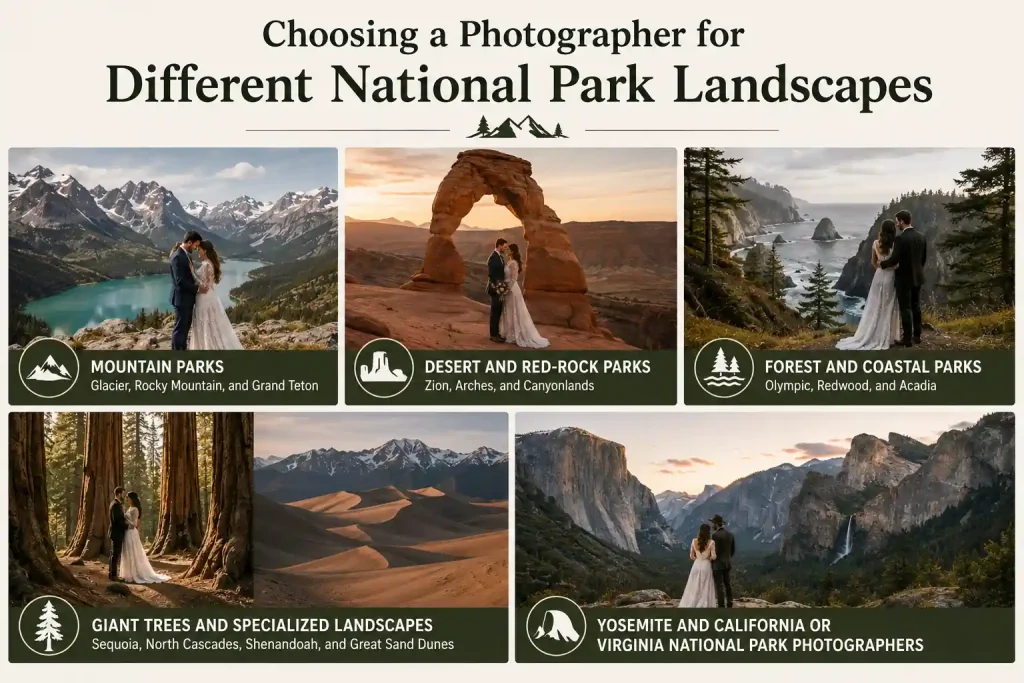
Not every park presents the same photographic challenges, and a photographer who excels in dramatic mountain terrain may approach a dense forest or a desert differently. You don’t need someone who has photographed every park in the country — you need experience that matches the type of environment you’re choosing.
Mountain Parks: Glacier, Rocky Mountain, and Grand Teton
Mountain environments put a premium on adaptability. If you’re comparing a Glacier National Park elopement photographer, a Rocky Mountain National Park elopement photographer, or a Grand Teton National Park elopement photographer, look for comfort working with sudden weather shifts, dramatic elevation changes, and rapidly moving light. You want someone who can use the mountains as a major visual element while still keeping the couple front and center — and who builds a realistic schedule, since a viewpoint that looks close on a map may take real time and effort to reach.
Desert and Red-Rock Parks: Zion, Arches, and Canyonlands
Desert landscapes are a different environment entirely. A Zion National Park elopement photographer needs to understand how enormous canyon walls, directional sunlight, and shadow interact with the couple’s position in the frame; the same applies to photographers working in Arches or Canyonlands. When comparing candidates, look at how they handle both wide canyon compositions and closer portraits — the skill isn’t photographing red rock, it’s understanding how light behaves against it.
Forest and Coastal Parks: Olympic, Redwood, and Acadia
An Olympic National Park elopement photographer may encounter forest, mountain, and coastal conditions in the same day; dense vegetation creates lower light, while coastal areas add wind, fog, and shifting weather. A Redwood National Park elopement photographer should know how to photograph people beneath enormous trees without losing detail in the surrounding shadow, and an Acadia National Park elopement photographer benefits from moving comfortably between forest, open viewpoints, and coastline. When reviewing portfolios from these environments, pay attention to how well shadows, fog, and muted light are handled.
Giant Trees and Specialized Landscapes: Sequoia, North Cascades, Shenandoah, and Great Sand Dunes
Some landscapes call for particularly intentional composition. A Sequoia National Park elopement photographer needs to communicate the scale of giant trees without losing the couple in the shadows they cast. A North Cascades National Park elopement photographer works with rugged, changeable mountain scenery, while a Shenandoah National Park elopement photographer balances forested overlooks with intimate portraits. A Great Sand Dunes National Park elopement photographer faces yet another challenge — open space, shifting light on the dunes, and few traditional landmarks to compose around.
In each case, the real question isn’t whether the photographer has shot that exact park before. It’s whether their existing work shows the skills that environment demands.
Yosemite and California or Virginia National Park Photographers
Yosemite is a useful example of why destination-specific experience helps without being the only factor. A Yosemite National Park elopement photographer should be able to handle both massive landscape compositions and intimate moments, since the park’s recognizable scenery can easily dominate a frame.
The same principle applies to a broader search for a national park elopement photographer in California or a national park elopement photographer in Virginia — state-level searches often surface photographers who work across several outdoor destinations rather than specializing in one. Choose based on the combination of portfolio quality, outdoor experience, style, communication, and familiarity with the type of landscape you’ve chosen, not on how many parks appear in their bio.
National Park Photography Permits: What Your Photographer Should Know
Permit questions can get confusing because photography and the ceremony itself aren’t always governed by the same rules. A couple may be allowed ordinary photography under one set of requirements while the actual vow exchange needs separate authorization from the park.
Photography Rules and Ceremony Rules Are Not Always the Same
Following the EXPLORE Act, signed into law in January 2025, the National Park Service’s current nationwide guidance generally does not require a photography permit or fee for filming or still photography involving eight or fewer people, provided the activity takes place in public areas, uses hand-carried equipment, doesn’t require exclusive use, doesn’t affect resources or other visitors, and won’t create additional administrative costs for the NPS.
That doesn’t make every national park elopement automatically permit-free. A wedding ceremony or other special activity can carry its own authorization requirement even when the photography itself qualifies for the exemption — so the question isn’t only “does my photographer need a permit,” but also “does our ceremony need authorization from this park?” The NPS advises contacting the specific park directly whenever you’re unsure.
A Small Elopement Does Not Automatically Mean No Permit
A small guest count simplifies photography requirements, but group size is only one factor. The exemption for eight or fewer people also depends on where the activity happens, what equipment is used, and whether it affects park resources or other visitors — and individual parks can layer on their own rules for weddings and designated locations.
That’s why a photographer’s general claim that “small elopements don’t need permits” isn’t something to rely on. The correct answer depends on what you’re doing, where, and the current rules of that specific park.
Your Photographer Should Help You Understand the Rules
A knowledgeable photographer can be a genuine planning resource — they may know which questions to ask, how photography affects the timeline, and which locations carry restrictions. But they shouldn’t be treated as the final authority on current regulations. Verify requirements directly with the relevant National Park Service office before your elopement, since rules can change and the NPS itself recommends contacting the park when in doubt. Your photographer’s role is to help you plan intelligently around the rules, not to replace the agency responsible for them.
How Much Does a National Park Elopement Photographer Cost?
There’s no single standard price for national park elopement photography. Cost varies with the photographer, destination, coverage length, travel requirements, and planning assistance involved, so it’s more useful to compare total value than to compare headline prices.
What Factors Affect Photographer Pricing?
Coverage time is usually the biggest variable — a short portrait session costs far less than documenting an entire day from getting ready through sunset. Travel matters too: a photographer may need to drive several hours, fly, or stay overnight. Planning support adds value as well, since some photographers provide extensive location research and timeline assistance while others focus mainly on the photography itself.
Other factors include photographer experience and demand, a second shooter, editing and delivery turnaround, and physical products like albums or prints. This is why direct price comparisons can be misleading — a higher price may reflect substantially more coverage or support, while a lower one may be built around a shorter session.
How Much Coverage Do You Actually Need?
Start with the experience you want documented rather than picking a number of hours first. A short session can work for a simple ceremony at one accessible location with portraits afterward. More coverage makes sense if you want getting-ready photos, a first look, a hike through the park, multiple portrait locations, or sunset.
Think about what you’d regret not having photographed. If the most meaningful part of your day is a quiet hike beforehand, booking coverage that only spans the vows will leave that out. At the same time, you don’t need an all-day package simply because it exists — the right amount of coverage is whatever actually matches your plans.
What Is Usually Included in a National Park Elopement Photography Package?
Packages vary a great deal from one photographer to another, so read the details rather than assuming a certain number of hours automatically includes everything you need. A package may include coverage, edited images, an online gallery, printing rights, planning consultations, and sometimes travel or physical products.
Compare Coverage, Images, Travel, and Planning Support
When comparing two photographers, check coverage hours first, and what it costs to add more. Then look at image delivery — how many edited photographs to expect, how they’re delivered, and the turnaround time. Check travel costs next, since an advertised package price may not include destination travel, accommodation, or park entrance fees.
Finally, compare planning support: does the photographer simply arrive and shoot, or do they help with location research and timeline logistics beforehand? There’s no universally best package — only the one whose coverage, deliverables, and travel terms actually match your elopement. This is worth keeping separate from broader elopement package planning, which covers the full day rather than photography specifically.
Questions to Ask Before Booking a National Park Elopement Photographer
Once you’ve narrowed your choices, a consultation reveals things a portfolio can’t. Use it to understand not just what the photographer produces, but how they work before, during, and after your elopement. You don’t need to ask everything — focus on the areas most likely to affect your experience.
Questions About Experience and Portfolio
Ask how many elopements they’ve photographed, which outdoor environments they regularly work in, and how they prepare for a park they haven’t shot before. Then ask to see a complete gallery rather than relying on social media alone — useful questions include how they approach couples who are uncomfortable posing, how much direction they typically give, and how many edited images are usually delivered.
Questions About Location and Planning Support
Find out how involved the photographer will be before the wedding: Do they research locations and lighting? Help build a photography timeline? Account for walking or driving time? What happens if your preferred spot becomes unavailable? This is also the moment to clarify what they don’t handle — planning assistance isn’t the same as full-service elopement planning.
Questions About Permits and Park Rules
Ask whether they’re familiar with the park’s current photography requirements, whether they’ve worked there before, and how they’d help you identify what to confirm with the park directly. A knowledgeable photographer can help you think through logistics, but shouldn’t be treated as the final word on current regulations.
Red Flags When Hiring a National Park Elopement Photographer
A beautiful portfolio doesn’t automatically mean a photographer is the right choice. A few warning signs are worth watching for before you commit.
They Only Show a Few Highly Curated Portfolio Images
Every photographer has favorites, and there’s nothing wrong with showcasing them. The problem is when those few images are all you have to go on. If a portfolio shows dramatic landscapes but little evidence of ceremonies, candid moments, or ordinary parts of a wedding day, ask for a full gallery before booking.
They Cannot Explain Their Outdoor Backup Plan
Outdoor conditions are unpredictable, so a photographer should have a real answer for basic scenarios: rain affecting portraits, strong wind, poor visibility, or a preferred location becoming inaccessible. They don’t need to promise every problem is solvable, but they should be able to describe how they typically adapt.
They Promise Locations Without Understanding Park Rules
Be cautious if a photographer confidently promises access to a location without discussing whether the activity is actually allowed there. National parks are public land with rules that affect ceremonies, group size, and access. A responsible photographer verifies information and encourages you to confirm current requirements with the park — confidence is useful, but overconfidence about regulations is not.
How Many Hours of Photography Do You Need?
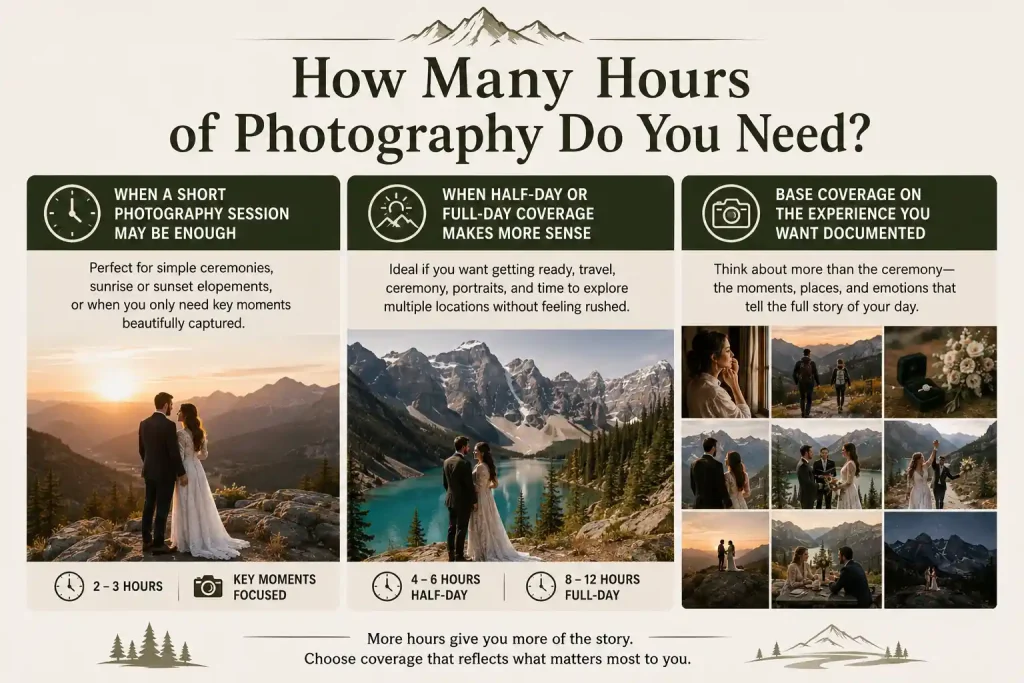
The right amount of coverage depends on how much of your elopement you actually want photographed. Your ceremony may last only minutes, but the experience surrounding it can take hours.
When a Short Photography Session May Be Enough
A shorter session can work well if your plans are simple: one easily accessible location, a short ceremony, minimal travel, and a small portrait session afterward. If the ceremony and portraits are all you care about capturing, you likely don’t need coverage for the entire day — just enough time to avoid feeling rushed.
When Half-Day or Full-Day Coverage Makes More Sense
More coverage is useful when photography is meant to document the experience around the ceremony, not just the ceremony itself — getting ready, a first look, a hike, multiple portrait settings, or sunset. Longer coverage also gives you flexibility to stop, explore, and let photographs happen naturally instead of rushing between spots.
Base Coverage on the Experience You Want Documented
Rather than asking how many hours other couples typically book, ask a better question: which parts of the day would we regret not having photographed? If that’s simply the ceremony and a few portraits, short coverage is fine. If it’s a sunrise hike or a full day outdoors, your coverage should reflect that.
What Happens If Weather or Park Conditions Change?
A national park elopement gives you beautiful surroundings, but those surroundings aren’t controlled the way an indoor venue is. Weather, seasonal access, and temporary closures can all affect your plans — which is why it’s worth discussing these possibilities before booking rather than after.
How Rain, Snow, Wind, and Fog Can Affect Photography
Different weather brings different challenges. Rain affects equipment, visibility, and comfort; snow can change access; wind complicates portraits; fog reduces visibility. But difficult weather doesn’t automatically mean disappointing photographs — clouds soften harsh light, fog adds atmosphere, and even rain can produce a memorable, distinct gallery when conditions are safe. Your photographer should be able to adapt creatively while also recognizing when conditions have crossed into unsafe or impractical territory.
What Happens When Trails or Locations Become Unavailable
A photographer can’t control a trail closure or seasonal restriction, but they can help you avoid building your entire plan around a single location. Ask whether they recommend backup options and how they handle a location becoming unavailable shortly before or during your elopement. A good backup doesn’t need to look identical to the original — it needs to be safe, permitted, and still able to produce a meaningful gallery.
Ask About Rescheduling and Backup Plans Before Booking
This is as much a contract question as a photography one. Ask what happens if severe weather makes the location unsafe, whether the date can be changed, what happens if the park closes, and whether additional travel costs apply to rescheduling. Don’t wait until the forecast looks bad to find out how your photographer handles it — a clear agreement removes most of the uncertainty in advance.
Frequently Asked Questions About National Park Elopement Photographers
What is a national park elopement photographer?
A photographer who specializes in documenting intimate weddings in outdoor settings like mountains, forests, deserts, and coastlines — often with added support for location research, timelines, and adapting when conditions change, rather than treating the park like an indoor venue.
How do I find the best national park elopement photographer?
Review complete elopement galleries rather than social media highlights, then compare outdoor experience, photography style, planning support, communication, and contract terms. The best fit isn’t necessarily the most popular or expensive photographer — it’s the one whose work and approach match the day you want.
Do I need a photographer who has worked in my national park before?
Not necessarily. It can help, but strong experience in a similar outdoor environment matters more than a specific park on their resume. If they haven’t shot there before, ask how they prepare.
Do national park elopement photographers help with permits?
Some offer permit guidance as part of planning support; others leave it to the couple. Either way, confirm current permit and ceremony requirements directly with the park — don’t rely on your photographer as the final authority.
How much does a national park elopement photographer cost?
There’s no standard price. Cost depends on coverage hours, travel, planning assistance, editing, and deliverables, so compare what’s actually included rather than the number alone.
How many hours should I book?
That depends on what you want documented. Ask yourself which parts of the day you’d regret not having photographed, and build your coverage around that rather than a default package length.
What happens if it rains on our elopement day?
Rain doesn’t automatically mean bad photographs — clouds and rain can create a distinct, memorable gallery. What matters is whether your photographer has a sensible way to adapt, including alternative locations and a clear policy on safety and rescheduling.
Can a photographer recommend national park locations?
Many offer some level of location guidance, though the depth varies. Ask exactly what’s included, and remember that photography recommendations don’t replace confirming current park rules yourself.
Should I choose a local national park photographer?
Local knowledge helps, but it isn’t automatically better than a photographer with strong national park and adventure-elopement experience elsewhere who’s willing to research your destination thoroughly. Compare experience and portfolio quality over location alone.
Can one photographer cover the entire elopement?
Usually, yes, especially for a simple two-person elopement. Larger or more complex celebrations, or multiple simultaneous locations, may call for a second photographer.
Choosing the Right National Park Elopement Photographer
Your national park elopement photographer will do more than create beautiful portraits. They may spend hours with you, help shape the photography timeline, navigate changing outdoor conditions, and document the small moments that happen between the major ones.
Look for someone whose complete galleries show consistent storytelling, whose style genuinely appeals to you, and whose outdoor experience matches the environment you’ve chosen. Ask what planning and location support they provide, how they handle weather, and exactly what’s included in their package.
You don’t need the photographer with the biggest following or the longest list of national parks in their bio. You need someone who can photograph your relationship, understand the landscape, adapt when plans change, and let you experience the day without turning every moment into a photo shoot. When the right photographer is behind the camera, your gallery becomes more than a set of beautiful national park photographs — it becomes a record of the people, places, and small moments that made your elopement yours.