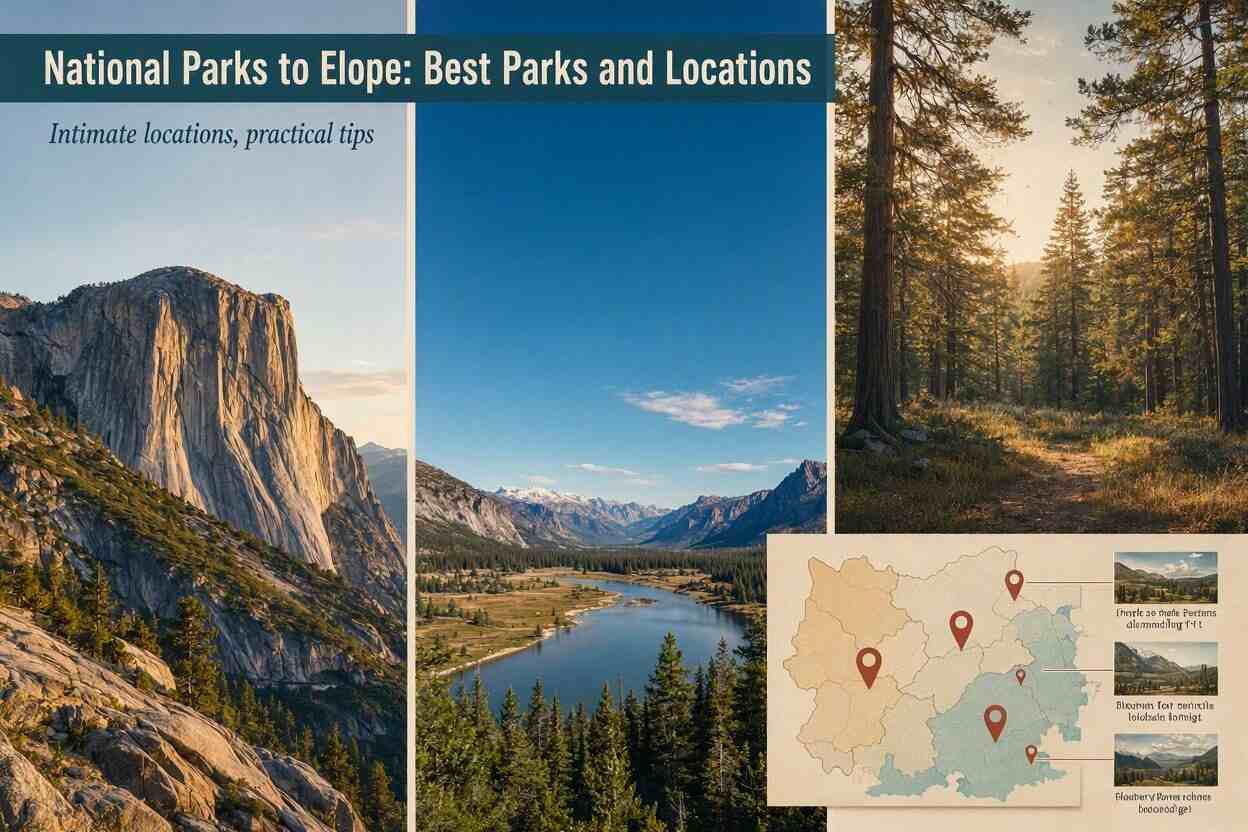
National Parks to Elope: Best Parks and Locations
Here’s the problem with searching for the best national parks to elope: there are dozens of options, they are nothing alike, and a park that looks perfect in someone else’s photos might be completely wrong for your actual wedding day.
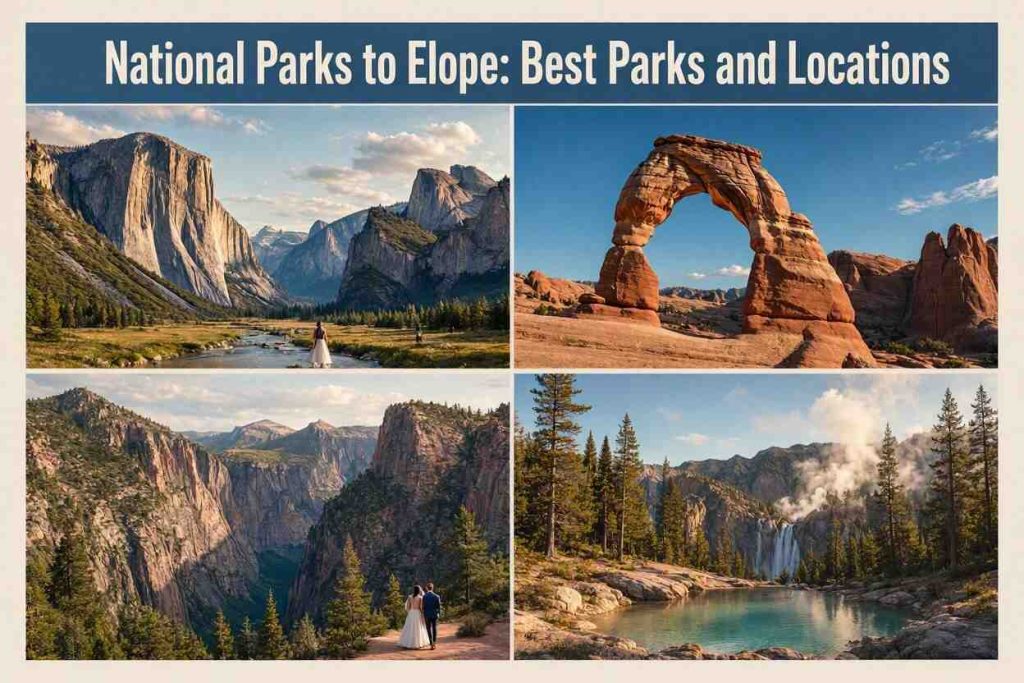
The fix is to stop browsing by prettiest picture and start choosing by landscape, permit rules, and how you actually want to spend the day — once those three things line up, the right park stops feeling like a guess.
That sounds simple, but it means asking a few questions before you fall in love with a location. Do you want red-rock cliffs, alpine mountains, giant trees, open desert, or sand dunes? How much hiking are you actually willing to do in wedding clothes? Are you bringing family, or is it just the two of you? And, maybe most importantly, what does the park itself allow you to do?
I put this guide together to walk through those questions park by park — what makes each one different, what the current permit situation looks like, and what I’d actually think about before booking flights.
Quick Comparison: Which National Park Should You Elope In?
Use this table to shortlist two or three parks before reading the full breakdown below — match the landscape you actually want against how accessible the park is and what the current permit situation looks like.
| Park | Best For | Landscape | Accessibility | Permit Situation |
|---|---|---|---|---|
| Joshua Tree | Desert elopements | Desert, boulders, Joshua trees | Easy — roadside sites | Special Use Permit required, $120 fee |
| Shenandoah | Mountain overlooks, fall color | Blue Ridge Mountains, forest | Easy — roadside overlooks | Permit-free under 15 guests, no props |
| Redwood | Giant trees | Old-growth coastal forest | Easy to moderate | Permit required on NPS land |
| Arches | Red rock scenery | Sandstone arches, desert | Easy to moderate | Permit required, book up to 1 year ahead |
| Canyonlands | Vast, dramatic views | Canyons, mesas, cliffs | Moderate — long distances | Site-dependent — confirm with park |
| Big Bend | Remote adventure | Desert, mountains, river canyon | Remote, more travel time | Confirm with park |
| Great Sand Dunes | Something completely different | Sand dunes with mountain backdrop | Moderate — walking in sand | Confirm with park |
| Great Smoky Mountains | Forest and mountain atmosphere | Lush forest, misty ridges | Easy, but crowded | Confirm with park |
| Saguaro | Sonoran desert | Desert, saguaro cacti | Easy | Confirm with park |
| Death Valley | Dramatic desert landscapes | Salt flats, dunes, stark desert | Moderate — extreme heat | Confirm with park |
| Badlands | Unusual rock formations | Layered ridges, prairie | Easy | Confirm with park |
| Crater Lake | Iconic alpine setting | Volcanic caldera lake | Moderate — seasonal snow | Confirm with park |
| White Sands | Minimalist, dreamlike photos | White gypsum dunes | Moderate — walking in sand | Confirm with park |
| Bryce Canyon | Hoodoo landscapes | Sculptural rock spires | Easy | Confirm with park |
| Denali | Wild, Alaskan experience | Mountains, wilderness | Remote — shuttle access | Confirm with park |
| Kenai Fjords | Coastal Alaska | Glaciers, fjords, coastline | Remote — often boat access | Confirm with park |
| Lassen Volcanic | Less-expected mountain setting | Volcanic peaks, lakes, forest | Moderate | Confirm with park |
| Cuyahoga Valley | Eastern woodland elopement | Forests, waterfalls, rivers | Easy | Confirm with park |
| Yosemite | Iconic granite cliffs and waterfalls | Granite cliffs, waterfalls, high Sierra | Easy to moderate | Permit required, $150 + possible $50/hr monitoring |
| Grand Teton | Dramatic mountain-lake backdrops | Jagged peaks, alpine lakes | Easy to moderate | Permit required, $200, apply 30+ days ahead |
| Grand Canyon | The world’s most recognizable canyon view | Layered canyon, desert rim | Easy (South Rim) to remote (North Rim) | Permit required, $240–$500 by site |
| Rocky Mountain | Easy-access Colorado alpine scenery | High alpine peaks, lakes | Easy — close to Denver | Permit required, $300 |
| Glacier | Glacier-carved peaks and alpine lakes | Glacial peaks, turquoise lakes | Moderate — remote sites, shuttle access | Permit required, $125, apply 20+ business days ahead |
What Makes a National Park a Good Place to Elope?
The scenery is the obvious draw, but I wouldn’t let it be the only factor, because a stunning photo doesn’t tell you whether the ceremony itself will go smoothly.
I’d weigh five things instead:
- The landscape: Does it actually match the setting you pictured?
- Accessibility: Can you get there without turning the wedding day into an exhausting hike?
- Privacy: How comfortable are you sharing the area with other visitors?
- Rules and permits: Does your ceremony need a permit, and are there limits on where you can stand?
- Season: Will weather, road conditions, crowds, and daylight actually cooperate?
That last point about privacy matters more than people expect. A permit does not mean the location is yours alone — both Joshua Tree and Arches are explicit that permitted wedding areas stay open to other visitors. You’re not building a private, controlled event. You’re stepping into a landscape that already belongs to everyone else too, and letting it become part of your story anyway.
Best National Parks to Elope
1. Joshua Tree National Park — Best for Desert Elopements
If your version of an elopement involves twisted desert trees, giant boulders, and golden-hour light without a multi-day backpacking trip, Joshua Tree National Park solves that immediately — it delivers a desert landscape that’s instantly recognizable without requiring you to go deep into true wilderness.
Joshua Tree National Park Elopement
The designated ceremony locations include Hidden Valley Picnic Area, Cap Rock, Rattlesnake Picnic Area, Quail Springs Picnic Area, Split Rock, and a handful of smaller sites, each with its own group limit. A Special Use Permit is required for any ceremony in the park — current NPS guidance allows applications from 15 days before your date up to 12 months in advance, with a $120 non-refundable application fee.
How to Elope in Joshua Tree National Park
Start by locking in your rough guest count and season before you pick a ceremony site, since each location has different capacity and vehicle limits and the park never gives you exclusive use of it. Then plan around the heat rather than the calendar — a striking summer photo doesn’t mean a comfortable summer ceremony, so mornings and evenings are worth prioritizing when temperatures climb. If you want that classic Joshua Tree look, build the whole day around light instead of just picking a convenient ceremony time; early morning and late-afternoon ceremonies feel like two completely different weddings.
2. Shenandoah National Park — Best for Mountain Overlooks and Fall Color
If you want mountains without the desert heat, Shenandoah National Park is the answer — its Blue Ridge scenery, forested drives, and sweeping overlooks give you a romantic, peaceful elopement rather than a rugged one.
Shenandoah National Park Elopement
What I like most here is the flexibility: a simple overlook ceremony can be the whole event, or just the opening act before a day of hiking and photography. Skyline Drive runs the length of the park, and well-known overlooks worth considering include Hogback Overlook, Big Meadows, Blackrock, and Range View Overlook — each has a different feel, from wide valley views to open meadow. Current NPS rules say a ceremony may not need a permit at all when there are 15 or fewer people and no props, decor, music, or equipment involved — a permit is only required for larger groups, added setups, or amphitheater ceremonies.
How to Elope in Shenandoah National Park
Don’t choose your overlook from a single photo you saw online; think through parking, walking distance, group size, and how that same view will look during your actual season. Fall color is genuinely spectacular, but it also brings heavier crowds, so if a quieter ceremony matters to you, plan around an early morning or an off-peak week rather than assuming the classic postcard shot will feel private.
3. Redwood National and State Parks — Best for Giant Trees
If you want your elopement to feel quiet, intimate, and almost storybook, standing beneath a grove of old-growth redwoods along the Northern California coast solves that better than almost anywhere else on this list.
Redwood National Park Elopement
The detail that trips people up: Redwood National and State Parks is actually a mix of National Park Service land and California State Park land, and which permit process applies depends entirely on your exact ceremony spot. The NPS currently requires a permit for all weddings, elopements, and vow exchanges on its portion of the land, and permits are non-exclusive.
Best Places to Elope in Redwood National and State Parks, California
Within the wider Redwood National and State Parks system you’ll find Jedediah Smith Redwoods State Park, Del Norte Coast Redwoods State Park, and Prairie Creek Redwoods State Park, each with a slightly different feel — some couples pair a redwoods elopement with a coastal stop, since the same corridor of Northern California national and state park land gives you both forest and shoreline in one trip. My advice for eloping in these California national parks is to identify the exact grove first, confirm which land it sits on, then apply for the right permit — not the other way around. The trees are already the decoration, so keep the ceremony simple and spend the rest of the day exploring the forest and coastline.
4. Arches National Park — Best for Red Rock Scenery
If your dream elopement involves sandstone arches that look almost unreal in photos, Arches National Park is hard to beat — but the location you love most in a photo may not be the location where ceremonies are actually allowed, so planning has to come before packing.
Arches National Park Elopement Locations
Approved wedding locations include Park Avenue, La Sal Mountains Viewpoint, Double Arch, The Windows, Panorama Point, and Devils Garden Campground Amphitheater, with permitted group size varying by site. The NPS currently allows weddings to be scheduled up to a year in advance and recommends contacting the Special Park Uses Coordinator about availability before you submit an application.
Eloping at Arches National Park
Leave room in the schedule for more than the ceremony itself — the vows might take five minutes, but the day becomes memorable when you build in time to actually explore the park afterward. Confirm your chosen site’s group limit and vehicle allowance early, since that’s usually what changes a couple’s plans more than anything else.
5. Canyonlands National Park — Best for Vast, Dramatic Views
If Arches feels too intimate and you want your photos to feel enormous, Canyonlands National Park is the move — huge canyon views, mesas, and cliffs replace Arches’ close-up rock formations with something far more expansive.
Canyonlands National Park Elopement Locations
Elopement locations here tend to center on the park’s overlooks and viewpoints rather than a single iconic formation. Grand View Point, Green River Overlook, and the area near Mesa Arch are among the most photographed spots in the Island in the Sky district, and distances inside the park are genuinely significant — a spot that looks close on a map can take much longer to reach than you’d expect. Ceremony logistics are less standardized than at Arches, so I’d confirm your exact viewpoint and any permit requirements directly with the park well before your date.
How to Elope in Canyonlands National Park
Plan fewer stops and give each one more time rather than trying to see everything in one day — there’s no reason to rush through a landscape this dramatic, and rushing is the easiest way to miss the golden-hour window you’re actually there for.
6. Big Bend National Park — Best for a Remote Adventure
If you want your elopement to feel like a genuine escape rather than a scenic backdrop, Big Bend National Park delivers that through sheer remoteness — its desert, mountains, and river landscapes sit far enough from any major city that the isolation becomes part of the experience.
Big Bend National Park Elopement
Eloping in Big Bend naturally slows the whole day down, since there’s no reception schedule competing with the landscape and nothing forcing you to be anywhere at a specific time. Couples drawn to the park’s dramatic scenery often look at Santa Elena Canyon, the Chisos Basin, and the Sotol Vista Overlook, each offering a very different backdrop — river canyon, mountain basin, and open desert vista. The tradeoff is the same remoteness that makes it appealing — travel time, accommodation, fuel, weather, and cell coverage all need to be planned around, not discovered on the drive in.
Planning an Elopement Near Big Bend National Park
If lodging inside the park doesn’t work for your dates, look at elopement-friendly stays near Big Bend in Terlingua or Study Butte, both close enough for an easy morning drive to your ceremony site. Wherever you land, I’d build in extra flexibility rather than scheduling every hour, since weather and drive times here are less predictable than in more visited parks.
7. Great Sand Dunes National Park — Best for Something Completely Different
If you’re picturing mountains or forest for every national park elopement, Great Sand Dunes National Park breaks that pattern entirely — its towering dunes set against a mountain backdrop create a landscape that looks almost surreal in photos.
How to Elope in Great Sand Dunes National Park
The practical catch is the sand itself: walking through dunes is genuinely harder than a normal trail, especially in formal shoes and a dress or suit that isn’t built for it. Most elopements happen in or near the main dunefield, reachable from the Dunes Parking Area, since it’s the most accessible point with the mountain backdrop already built into the view. Plan your footwear and how far into the dunes you actually want to walk before the day arrives, and lean toward a sunrise or sunset ceremony — both look stunning here, but only if your plans account for the physical effort of getting to the spot.
8. Great Smoky Mountains National Park — Best for Forest and Mountain Atmosphere
If lush forest and misty mountains sound more like your elopement than desert or dunes, Great Smoky Mountains National Park delivers that atmosphere better than almost anywhere else on this list, with streams, seasonal color, and mountain ridges replacing the starkness of the Southwest parks.
Smoky Mountain National Park Elopement
A Smoky Mountain elopement tends to suit couples who want the scenery to feel romantic rather than dramatic, and each season changes that mood — spring brings wildflowers, summer brings full green canopy, and fall brings the foliage colors the park is famous for. Clingmans Dome, Newfound Gap, and Cades Cove are the park’s best-known spots for a ceremony, though each draws heavy visitation, so weigh the view against the crowd it comes with. The one thing I’d watch closely is crowding: some of the most photogenic overlooks get busy fast, so I wouldn’t assume a popular viewpoint will feel private just because you’re calling it an elopement.
9. Saguaro National Park — Best for the Sonoran Desert
If you want a desert elopement but towering saguaro cacti appeal to you more than Joshua Tree’s twisted branches, Saguaro National Park gives you a completely different desert character built around southern Arizona’s defining plant.
Saguaro National Park Elopement Locations
The park’s desert landscape reads instantly as Sonoran rather than Mojave, which matters if you’ve already ruled out Joshua Tree for aesthetic reasons but still want that desert feel. The park is split into two districts, and Signal Hill in the Tucson Mountain District and the Cactus Forest Loop in the Rincon Mountain District are both popular for their dense concentrations of saguaros. Heat should shape your planning from day one — an outdoor ceremony works far better around comfortable morning or evening temperatures than a midday slot chosen purely to fit a schedule.
10. Death Valley National Park — Best for Dramatic Desert Landscapes
If Joshua Tree and Saguaro still feel too green for you, Death Valley National Park pushes the desert elopement idea to its most extreme — salt flats, sand dunes, and stark mountain backdrops create a landscape with almost nothing softening it.
Death Valley National Park Elopement
That starkness is the whole appeal, but it comes with the most demanding weather planning on this list. Zabriskie Point and Badwater Basin are the park’s two most recognizable spots — one for sweeping badland views at sunrise, the other for the otherworldly salt flats — and both work well for a short ceremony followed by photos. Check seasonal temperatures before you commit to a date rather than after — timing here can be the difference between a comfortable ceremony and a dangerous one.
11. Badlands National Park — Best for Unusual Rock Formations
If you want something visually distinctive without the crowds of the Southwest’s more famous parks, Badlands National Park answers that with layered rock formations, dramatic ridges, and open prairie that photograph like nowhere else.
Badlands National Park Elopement
The landscape works especially well for couples building a road-trip-style elopement, where Badlands is one striking stop among several rather than the sole destination. Pinnacles Overlook, the Door Trail, and Yellow Mounds Overlook are among the most photographed spots along the park’s main loop road, each showing a different side of the eroded rock formations. Because the terrain is less predictable than a groomed overlook, I’d scout your exact ceremony spot in advance or work with a local photographer who already knows which ridges hold up in changing light.
12. Crater Lake National Park — Best for an Iconic Alpine Setting
If exchanging vows beside an intensely blue mountain lake sounds like the whole reason to elope in a national park, Crater Lake National Park is that image realized — but the season you choose will decide whether you can actually reach it.
Crater Lake National Park Elopement
Snow significantly affects access and road conditions here for much of the year, so the date needs to be chosen around park conditions, not around what looks good on a calendar. Once you’ve confirmed seasonal access, Rim Village and the Sun Notch viewpoint are the two spots most couples gravitate toward — Rim Village for easy access, Sun Notch for a quieter view with less foot traffic. The payoff is one of the most distinctive backdrops on this entire list — few other parks give you a single, unmistakable focal point like the lake itself.
13. White Sands National Park — Best for Minimalist, Dreamlike Photos
If you want photos where nothing competes with the two of you, White Sands National Park solves that with its bright, near-empty dunes acting as the simplest possible background for a ceremony.
White Sands National Park Elopement
As with Great Sand Dunes, the walking is harder than it looks — think through footwear and how far into the dunes you actually want to go before the day arrives. The Interdune Boardwalk offers an easy, accessible option close to parking, while couples wanting a more secluded backdrop tend to walk further out along Dunes Drive. Once you’ve planned around that, the minimalist look is what makes White Sands stand out from every other desert park on this list; there’s no rock formation or tree line pulling focus, just you and the dunes.
14. Bryce Canyon National Park — Best for Hoodoo Landscapes
If you want dramatic scenery without a huge production, Bryce Canyon National Park delivers that through its hoodoos alone — the dense, sculptural rock formations do more visual work than most couples could ever add with decor.
Bryce Canyon National Park Elopement
The amphitheater changes character completely depending on when you’re standing there, so I’d spend time studying how the light moves across it before locking in a ceremony time. Sunrise Point, Sunset Point, Inspiration Point, and Bryce Point each look out over the same amphitheater from a slightly different angle, and the names are a genuinely useful guide to when each one looks best. Sunrise brings a soft, pink-orange glow across the hoodoos, while midday flattens the same view considerably — the time you choose matters here more than almost any other park on this list.
15. Denali National Park — Best for a Wild, Alaskan Experience
If you want your wedding day to feel like an adventure from the first hour to the last, Denali National Park gives you that through sheer scale — mountains, wilderness, and wildlife replace anything resembling a conventional wedding setting.
Denali National Park Elopement
It’s not the easiest destination on this list, and that’s intentional rather than a downside — the remoteness is exactly what makes a Denali elopement feel earned rather than staged. Savage River, Wonder Lake, and the area around the Eielson Visitor Center are among the most accessible spots with real mountain views, though reaching the deeper ones typically means riding the park’s shuttle system rather than driving in yourself. I’d work with local guides who know current access and weather conditions rather than trying to plan the day entirely from home, since Alaska’s interior doesn’t always cooperate with a fixed itinerary.
16. Kenai Fjords National Park — Best for Coastal Alaska
If Denali’s interior wilderness isn’t quite the Alaska you pictured, Kenai Fjords National Park offers the coastal version — rugged shoreline, glaciers, and marine landscapes for couples who want their elopement to feel adventurous in a completely different direction.
Kenai Fjords National Park Elopement
Exit Glacier is the one part of the park reachable by road, making it the most practical ceremony spot for couples who don’t want to charter a boat; everything past it — the fjords, tidewater glaciers, and marine wildlife the park is named for — is generally only reachable by water. The logistics here are more involved than almost any park in the lower 48, often requiring boat access to reach the most dramatic glacier and coastline views. I’d work with someone who knows the area well and plan the whole day around transportation and weather windows rather than trying to force it into a rigid, hour-by-hour schedule.
17. Lassen Volcanic National Park — Best for a Less-Expected Mountain Setting
If you want mountain scenery without picking one of the more obvious national park destinations, Lassen Volcanic National Park offers volcanic landscapes, alpine views, forests, and lakes in a package far fewer couples consider.
Lassen National Park Elopement
That relative obscurity is actually the draw — you get a beautiful outdoor setting with a genuinely different feel from the well-photographed parks everyone else is considering. Manzanita Lake offers an easy, accessible lakeside setting with the peak reflected in the water, while Bumpass Hell gives you a genuinely unusual volcanic backdrop if you want the “less-expected” part of this park’s appeal to show in the photos. Because it’s less traveled, I’d confirm current trail and road conditions directly with the park before finalizing a ceremony site, since access can vary more here than at higher-traffic parks.
18. Cuyahoga Valley National Park — Best for an Eastern Woodland Elopement
If flying across the country for a Western landscape isn’t practical, Cuyahoga Valley National Park proves an elopement doesn’t need dramatic desert or alpine scenery — its forests, waterfalls, and rivers create a softer, more accessible setting instead.
Cuyahoga Valley National Park Elopement
For couples living in or traveling through the eastern United States, this is often the more practical choice logistically, without giving up a genuinely beautiful natural setting. Brandywine Falls and the Ledges Overlook are the park’s two standout spots — a 65-foot waterfall framed by a boardwalk, and a sweeping view over the valley from a rock outcrop. The changing seasons do a lot of the visual work here too — spring waterfalls and fall foliage each give the same trails a completely different mood, so it’s worth picking a season as deliberately as you’d pick a location.
A Note on the Bigger-Name Parks
The 18 parks above were chosen deliberately to skip the destinations most couples default to first — less competition for permits, more privacy, and often a genuinely easier planning process. But Yosemite, Grand Teton, Grand Canyon, Rocky Mountain, and Glacier are also some of the most-searched national park elopement destinations in the country, so leaving them out entirely would miss what a lot of people are actually looking for. Here’s the same permit-verified breakdown for each of those five.
19. Yosemite National Park — Best for Iconic Granite Cliffs and Waterfalls
If your version of an elopement means towering granite cliffs, thundering waterfalls, and the single most photographed valley in America, Yosemite National Park delivers that instantly recognizable High Sierra backdrop — but it’s also one of the most tightly permitted parks on this list, so the paperwork needs to happen early.
Yosemite National Park Elopement
Every ceremony inside the park requires a Special Use Permit, even a two-person elopement with just an officiant — the fee is $150 (non-refundable), with an additional $50-per-hour monitoring fee for outdoor ceremonies with 30 or more guests, on top of the standard $35 park entrance fee. Apply through the Special Park Uses office up to 12 months ahead and no later than 21 days before your date; ceremonies are capped at two hours, and popular spots like Glacier Point tend to fill up close to that 12-month mark.
Yosemite Elopement Locations
There are more than a dozen designated ceremony sites across the park, and each has its own guest cap and seasonal availability — some hold up to 50 people, while others are limited to as few as 10. Amplified music isn’t allowed, and decor, arches, and signage are off the table everywhere except picnic-table sites, so plan on letting the granite and waterfalls do the visual work rather than bringing your own setup.
20. Grand Teton National Park — Best for Dramatic Mountain-Lake Backdrops
If jagged peaks reflected in a still alpine lake is the image in your head, Grand Teton National Park is built for exactly that — the Teton Range rises straight up from the valley floor with almost no foothills in between, which is part of what makes it look so dramatic in photos.
Grand Teton National Park Elopement
A Special Use Permit is required for any ceremony in the park, currently $200, and you’ll need to apply at least 30 days ahead — plus the standard $35 park entrance fee, bringing the baseline cost to around $235 before any vendors. There are two permit types: a Reserved Site-Specific Ceremony (25–40 people, at one of six designated locations like Signal Mountain Summit, Schwabacher’s Landing, and Blacktail Ponds Overlook) and a Small Dispersed Ceremony permit for groups of 12 or fewer.
Grand Teton Elopement Locations
If a ceremony inside a historic building appeals to you more than an overlook, the Chapel of the Transfiguration and Chapel of the Sacred Heart are both inside the park and don’t require a Special Use Permit at all — but they’re privately operated, so you’ll book directly with the church rather than through the NPS. Aim for mid-May through late September, since a lot of the park’s wedding sites offer no shade and much of the park isn’t accessible in winter.
21. Grand Canyon National Park — Best for the World’s Most Recognizable Canyon View
If you want a single, unmistakable backdrop that needs zero explanation in photos, Grand Canyon National Park delivers that better than almost anywhere else on this list — there’s a reason it’s one of the most requested elopement parks in the country.
Grand Canyon National Park Elopement
Every ceremony requires a Special Use Permit, and the cost depends heavily on location: most designated sites run $240, while Shoshone Point — the only NPS site that allows full catering and a covered pavilion — costs $500 for a six-hour exclusive window. Applications are accepted up to a year in advance but need at least four weeks’ notice, and requests aren’t expedited, so a date less than 45 days out is a real risk.
Grand Canyon Elopement Locations
The South Rim is the more accessible and popular choice, with well-known overlooks like Moran Point and Grandeur Point close to lodging and easy to reach; the North Rim offers a quieter, less-visited version of the same views but closes entirely in winter due to snow. Sunrise or sunset gives you the canyon’s best light, when the layered rock actually shows its color — a midday ceremony tends to look flat by comparison.
22. Rocky Mountain National Park — Best for Easy-Access Colorado Alpine Scenery
If you want genuine high-alpine mountain scenery without the remoteness of somewhere like Denali, Rocky Mountain National Park is the answer — it’s close enough to Denver for a straightforward trip, with alpine lakes, peaks over 12,000 feet, and a road that climbs right through it.
Rocky Mountain National Park Elopement
A Special Use Permit is required for every ceremony in the park, even a two-person elopement with no guests at all — the fee is $300, separate from the standard park entrance fee of around $30 per vehicle. You can apply up to a year in advance, and with roughly a dozen designated ceremony sites, popular ones fill up months ahead, especially for summer and fall dates.
Rocky Mountain National Park Elopement Locations
3M Curve is often cited as the park’s best small-group ceremony site, while Lily Lake Picnic Area and Moraine Park Amphitheater handle larger groups more comfortably, the latter with actual seating. Sunrise is the quietest time to have your ceremony, since Rocky Mountain draws heavy midday crowds during peak season and an early start avoids most of it. If you need a marriage license, Estes Park’s local office is the most convenient stop before your ceremony.
23. Glacier National Park — Best for Glacier-Carved Peaks and Alpine Lakes
If you want your elopement to feel like true Montana wilderness — jagged, glacier-carved peaks dropping straight into turquoise lakes — Glacier National Park delivers a version of alpine scenery that’s genuinely different from the Rockies further south.
Glacier National Park Elopement
Every ceremony requires a Special Use Permit, currently $125, and the application needs to go in at least 20 business days before your date (roughly a month), up to a year in advance. Many of the park’s ceremony sites are built for intimate groups, with maximums as low as 15 people including the couple, officiant, and photographer.
Glacier National Park Elopement Locations
Sites cluster around a few areas: the Lake McDonald region and the west side of Going-to-the-Sun Road, the St. Mary area on the park’s eastern, big-sky side, and Many Glacier, which delivers the most dramatic alpine-lake scenery but sometimes runs a shuttle-only access system in peak season. Build extra travel time into your day — peak-season traffic inside the park can add 30 to 60 minutes to routes that would otherwise be quick, especially if your ceremony site is on the east side.
How to Choose the Right National Park for Your Elopement
Looking at all twenty-three parks at once creates a new problem: too many good options. Here’s how I’d actually narrow it down.
Start With the Landscape, Not the Park Name
Work backward from the setting you actually picture, not a park you’ve already heard of:
Desert: Joshua Tree, Saguaro, Death Valley, Big Bend
Red rock and canyon country: Arches, Canyonlands, Bryce Canyon, Grand Canyon
Forests: Redwood, Shenandoah, Great Smoky Mountains, Cuyahoga Valley
Dunes: Great Sand Dunes, White Sands
Alpine and mountain scenery: Crater Lake, Denali, Lassen, Grand Teton, Rocky Mountain, Glacier
Granite cliffs and waterfalls: Yosemite
Unusual geology: Badlands, Lassen, Bryce Canyon
Once the landscape is settled, your shortlist gets a lot shorter on its own.
Think About How Much Hiking You Actually Want
There’s a real gap between saying “we want an adventurous elopement” and actually hiking several miles in wedding clothes while someone carries a camera bag. If hiking is genuinely part of what you enjoy, lean into it. If you’d rather have a relaxed day, pick an accessible ceremony spot and spend the extra time on photos and simply being together instead.
Consider Your Guests
If you’re bringing parents, siblings, or close friends, factor in parking, walking distance, mobility needs, and group-size limits before you fall in love with a specific overlook. A location that’s perfect for two people can fall apart fast for a group of twenty.
Check the Permit Rules Before You Book Anything
This is the step I’d never skip. Rules are park-specific and they change — Joshua Tree currently requires a Special Use Permit for every ceremony, Shenandoah’s rules hinge partly on group size and whether you’re using props or music, Redwood requires a permit across its NPS land, and Arches has designated locations with specific group limits. Not every park publishes an official list of approved ceremony spots the way those three do — for the others, treat the named viewpoints in this guide as a starting point for research, not a confirmed permit list. Always check the current NPS page for your exact park before finalizing anything.
Don’t Ignore the Season
A park can be perfect in one month and a completely different experience the next. Weigh temperature, snow, road closures, wildfire risk, crowd levels, sunrise and sunset timing, trail access, wildlife activity, and your own comfort in wedding clothing — this matters most for desert parks and anywhere at high elevation.
How Much Does It Actually Cost to Elope in a National Park?
The permit fee is rarely the only cost, and it varies more than most couples expect — anywhere from about $120 to $500 depending on the park and the specific site you choose. Here’s what actually goes into the total:
- Special Use Permit: Typically $120–$300, though a handful of high-demand sites run higher — Glacier is $125, Joshua Tree is $120, Grand Teton is $200, Rocky Mountain is $300, and Grand Canyon’s Shoshone Point alone is $500.
- Park entrance fee: Usually $25–$35 per vehicle, separate from the permit and not waived for your ceremony.
- Event monitoring fee: Some parks charge an hourly fee if a ranger has to be present, commonly triggered once your group passes a certain size — Yosemite, for example, charges $50 an hour for outdoor ceremonies with 30 or more guests.
- Photographer’s Commercial Use Permit: A separate permit some parks require for anyone photographing commercially inside park boundaries. Ask your photographer directly whether this is included in their fee or passed on to you — it’s a common surprise for couples who assumed the ceremony permit covered everything.
- Marriage license: A state or county fee, not a park fee — more on this below.
As a real example: a Rocky Mountain National Park elopement runs about $300 for the permit, $30 for park entrance, and $30 for a marriage license through Estes Park — roughly $360 total before vendors, attire, or travel. That’s still a fraction of what a traditional venue alone would cost, which is a big part of why national park elopements have become so popular.
Marriage License and Legal Requirements
Here’s the detail that catches a lot of couples off guard: your national park permit and your marriage license are two completely separate things. The permit gives you permission to hold a ceremony inside the park. It does not make your marriage legal — that’s handled entirely at the state or county level, regardless of which park you’re standing in.
A few things worth knowing before you plan around this:
- Marriage licenses typically cost $40–$80, issued by the county clerk’s office in the state where you’re getting married — not by the National Park Service.
- Some states require a waiting period between when the license is issued and when it becomes valid, often just a few days, so check this before you finalize travel dates.
- Most states require an officiant and one or two witnesses to be present. A handful of states — Colorado is the best-known example — allow self-solemnization, meaning the two of you can legally marry each other with no officiant required at all.
- If legal logistics don’t line up with your ideal ceremony date, some couples treat the park ceremony as symbolic and make the marriage legally official at a courthouse before or after — a completely valid path if the paperwork timing doesn’t cooperate.
Always confirm the specific requirements for the state and county your park is in — marriage law is a state matter, not a national park matter, and it varies more than people expect.
Step-by-Step: How to Plan a National Park Elopement
Once you’ve picked a park, here’s roughly the order things need to happen in:
1. Confirm your ceremony location and check permit requirements for that specific park.
2. Apply for your Special Use Permit — as early as the park allows, since popular sites and dates fill up fast.
3. Apply for your marriage license in the state and county where your park is located, accounting for any waiting period.
4. Decide how you’ll make it legal — officiant, self-solemnization (where allowed), or a symbolic ceremony followed by a courthouse visit later.
5. Book your photographer and any other vendors, and confirm whether they need their own Commercial Use Permit.
6. Book lodging and travel, ideally before the popular season fills up near your park.
7. Build your day-of timeline and packing list, working backward from your ceremony time and the light you want in your photos.
How Many Hours of Photography Do You Need?
You don’t automatically need a full day of coverage. If the plan is a ceremony at an accessible location plus a few portraits afterward, a shorter session is probably enough.
But if the day includes hiking, multiple locations, a picnic, private vows, and watching the sunset together, I’d lean toward half-day or full-day coverage instead.
The better question isn’t “how many hours of photography do we need” — it’s “how much of this day do we actually want documented.” That reframing changes the answer fast. If photography is only there to record the ceremony, a couple of hours covers it. If it’s how you want to remember the whole experience, more coverage earns its cost.
What Should You Bring to a National Park Elopement?
Keep the packing list as simple as the ceremony itself:
- Comfortable shoes for walking
- Wedding clothes that work with the terrain
- Water
- Layers for the weather
- Sun protection
- Marriage license and required documents
- Permit documentation
- Personal vows or small keepsakes
- Food or snacks, if the park allows them
- Emergency supplies appropriate to the location
And check what your specific park prohibits before you pack any decorations. Joshua Tree, for example, currently bans amplified music, balloons, scattered materials, site furniture, drones, sparklers, fireworks, and several other common wedding items. The goal is to leave the park looking exactly like you found it.
National Park Elopement vs. Traditional Wedding
The real advantage of a national park elopement isn’t the scenery — it’s that the day becomes about the experience instead of the production. There’s no table-hopping, no reception timeline, no hundred-person guest list to manage.
Instead, the day can look something like this:
Morning: Get ready together or separately.
Late morning: Explore the park and take photos.
Afternoon: Hike, picnic, or just have a private moment together.
Golden hour: Exchange vows somewhere that means something to you.
Sunset: Photos, and time to actually enjoy the landscape.
Evening: Dinner somewhere nearby.
The ceremony might take five minutes. The rest of the day is where the actual memory gets built.
Frequently Asked Questions About National Parks to Elope
Can you legally elope in a national park?
Yes — but the requirements depend entirely on the park. Some require a Special Use Permit for every ceremony, while others waive it for very small, simple ones.
Do I need a marriage license to elope in a national park?
Yes — and it’s separate from your park permit. The permit lets you hold the ceremony inside the park; the marriage license, issued by the state or county where the park is located, is the document that actually makes the marriage legal.
How much does it cost to elope in a national park?
Usually a few hundred dollars total, well below a traditional venue. Expect a Special Use Permit fee (roughly $120–$500 depending on the park and site), a park entrance fee, and a marriage license, on top of whatever you spend on vendors, attire, and travel.
Do I need an officiant to elope in a national park?
In most states, yes, plus a witness or two — though a handful of states allow self-solemnization. Colorado is the best-known example of a state where the two of you can legally marry each other with no officiant present. Check your specific state’s requirements, since this varies more than people expect.
Do you need a photographer for a national park elopement?
No, but if photography matters to you, pick someone who understands outdoor conditions, shifting light, hiking, weather, and Leave No Trace practices — not just someone with a strong studio portfolio.
Can you bring guests to a national park elopement?
Usually yes, though group size and vehicle limits can apply and often vary by ceremony location within the same park.
Can you decorate a national park for an elopement?
Don’t assume you can. National parks generally have strict rules to protect natural resources and keep locations open to other visitors — always check your specific park’s regulations before packing decorations.
What is the best national park to elope in?
There’s no single answer for everyone. Joshua Tree suits desert scenery, Shenandoah suits forested mountain views, Redwood suits giant trees, Arches and Canyonlands suit red rock, Great Sand Dunes and White Sands suit dunes, and Great Smoky Mountains suits lush mountain scenery.
What is the easiest national park to elope in?
That depends on your group size, home base, and current permit rules more than the park’s reputation. I’d judge “easy” by the whole experience — getting there, parking, walking, weather, lodging, and photography — not just the ceremony permit alone.
Final Thoughts
Choosing one of the best national parks to elope isn’t really about finding the most impressive photograph — it’s about finding the place that fits your version of an elopement. If you’ve always pictured desert and giant boulders, Joshua Tree is the obvious answer. If it’s mountains and fall color, look at Shenandoah or Great Smoky Mountains. If giant trees are the dream, Redwood is hard to beat. If dramatic rock formations are calling you, Arches, Canyonlands, and Bryce Canyon each give you a different version of the Southwest.
Slow the decision down: landscape first, then season, accessibility, guest count, and permits. Once those pieces line up, the right park usually becomes obvious on its own.
And remember — the best elopement location isn’t the one that looks most impressive on Instagram. It’s the place where you can actually picture yourselves having a great day together.