National Park Wedding: Permits, Costs, Venues and Complete Planning Guide
Can You Get Married in a National Park? Yes, you can get married in many national parks, but a national park wedding isn’t quite the same as booking a conventional venue. National parks are protected public lands, so weddings are treated as events that may require approval, permits, or compliance with location-specific rules. What’s actually required depends on the park, the ceremony location, the number of guests, and what you’re planning to do during the event.
Yellowstone, for example, states that weddings, elopements, vow renewals, and similar ceremonies may be permitted depending on location, group size, and time of year or day, and requires a Special Use Permit. Other parks have different requirements, including different permit rules, guest limits, ceremony locations, and restrictions on decorations or equipment.
So the first rule of planning a national park wedding is simple: choose the park before assuming what’s allowed.
Every Park Has Its Own Rules
There’s no single wedding setup that works across every national park. One park may have designated ceremony locations with specific capacity limits, while another may let you request a location for approval. Some locations accommodate only a handful of people; others can hold substantially larger groups.
Rules can also apply to things that would normally be routine at a traditional wedding:
- chairs and seating
- wedding arches
- signs
- flowers and petals
- music and amplified sound
- food and alcohol
- drones
- pets
- photography and videography
- parking and vehicles
That’s why you shouldn’t choose a location based on photographs alone. Before making any nonrefundable bookings, check the current rules for the specific park and ceremony location you have in mind.
Does Every National Park Allow Weddings?
No. You shouldn’t assume that just because a place is a national park, weddings are automatically allowed everywhere within it.
Even where weddings are allowed, not every area of the park will necessarily be available for ceremonies. Some parks have designated wedding locations, while others consider alternative locations case by case. Guest limits and other conditions can also differ between locations within the same park.
It helps to contact the park’s permit office before finalizing your plans. Ask whether your preferred date, location, group size, and planned activities are allowed — it can save you an expensive surprise later.
Also remember that a wedding permit and a marriage license aren’t the same thing. A park permit concerns permission to hold your ceremony or event in the park; your legal marriage requirements are governed separately by the applicable state or local authority.
National Park Wedding vs. Traditional Wedding Venue
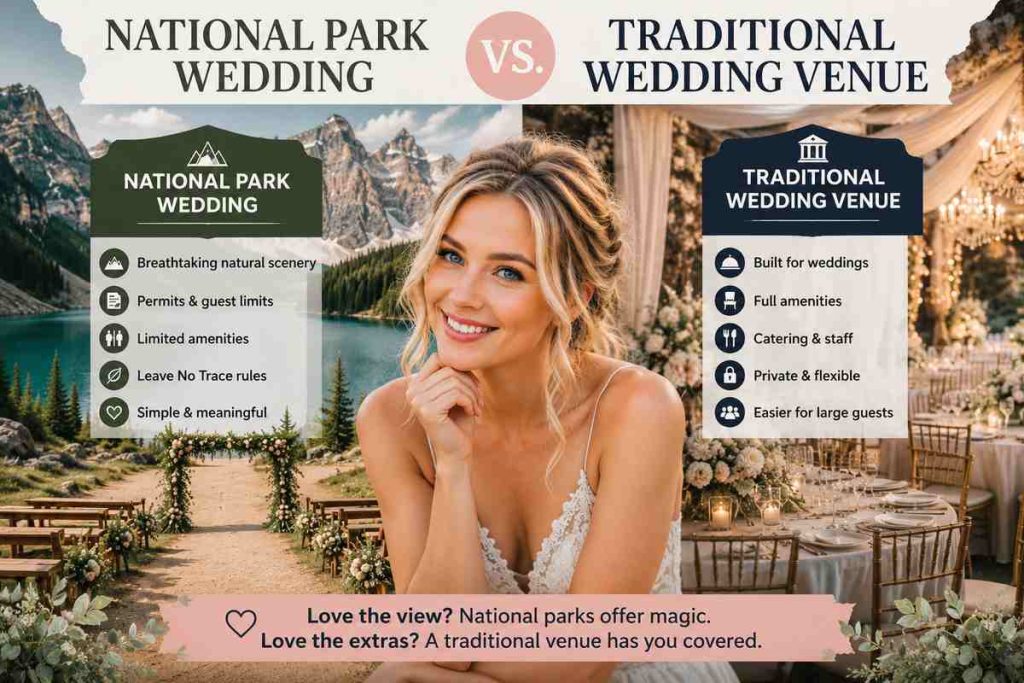
A traditional wedding venue is generally built around weddings — a ceremony space, a reception room, tables, chairs, restrooms, catering, parking, electricity, and staff who host events regularly.
A national park works differently. The attraction is the landscape itself: mountains, forests, deserts, beaches, lakes, waterfalls, or other natural scenery. But the same protected environment that makes the setting special also means there may be limits on what you can bring, where you can stand, how many people can attend, and how much you can alter the space.
In other words, the park provides the setting — not necessarily the wedding infrastructure.
For couples who want a large, heavily decorated celebration with extensive catering, music, and private space, a private venue near the park may be more practical. For couples who care most about the natural setting and are comfortable keeping things simpler, a national park can be an excellent choice.
Is a National Park Wedding Right for You?
A national park wedding may be a good fit if you want:
- a naturally beautiful ceremony setting
- an outdoor experience rather than a traditional ballroom
- a small or intimate celebration
- an adventurous destination wedding
- a wedding centered more on the landscape than elaborate decorations
It may be less suitable if you need a large private venue, extensive decorations, substantial seating, or a fully equipped reception space.
The important question isn’t simply “which national park is the prettiest.” It’s “which park can realistically accommodate the wedding we want.”
National Park Wedding vs. Elopement vs. Micro Wedding
The terms wedding, micro wedding, and elopement are often used interchangeably, but the difference matters once you’re planning inside a national park — as your guest count grows, the logistical requirements change with it.
National Park Elopement
A national park elopement is generally the simplest version, involving only the couple or a very small number of guests. With fewer people, you have more flexibility choosing a ceremony location, managing transportation, and dealing with seating or parking — one reason national parks work particularly well for intimate celebrations.
If you’re specifically planning an elopement rather than a larger wedding, the dedicated guide to national park elopement covers the deeper planning considerations.
National Park Micro Wedding
A micro wedding sits between an elopement and a traditional wedding — close family and friends, but still relatively small. At this size, guest logistics start to matter: where will everyone park, can the ceremony location accommodate the group, can guests reach the site comfortably, and is seating even permitted.
A location that works beautifully for two people may not work at all for twenty.
National Park Wedding
A larger national park wedding brings another level of planning. More guests can mean greater demand for parking, transportation, seating, accessible routes, restrooms, ceremony space, and reception facilities. Some locations simply aren’t suitable for a larger group, even if they look perfect in photographs.
How Guest Count Changes Your Planning
Guest count is one of the first things to determine — not something to figure out after falling in love with a ceremony location. A two-person ceremony can fit into a much wider range of locations than a fifty-person wedding. As the group grows, you may need a larger designated site, better parking, easier access, more infrastructure, and possibly a separate reception venue.
Your guest list can determine your available locations.
What Makes a National Park Wedding Different?
Public Land, Not a Private Venue
Your wedding doesn’t automatically make the park private. National parks are public places, so other visitors may still be nearby. At popular overlooks and attractions, you may encounter hikers, tourists, or other visitors during your ceremony. A permit may authorize your event without giving you exclusive control over the surrounding landscape.
Natural Beauty With More Restrictions
The advantage is obvious — you don’t have to create the backdrop. The trade-off is that you generally have less freedom to modify it. Restrictions exist to protect the land, wildlife, and experience of other visitors.
That’s why simple plans often work best. Instead of trying to transform a national park into a traditional wedding venue, design your wedding around the park that already exists.
Why Bigger Weddings Are More Complicated
The larger the wedding, the more your plans depend on infrastructure and logistics. A couple can walk to a scenic location with minimal equipment. A larger group needs somewhere to park, potentially needs seating, may require accessible transportation, and may need a reception space afterward.
That’s the central planning reality of a national park wedding: the more people and wedding elements you add, the more carefully you need to work within the park’s rules and physical limitations.
How to Plan a National Park Wedding
Planning becomes much easier when you handle the major decisions in the right order. Rather than choosing a beautiful viewpoint first and trying to solve the logistics afterward, start with your wedding size and priorities, then work through the park’s rules, ceremony location, legal requirements, permit, vendors, transportation, and reception.
The exact process varies by park, so use the steps below as a planning framework rather than a universal set of rules.
1. Decide What Type of Wedding You Want
Before choosing a park, decide what you actually want your wedding day to look like. Just the two of you? A small ceremony with immediate family? A micro wedding with fifteen or twenty guests? Or a larger celebration followed by a formal reception?
This decision affects almost everything else. A very small wedding may give you more options for ceremony locations and require less transportation and equipment. A larger wedding may require a location with more parking, easier access, seating, restrooms, and a higher permitted group capacity.
Also decide whether you want only the ceremony in the park or whether you hope to hold the reception there too — two very different planning scenarios.
2. Choose Your National Park
Once you know what kind of wedding you’re planning, start comparing parks. Don’t choose entirely on scenery — a location that looks incredible in photographs may be impractical for your guests or unavailable for your group size.
Consider:
- landscape and scenery
- ceremony locations
- maximum group size
- accessibility
- parking
- seasonal road access
- nearby accommodation
- reception options
- travel time for guests
- permit requirements
Your wedding priorities matter here too. A couple looking for dramatic mountain scenery may have completely different requirements from a couple bringing elderly relatives or planning a forty-person celebration.
3. Choose Your Ceremony Location
After choosing the park, look into the actual locations where weddings are permitted. A national park can span hundreds or thousands of acres, but that doesn’t mean you can simply choose any scenic spot and set up your ceremony there.
Some parks have designated ceremony locations; others allow alternative locations to be requested and evaluated by park staff. Look beyond the view and ask:
- How many people can the site accommodate?
- Is the site accessible?
- How far is it from parking?
- Are chairs permitted?
- Are restrooms nearby?
- Is the area heavily visited?
- Is the location open during your chosen season?
- Does the permit cover that specific location?
The best national park wedding location is the one that works for both your vision and your practical needs.
4. Check the Park’s Current Rules
Do this before you commit to vendors or make nonrefundable arrangements. Park rules can govern everything from guest numbers to decorations and sound. Check the official website for your chosen park and look specifically for wedding, ceremony, Special Use Permit, and event information.
Pay particular attention to restrictions involving guest and vehicle limits, ceremony locations, seating, arches and structures, wedding signs, flowers and petals, food and alcohol, music and amplified sound, drones, pets, and photography and commercial activity.
Don’t assume a rule you found for one national park applies to another. Requirements can vary considerably from park to park, and even between locations within the same park.
5. Confirm Marriage License Requirements
Your park approval is only one part of getting legally married. A national park wedding permit doesn’t replace a marriage license. The legal requirements depend on the state and, in some cases, the county or local jurisdiction where the marriage takes place.
Before your wedding date, determine where you need to obtain the marriage license, how long it remains valid, whether there’s a waiting period, who can legally officiate, whether witnesses are required, what identification is needed, and how the completed license must be returned.
Don’t leave this until the week of your wedding. Your ceremony can be beautifully planned and fully approved by the park while still requiring separate legal paperwork.
6. Apply for Your Wedding Permit
If your chosen park requires a permit, follow its application process carefully. The application may ask for your wedding date, ceremony time, requested location, number of guests, number of vehicles, vendors, activities, and equipment or structures.
Apply according to the park’s current instructions and timeline. Popular dates and locations can require advance planning, and processing times vary.
Also remember that a permit isn’t the same as a park entrance pass. Your guests may have separate entrance requirements or fees depending on the park.
Keep a copy of your approved permit, and make sure your photographer, planner, officiant, and other relevant vendors understand the conditions attached to it.
7. Book Your Wedding Vendors
Once you’ve confirmed that your plans are permitted, you can start building your vendor team — photographer, videographer, officiant, wedding planner, florist, caterer, and transportation provider, depending on the size and style of your wedding.
A photographer or planner who regularly works in national parks can be particularly useful because they may already understand location access, changing conditions, Leave No Trace practices, and park-specific logistics. That said, don’t assume a vendor’s experience at one national park means they automatically know the rules at another — your chosen park’s current requirements remain the authority.
8. Plan Guest Transportation and Parking
Parking is easy to overlook until you realize that a ceremony location can only accommodate a limited number of vehicles. For a larger wedding, find out where guests can park, how many vehicles are permitted, whether carpooling is recommended, whether shuttles are required, whether roads or parking areas have seasonal closures, and how far guests must walk from parking to the ceremony.
Give your guests these instructions well before the wedding day. If everyone arrives separately and expects to park beside the ceremony site, you could create a logistical problem before the ceremony even begins.
9. Plan Your Reception
Decide early whether your reception will take place inside the park or somewhere else. If the park permits receptions, verify what’s actually allowed rather than assuming a ceremony permit covers everything — food, alcohol, seating, music, decorations, and larger gatherings may have separate restrictions.
For many couples, a practical solution is a ceremony in the national park and a reception at a nearby private venue. This can give you the scenery you want for your vows while providing more flexibility for dinner, dancing, bathrooms, weather protection, and a larger guest list.
10. Create a Backup Plan
Outdoor weddings always require some flexibility, but national parks can add another layer of uncertainty. Think about what you’ll do if severe weather affects the location, a road closes, wildfire affects the area, the ceremony site becomes unavailable, seasonal conditions change, park operations change, or your guests can’t safely reach the location.
Ask the park what happens if your approved location becomes unavailable. Find out whether an alternate location can be approved and what you’d need to do to change the plan.
Your backup plan doesn’t have to recreate your original wedding. It just needs to give you a realistic alternative.
11. Reconfirm Everything Before the Wedding
A permit approved months ago doesn’t mean conditions will be identical on your wedding day. As the date approaches, check the park’s current alerts, road conditions, weather, operating status, and ceremony-location availability.
Reconfirm important details with your vendors, and make sure everyone knows the final meeting point, parking instructions, ceremony time, and backup plan. This final check can prevent a small change in park conditions from becoming a major wedding-day problem.
National Park Wedding Locations: What Should You Look For?
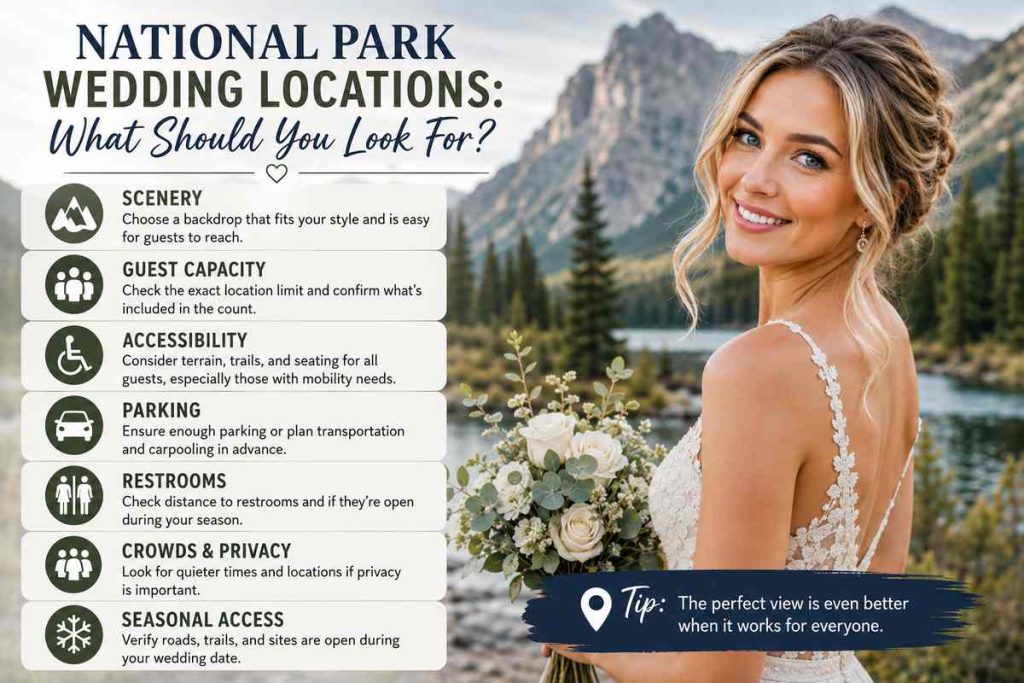
Choosing the right location isn’t simply about finding the most spectacular viewpoint. The location has to work for your guests, your permit, your wedding size, and the conditions you’re likely to encounter.
Scenery. Mountains, forests, beaches, deserts, waterfalls, lakes, and dramatic rock formations can provide a backdrop that requires very little decoration. But don’t let the photograph make the decision for you — consider whether your guests can comfortably reach the location and whether the site actually allows weddings.
Guest capacity. Check the maximum permitted group size for the exact location, not merely the park as a whole. A park may accommodate weddings while a particular overlook or trail location allows only a small group. Clarify whether the stated group limit includes vendors, photographers, or officiants.
Accessibility. Think about everyone attending, not just the couple. A beautiful ceremony site may involve steep terrain, stairs, uneven ground, a long walk, narrow trails, or limited seating. If older relatives, children, or guests with mobility limitations are attending, accessibility should be one of your first location criteria.
Parking. Look at the complete journey from the entrance or parking area to the ceremony site. Limited parking can make a location unsuitable for a larger wedding even when the ceremony site itself has enough physical space. If parking is restricted, plan carpooling or transportation well in advance.
Restrooms. Don’t assume a scenic ceremony location has restroom facilities nearby. For a short elopement, this may be a minor consideration; for a wedding with numerous guests or several hours of activities, it becomes much more important. Check the distance to the nearest restroom and whether those facilities are open during your wedding season.
Crowds and privacy. National parks are public places, so a wedding permit doesn’t necessarily mean you’ll have the landscape to yourselves. Popular overlooks can attract visitors throughout the day. If privacy matters, investigate less-crowded locations and consider a weekday, an early-morning ceremony, or a less-busy season.
Seasonal access. A location accessible in summer may be difficult or impossible to reach in winter. Roads, trails, and ceremony locations can have seasonal operating schedules or temporary closures. Check the park’s seasonal conditions before choosing your wedding date.
The best national park wedding location isn’t necessarily the most famous one. It’s the location that gives you the scenery you love while still working for your guest count, accessibility needs, permit, transportation, season, and overall wedding plans.
National Park Wedding Venues vs. Wedding Locations
One of the most confusing parts of planning a national park wedding is understanding what people mean by “wedding venue.” In a traditional wedding, a venue usually means a private property designed to host an event. In a national park, you may be choosing a permitted ceremony location rather than booking a conventional venue — and that distinction matters, because the two options provide very different experiences, facilities, privacy, and flexibility.
What Is a National Park Wedding Location?
A national park wedding location is a specific place within the park where a ceremony may be permitted — an overlook, meadow, beach, amphitheater, picnic area, forest setting, or another approved outdoor site. It may be little more than a natural setting, without chairs, tables, catering, electricity, or a private reception area.
Some parks designate specific ceremony locations and set maximum group sizes for them. Yellowstone, for example, lists individual ceremony locations with different capacities, including locations for very small groups as well as larger gatherings.
So when researching national park wedding locations, don’t just ask “is this place beautiful?” Ask whether it can actually accommodate your wedding.
What Is a National Park Wedding Venue?
This term can mean one of two things. Sometimes people use “venue” loosely to describe an approved ceremony location inside a national park. More usefully, a wedding venue can also refer to a private property near or associated with a national park — one that may offer facilities the park itself doesn’t provide, such as reception rooms, lodging, catering, tables and chairs, bathrooms, electricity, weather protection, and space for dancing.
This distinction becomes especially important when your wedding involves more than a simple ceremony. A dramatic overlook might be perfect for exchanging vows but not the right place for a fifty-person dinner afterward.
Ceremony Locations Inside the Park
Holding your ceremony inside the park gives you the experience many couples are looking for — the landscape becomes the backdrop instead of a decorated ballroom. The trade-off is that you’re working within the park’s limitations.
Depending on the location, you may encounter restrictions on group size, parking, seating, decorations, sound, food, access, ceremony duration, and visitor impact. Some locations are also rustic and exposed to weather — Yellowstone specifically notes that its ceremony locations are outdoors and rustic, and that many don’t have restroom facilities at or near the ceremony site.
That doesn’t make them bad wedding locations. It simply means you need to plan for what the location actually provides.
Private Wedding Venues Near National Parks
A private venue near a national park can be a better solution when you want the landscape without giving up the conveniences of a traditional wedding. You might exchange vows at an approved location inside the park and then travel to a nearby lodge, hotel, resort, restaurant, or private event property for the reception. The national park provides the scenery and ceremony; the private venue provides the infrastructure and reception.
This hybrid approach shows up around parks such as Grand Teton, Zion, Yosemite, Sequoia, Yellowstone, Olympic, and Arches, where private properties near the parks can provide wedding or event facilities. Availability and services should always be verified directly with the property and the relevant park.
Consider a private venue if you’re planning a larger celebration or need amenities a park ceremony location doesn’t provide — a formal dinner, dancing, extensive catering, a large guest list, indoor space, weather protection, overnight accommodation, or more predictable facilities.
You don’t have to choose between a national park and a traditional wedding experience. A ceremony in the park followed by a reception nearby can give you both.
Best National Parks for Weddings
There isn’t one national park that’s objectively best for every wedding. The right choice depends on your guest count, scenery preferences, travel plans, accessibility needs, season, and reception plans. Rather than ranking parks simply by how beautiful they are, consider what kind of wedding each landscape and setting can support.
Best National Parks for Mountain Weddings
If towering peaks, alpine scenery, valleys, and dramatic mountain landscapes are your priority, parks such as Glacier, Grand Teton, Rocky Mountain, and Yosemite are natural candidates to research. These destinations can create spectacular ceremony backdrops, but mountain scenery also means paying attention to weather, seasonal access, elevation, road conditions, and how easily guests can reach your chosen location.
Best National Parks for Desert and Red-Rock Weddings
For warm desert landscapes and dramatic geological scenery, consider parks such as Zion, Bryce Canyon, Arches, and Joshua Tree. These settings can be especially striking for couples who want a wedding that feels very different from a conventional indoor ceremony — but desert weddings require thoughtful planning around heat, sun exposure, water, and guest comfort.
Best National Parks for Coastal Weddings
For forests, rocky coastlines, beaches, and ocean scenery, Acadia, Olympic, and Redwood offer very different coastal environments. Coastal and forested locations can provide beautiful natural backdrops without requiring elaborate decorations, though weather, wind, tides, and seasonal access can affect your plans.
Best National Parks for Larger Weddings
Larger weddings require a different selection process. Instead of starting with “which park has the prettiest view,” start with “which permitted ceremony locations can accommodate our group.” Yellowstone demonstrates why this matters — its official wedding information lists ceremony locations with different maximum group sizes, ranging from very small groups to locations capable of hosting substantially larger gatherings.
If you’re planning a larger wedding, prioritize ceremony capacity, parking, transportation, accessibility, restrooms, reception facilities, and nearby accommodation.
Best National Parks for Small and Intimate Weddings
Smaller weddings open up considerably more possibilities. With only a few guests, you may be able to consider ceremony locations where parking, seating, and infrastructure would become difficult with a larger group. Still, small doesn’t mean rule-free — verify whether a permit is required and whether your chosen location allows the ceremony you have planned.
How to Choose the Right National Park for Your Wedding
Match the park to your guest count. A ceremony for two people has very different requirements from a ceremony for thirty or fifty. Check the capacity of the exact location, not merely the park’s overall ability to host weddings, and ask whether vendors count toward the group limit.
Match the park to your wedding style. A simple outdoor ceremony, a mountain wedding, a desert celebration, a coastal ceremony, a small family gathering, or a ceremony followed by a formal reception — your answer should influence the park you choose.
Consider travel and accommodation. Check the nearest airport, driving time, lodging, rental cars, shuttle options, nearby restaurants, and accessibility for older guests. A beautiful location becomes much less appealing if half your guests have to make an exhausting journey just to reach the ceremony.
Consider accessibility and infrastructure. Can everyone reach the site comfortably? Is there parking nearby? Are restrooms available? Is seating permitted? Will guests have to hike?
Consider the reception options. If you want dinner, dancing, catering, or a weather-protected celebration, research reception options before committing to the park.
In many cases, the smartest approach is to think of the wedding as two connected experiences: a ceremony in the national park and a reception at a suitable venue nearby.
National Park Wedding Permit: What You Need to Know
For most couples, the national park wedding permit is the first major piece of paperwork to understand. National Park Service rules treat weddings and similar ceremonies as special park uses in many locations, because they provide a private benefit and require some degree of park management. A Special Use Permit gives the park a way to control the activity, protect resources, and manage potential conflicts with other visitors. (National Park Service)
The important thing to remember is that there’s no single nationwide wedding-permit rule. Each park establishes its own requirements, fees, locations, deadlines, and conditions.
What Is a Special Use Permit?
A Special Use Permit, often called an SUP, is written authorization from the National Park Service for activities that wouldn’t otherwise be considered ordinary visitor use. Weddings are one common example. The permit can specify the date and time, ceremony location, number of participants, number of vehicles, permitted activities, equipment, and restrictions and conditions.
Zion National Park, for example, requires a Special Use Permit for all wedding ceremonies, elopements, and vow exchanges regardless of group size. Great Sand Dunes likewise requires a permit for all ceremonies, regardless of size. (National Park Service)
Does Every National Park Require a Wedding Permit?
No. Don’t assume every park has identical requirements, or that every ceremony everywhere in the NPS system follows the same process. Some parks require permits for all weddings; others have thresholds or special circumstances that determine whether a permit is necessary. Acadia, for example, currently states that weddings with more than ten participants require a Special Use Permit. (National Park Service)
Even when a permit isn’t required for a particular small gathering, other park rules can still apply. The safest approach is to check the official website for the exact park and location you’re considering, and contact the park’s permitting office if the information isn’t clear.
When Should You Apply?
Apply as early as the specific park allows, rather than waiting until your wedding date is close. There’s no universal “national park wedding deadline.” Yellowstone currently accepts applications up to twelve months ahead and requires requests at least ten business days before the event, while Bandelier National Monument requires applications at least one month ahead and notes that processing can take four to five weeks. (National Park Service)
Those differences are exactly why copying a deadline from another park can be risky. Before applying, confirm when applications open, the minimum application lead time, whether your preferred date and location are available, how long processing normally takes, and whether additional documents or fees are required.
What Information Does the Application Usually Require?
Your application will typically need enough information for the park to understand what you’re planning — wedding date, ceremony time, requested location, number of guests, number of vehicles, vendors, equipment, decorations, structures, and planned activities. Bandelier, for example, asks applicants to provide details such as expected guests, vehicles, artificial flowers, and shade structures. (National Park Service)
Be as accurate as possible. If your plans change after the permit is issued, contact the park rather than assuming the original approval covers the new arrangements.
How Much Does a National Park Wedding Permit Cost?
There’s no universal national park wedding permit price. Fees vary by park and may include application fees, administrative charges, monitoring fees, or other cost-recovery charges. Zion currently lists a $100 application fee, Great Sand Dunes lists a $200 non-refundable application fee, and Yellowstone currently lists a $250 non-refundable application fee, with additional monitoring fees possible depending on the event. (National Park Service)
So while you may see general estimates online, don’t build your wedding budget around a generic national figure. Use the current fee schedule for your specific park.
Wedding Permit vs. Park Entrance Pass
A wedding permit and a park entrance pass serve different purposes. The wedding permit authorizes the permitted ceremony or event under the conditions established by the park. An entrance fee or park pass relates to entering the park.
Your wedding permit doesn’t automatically mean that everyone attending can enter without paying the normal entrance fee. Great Sand Dunes, for example, specifically states that normal entrance fees apply to vehicles associated with ceremonies. (National Park Service)
Tell guests about entrance requirements ahead of time so they aren’t surprised on the wedding morning.
Wedding Permit vs. Marriage License
These are also completely separate. The park permit concerns your ability to hold the ceremony in the park. The marriage license concerns the legal marriage itself and is governed by the applicable state or local authority.
The park may not require you to show a marriage license in order to conduct the ceremony. Joshua Tree National Park, for example, states that NPS doesn’t require a marriage license for a wedding ceremony in the park, while directing couples to follow state requirements. (National Park Service)
So before the wedding, verify the marriage-license rules for the jurisdiction where your marriage will be legally recorded.
Does a Wedding Permit Give You Exclusive Use?
Usually, you shouldn’t assume that it does. A national park remains public land. Your permit may authorize your ceremony without closing the location to everyone else. Bandelier National Monument explicitly states that exclusive use isn’t permitted and that ceremony sites remain open to public use alongside the permitted activity. (National Park Service)
This is particularly important if you have your heart set on a famous overlook. If privacy matters, ask the permitting office about visitor traffic and consider a less-popular location, weekday ceremony, early time slot, or another permitted site.
What Happens If Your Ceremony Location Closes?
Outdoor conditions can change. Road closures, severe weather, wildfire, construction, natural hazards, or other park emergencies can make an approved location unavailable. Your permit doesn’t guarantee that a location will remain accessible under every circumstance. Pecos National Historical Park, for example, states that an event may need to be cancelled or rescheduled if the park closes because of a natural disaster or significant weather event. (National Park Service)
Before finalizing your plans, ask the park what happens to your wedding if your permitted location becomes unavailable. If possible, identify an alternate location and understand the park’s procedure for changing your plans.
National Park Wedding Cost: What Should You Budget?
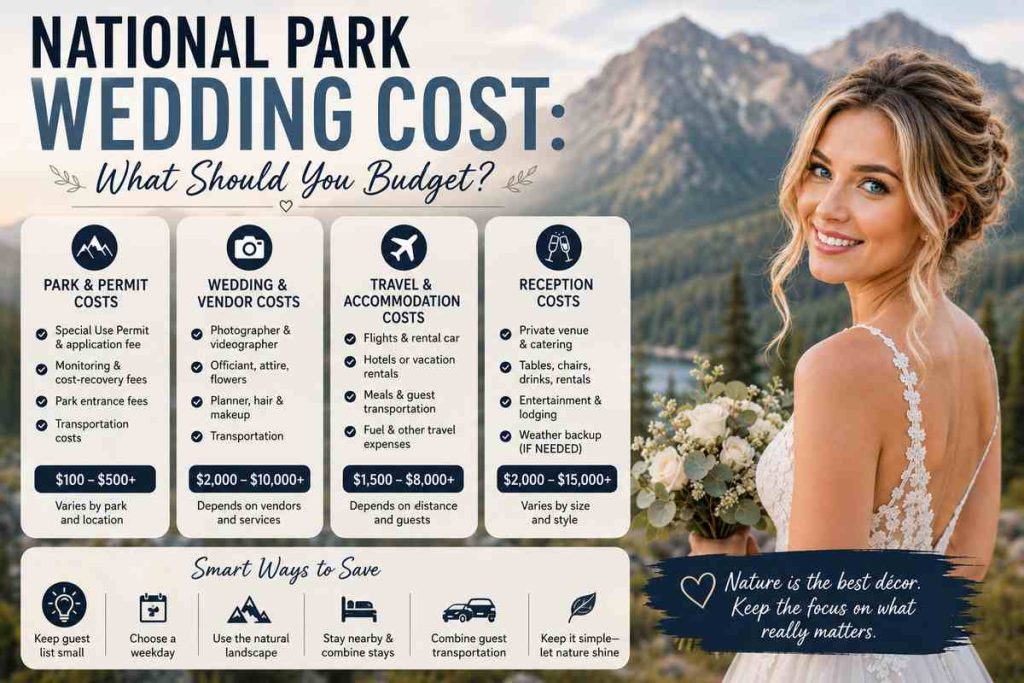
The permit may be one of the most visible costs, but it’s only one part of your national park wedding cost. Your total budget can include the park, wedding vendors, travel, accommodation, and reception.
Park and permit costs include the Special Use Permit, application fee, monitoring or cost-recovery fees where applicable, park entrance fees, and transportation-related costs. These vary by location — don’t assume a $100 or $200 permit fee represents the total amount you’ll spend on the park.
Wedding and vendor costs include your regular wedding expenses: photographer, videographer, officiant, wedding attire, flowers, planner, hair and makeup, and transportation. A national park can reduce your need for elaborate décor because the landscape provides the backdrop, but it doesn’t eliminate the normal costs of getting married.
Travel and accommodation costs include flights, rental vehicles, fuel, hotels or vacation rentals, meals, and guest transportation. For a wedding in a remote park, travel and accommodation can sometimes become more significant than the permit itself.
Reception costs can include a private venue, catering, tables and chairs, drinks, rentals, entertainment, lodging, and an indoor weather backup. This is why a ceremony inside the park followed by a reception at a nearby private venue can sometimes be easier to budget and manage.
Rather than assuming one fixed national park wedding cost, think in terms of budget categories. A simple intimate ceremony might involve park fees, marriage requirements, basic attire, a photographer, and travel. A small wedding adds more guests, transportation, accommodation, an officiant, flowers, and potentially a reception. A larger wedding adds a dedicated reception venue, catering, rentals, transportation, additional vendors, and more complex coordination. The actual amount can vary dramatically by destination and wedding size.
You can often reduce costs by keeping the guest list small, choosing a weekday, minimizing decorations, using the natural landscape as your backdrop, choosing nearby accommodation, combining guest transportation, holding the ceremony and reception at separate but nearby locations, and avoiding unnecessary rentals. The simplest national park weddings often have an advantage — you don’t need to build the scenery yourself.
National Park Wedding Rules and Restrictions
A national park wedding should be planned around the park rather than treating the park like a blank event space. Rules vary, but the following are among the issues you should investigate before booking anything.
Guest limits are often location-specific. A park may permit weddings but restrict individual ceremony sites to different group sizes. Yellowstone, for example, lists locations ranging from very small groups to larger venues, with capacities varying by site. (National Park Service) Always confirm the maximum number for your exact location.
Chairs and seating aren’t a given — some parks restrict seating or permit it only under particular circumstances. Grand Teton, for example, allows chairs under special circumstances but prohibits many other temporary structures and furnishings. (National Park Service) Ask before arranging rentals.
Wedding arches may look harmless, but structures can be restricted because they alter the site or require setup. Grand Teton, for example, prohibits arches, arbors, altars, platforms, rugs, tables, tents, and similar structures. (National Park Service) Never assume a traditional wedding setup is permitted.
National park wedding signs can also be subject to restrictions on placement, size, or materials — or may not be allowed at all. Hot Springs National Park, for example, lists signs among items it doesn’t allow at its wedding locations. (National Park Service) Check before ordering custom signage.
Flowers and petals can be treated differently from one park to another. A bouquet may be allowed while scattering petals is prohibited. Great Sand Dunes, for example, allows bouquets and boutonnieres but prohibits flower petals, rice, birdseed, and similar materials from being used or scattered. (National Park Service) Ask specifically about bouquets, artificial flowers, dried flowers, petals, and floral installations.
Confetti, rice, and other throwing traditions can be problematic on protected land, since they can affect wildlife and leave material behind. Grand Teton prohibits scattering or throwing these materials, and Great Sand Dunes has similar restrictions. (National Park Service) When in doubt, leave the throwing traditions out.
Music and amplified sound are generally limited. Grand Teton prohibits electronically amplified sound and allows acoustic music only at normal conversation-level volume. (National Park Service) If music is important to your wedding, confirm exactly what the park allows before booking musicians or equipment.
Food and alcohol rules can vary by location and event type. Some locations may permit limited food or picnic-style gatherings, while others restrict them. Great Sand Dunes, for example, identifies a specific site that can accommodate a picnic or simple food reception. (National Park Service) Never assume a ceremony permit automatically authorizes a catered reception or alcohol service.
Drones are a particularly important restriction for wedding photography. Several NPS wedding pages explicitly prohibit drones — Great Sand Dunes states that drones are prohibited even for weddings, and Arches and Canyonlands also prohibit drone operations. (National Park Service) If aerial photography matters to you, verify the current park rules before hiring a photographer who intends to use one.
Pets are another common point of confusion. A dog-friendly national park isn’t necessarily a dog-friendly wedding location. Grand Teton, for example, prohibits pets on park trails and in the backcountry, while Canyonlands notes that pets typically aren’t allowed at ceremony sites, particularly undeveloped areas. (National Park Service) Check the exact ceremony site’s rules before planning to include your pet.
Photography and videography may be allowed as part of a permitted wedding, though commercial photography and other activities can have separate rules depending on the park. Bandelier, for example, allows photography and videography during the permitted period under its Special Use Permit. (National Park Service) Your photographer should understand the park’s current requirements rather than assuming the rules from another destination apply.
Leave No Trace applies throughout — treat the park as a place you’re borrowing, not a backdrop you can modify. Stay within permitted areas, pack out what you bring, avoid disturbing plants and wildlife, and follow every condition attached to your permit.
The most important rule throughout the entire planning process is simple: park-specific rules always win over generic wedding advice. Check the current official National Park Service guidance for your chosen location before paying vendors, ordering decorations, or sending final instructions to guests.
Planning for National Park Wedding Guests
A national park wedding can be unforgettable for your guests, but it may require more preparation from them than a traditional venue wedding. Instead of simply driving to a hotel or ballroom, guests may have to deal with park entrances, limited parking, uneven terrain, changing weather, long distances, or limited cell service.
The key is to make those conditions clear before they arrive, so your guests know what they’re signing up for and what they need to bring.
Accessibility for Guests
Start by considering who will actually attend. A ceremony location that requires a long walk, steep climb, stairs, or uneven ground may be perfectly manageable for you but difficult for an older relative or someone with mobility limitations.
When evaluating a location, check distance from parking, trail surface, elevation changes, stairs or steep sections, availability of seating, accessible parking, restroom access, and weather exposure. If accessibility matters, contact the park before choosing the location rather than relying solely on photographs or general descriptions.
You may also want to separate the ceremony location from the reception location. A scenic, less-accessible ceremony could be followed by a more comfortable reception venue for everyone.
Parking and Transportation
Parking can become one of the biggest logistical issues at a national park wedding. A ceremony site may have limited parking, and some parks may restrict the number of vehicles associated with an event. If every guest drives separately, you could quickly exceed the available parking.
Consider carpooling, rental vans, shuttles, designated meeting points, or shared transportation from nearby accommodation, and give guests clear instructions about where they should park and when they should arrive. For larger weddings, consider arranging transportation rather than expecting guests to navigate unfamiliar park roads themselves.
Restrooms
Don’t assume your ceremony location will have a restroom nearby. National parks are designed primarily for recreation and conservation, not as full-service wedding venues, so some ceremony locations may be several minutes — or much farther — from the nearest restroom.
Check the location before finalizing your plans and tell guests what to expect. If your ceremony and reception are separated by a significant distance, make sure guests know where restroom facilities will be available during each part of the day.
Weather and What Guests Should Bring
Your guests should know that an outdoor national park wedding is different from an indoor venue. Depending on the park and season, they may encounter heat, cold, wind, rain, snow, intense sun, or sudden weather changes.
Tell guests what clothing and footwear make sense for the location — a beautiful formal outfit may not be practical if everyone has to walk along an uneven trail. You can also recommend practical items such as water, sun protection, layers, comfortable shoes, and rain protection when appropriate.
Cell Service and Communication
Cell service can be limited or unavailable in parts of national parks. Don’t assume every guest will be able to call you, check a rideshare app, or pull up directions at the ceremony site.
Send important information before the wedding, including the exact meeting location, parking instructions, ceremony time, directions, transportation details, emergency contact information, and what guests should bring. If you’re using shuttles, establish a clear meeting point and schedule ahead of time.
Preparing Guests for a National Park Wedding
Your invitation or wedding website should explain that the celebration is taking place in a national park. Give guests practical information about entrance fees, parking, walking distances, weather, appropriate footwear, transportation, accommodation, cell service, accessibility, and expected arrival time.
The more your guests know beforehand, the fewer problems you’ll have on the wedding day.
Does a National Park Wedding Give You Privacy?
One of the biggest misconceptions about getting married in a national park is assuming that a permit means you get the entire location to yourselves. Usually, you’re still sharing a public landscape with other visitors.
Why Your Ceremony May Still Have Other Visitors
National parks remain public places during weddings. At a popular overlook, trailhead, beach, meadow, or scenic viewpoint, other visitors may walk past or stop nearby while you’re exchanging vows.
That isn’t necessarily a bad thing. Some couples enjoy the spontaneity of having strangers offer congratulations. Others want a quieter, more private experience. If privacy is important to you, don’t leave it to chance.
How to Find a More Private Wedding Location
Start by asking the park about less-crowded permitted locations. A famous viewpoint might have the best-known photograph, but a quieter location can provide a much more intimate experience. You can also consider less popular areas, weekday ceremonies, early or late ceremony times where permitted, less crowded seasons, and smaller guest lists. A wedding planner or photographer familiar with the park may also know which areas tend to experience heavier visitor traffic, but the park’s own rules and current conditions should remain your primary source.
Best Times for Fewer Crowds
There’s no universal “quietest” time for every national park. However, weekday ceremonies, early-morning time slots, and less busy seasons can sometimes reduce visitor traffic. Before choosing a time, consider both crowds and practical conditions — an early ceremony may mean fewer visitors but colder temperatures, and an off-season wedding may offer more solitude but also create road closures or difficult weather. Privacy, then, is a balance between visitor traffic, season, accessibility, and safety.
National Park Wedding Reception Ideas
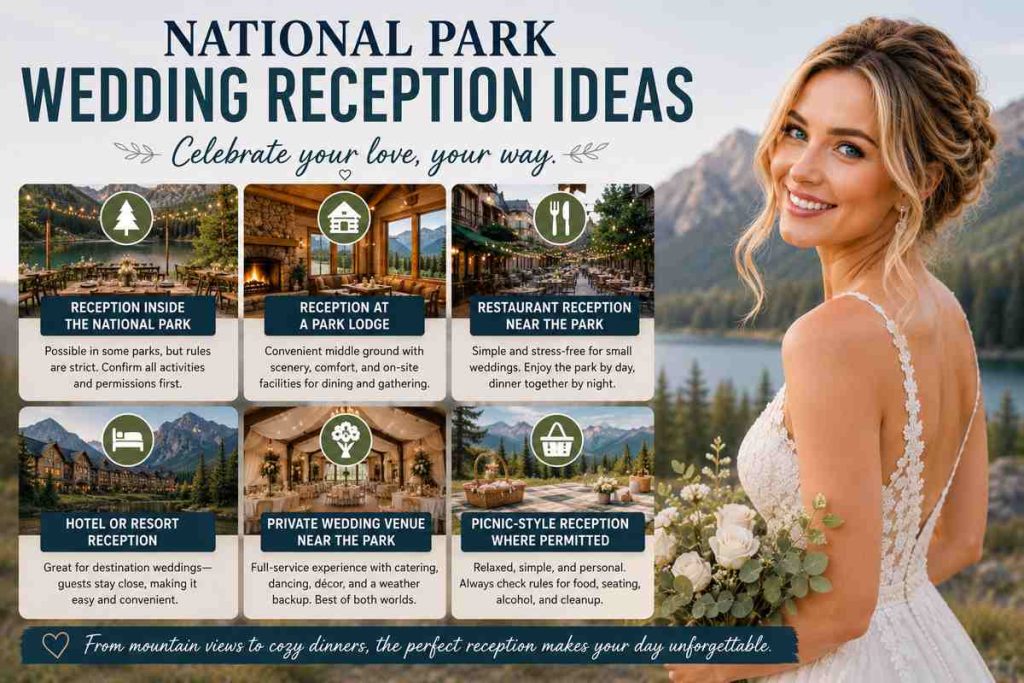
The ceremony and reception don’t necessarily have to happen in the same place. In fact, separating them can give you much more flexibility.
Reception inside the national park. Some parks allow certain types of gatherings or receptions, but the rules can be restrictive. Before planning food, drinks, seating, music, decorations, or entertainment, confirm that the park permits each activity. A ceremony permit shouldn’t automatically be treated as permission for a full wedding reception.
Reception at a park lodge. A lodge inside or associated with a national park can provide a convenient middle ground — the destination’s atmosphere along with more practical facilities for dining and gathering. Availability and services vary, so confirm directly with the specific lodge.
Restaurant reception near the park. For a small wedding, reserving a restaurant can be one of the simplest reception solutions. It removes much of the logistical burden of arranging tables, food preparation, bathrooms, and cleanup yourself, and lets you spend the ceremony in the park while moving to a comfortable indoor setting afterward.
Hotel or resort reception. A nearby hotel or resort can work especially well for destination weddings — guests can stay in the same area where the reception takes place, reducing transportation requirements. Look for properties that can accommodate your guest count and offer the services you actually need rather than choosing solely based on proximity to the park.
Private wedding venue near the park. A dedicated private wedding venue can provide the most traditional reception experience, particularly useful if you want catering, dancing, decorations, tables and chairs, music, indoor space, a weather backup, and overnight accommodation. One popular strategy is to have the ceremony at the national park and the reception at a private venue nearby.
Picnic-style reception where permitted. For a small and relaxed celebration, a picnic-style gathering can be appealing — simple food, drinks where permitted, blankets or approved seating, and time with family and friends. But don’t assume a picnic is automatically allowed; check the park’s rules for food, seating, decorations, alcohol, group size, and cleanup before making plans. The best picnic reception is one that leaves the location looking exactly as you found it.
Should You Hire a National Park Wedding Planner?
A planner isn’t essential for every national park wedding, but the value can increase significantly as the wedding becomes larger or more complicated.
Consider hiring a national park wedding planner if you’re bringing a larger guest group, traveling from another state, have never planned an outdoor wedding, the park has complicated permit requirements, you need transportation coordination, you’re arranging multiple vendors, you’re planning a separate reception, accessibility is a major consideration, or you simply don’t want to handle logistics yourself.
A planner who regularly works with outdoor weddings can help coordinate the many moving pieces. However, make sure the planner understands that park-specific rules come from the National Park Service or the relevant park authority, not from the planner.
You may not need one if your wedding is very small and straightforward — a couple with a handful of guests, a simple ceremony, one photographer, and a nearby restaurant reception may be able to manage the planning themselves. In that situation, the most important thing is organization: keep your permit, park rules, vendor contacts, transportation details, marriage documents, ceremony schedule, and backup plan together in one place.
Whether you hire a planner or do everything yourself, the objective is the same: make the wedding day feel simple even though you’ve done the complicated planning beforehand.
15 Questions to Ask Before Booking Your National Park Wedding
Before you put down deposits or send invitations, make sure you can answer these questions:
- Does this national park allow weddings or ceremonies?
- Do I need a Special Use Permit for my wedding?
- What is the current wedding permit fee?
- How far in advance can I apply, and what is the minimum application deadline?
- Is my preferred ceremony location actually available?
- What is the maximum number of people allowed at that location?
- Are vendors, photographers, and officiants included in the guest limit?
- Can guests bring chairs or other seating?
- Are arches, decorations, flowers, or a wedding sign permitted?
- Can we play music or use amplified sound?
- Can we bring food or alcohol into the park?
- Are pets allowed at the ceremony location?
- Where can guests park, and do they need an entrance pass or fee?
- What happens if weather, wildfire, road closures, or another issue makes the location unavailable?
- Where will the reception take place after the ceremony?
If you can’t answer several of these questions, you’re probably not ready to make the final booking.
National Park Wedding Checklist
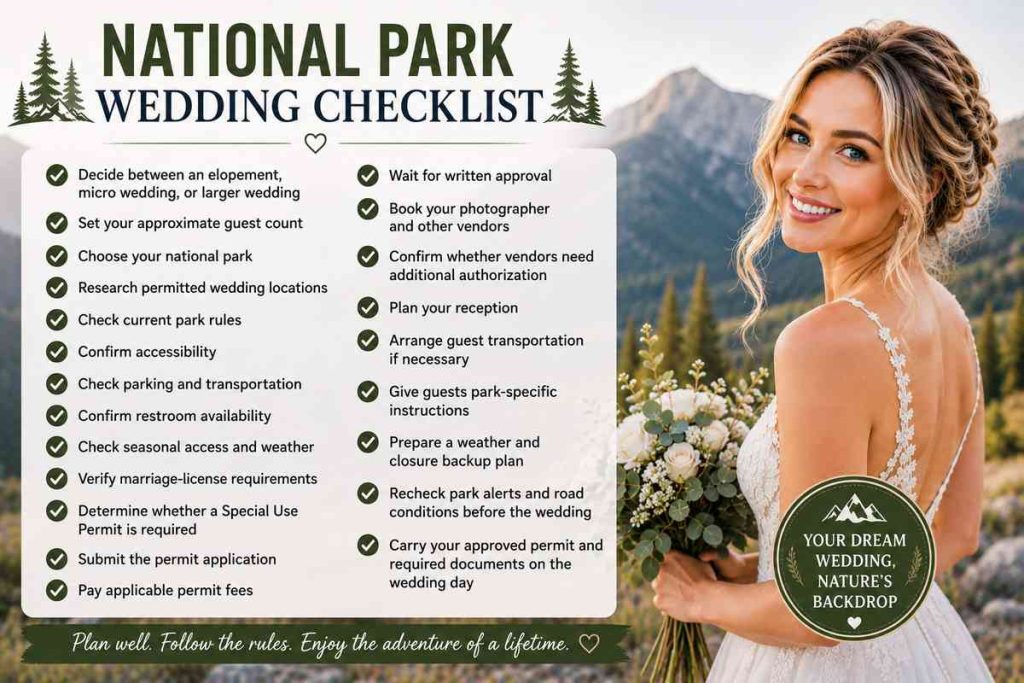
- Decide between an elopement, micro wedding, or larger wedding
- Set your approximate guest count
- Choose your national park
- Research permitted wedding locations
- Check current park rules
- Confirm accessibility
- Check parking and transportation
- Confirm restroom availability
- Check seasonal access and weather
- Verify marriage-license requirements
- Determine whether a Special Use Permit is required
- Submit the permit application
- Pay applicable permit fees
- Wait for written approval
- Book your photographer and other vendors
- Confirm whether vendors need additional authorization
- Plan your reception
- Arrange guest transportation if necessary
- Give guests park-specific instructions
- Prepare a weather and closure backup plan
- Recheck park alerts and road conditions before the wedding
- Carry your approved permit and required documents on the wedding day
The most important item on this list is checking the current rules for your specific park. National park wedding requirements aren’t standardized across the entire system.
Yellowstone National Park Wedding Permit: An Example
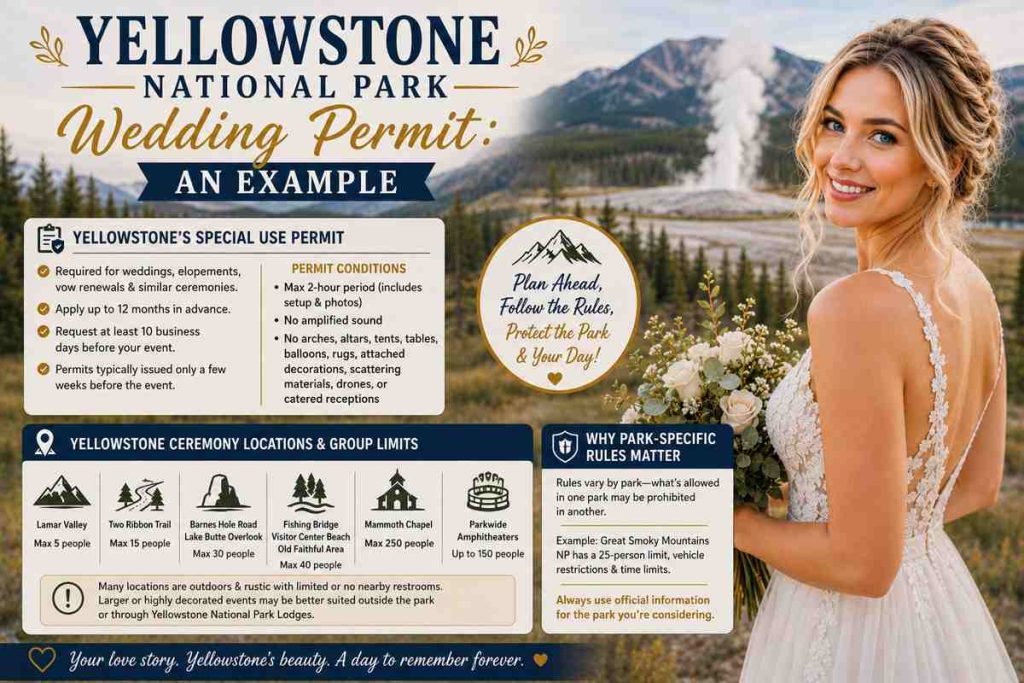
If you’re wondering what the process looks like in practice, Yellowstone National Park provides a useful example of how detailed park-specific wedding requirements can be.
Yellowstone’s Special Use Permit
Yellowstone requires a Special Use Permit for weddings, elopements, vow renewals, and similar ceremonies. The park currently accepts applications up to twelve months in advance and requires requests at least ten business days before the event. However, Yellowstone notes that permits are typically issued only a few weeks before the event because conditions can change. (National Park Service)
The permit also establishes conditions for the ceremony, including a maximum two-hour period that includes setup and photography or video at the ceremony location. Yellowstone restricts amplified sound and prohibits items such as arches, altars, rugs, tents, tables, balloons, attached decorations, scattering materials, drones, and catered receptions. (National Park Service)
This illustrates why you shouldn’t simply copy a wedding plan from another national park — what works at one park may be prohibited at another.
Yellowstone Ceremony Locations and Group Limits
Yellowstone has multiple permitted ceremony locations, and the capacity varies considerably. For example, the park currently lists Lamar Valley at a maximum of 5 people, Two Ribbon Trail at 15, Barnes Hole Road and Lake Butte Overlook at 30, Fishing Bridge Visitor Center Beach and the Old Faithful Area at 40, the Mammoth Chapel at 250, and parkwide amphitheaters at capacities of up to 150. (National Park Service)
Yellowstone also notes that many ceremony locations are outdoors and rustic, with limited or no nearby restroom facilities. Larger or highly decorated events may be better suited to venues outside the park or through Yellowstone National Park Lodges. (National Park Service)
Why Park-Specific Rules Matter
Yellowstone is a good example of the central lesson of this guide: “national park wedding” isn’t one standardized type of wedding. The permit process, location capacity, decorations, sound, food, parking, photography, and other restrictions can change from one park to another.
Great Smoky Mountains National Park, for example, requires a Special Use Permit for weddings and currently accepts applications up to twelve months ahead, while its designated outdoor locations generally have a 25-person limit and restrictions on vehicles and duration. (National Park Service)
Always use the official information for the park you’re actually considering.
Frequently Asked Questions About National Park Weddings
Can you get married in a national park? Yes. Many national parks allow weddings, elopements, and other ceremonies, but the requirements vary by park. Some require a Special Use Permit for every wedding, while others have different rules based on group size or circumstances. (National Park Service)
Can you get married at a national park without a permit? Sometimes, depending on the park and the specific circumstances, but you shouldn’t assume a permit is unnecessary. Some parks require permits for all weddings regardless of group size. Check directly with the park before planning your ceremony. (National Park Service)
How much does a national park wedding cost? There’s no single national park wedding cost. Your budget may include permit and park fees, travel, accommodation, photography, attire, vendors, transportation, and reception expenses. Permit fees vary significantly between parks.
Do national parks have wedding venues? Some parks have designated ceremony locations, historic buildings, chapels, amphitheaters, or other facilities, but most national park ceremony locations aren’t full-service wedding venues. A private venue, lodge, hotel, or restaurant near the park may be better for a larger reception.
What is the best national park to get married in? There’s no universal best park. The right choice depends on your scenery preferences, guest count, accessibility, season, travel requirements, ceremony rules, and reception plans.
Can you have a wedding reception in a national park? Sometimes, but it depends on the park and location. A ceremony permit doesn’t automatically authorize a catered reception, food service, alcohol, music, or other activities. Yellowstone, for example, currently prohibits receptions and catered food service at its permitted ceremony locations. (National Park Service)
Can you bring chairs to a national park wedding? It depends on the park. Some locations restrict or prohibit chairs, while limited seating may be permitted for guests with mobility needs. Yellowstone, for example, allows only a few portable chairs for guests with mobility needs. (National Park Service)
Can you use a wedding sign in a national park? Not necessarily. Some parks prohibit signs or restrict how they can be used. Never order large signage before checking the specific park’s wedding conditions.
Can you bring flowers to a national park wedding? Possibly, but rules vary. Some parks allow bouquets or flowers while prohibiting petals, scattering, or certain plant materials. Check the rules for your specific location before bringing floral decorations.
Can you bring pets? Pet rules vary by park and location. A park allowing dogs in some areas doesn’t necessarily mean dogs are allowed at ceremony sites. Check the specific wedding-location rules before including your pet.
Does a wedding permit give you privacy? Usually, you shouldn’t assume it does. National parks remain public places, and other visitors may still use the area. Some parks explicitly state that permits don’t provide exclusive use. (National Park Service)
Does a wedding permit replace a marriage license? No. A park permit authorizes the event under park rules; a marriage license concerns the legal marriage and is handled under applicable state or local requirements.
How far in advance should you plan? Start as early as possible. Permit timelines vary considerably — some parks accept applications up to a year ahead, while others have different windows or minimum deadlines. For popular locations, early planning also gives you more options for dates, lodging, vendors, and transportation. (National Park Service)
What happens if your ceremony location closes? Your plans may need to change because of weather, wildfire, road closures, safety issues, or other park conditions. Ask the park about its procedures for alternate locations, rescheduling, or cancellation before your wedding date.
Final Thoughts on Planning a National Park Wedding
A national park wedding gives you something very few traditional venues can reproduce: the opportunity to exchange your vows surrounded by a landscape that already feels extraordinary. But that beauty comes with responsibility.
You’re not booking a private property where you can control every detail — you’re using protected public land, which means your ceremony has to fit within the park’s rules, protect natural and cultural resources, and coexist with other visitors.
The smartest approach is to start with your guest count and wedding style, choose a park that fits them, confirm the exact ceremony location, check the current rules, handle the permit and marriage requirements, and plan your reception and transportation before the wedding day arrives.
Let the park be the backdrop rather than trying to turn it into a traditional venue. The simpler and more thoughtful your plans are, the more likely you’ll be able to enjoy what you came for in the first place: an unforgettable wedding in an unforgettable place.