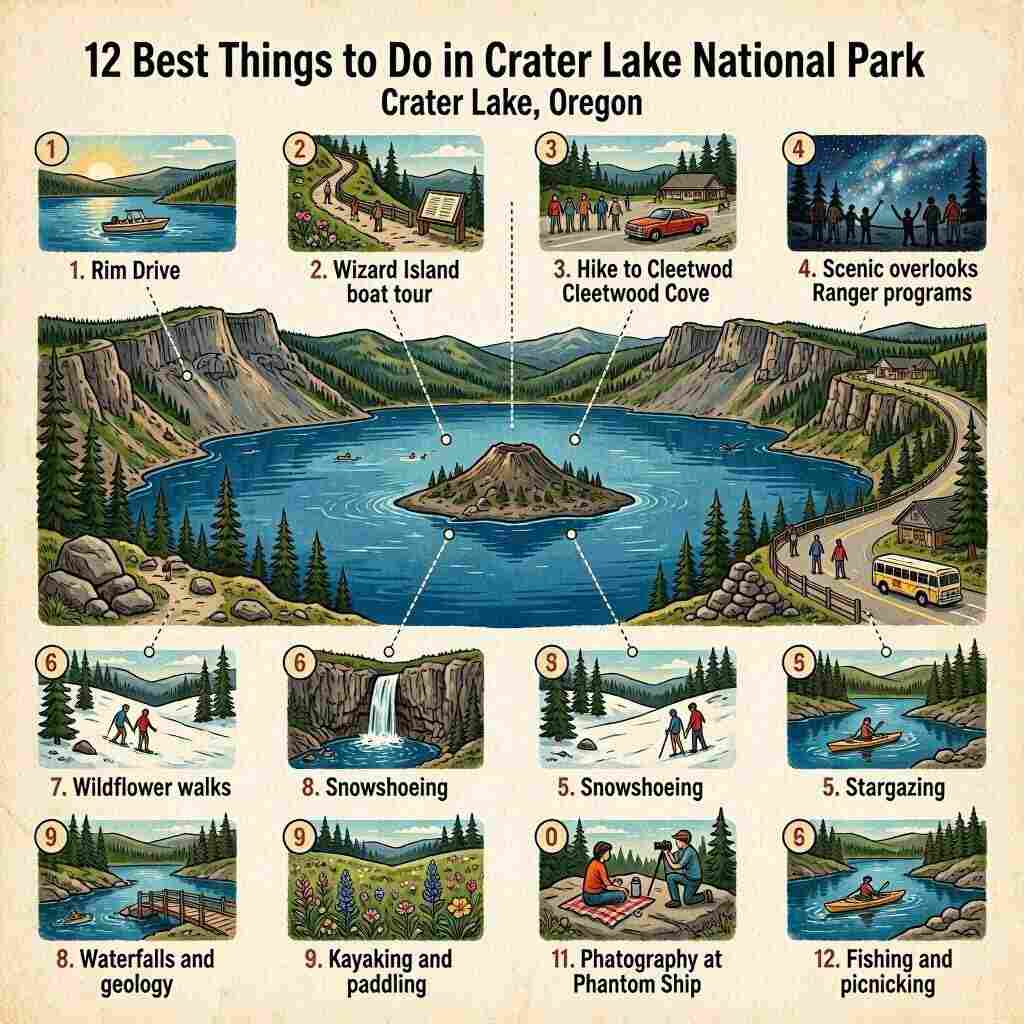
12 Best Things to Do in Crater Lake National Park
At 1,943 feet deep, Crater Lake is the deepest lake in America — a volcanic masterpiece so impossibly blue that first-time visitors often stop mid-sentence just to stare. It was born roughly 7,700 years ago when Mount Mazama collapsed in on itself after a catastrophic eruption, leaving a caldera that slowly filled with some of the purest water on earth. Planning your visit around things to do in Crater Lake National Park in 2026, however, requires more than just showing up and pointing a camera at the water. Major infrastructure construction has closed the park’s most popular trail corridor and eliminated lake access entirely this season. This guide tells you exactly what is closed, what remains spectacular, and how to build a visit worth making — so you arrive with accurate expectations and leave with memories that justify the drive.
The 2026 Reality Check: Critical Road & Trail Closures
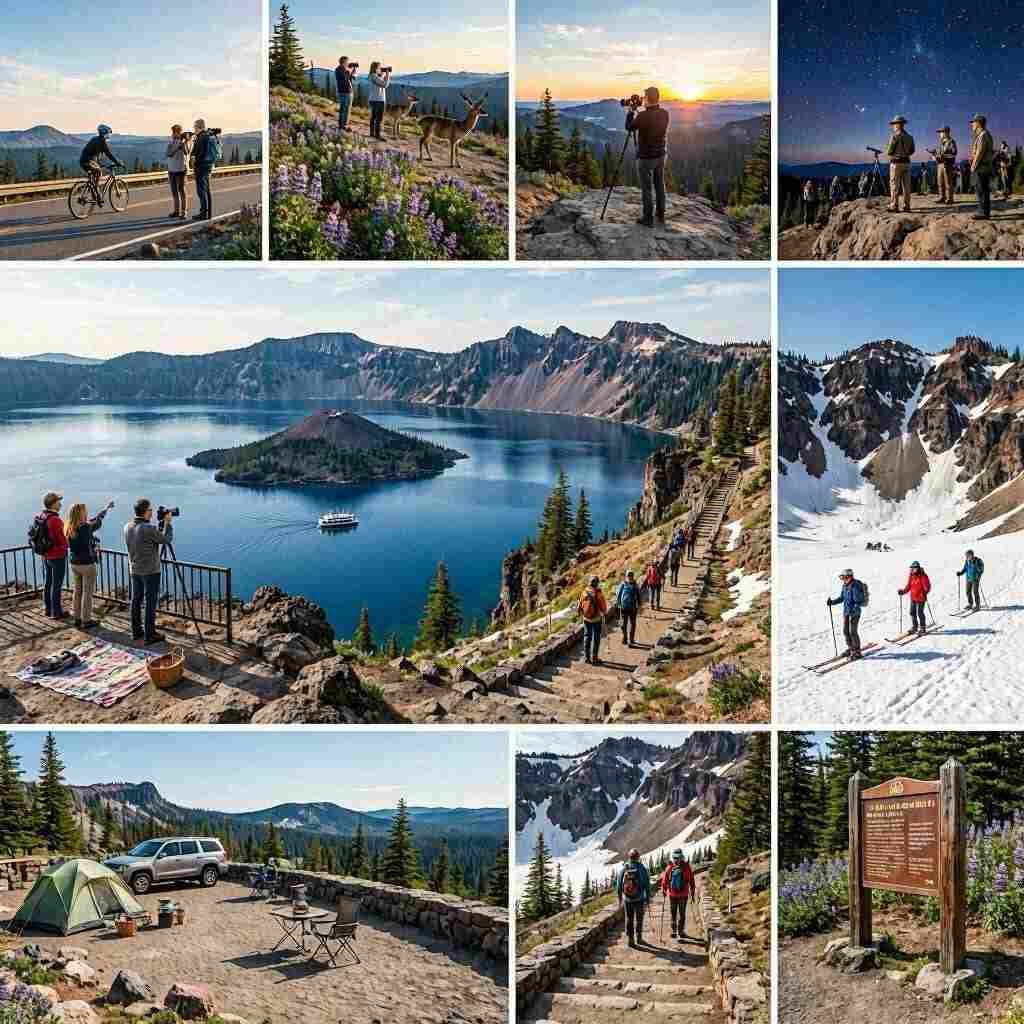
Before you plan a single activity, you need to know what the park actually looks like this year. The 2026 construction season has fundamentally changed how visitors experience Crater Lake — and most articles you’ll find online were written before these closures took effect.
The most significant impact is the complete closure of the Cleetwood Cove Trail, the only legal trail that descends to the lake’s shoreline. This eliminates swimming access, boat tour boarding, and Wizard Island excursions for the entire 2026 season. NPS alerts confirm no boat tours are operating. No exceptions exist for independent access.
The table below gives you a clear-eyed summary of what’s accessible and what isn’t. Use it before building any itinerary.
Summer 2026 Accessibility Matrix
| Feature | Status | Restrictions | Alternative |
|---|---|---|---|
| Cleetwood Cove Trail | CLOSED | Full 2026 closure | Garfield Peak, Watchman Peak |
| Boat Tours to Wizard Island | CLOSED | No operations in 2026 | Diamond Lake boat rentals |
| Swimming Access | CLOSED | No lake access | Diamond Lake swimming |
| West Rim Drive | OPEN | Check NPS for seasonal timing | Primary scenic route |
| East Rim Drive | PARTIALLY OPEN | Verify current status with NPS | West Rim as primary |
| Garfield Peak Trail | OPEN | Standard hiking access | — |
| Watchman Peak Trail | OPEN | Standard hiking access | — |
| Rim Village & Facilities | OPEN | Normal operations | — |
| Steel Visitor Center | OPEN | Normal operations | — |
| Crater Lake Lodge | OPEN | Reservations required | — |
| Sinnott Memorial Overlook | OPEN | Accessible from Rim Village | — |
| North Entrance Road | OPEN | Standard vehicle access | — |
What the East Rim Drive Rehabilitation Means for Your Trip
The second major 2026 change affects portions of the East Rim Drive corridor. While many older travel guides still describe a full scenic loop around the lake, visitors should expect altered access patterns throughout the season due to ongoing rehabilitation work. The most significant impacts occur on the southern and southeastern portions of the rim where construction activity affects vehicle access and trailhead connectivity.
For trip planning purposes, this means destinations such as Phantom Ship viewpoints, Sun Notch, Vidae Falls, and the Crater Peak trail area may have limited access, temporary closures, or route adjustments depending on construction schedules. Conditions can change throughout the season, making official National Park Service updates essential before arrival.
An important detail rarely mentioned by competitors is that some East Rim segments may remain accessible to pedestrians and cyclists even when closed to standard vehicle traffic. Where construction schedules permit, these quieter sections can provide a unique experience with dramatically reduced traffic and uninterrupted lake views. However, access conditions vary and should never be assumed without verification.
For most visitors, the practical strategy is simple: build your itinerary around the fully operational West Rim Drive, Rim Village, Garfield Peak Trail, and Watchman Peak Trail first. Treat any East Rim access opportunities as a bonus rather than a core component of your schedule. This approach eliminates disappointment while ensuring you still experience the park’s most iconic scenery.
Planning recommendation: If you have only one day at Crater Lake in 2026, allocate at least 80% of your time to the West Rim corridor and only pursue East Rim stops after confirming same-day accessibility through official park alerts.
The trust baseline this article operates from: every recommendation in this guide reflects the 2026 closure reality. No boat tours. No Cleetwood access. No swimming in the lake. What follows is a guide to what genuinely remains — and it is still extraordinary.
Cruising the Crater Lake Scenic Rim Drive: Open Routes & Overlooks
The crater lake scenic rim drive is the backbone of any Crater Lake visit, and in 2026 it becomes even more essential. With lake-level access eliminated, the 33-mile road that circles the caldera rim transforms from a scenic bonus into the primary experience. Most visitors spend the majority of their time here — and the ones who plan it strategically leave with far better photographs, less frustration, and a deeper understanding of what they’re looking at.
The West Rim Drive is fully open this season and should anchor your planning. It connects Rim Village in the south to the junction with the North Entrance Road, delivering a sequence of overlooks at different angles and elevations. The key strategic insight that most Rim Drive articles miss entirely: the quality of your experience at each overlook depends almost entirely on what time of day you arrive and which direction the sun is traveling. Visitors who drive the full loop at noon in flat light miss the lake’s most extraordinary visual quality — that deep, saturated cobalt blue that emerges only when the sun is at the right angle to penetrate the water column rather than reflect off its surface.
The Overlook Solar Optimization Framework
Use this framework to sequence your Rim Drive stops for maximum photographic and visual impact. Overlooks are listed from Rim Village moving north along the West Rim.
| Viewpoint | Best Time | Sun Position | Primary Feature | Parking Tier |
|---|---|---|---|---|
| Sinnott Memorial Overlook | 8–10 AM | Low eastern angle | Full caldera panorama | Easy — Rim Village lot |
| Discovery Point | 9–11 AM | East-southeast | Wizard Island framing | Small pullout — 6–8 cars |
| Merriam Point | 10 AM–12 PM | High southeast | North lake expanse | Roadside pullout |
| The Watchman Overlook | 11 AM–1 PM | High south | Western rim ridgeline | Small lot — 10–12 cars |
| Hillman Peak Overlook | 11 AM–2 PM | High south | Highest caldera rim point | Roadside pullout |
| Cloudcap Overlook | 12–3 PM | South-southwest | Phantom Ship rock formation | Small lot — 8 cars |
| Phantom Ship Overlook | 2–4 PM | West-southwest | Phantom Ship island | Roadside pullout |
| Kerr Notch | 3–5 PM | West-southwest | Southeast lake angle | Small lot |
| Pinnacles Overlook | 3–5 PM | West | Volcanic pinnacle formations | Designated lot — moderate |
| Pumice Castle Overlook | 3–6 PM | West | Orange pumice formations | Small roadside pull |
Parking reality at Crater Lake: Rim Village fills by 9 AM on summer weekends. If you arrive after 10 AM on a Saturday or Sunday in July or August, plan to park at the Steel Visitor Center and walk or use the seasonal shuttle if available. Individual overlook pullouts along the West Rim are small — 6 to 12 cars at most. If one is full when you arrive, drive 0.5 miles to the next; the lake is equally spectacular from any vantage point on the rim.
One-Day Crater Lake Priority Framework
Many visitors only have a single day inside the park. The framework below prioritizes experiences based on available time, helping travelers avoid spending valuable hours chasing lower-priority stops during a season affected by closures.
| Available Time | Priority Experiences | Lower-Priority Stops to Skip if Necessary |
|---|---|---|
| 2–3 Hours | Rim Village, Sinnott Memorial Overlook, Discovery Point | Extended scenic drives, secondary overlooks |
| 4–5 Hours | Rim Village, West Rim Drive, Discovery Point, Watchman Overlook | Less significant roadside pullouts |
| Full Day | Complete West Rim exploration, Garfield Peak Trail, Watchman sunset | None required |
| Full Day + Evening | West Rim Drive, Garfield Peak, Watchman sunset, Crater Lake Lodge porch experience | None required |
| Multi-Day Visit | All major viewpoints plus Diamond Lake recreation and winter activities (season permitting) | No major exclusions |
For first-time visitors in 2026, the highest-value combination remains Rim Village, multiple West Rim overlooks, Garfield Peak Trail, and a Watchman sunset. These experiences collectively deliver the strongest visual, geological, and photographic representation of Crater Lake while avoiding areas impacted by construction or seasonal restrictions.
Top Things to Do Along the West Rim Drive
The best things to do in Crater Lake National Park for most visitors center on the West Rim corridor — and there is genuinely more here than most itineraries acknowledge. Beyond simply stopping at viewpoints, the West Rim Drive rewards the visitor who slows down and understands what they’re looking at.
Start at Rim Village, the hub of services and the most accessible overlook complex. The Sinnott Memorial Overlook, just below the rim here, offers a protected viewing terrace that puts you at eye level with the caldera’s sheer interior walls. This is where you feel the scale — not just the width, but the depth. From the surface, the lake appears to absorb light rather than reflect it, a product of its extraordinary optical purity. Crater Lake contains no inflows and no outflows; all water arrives as precipitation and departs only through evaporation and seepage. This makes it one of the clearest large lakes on earth, with visibility extending to depths of over 100 feet in some areas.
Moving north along the West Rim, the viewpoints shift angle progressively. Discovery Point frames Wizard Island — the cinder cone rising from the western lake — in its most photogenic position. Hillman Peak, at 8,151 feet, is the highest point on the caldera rim accessible by vehicle, and the westward view from here includes the full arc of the southern rim on clear days.
The competitor gap most Rim Drive articles miss: very few guides explain the geology visible from rim-level viewpoints. Every exposed cliff face you see on the interior caldera wall is a chapter in the collapse of Mount Mazama. The layers of pumice, lava, and volcanic ash tell a sequence — darker ancient lava flows beneath, lighter pumice deposits above from the final catastrophic eruption phase. You can read this from any overlook without a geology degree. The more you understand what you’re looking at, the more the drive rewards you.
Direction for your Rim Drive visit: Plan a minimum of four hours. Drive the full West Rim before looping back east if time allows. Stop at no fewer than six viewpoints. Bring water — there are no services beyond Rim Village.
Spectacular Crater Lake Non-Hiker Activities
Crater lake non-hiker activities are more substantial than most guides suggest, and this is worth addressing directly because a significant portion of Crater Lake visitors — families with young children, older travelers, visitors with mobility considerations — arrive without plans to hike.
The good news: the rim drive experience requires no hiking. Every viewpoint described above is accessible from your vehicle or with a walk of 50–200 feet from a parking area. Sinnott Memorial Overlook is the most accessible — a paved path from Rim Village leads directly to the viewing terrace. The overlook sits at a notch in the rim wall, putting you visually inside the caldera without any elevation gain.
Rim Village itself offers a legitimate half-day experience for non-hikers. The visitor center here, the lodge, the cafeteria, and the gift shop cluster near the rim’s edge. Walk the short paved path from the lodge to the rim and back — it takes 15 minutes and delivers a view that ranks among the most dramatic in the Pacific Northwest. On clear days, this 15-minute walk produces photographs that friends will not believe were taken from a parking area.
Crater Lake Lodge warrants special mention. Even if you are not staying overnight, the lodge’s back porch sits directly on the caldera rim. Guests and day visitors alike can sit at porch tables, drink coffee, and watch the light change on the lake over the course of an hour. This is one of the most effortlessly rewarding experiences in any national park — and it requires neither hiking nor reservations for non-dining visitors during shoulder hours.
For families with children, the Steel Visitor Center on the south entrance road offers a comprehensive geological exhibit that builds genuine context for the rest of the visit. Understanding the Mount Mazama eruption before arriving at the rim transforms a spectacular view into a coherent story.
Elite Caldera Hikes: Trails Open for Adventure
Despite the Cleetwood Cove closure, Crater Lake’s open trail system offers two of the finest ridge hikes in Oregon. Both gain significant elevation, both reward with full-caldera panoramas, and both require physical preparation that most Crater Lake articles underestimate.
The elevation at Crater Lake’s rim averages 7,000–8,000 feet. At this altitude, visitors accustomed to sea-level hiking should expect meaningful cardiovascular effort on slopes that would feel moderate at lower elevations. Altitude fatigue compounds with solar exposure — the crater rim offers minimal shade from late morning onward. Carry a minimum of two liters of water per person. There are no water sources on either trail.
Garfield Peak Trail: Ultimate Open Lake View Trek
Garfield Peak stands at 8,054 feet and the trail to its summit gains approximately 1,010 feet over 1.7 miles one-way from the Rim Village trailhead. This is a legitimate mountain hike — not a walk. The grade is consistent and exposed, with wildflower meadows in the lower sections and rocky open terrain above treeline.
The payoff justifies the effort. From Garfield Peak’s summit, the entire caldera opens beneath you in a 360-degree panorama that no rim-level viewpoint can replicate. The distinction that makes Garfield unique: you are now above the caldera rim rather than on it. This elevation shift reveals the lake’s full oval shape, the proportional scale of Wizard Island relative to the caldera walls, and the geological sequence of the interior cliffs in their totality. Photographs taken from Garfield Peak look fundamentally different from rim-level shots — you can see the curvature of the caldera’s far wall dropping away to the lake surface.
Plan three to four hours for the round trip including summit time. Start before 9 AM to avoid afternoon thunderstorm risk, which develops on summer afternoons above 7,500 feet in Oregon’s Cascades. Bring layers — wind on the exposed summit can drop apparent temperature by 15–20 degrees Fahrenheit even on warm days. Hiking poles are useful on the descent over loose volcanic rock.
EEAT note: Garfield Peak’s elevation combined with a 7,000-foot starting point creates a physiologically demanding hike even for fit hikers. Anyone with cardiovascular concerns should discuss high-altitude exertion with a physician before attempting it.
The Watchman Peak Trail Sunset Strategy
Watchman peak trail sunset photography is one of Crater Lake’s most coveted experiences — and one of its most planning-dependent. The Watchman tower trail gains 420 feet over 0.8 miles, making it the most accessible summit hike at Crater Lake. The round trip takes 45–90 minutes for most visitors.
The strategic value is the viewpoint’s western orientation. The Watchman sits on the western rim, positioned to catch the final hour of sunlight sweeping across the lake’s surface from the west. At sunset, the light quality transforms — the lake shifts from cobalt to a succession of colors that move through teal, violet, and finally a deep indigo as the sun drops behind the ridge. Wizard Island, to your west-northwest from this position, catches the last direct light and becomes a silhouette against the illuminated water behind it.
The sunset strategy in practice: arrive at the Watchman trailhead parking area by 6 PM for a sunset in the 8:15–8:45 PM range typical of mid-summer. The small parking lot fills fast on clear evenings. Walk to the summit — it takes 30–40 minutes at a moderate pace — and position yourself on the eastern side of the restored fire lookout tower for the best lake angle. Bring a jacket; temperatures at 8,013 feet drop sharply as the sun sets and convective winds off the caldera walls pick up.
The competitor gap most sunset guides miss: the best position on the Watchman is not at the tower itself, but 50 feet north of it along the ridgeline, where a natural rock shelf provides a clear sightline to Wizard Island with the full southern lake basin in frame. The tower itself is more crowded and slightly less photogenic due to the fence structure.
Beyond the Rim: Things to Do Near Crater Lake
Crater Lake’s surrounding region offers a genuinely excellent alternative recreation corridor that becomes especially important in 2026, given the elimination of lake-level access. If swimming, boating, or fishing were on your list, the area surrounding the park delivers all three — 15 minutes north of the North Entrance.
Exploring Diamond Lake Resort & Waterfront Trails
Diamond Lake sits at 5,183 feet in the Umpqua National Forest, just 15 miles north of Crater Lake’s North Entrance. It is a full-service recreational destination — boat rentals, fishing, swimming, a resort lodge, and campgrounds — and it serves as the ideal complement to a Crater Lake visit that no longer includes lake access.
The lake itself stretches 3.3 miles long and 1.5 miles wide, surrounded by lodgepole pine and with unobstructed views of Mount Thielsen’s dramatic summit spire to the northeast. Diamond Lake substitutes for Crater Lake swimming directly: the water is accessible from a sandy beach near the resort, temperatures reach 60–65°F by mid-summer, and boat rentals are available for hourly and half-day excursions.
For hikers, the Diamond Lake Loop Trail circles the entire lake at an easy grade over 11 miles — or can be broken into shorter segments. The north shore section, from the resort to the boat launch, takes about 90 minutes and delivers consistent Thielsen views with minimal elevation change.
Fishing at Diamond Lake is well-documented in Oregon outdoors circles: rainbow trout stocking makes it one of the more productive fly-fishing destinations in Southern Oregon, particularly in spring and early fall. Rental boats are available at Diamond Lake Resort for visitors who don’t have their own watercraft.
For visitors staying multiple nights in the Crater Lake region, the combination of a morning at Crater Lake’s rim (Garfield Peak hike or full Rim Drive) and an afternoon at Diamond Lake creates a genuinely complete Pacific Northwest outdoor day.
Why Diamond Lake Becomes Even More Valuable in 2026
Under normal circumstances, many visitors split their time between Crater Lake’s rim viewpoints and lake-level experiences such as swimming, boat tours, or Wizard Island excursions. Because those opportunities are unavailable in 2026, Diamond Lake effectively becomes the region’s primary destination for water-based recreation.
Families traveling with children will find Diamond Lake particularly useful because it provides activities that are largely unavailable inside the national park this year. The resort area offers accessible swimming beaches, seasonal boat rentals, fishing opportunities, lakeside picnic areas, and campgrounds that create a more relaxed environment after a day spent exploring Crater Lake’s high-elevation viewpoints.
Visitors staying multiple nights can use a highly effective two-part itinerary. Spend the morning exploring Rim Village, Garfield Peak, and the West Rim Drive while visibility is best. Then relocate to Diamond Lake during the afternoon for swimming, paddle sports, fishing, or shoreline walks. This combination recreates much of the experience travelers originally expected from a pre-closure Crater Lake itinerary.
Camping options around Diamond Lake also provide flexibility for budget-conscious travelers. Rather than relying exclusively on lodging near Rim Village, visitors can use Diamond Lake campgrounds as a base while making day trips into the national park. This strategy often reduces costs while providing easier access to evening recreation and sunrise photography opportunities around the lake.
For travelers disappointed by the temporary loss of boat tours and swimming inside Crater Lake National Park, Diamond Lake is not merely an alternative—it is the most practical way to restore those experiences to a 2026 Southern Oregon adventure.
Embracing the Snow: Things to Do in Crater Lake in Winter
Things to do in crater lake in winter represent a dramatically underappreciated dimension of this park. Most travel coverage focuses on summer, leaving winter visitors without accurate guidance. The reality is that winter at Crater Lake is extraordinary — and operationally very different from summer.
Crater Lake receives an average of 533 inches of snow annually, one of the highest snowfall totals in the continental United States. The South Entrance Road and Rim Village remain accessible year-round under normal conditions. The North Entrance Road closes for winter, typically from November through late May, eliminating the full rim loop for vehicles.
Winter brings the lake to its most surreal — the caldera walls in white, the deep blue water against snow-covered rim, and, on clear days, a silence that is absent in the summer visitor season. Crowds are minimal. The solitude is genuine.
Winter Snowshoeing and Cross-Country Skiing
Snowshoeing is the primary winter activity at Crater Lake, and the park supports it with groomed snowshoe trails departing from Rim Village. The park rents snowshoes at the Rim Village gift shop (availability varies — call ahead), and ranger-led snowshoe walks operate on winter weekends when staffing allows.
The most rewarding snowshoe route follows the rim east from Rim Village toward Garfield Peak’s lower slopes — a 2–3 mile out-and-back at a gentle grade with lake views throughout. This route requires no technical winter skills and is suitable for first-time snowshoers with appropriate footwear.
Cross-country skiing operates on marked trails from Rim Village, with beginner-appropriate terrain on the south-facing meadows and more demanding routes toward the crater rim. The Crater Lake ski trails are ungroomed; skiers should be comfortable with variable snowpack conditions. Avalanche risk on the open crater rim is real on days following heavy snowfall — check NPS conditions before skiing above treeline.
Winter Viewpoints and Rim Access
Winter viewpoints at Crater Lake differ from summer in one critical respect: the rim road itself may be snow-covered and accessible only by snowshoe or ski. The park does not plow the full rim road in winter. Plowing typically maintains access to Rim Village and the first few miles of the rim road only.
This means that in winter, your viewpoint access concentrates around Rim Village and the immediately accessible rim overlooks — a constraint that is simultaneously a feature. The reduced walking distances in snow, combined with fewer visitors and more dramatic conditions, make the accessible winter viewpoints feel intensely personal in a way that summer crowds preclude.
Winter visitor expectations that most guides omit: temperatures at the rim regularly drop below 0°F overnight and may stay below 20°F through the day in January and February. Wind chill on the exposed rim can be severe. Visitors should carry hand warmers, wear waterproof insulated boots, and dress in wool or synthetic layers rather than cotton at any time of year at this elevation. Check road conditions via the NPS Crater Lake website or by calling the park’s recorded conditions line before departing.
Winter Activity Planning Framework
| Visitor Type | Recommended Activity | Skill Level | Time Commitment | Weather Dependency | Difficulty |
|---|---|---|---|---|---|
| First-Time Winter Visitor | Ranger-led snowshoe walk | Beginner | 2–3 hours | Moderate | Easy |
| Families with Children | Rim Village snowshoe routes | Beginner | 1–2 hours | Moderate | Easy |
| Casual Outdoor Enthusiasts | Independent snowshoeing | Beginner–Intermediate | 2–4 hours | Moderate | Moderate |
| Photographers | Sunrise and blue-hour rim viewpoints | Any | Flexible | High | Easy |
| Experienced Nordic Skiers | Cross-country ski routes | Intermediate | Half day | Moderate | Moderate |
| Advanced Winter Adventurers | Extended rim-access ski tours | Advanced | Half to full day | High | Strenuous |
How to choose the right winter activity: Visitors with limited snow experience should prioritize ranger-led walks or short snowshoe routes near Rim Village. Intermediate outdoor enthusiasts generally gain the most value from independent snowshoe exploration, while experienced winter athletes can expand their range through cross-country skiing and longer backcountry-style outings. The key decision factor is not fitness alone but comfort navigating changing mountain weather, deep snowpack, and limited winter services.
Frequently Asked Questions About Crater Lake National Park
Can you swim in Crater Lake in 2026?
Swimming in Crater Lake is normally permitted at Cleetwood Cove, the only legal lake access point in the park. In 2026, Cleetwood Cove Trail is fully closed due to construction, which means no swimming access exists inside the park this season. There is no alternative lake-level access; the caldera walls are sheer and descent without the trail is prohibited. Visitors who want to swim near Crater Lake should plan a visit to Diamond Lake, 15 miles north of the North Entrance, which offers an accessible beach, rental boats, and comfortable summer water temperatures in the 60–65°F range. Diamond Lake provides the nearest practical swimming alternative to Crater Lake’s lakeshore.
Are there boat tours at Crater Lake in 2026?
No. Crater Lake’s iconic boat tours — which normally depart from the Cleetwood Cove dock and serve both Wizard Island excursions and full-caldera cruises — are not operating in 2026. The Cleetwood Cove Trail closure eliminates the only access point to the boat launch. NPS has confirmed no boat tour operations for the 2026 season. Visitors interested in a boating experience near Crater Lake can rent motorboats and kayaks at Diamond Lake Resort, 15 miles north of the park’s North Entrance, where Mount Thielsen provides a dramatic alpine backdrop.
What is the best time of day to drive the Rim Drive?
The best time to drive Crater Lake’s Rim Drive depends on what you prioritize. For photography and the deepest blue water color, drive the West Rim in morning light between 8 and 11 AM, when the low eastern sun angle produces saturated reflections and minimal haze. For sunset views, position yourself at the Watchman overlook or Rim Village facing west in the final 90 minutes of daylight. Midday driving between 11 AM and 2 PM delivers the flattest light and the highest parking competition. Arrive at Rim Village before 9 AM on summer weekends to secure parking without a wait. The full Rim Drive loop takes a minimum of two hours at a moving pace; allow four hours to stop meaningfully at six or more overlooks.
Is Crater Lake worth visiting during 2026 construction?
Yes — clearly and without qualification. The 2026 closures affect lake-level access and boat tours, but the rim experience, which is what makes Crater Lake one of the world’s great viewscapes, is fully intact. The Rim Drive, Garfield Peak trail, Watchman Peak trail, Rim Village, Crater Lake Lodge, and all major overlooks remain accessible. Visitors who go expecting to hike to the lake or take a boat tour will be disappointed because those experiences are genuinely unavailable. Visitors who plan around the rim experience — drives, overlooks, ridge hikes, sunsets — will find the park as spectacular as it has ever been. The 2026 closure of Cleetwood Cove eliminates one attraction, not the park’s defining character.
Conclusion
Crater Lake in 2026 is not the full-access park most travel articles describe — but it remains one of the most visually stunning places on the continent. The things to do in Crater Lake National Park this season center on the rim itself: the West Rim Drive and its sequence of overlooks, the Garfield Peak and Watchman Peak trails, Rim Village’s effortless accessibility, and the winter snowshoe routes that most visitors never consider. The Cleetwood closure changes the logistics but not the lake. At 1,943 feet of depth and a blue that doesn’t exist anywhere else in nature, the water is still there — you just experience it from above.
If lake-level recreation is a priority, build Diamond Lake into your itinerary. If photography drives your visit, use the Overlook Solar Optimization Framework to sequence your stops. If you’re planning a future trip, bookmark NPS alerts for Cleetwood Cove’s reopening — when access returns, the boat tours to Wizard Island are genuinely worth a return visit.