National Park Elopement: Understanding What You’re Choosing
What Is a National Park Elopement? A national park elopement is an intimate wedding or commitment ceremony held inside a national park, usually with a handful of people and a stronger focus on the experience than on a traditional wedding production. Instead of spending the day inside a private venue, couples exchange vows surrounded by mountains, forests, deserts, lakes, beaches, or alpine scenery.
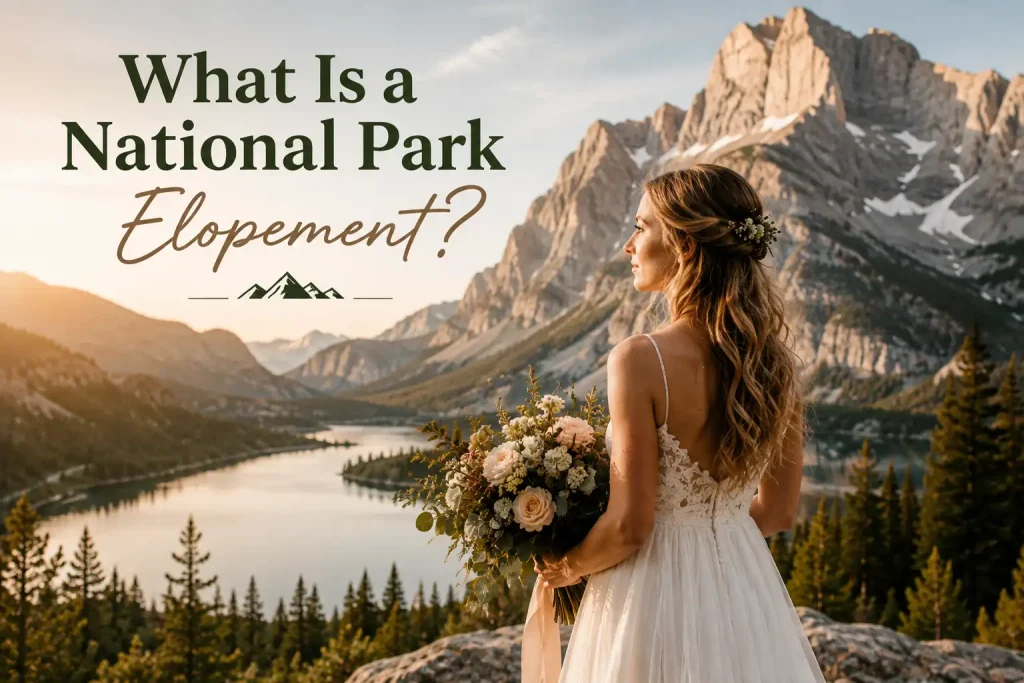
But it’s more than a wedding ceremony that happens to be outdoors. The setting changes how the whole day works. You’re planning a celebration on protected public land, so the experience gets shaped by the environment, park rules, other visitors, the weather, accessibility, and the ordinary logistics of moving people around outdoors.
That combination is exactly what draws couples to it. Your wedding can feel less like a formal event and more like a meaningful adventure built around the two of you.
What makes an elopement different from a traditional wedding?
The biggest difference is what the day is built around.
A traditional wedding usually revolves around a venue, a guest list, a reception, seating charts, decorations, and a tightly structured schedule. An elopement puts the couple at the center instead.
You might spend part of the day hiking, exploring a scenic area, sharing private vows, having a picnic, watching the sunset, or just enjoying time together without the pressure of entertaining a crowd.
That doesn’t mean it has to be rushed or informal. You can still wear wedding attire, exchange rings, hire an officiant, book a photographer, invite family, and plan a beautiful meal afterward. The difference is how much freedom you have to decide what actually matters.
A national park is still a public place
One of the most important things to understand before you plan a national park elopement: the park doesn’t become your private venue just because you booked a ceremony there.
Other visitors may still be hiking the trail, photographing the same overlook, or simply enjoying the same view. Depending on the park and the location, you may not be able to claim an entire scenic area for yourselves.
So treat privacy as something you plan for, not something you assume. Choosing a quieter time of day, considering a weekday, building flexibility into your schedule, and picking a location that fits your group size can make the day feel far more intimate — even with strangers nearby.
The goal isn’t necessarily having the whole park to yourselves. It’s creating a meaningful ceremony while sharing a landscape that belongs to everyone.
Is a National Park Elopement Right for You?
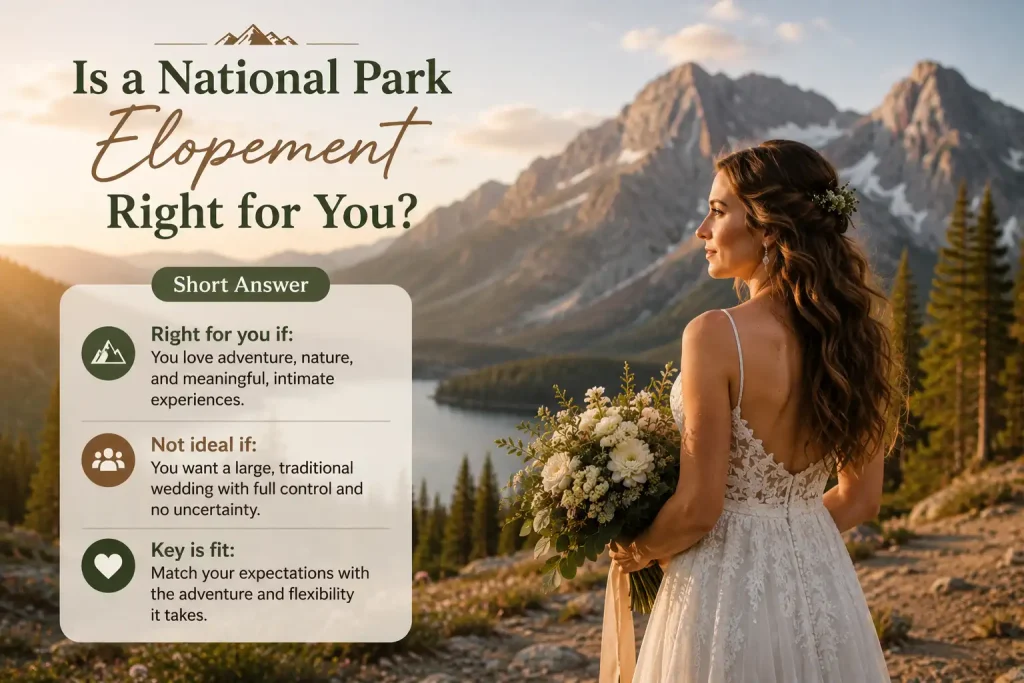
It can be extraordinary. It isn’t the right wedding style for everyone. The right choice depends as much on your expectations as it does on how good the scenery looks in photos.
It may be right for you if…
You want your wedding day to feel like an experience, not a formal event. You like nature, travel, hiking, scenic drives, or simply being outdoors, and you’d rather say your vows beside a mountain than inside a ballroom. You’re comfortable keeping the guest list small and focused on the people who matter most.
It’s also a strong fit if you value flexibility. Instead of building the whole day around a reception timeline, you can shape it around moments that actually feel personal to your relationship — and combine the wedding with a longer trip, so the day becomes part of a bigger getaway rather than a single scheduled event.
Most of all, it suits you if you’re willing to trade some control for a more natural, immersive setting.
It may not be the best fit if…
You want complete privacy, predictable weather, or a tightly controlled environment. It can also be a poor match if your ideal day includes a large guest list, elaborate decor, a full seated reception in the park, or a venue where every detail is handled for you.
Accessibility deserves honest thought here. Some scenic spots involve walking, uneven ground, elevation gain, or real physical effort. If elderly relatives, young kids, or guests with mobility limitations are coming, the location has to work for them too — not just for you.
And think about your tolerance for uncertainty. Conditions change, popular spots get crowded, and access to certain areas can depend on the season or on rules specific to that park.
Choosing a national park elopement doesn’t mean you need to be an experienced hiker. It does mean you should be comfortable adapting when the environment doesn’t cooperate.
How adventurous do you want your elopement to be?
Not every national park elopement needs a difficult hike or a remote backcountry location. Think of it as a spectrum.
Easy-access: a scenic spot close to parking, minimal walking, a simpler schedule. Great for couples who want dramatic scenery without a physically demanding day.
Moderate adventure: a longer walk or short hike to reach a quieter, more scenic setting, while the day stays manageable overall.
Full adventure: the wedding becomes part of a bigger outdoor experience — significant hiking, camping, or other activities where they’re permitted and appropriate.
None of these is “better.” The right level matches your comfort, your guests, the season, and the kind of memories you’re trying to make.
What Makes a National Park Elopement Different From a Traditional Wedding?
A national park elopement shifts the balance between control and experience. A traditional venue gives you more control over the environment. A national park gives you a landscape that becomes part of the wedding itself.
| Traditional Wedding | National Park Elopement |
| Usually held at a private venue | Held in a public or protected landscape |
| More control over the environment | Weather and natural conditions matter |
| Private event space is common | Other visitors may be present |
| Seating and decorations are easier to arrange | Park rules may restrict equipment and decorations |
| Parking and facilities are usually planned for the event | Visitor access and site logistics matter |
| Schedule is often venue-driven | Schedule can be built around the landscape |
| Larger guest counts are more practical | Smaller groups are often easier to manage |
| Ceremony and reception happen in one controlled location | The day can move between different experiences |
The trade-off is simple: you give up some predictability in exchange for scenery, intimacy, and the freedom to make your wedding day feel like an adventure. That’s the real appeal — you’re not just choosing a beautiful backdrop to stand in front of. You’re choosing a different way to experience the day itself.
Where Can You Have a National Park Elopement?
Picking a beautiful spot is one of the most exciting parts of planning, but the prettiest view isn’t automatically an available ceremony location. National parks protect natural areas for public use, and each park sets its own rules about where ceremonies can happen, how many people can attend, and what’s allowed once you’re there.
So the right question isn’t “where has the best view?” It’s:
“Where can we legally and comfortably hold our ceremony while still getting the experience we want?”
Some parks designate specific ceremony sites — overlooks, picnic areas, meadows, beaches, amphitheaters. A designated site usually makes planning easier, since the park has already decided ceremonies can happen there under certain conditions.
Other locations work differently. You might be able to request a specific spot, but it may still need approval. A remote trail or secluded meadow can look perfect in photos and still be unsuitable because of environmental concerns, visitor use, or access restrictions.
That’s why location research has to happen before you commit to anything else.
Designated ceremony locations
These sites are ones the park has identified as appropriate for weddings. They tend to be the smoother path, since you usually have clearer information on capacity, access, parking, and what’s permitted there.
The trade-off: designated locations can also be popular. A beautiful, easy-to-reach overlook may attract plenty of other visitors, especially during peak travel periods. If privacy matters to you, check the location at the actual time of day and season you’re considering — not just in photos taken by someone else.
A designated ceremony site also doesn’t automatically mean you can decorate it freely, occupy it indefinitely, or ask other visitors to clear out. The site’s specific rules still apply.
Approved locations, trails, and overlooks
Some couples picture vows at a remote overlook, far from the main visitor areas. That’s sometimes possible — but a scenic spot isn’t automatically a permitted ceremony site.
A trail might be open for hiking but not approved for a wedding. An overlook might welcome visitors but restrict organized ceremonies. A backcountry setting might need extra authorization.
Before you fall in love with a photograph, find out whether the location can actually support your ceremony — whether everyone can get there, whether it can hold your group, and whether what you’re planning to do is even allowed.
The location test: 10 questions to ask before choosing a spot
| Question | Why it matters |
| 1. Are ceremonies allowed here? | A public location is not automatically a ceremony location. |
| 2. Do I need approval or a permit? | Authorization may be required before you can hold the ceremony. |
| 3. How many people are allowed? | Site capacity can determine your guest list. |
| 4. Where will everyone park? | A beautiful location can become impractical if parking is limited. |
| 5. How far is the walk? | Guests may have very different mobility and comfort levels. |
| 6. What is the terrain like? | Uneven ground, elevation and weather can change the experience. |
| 7. Are there accessibility limitations? | The best view is not useful if important guests cannot comfortably reach it. |
| 8. How busy is the location likely to be? | Public visitors can affect privacy and the ceremony atmosphere. |
| 9. What activities or equipment are restricted? | Decorations, music and other planned elements may not be allowed. |
| 10. What is the backup plan? | Weather, closures or other conditions can make your first choice unavailable. |
The strongest location usually isn’t the most remote or dramatic one. It’s the one that delivers the scenery and atmosphere you want while still working for your people, your schedule, and the park’s rules.
Do You Need a Permit for a National Park Elopement?
This is one of the first practical questions worth sorting out, because getting it wrong can throw off your entire plan.
Here’s the most important thing to know: there’s no single permit rule that applies identically to every national park. Requirements can shift depending on the park, the location, your group size, the date and time, and the kind of activity you’re planning. A tiny two-person ceremony can face different requirements than a larger, organized gathering.
Check the rules for your specific park — don’t assume.
What is a Special Use Permit?
A Special Use Permit is a form of authorization parks use for activities that go beyond ordinary visitor use. For an elopement, that process typically reviews where the ceremony will happen, when, how many people are attending, and what you intend to do.
The exact terminology and process differ from park to park, so don’t assume every park runs an identical application system. The important point stays constant: a wedding held inside a national park may require formal authorization even though the park itself is open to the public. And a permit doesn’t necessarily give you exclusive use of the area — the park can remain open to other visitors around you.
Do all national parks require one?
No single answer covers every park and every elopement. Some parks require permits for wedding ceremonies. Very small gatherings, or particular locations, may fall under different rules. And requirements can change over time.
Even within one park, requirements may shift based on:
- group size
- ceremony location
- activity
- time of day
- equipment
- whether the event is organized
- other park-specific restrictions
Broad claims like “all national park elopements need a permit” or “small elopements never do” are too simplistic. Treat the park’s current official guidance as the deciding source — not a wedding blog, and not what worked for a friend two years ago.
What can affect permit requirements?
Group size is the most obvious factor — two people have a very different impact than a larger gathering with multiple vehicles. Location matters too: a designated ceremony site may have established rules, while a requested location may need extra review.
Activities and equipment matter as well — large structures, amplified sound, elaborate decor, or other event gear may face restrictions. Timing plays a role too, since a ceremony during a high-use period can raise different logistical questions than one scheduled during a quieter stretch.
The safest approach: describe your actual plans when you contact the park, rather than trying to squeeze your ceremony into a general rule you found online.
When should you check the permit rules?
Before you lock in anything important. Ideally, look into permit requirements while you’re still choosing your general destination and ceremony location — that gives you room to change plans if your preferred spot is unavailable or the requirements don’t match what you had in mind.
Don’t assume an old blog post or social media caption still reflects the current process. Park procedures change, and outdated articles won’t warn you.
A practical order to work through things: choose your general destination → review official park rules → investigate your ceremony location → confirm permit requirements → then finalize the rest of your plans.
What information might a permit application require?
The exact application varies, but you may be asked for:
- Your names and contact information
- Proposed ceremony date and time window
- Ceremony location
- Number of participants and vehicles
- Description of the ceremony
- Planned equipment or decorations
- Other activities tied to the event
You don’t need to plan every minute of the day before contacting the park — you do need a realistic picture of your ceremony. And keep copies of any permit, approval, or correspondence you receive, then review them again shortly before the event.
Marriage License vs. Park Permit vs. Entrance Fee
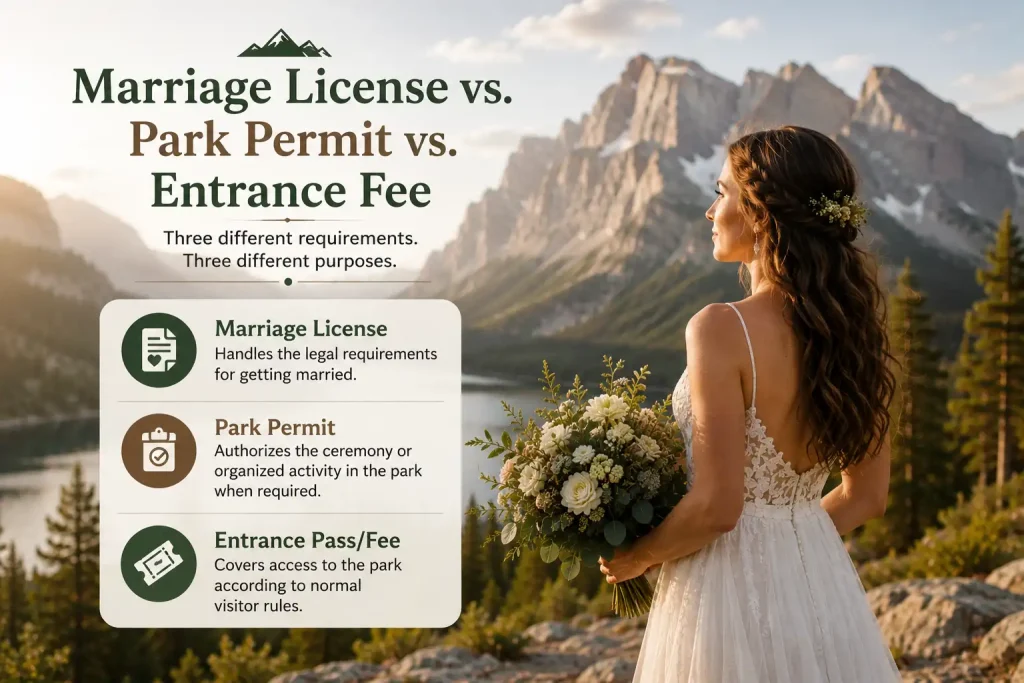
One of the easiest ways to get tangled up while planning is treating every official requirement as the same thing. They’re not.
| Requirement | What it does |
| Marriage license | Handles the legal requirements for getting married under the applicable jurisdiction. |
| Park permit | Authorizes the ceremony or organized activity in the park when one is required. |
| Entrance pass/fee | Covers access to the park according to its normal visitor-entry rules. |
Marriage license — concerns the legal marriage itself. Its requirements come from the relevant jurisdiction, so look into the marriage rules that apply to the place you’re getting married, rather than assuming a park permit covers the legal side. A park can approve your ceremony without that approval doubling as your marriage license.
Park permit — concerns your use of the park for the ceremony or related activity, when one’s required. Having a marriage license doesn’t give you permission to hold a ceremony wherever you want inside the park.
Entrance fee or pass — concerns entering the park at all. Even with the ceremony approved, participants may still need to follow normal entrance rules.
A simple way to keep it straight: marriage license = can the marriage be legally recognized. Park permit = is the ceremony authorized here, when one’s required. Entrance pass = can people get into the park in the first place.
Verify all three separately, using current official information from the relevant authority and the specific park. That’s what prevents one of the most avoidable planning mistakes — assuming that satisfying one requirement covers the others.
How Much Does a National Park Elopement Cost?
One of the real advantages here is that you don’t necessarily need to spend thousands on a venue. That doesn’t mean the experience is automatically cheap, though.
Your total depends on how you travel, how many people come, how long you stay, which vendors you hire, and how ambitious you want the day to be. A couple who lives close to the park and plans something simple has a very different budget than one flying across the country, staying several nights, and hiring multiple vendors.
The useful way to think about it: separate the costs you have to account for from the extras you choose to add.
What you may need to budget for
| Expense | What it can include |
| Park-related costs | Permit, entrance fees, or other applicable charges |
| Marriage requirements | Marriage license and related administrative costs |
| Travel | Flights, fuel, rental car, or other transportation |
| Accommodation | Hotel, cabin, lodge, or vacation rental |
| Attire | Dress, suit, shoes, outer layers, and accessories |
| Food | Meals, picnic supplies, or a special dinner |
| Officiant | Ceremony services where required |
| Photography | Elopement photography coverage |
| Activities | Hiking, tours, or other experiences |
| Miscellaneous | Emergency gear, parking, tips, and unexpected expenses |
Not every couple needs every category — you may already own suitable clothing, live within driving distance, or handle parts of the day yourselves. You also don’t need to spend evenly across categories; one couple prioritizes photography, another prioritizes a comfortable place to stay.
A simple framework helps:
Lower-cost: tiny guest list, nearby accommodation, few paid vendors, a ceremony built around free activities.
Mid-range: professional photography, comfortable accommodation, a special meal, a couple of planned activities.
Experience-focused: more spent on travel, premium accommodation, extended photography coverage, multiple days, memorable outdoor experiences.
There’s no single “normal” price for this. A useful budget reflects the experience you actually want.
What makes the cost go up?
Travel is usually the biggest variable — a park’s permit or entrance cost might be modest, but flights, a rental car, fuel, and several nights of lodging add up fast. Guest count matters too, since more people mean more transportation, lodging, and logistics. Location choice plays a role as well: a simple ceremony near a main road takes less time and gear than an itinerary spanning multiple remote spots.
Other cost drivers: peak-season travel, last-minute accommodation, extended photography coverage, professional hair and makeup, specialized transportation, multi-day celebrations, adventure activities, premium lodging, and additional meals or private dining.
What can make it more affordable?
Decide what matters most before you start spending. If the scenery and experience are the priority, you probably don’t need an elaborate floral setup or a long reception. Traveling on a weekday can also simplify the trip, particularly at high-demand destinations.
Other ways to trim the budget: keep the guest list very small, book accommodation with a kitchen, fold the honeymoon into the same trip, skip unnecessary decorations, choose a simple meal over a formal reception, limit paid activities, use what you already own, and book major travel early.
A sample national park elopement budget
Here is an example framework rather than a universal average:
| Category | Example allocation |
| Travel | $700 |
| Accommodation | $800 |
| Photography | $2,000 |
| Attire | $500 |
| Food | $300 |
| Officiant | $250 |
| Park/license-related costs | $200 |
| Miscellaneous | $250 |
| Example total | $5,000 |
Your numbers could look completely different — the point of the example is showing how the pieces fit together, not suggesting every elopement should cost this much. Before booking anything, decide which three parts of the experience matter most. Let those priorities shape the budget, instead of letting every possible wedding expense shape the day for you.
How Many People Can Attend a National Park Elopement?
There’s no single guest count that defines an elopement. Some couples bring no one beyond who’s legally required for the ceremony. Others invite parents, siblings, or a few close friends.
The real question isn’t how many people you want to invite — it’s how the group size affects your location, access, transportation, privacy, and the park’s rules.
Just the couple
A two-person elopement gives you the most flexibility. You can focus entirely on each other, choose locations that would be impractical for a bigger group, and move at your own pace — with an easier time handling parking, walking distances, weather shifts, and last-minute changes. It’s often the simplest option if you’re after a quiet, adventure-focused day.
Couple plus a few loved ones
A small group lets you keep the intimacy of an elopement while sharing it with the people closest to you. Before inviting anyone, think past the ceremony itself: can everyone reach the location comfortably? Will older relatives or young kids manage the terrain? Is there enough parking? Can everyone travel together? Does the site have a group-size limit?
A remote spot that’s perfect for two people can be completely impractical for ten.
When does it start becoming a micro-wedding?
There’s no universal line that turns an elopement into a micro-wedding — different couples and wedding professionals draw it differently. In practice, the distinction gets useful once the guest count starts changing how you plan: substantial seating, coordinated transportation, more parking, a reception setup, more vendors, a more formal schedule. That’s the shift from elopement logistics to micro-wedding logistics.
In a national park, that distinction matters more, because a larger group narrows your location options and adds planning requirements.
When Is the Best Time for a National Park Elopement?
There’s no universally perfect month or season. The best time depends on the landscape you want, the weather you can handle, access conditions, and how much visitor traffic you’re comfortable with.
Choosing the season
Spring can bring fresh landscapes and flowing water, though some higher-elevation areas may still hold snow or have limited access. Summer often makes mountain and high-elevation areas easiest to reach, but popular parks see heavier visitation too. Fall can bring cooler conditions and seasonal color in some regions, though access can start changing as temperatures drop. Winter can be spectacular and quiet in some locations, but snow, ice, short daylight, and road closures complicate planning significantly.
Don’t choose a season just because the photos look beautiful — confirm the roads, trails, ceremony locations, and services you’ll actually need are available.
Weekday vs. weekend
A weekday can appeal if you want a quieter experience — popular locations may see fewer visitors than on a busy weekend, though that’s never guaranteed. It can also make the rest of your trip easier, since accommodations and other logistics often have more availability. But don’t assume “weekday” automatically means “private.” Parks remain public places, and visitor patterns vary by location and season.
Sunrise vs. sunset
| Sunrise | Sunset |
| Often quieter | Dramatic evening light |
| Cooler in many locations | Potentially warmer depending on season |
| Requires an early start | Allows a slower morning |
| Can reduce visitor traffic | Popular viewpoints may become busy |
| Excellent for beginning the day | Great for ending the celebration |
Choose based on your whole itinerary, not photography alone. A sunrise ceremony can be beautiful but means an early departure and extra preparation. A sunset ceremony might fit your schedule better but leaves you traveling after dark.
Checking conditions before the wedding
Your chosen date is only part of the equation — conditions can shift even after your plans are set. Before the trip, check weather forecasts, road conditions, trail conditions, seasonal closures, park alerts, fire or smoke conditions where relevant, transportation or shuttle information, and any changes to your ceremony location or access. The closer you get to the wedding, the more these checks matter.
What Happens If the Weather Changes?
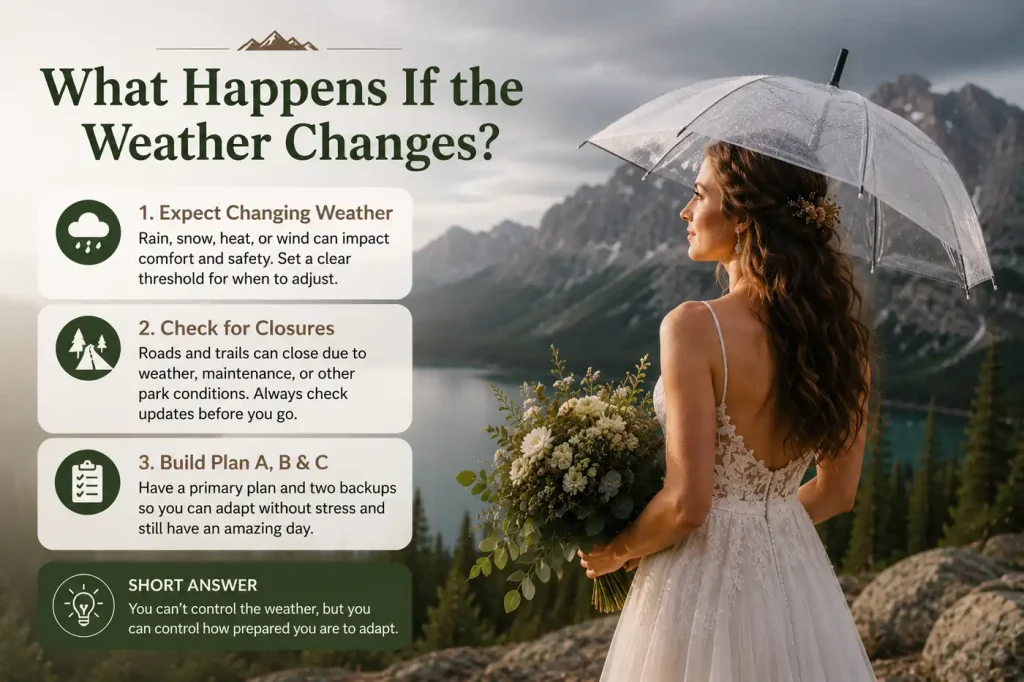
An outdoor wedding needs a weather strategy. That doesn’t mean panicking over every cloud — it means deciding ahead of time what conditions you can handle comfortably and what would require a change of plan.
Rain, snow, and extreme temperatures
Light rain might just mean adding layers and waterproof gear. Heavy rain, thunderstorms, snow, extreme heat, or high winds are a different matter — they can affect roads, trails, visibility, comfort, and safety, along with how much time you can realistically spend outside. Match your clothing and gear to the season, but also set a clear threshold for when you’ll change locations or timing. The goal isn’t forcing the original plan at any cost — it’s protecting the experience.
Road, trail, and environmental closures
Weather isn’t the only thing that can change your plans. Roads and trails can close due to snow, flooding, rockfall, wildfire, storm damage, environmental protection, maintenance, or other park-management decisions. A location that was open when you researched it may not be accessible on your wedding day — which is why checking current conditions shortly before the trip matters just as much as the original planning.
Build Plan A, B, and C
A strong plan doesn’t rest on one perfect location.
Plan A: your preferred ceremony location and schedule.
Plan B: a realistic alternative that still fits the kind of experience you want.
Plan C: a broader fallback — another permitted setting, a different time of day, or a nearby option that doesn’t depend on the same conditions.
Your backup doesn’t need to be equally spectacular. It just needs to be good enough that a change doesn’t ruin the day.
That mindset is one of the biggest advantages you can give yourself with an outdoor wedding. You can’t control the weather, the visitor count, or every road condition. You can control how prepared you are to adapt.
How to Design Your Elopement Day Around the Experience
A national park elopement doesn’t have to start with a ceremony and end with photographs. One of the biggest advantages of the setting is that the landscape gives you a whole day to work with, not just an hour.
Instead of asking only “where will we exchange vows?” — think about what you want the day to feel like from start to finish. Maybe that’s a quiet morning together, a scenic walk, time to explore, a favorite meal, or an activity that has nothing to do with a traditional wedding structure. The ceremony matters, but it doesn’t have to carry the entire day.
Don’t make the ceremony the entire day
A common mistake: building a detailed ceremony schedule and leaving everything before and after it nearly empty. A national park gives you room to build a much richer day — breakfast, travel to your chosen area, private vows, exploring the landscape, a picnic, a scenic drive, or just time together enjoying the place.
Some couples want a quiet day with very little on the schedule. Others want something more adventurous. Neither is better — the activities should feel natural to you, not added because an elopement is “supposed” to be adventurous. Think about what you’d enjoy doing together even without a wedding involved. Those are usually the moments that make the day feel personal.
Build breathing room into the schedule
Outdoor plans rarely move exactly on the clock. You might need extra time to find parking, walk from the lot, wait out traffic, catch a quiet moment at a busy overlook, adjust your clothing, or just stop because the view is better than expected.
A tightly packed itinerary can turn a relaxed elopement into a string of deadlines. Leave space between major activities instead. If a walk should take 20 minutes, don’t build your schedule around arriving exactly 20 minutes later — leave room for a slower pace, photos, conversation, and unexpected delays.
Breathing room also gives you permission to actually experience the day. You don’t need to spend every minute moving toward the next thing.
Example experience-focused timeline
The following is only an example of how a day could flow. Your actual schedule should reflect your location, season, access conditions, ceremony requirements, and preferred pace.
- 6:00 a.m. — Get ready and have a relaxed breakfast
- 7:00 a.m. — Travel toward the ceremony area
- 8:00 a.m. — Arrive and walk to the location
- 8:30 a.m. — Private vows or first look
- 9:00 a.m. — Ceremony
- 9:30 a.m. — Explore and take photographs
- 11:00 a.m. — Picnic or early lunch
- 12:30 p.m. — Rest or return to accommodation
- 3:00 p.m. — Second activity or scenic exploration
- 5:30 p.m. — Golden-hour experience
- 6:30 p.m. — Sunset or final quiet time together
- 7:30 p.m. — Dinner
Notice that the ceremony occupies only one part of the day. That’s intentional. The goal is a wedding day you actually experience rather than one you spend watching the clock.
What Should You Wear for a National Park Elopement?
Your clothing should reflect your personal style and the environment you’ll actually be in. A dramatic dress or a formal suit can look beautiful outdoors, but comfort and practicality matter more once the ceremony involves walking, uneven ground, wind, cold, or shifting weather.
Choose clothing for the terrain
Think about where you’ll actually be standing and walking. A long formal outfit might work beautifully at an accessible viewpoint and become a liability on a rocky trail. A heavily structured outfit can feel exhausting over a long outdoor day, while lightweight layers adapt more easily to temperature swings.
Consider how much walking is involved, whether the ground is uneven or steep, how much wind the location gets, whether temperatures will shift during the day, and how easily your outfit layers. You don’t have to sacrifice style for practicality — just choose clothing that lets you enjoy the environment instead of constantly managing it.
Footwear and weather considerations
Footwear matters most if the ceremony involves walking. You can wear traditional wedding shoes for portraits or the ceremony itself and carry more comfortable shoes for the rest of the day — or choose attractive outdoor footwear from the start so you never have to change. Prepare for conditions that differ from the forecast: a warm layer, a waterproof shell, sun protection, or an extra pair of socks can end up mattering more than any accessory you packed purely for photos.
What Should You Bring?
Packing for a national park elopement is different from packing for an indoor wedding. You need what the ceremony itself requires, but you also need to think about the environment you’ll be in.
Essential documents and wedding items
Keep the important items together and easy to reach: marriage license and ID, permit or authorization documents if applicable, rings, written vows, officiant paperwork if needed, appropriate clothing and accessories, phone, backup power bank, water, snacks, weather protection, basic first aid, and any essential personal items.
Don’t store irreplaceable documents somewhere they could get damaged by rain or lost on a hike. Keep digital copies where it makes sense, while still carrying any originals officials require.
What changes if you’re hiking?
The farther you travel on foot, the more carefully you should think about your bag — every extra item adds weight, and wedding clothing already limits comfortable movement.
Prioritize what directly supports the day: enough water for the conditions and distance, weather protection for exposed areas, small comfort items like blister protection or sunscreen, and basic emergency supplies appropriate to the terrain. Skip decorations or equipment you’re carrying purely because you assume a wedding requires them.
The best packing strategy isn’t bringing everything you might possibly need — it’s bringing what keeps you comfortable, safe, legally prepared, and able to actually enjoy the day.
How to Make a National Park Elopement Feel Personal
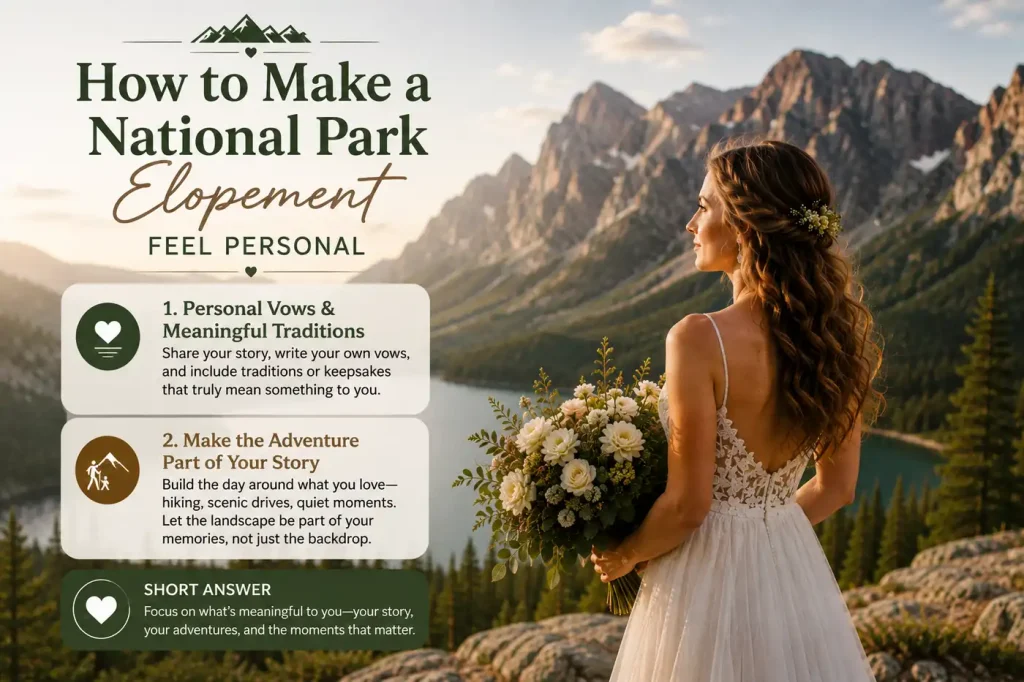
The landscape can make your wedding visually spectacular, but scenery alone doesn’t make it meaningful. The details that stick are usually the ones that would only make sense for the two of you.
Personal vows and meaningful traditions
Personal vows can turn a beautiful setting into a meaningful moment. Instead of writing something that sounds like a generic wedding speech, talk about your actual relationship — what you appreciate about each other, what you’ve been through together, what you’re hoping to carry forward.
You can also bring in a tradition that means something to you: reading letters, carrying a family keepsake, recreating a moment from an earlier trip, sharing a favorite meal, or including a small ritual with real significance. How elaborate it looks matters far less than whether it means something.
Make the adventure part of the story
A national park elopement gives you room to build memories outside the ceremony itself. Maybe you both love hiking. Maybe you’d rather take a scenic drive, sit by a lake, or have breakfast somewhere memorable. Build the day around those interests instead of a generic wedding-day template.
The landscape shouldn’t just be a backdrop for photographs — let it become part of the story. A meaningful elopement often gets remembered not only for the moment you exchanged vows, but for the walk afterward, the unexpected view, the meal you shared, or the quiet conversation where you simply stopped and took in where you were. That’s what makes the day feel like your wedding, not a ceremony that happened to take place somewhere beautiful.
National Park Elopement Rules That Can Affect Your Plans
A national park elopement should feel personal and relaxed, but the setting comes with responsibilities you wouldn’t have at a private venue. Parks are managed to protect natural and cultural resources while still welcoming visitors, so your ceremony has to fit within rules specific to that park and location. The National Park Service notes that special uses such as weddings may require written authorization, and approval can depend on resource protection, visitor experience, and potential impacts.
Leave No Trace
Your wedding should leave behind memories, not physical evidence. Stay on designated or permitted routes, avoid disturbing plants and wildlife, and pack out everything you bring in. Even something as small as dropped decorations or food scraps can become a resource or wildlife problem. The useful question isn’t “is this technically on the list of prohibited items?” It’s “would this damage vegetation, disturb wildlife, or leave something behind?”
Flowers, petals, and confetti
Don’t assume ordinary wedding traditions are automatically fine outdoors. Loose petals, confetti, rice, glitter, and balloons can become litter or affect wildlife and vegetation, and some parks specifically restrict them. If flowers matter to your ceremony, ask the park directly what’s allowed rather than trusting advice written for a different location.
Decorations and equipment
A national park isn’t a blank canvas. Large arches, chairs, signage, elaborate floral installations, generators, and amplified sound may be restricted depending on the location. It’s not just about appearance — equipment can affect vegetation, visitor movement, and safety. Keep the setup simple, and verify anything beyond ordinary personal belongings before you bring it.
Pets
Your dog may be family, but that doesn’t mean automatic access to the ceremony. Pet rules vary considerably between parks and even between areas within the same park — Great Smoky Mountains National Park, for example, restricts pets from most trails, while other units set their own rules. Check the exact policy for your ceremony location before planning a pet-inclusive day.
Drones
Unmanned aircraft are prohibited in many National Park Service areas, and individual parks add their own restrictions or exceptions — Zion prohibits remote-controlled aircraft entirely, and Great Sand Dunes bars drones for all uses, including weddings. A drone being legal at home doesn’t make it legal inside a national park.
Music, food, and drinks
A picnic or celebratory meal can work well in the right spot, but food, alcohol, amplified music, and similar activities can be restricted by location. Alcohol rules especially vary — some park units limit open containers or consumption to designated areas or specific approvals. Keep the celebration low-impact, and check the rules before planning champagne, catering, speakers, or anything resembling a reception.
Photography and other visitors
Photography is part of nearly every elopement, but a professional shoot doesn’t mean claiming a public location. Current NPS guidance draws a useful distinction: in many circumstances, still photography involving eight or fewer people doesn’t need a separate photography permit when it happens in public areas, uses hand-carried equipment, doesn’t require exclusive use, and doesn’t affect resources, visitors, or create added administrative costs. Photography tied to an already-authorized event, like a wedding, generally doesn’t need its own permit on top of that.
None of that removes the need to follow the rules governing the ceremony itself — and other visitors still have every right to enjoy the park, so a photographer should work around normal use rather than block a trail or monopolize an overlook.
How to Have a Beautiful Elopement Without Damaging the Park
The best national park elopement looks beautiful in photographs without requiring the landscape to change for you. Keep the setup minimal, stay on established or permitted routes, and skip picking flowers, moving rocks, disturbing wildlife, or leaving anything behind. Avoid activities that add unnecessary noise, crowding, or disruption.
Think past what’s technically allowed and toward what’s respectful. If your ceremony needs an elaborate setup to look beautiful, the location may not be doing enough of the work for you — let the landscape provide the setting instead. A mountain view, forest, desert, coastline, or meadow rarely needs heavy decoration; often, the simpler the ceremony, the more naturally the surroundings become part of it. Aim to leave the location looking essentially the way it did before you arrived.
What Can Go Wrong With a National Park Elopement?
Outdoor weddings have a few variables you can’t fully control. The trick is naming them before they become surprises.
Your preferred location isn’t available
Ceremony sites can have restrictions, capacity limits, closures, or scheduling conflicts — which is exactly why your favorite photograph should never be your only plan. Have at least one realistic alternative.
Your group is too large
A spot that’s beautiful for two people may not work for ten. More guests mean more vehicles, more walking, more impact on the site, and sometimes different permit or location requirements. Confirm the group size limit before finalizing the guest list.
Weather or access changes
Weather affects roads, trails, visibility, and comfort; wildfire, flooding, snow, or maintenance can change access on top of that. The NPS manages areas according to changing conditions and local restrictions, and rules can shift through superintendent decisions, so check current alerts before the event.
Someone can’t handle the terrain
Don’t judge a location only by how far it looks on a map. Elevation, uneven surfaces, heat, cold, stairs, and long walking distances can make a spot unworkable for someone in your group. If an important family member can’t comfortably reach the ceremony, the location may not actually be the right one.
How to prepare for the unexpected
Before you leave for the trip, confirm your ceremony authorization, location access, group size, current weather, road and trail conditions, transportation, and your backup location or schedule. The goal isn’t eliminating every possible problem — it’s making sure one problem doesn’t take down the whole day.
National Park Elopement Planning Timeline
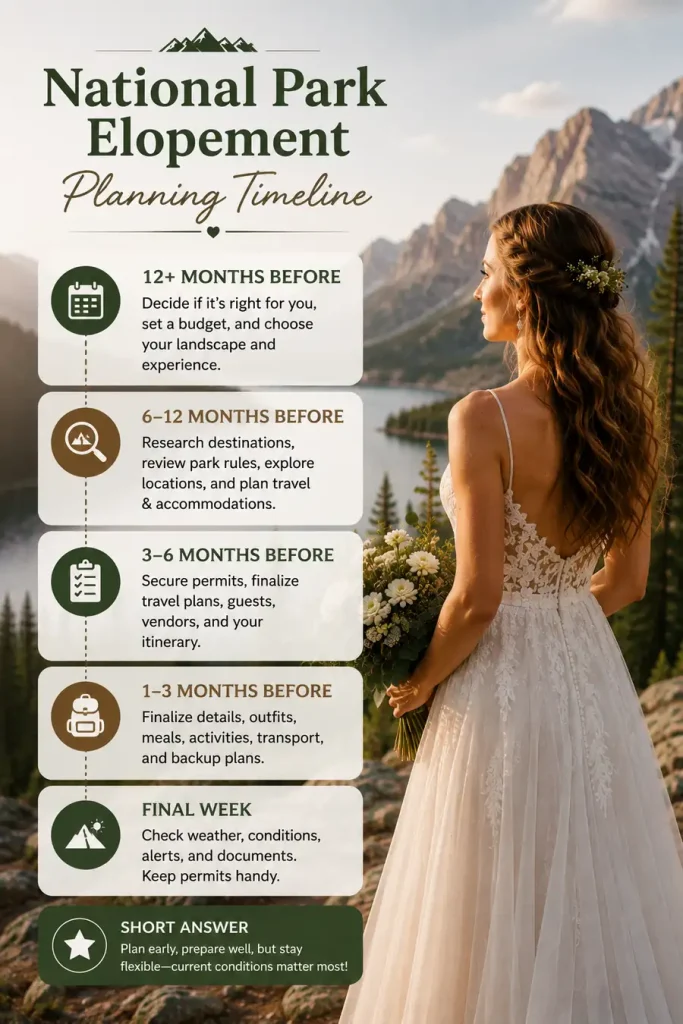
There’s no universal planning calendar, since park rules, permit windows, travel distances, and seasonal access all vary. Use this as a framework, not a fixed set of deadlines.
12+ months before: Decide whether a national park elopement suits you, set a rough budget, and identify the landscape and experience you want.
6–12 months before: Research destinations, review official park rules, investigate ceremony locations, and start planning accommodation and travel.
3–6 months before: Confirm permits or approvals, finalize major travel, and settle guests, vendors, and your general itinerary.
Final 1–3 months: Finalize clothing, ceremony details, transportation, meals, activities, and backup plans. Recheck the park’s current requirements instead of relying on what you found months earlier.
Final week: Check weather, road and trail conditions, park alerts, and any last-minute instructions. Confirm your documents and keep permit or approval information within reach.
The closer the wedding gets, the more the current conditions matter — more than anything you researched early on.
Frequently Asked Questions About National Park Elopements
Can you legally get married in a national park?
Yes — couples can legally marry in national park areas when the applicable legal and park requirements are satisfied. The marriage itself and permission to hold a ceremony in the park are separate issues, so verify both the marriage rules for the relevant jurisdiction and the park’s current ceremony rules.
Do you need a permit?
Sometimes. Requirements vary by park, location, group size, and activity. Many park units require special-use authorization for weddings, while small gatherings or particular situations may have different rules. Always check the specific park’s current guidance.
Can you elope with no guests?
Yes. A two-person elopement is one of the simplest ways to plan the experience, but you still need to meet the legal and park requirements that apply to your ceremony.
Can you bring family?
Often, yes, provided the location and park rules allow your group size. Before inviting relatives, think through parking, walking distance, accessibility, and whether the site can comfortably hold everyone.
Can you elope anywhere in the park?
No. A location being open to visitors doesn’t mean it’s available for a wedding ceremony. Some parks designate specific ceremony sites, while others require approval or carry extra restrictions.
Is a marriage license the same as a park permit?
No. A marriage license concerns the legal marriage; a park permit authorizes a ceremony or activity in the park when one’s required. They serve different purposes.
Is a national park elopement private?
Not necessarily. Parks are public places, so other visitors may be around. Quieter times or locations can improve privacy, but you generally shouldn’t assume a scenic viewpoint belongs exclusively to your wedding.
What happens if it rains?
You adapt. Light rain might just mean the right clothing and gear; severe weather may mean changing the location or schedule. A strong plan includes an alternative rather than betting everything on perfect weather.
Can you bring a dog?
It depends on the park and the specific area. Pet access varies considerably, and many trails restrict dogs. Check the current rules for your exact ceremony location before including your dog in the plan.
Can you have flowers or decorations?
Some simple items may be permitted, but restrictions can apply to petals, confetti, structures, signs, and other decor. Never assume a tradition is allowed just because it’s common at private venues.
Can you hire a photographer?
Yes, but the photographer has to follow the park’s rules. Current NPS regulations generally allow many small photography activities without a separate permit when specific conditions are met, and photography tied to an authorized event like a wedding generally doesn’t need another permit on top of that.
Is it cheaper than a traditional wedding?
It can be, especially with fewer guests and fewer venue-related expenses. But travel, accommodation, photography, and activities can still add up to a substantial total. An elopement isn’t automatically cheap — it’s simply more flexible about where the money goes.
How far in advance should you plan?
Start as early as practical, especially if you’re traveling far, choosing a popular season, or need a permit. There’s no single national deadline that applies everywhere — some park units publish their own application requirements and lead times, so let the specific park set your schedule.
What is the biggest mistake couples make?
Treating a national park like a private wedding venue. The biggest planning mistake is assuming a beautiful location is automatically available, private, accessible, and suitable for a ceremony. Research the rules, understand the logistics, prepare for changing conditions, and keep a backup plan.
A national park elopement works best when you plan carefully without letting the plan become so rigid that the environment controls your emotions. You can’t control the weather, the visitor count, or every road condition. You can control how prepared you are to enjoy the day even when it doesn’t go exactly as expected.