
The Best Cities to Live in USA: Your Decision Framework
The search for the best cities to live in USA has never been more complex — or more consequential. In 2026, the traditional ranking metrics of weather, nightlife, and generic ‘quality of life’ scores are no longer sufficient. Remote work has untethered millions from major metros. Insurance premiums have doubled in some Sun Belt states. Property tax bills are arriving that buyers never anticipated. HOA restrictions are turning would-be homeowners into reluctant renters. And the cities that dominated the top-ten lists five years ago are now grappling with infrastructure overload, school funding crises, and population-driven cost spikes that erode the very affordability that attracted newcomers in the first place.
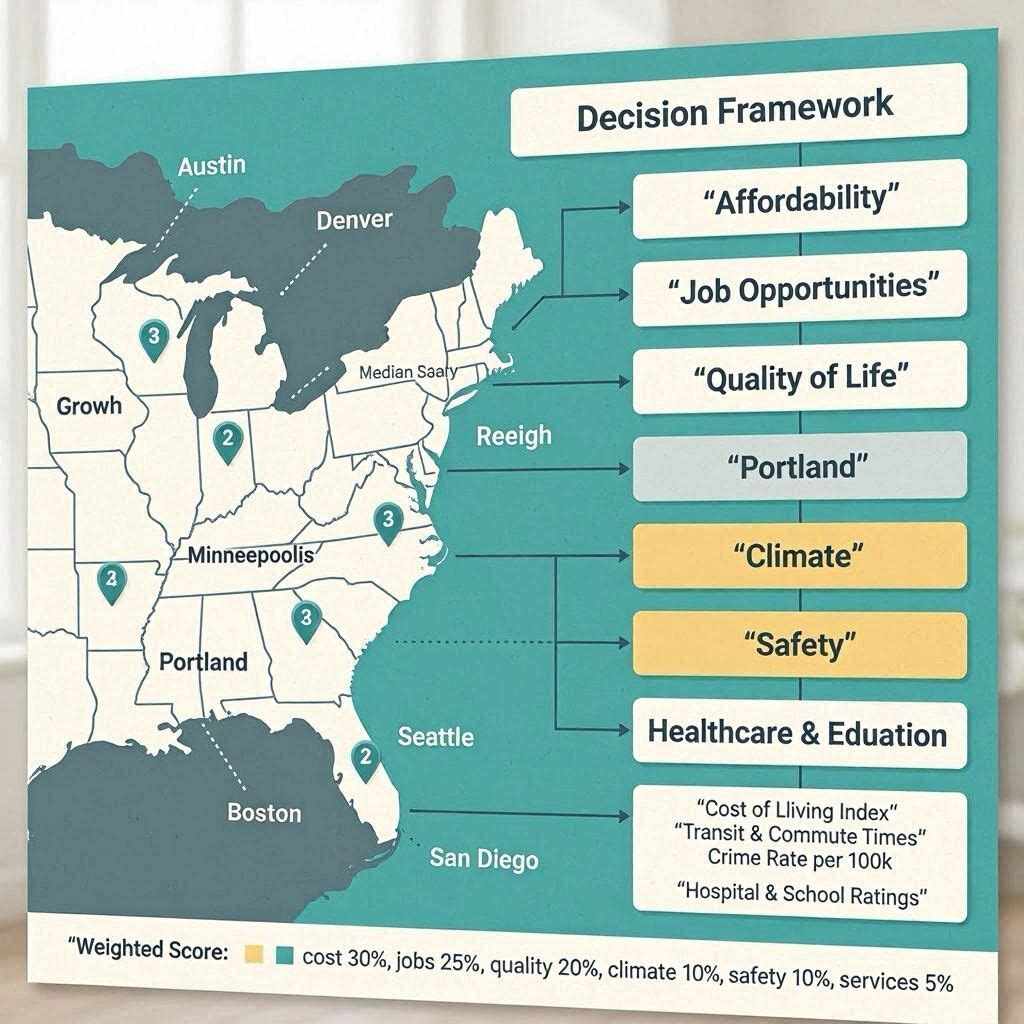
This guide was built to fill the gap. It does not exist to celebrate cities — it exists to help you make a sound, lasting decision. Whether you are a young professional chasing career momentum, a family seeking school quality and neighborhood safety, a remote worker optimizing for purchasing power, or a buyer trying to understand the true long-term cost of a move, every section of this guide is designed around a single question: what does living here actually cost, and is that cost sustainable?
We ranked cities across seven dimensions: economic opportunity, housing affordability, true tax burden, insurance and utility risk, school and safety quality, infrastructure resilience, and long-term climate sustainability. We then applied those dimensions to the most common relocation profiles: families, young professionals, affordability seekers, and coastal balance-seekers. The result is a guide that exposes what most rankings conceal and arms you with the framework to stop Googling and start deciding.
The 2026 Liveability Index: How We Ranked the Best Cities to Live in America

City rankings are only as trustworthy as the methodology behind them. Most national rankings lean heavily on cost-of-living indexes, median home prices, and walk scores — metrics that tell you what a city costs in a vacuum, but nothing about what you can actually afford relative to what you earn there. Our 2026 Liveability Index was built to correct this bias by centering purchasing power, not price, as the master variable.
2026 LIVEABILITY SCORING MATRIX
| Dimension | Weight | Data Sources | Key Variables |
| Economic Opportunity | 20% | BLS, LinkedIn, Indeed | Wage growth, job density, remote-work infrastructure |
| True Housing Affordability | 20% | Redfin, Zillow, FHFA | Median home price / local median income ratio |
| Tax Burden (Total) | 15% | Tax Foundation, State DOR | Property, income, sales tax combined effective rate |
| Insurance & Utility Costs | 15% | NAIC, EIA, FEMA | Home insurance premiums, flood/wind risk, utility inflation |
| School & Safety Quality | 15% | NCES, GreatSchools, FBI UCR | School ratings, student-to-teacher ratios, crime index |
| Infrastructure Resilience | 10% | ASCE, FHA, EPA | Road quality, broadband, water system age, grid reliability |
| Climate & Long-Term Risk | 5% | NOAA, First Street Foundation | Extreme heat days, flood/wildfire exposure, insurance trend |
Each city in this guide scored across all seven dimensions. Cities with strong economic scores but poor tax or insurance scores were penalized accordingly — the index is designed to surface the cities where a well-rounded life is actually achievable, not just the cities with the lowest sticker price on a two-bedroom home.
Critically, we excluded cities from the top tier if they scored below the national median on infrastructure resilience or had climate insurance trends moving against residents at an accelerating pace. A city offering affordable housing today that will require $8,000 per year in homeowner premiums by 2028 is not actually affordable — it is a trap with a delayed trigger.
We also applied a minimum wage-to-rent threshold: for a city to qualify as ‘affordable,’ the median wage earner should be able to rent a two-bedroom unit for no more than 30 percent of gross income. By that standard, several cities commonly listed as affordable — including parts of the greater Phoenix, Tampa, and Miami metro areas — no longer qualify at the entry-level income tier.
Career Velocity: Top Metros for Young Professionals
For young professionals, the best cities to live in USA for young adults are not simply the cities with the most job postings. Career velocity — the rate at which income grows in the early career window — varies enormously by metro, and that variation compounds over a decade into six-figure wealth differences.
Austin, Texas remains a top-five destination for early-career professionals in technology, finance, and media. Despite well-documented cost-of-living increases, wage growth in Austin has outpaced inflation for workers in the $60,000 to $110,000 range consistently since 2021. The city’s concentration of Fortune 500 satellite headquarters, a maturing venture ecosystem, and no state income tax create a compounding advantage for professionals who secure mid-market or above-median compensation.
Raleigh-Durham, North Carolina has emerged as arguably the highest career-velocity market in the Southeast. The Research Triangle’s density of biotech, semiconductor, and advanced manufacturing employers has pushed median engineering and life sciences wages above $90,000, while housing costs, though rising, remain meaningfully below the national tech-hub average. The combination of Duke, UNC, NC State, and a growing number of research institutions creates an intellectual ecosystem that retains talent at unusually high rates.
Columbus, Ohio is consistently underrated. With Ohio State University anchoring a growing tech and fintech sector, Amazon’s mid-Atlantic hub, and a downtown that has seen sustained mixed-use development, Columbus offers something rare: rapid wage growth in a city that has not yet undergone the cost-of-living transformation that has made Austin or Denver less accessible. Median one-bedroom rents in Columbus remain below $1,400 in desirable neighborhoods, while tech salaries in the $70,000–$100,000 range are increasingly common.
For young professionals who can tolerate cold winters, Minneapolis stands out for its combination of Fortune 500 concentration — United Health, Target, Best Buy, 3M — with a talent market that rewards loyalty and specialization. The city’s healthcare, retail analytics, and financial services sectors offer career tracks with above-average upward mobility, and Minnesota’s competitive but predictable tax environment creates fewer financial surprises than Sunbelt peers that rely on high property taxes and insurance to compensate for missing income tax revenue.
The East Coast Corridor: Infrastructure & Access
The best cities to live in east coast USA are defined less by glamour and more by the infrastructure advantages that compound over years of daily life. Amtrak’s Northeast Corridor, the density of international airports, the concentration of hospitals rated in the top tier, and the breadth of cultural and educational institutions create a standard of infrastructure access that no other region in the country can fully match.
Philadelphia deserves renewed attention in 2026. Median home prices in commuter-accessible neighborhoods remain well below comparable New York and Boston suburbs, while access to both cities via rail is reliable and under 90 minutes. The city’s healthcare sector — anchored by Jefferson Health, Penn Medicine, and CHOP — is one of the largest employment ecosystems in the Mid-Atlantic, and the recent expansion of life sciences and biotech real estate in University City has added another demand layer to an already diverse labor market.
Richmond, Virginia has matured from a mid-tier underdog into a legitimately compelling small-metro option for East Coast professionals. Positioned between Washington, D.C. and the Research Triangle, with I-95 access and a regional airport that has expanded meaningfully in the past four years, Richmond offers sub-$350,000 median home prices in established neighborhoods, a thriving arts and food scene, and a financial services employment base anchored by Capital One, Markel, and a growing number of remote-work imports who have chosen the city for its balance of cost, culture, and connectivity.
Hartford and New Haven in Connecticut represent value opportunities that are easy to overlook. Connecticut’s high income taxes are a genuine drawback, but for buyers who can capitalize on median home prices that remain 35 to 50 percent below the Massachusetts market while accessing Boston, New York, and Providence within two hours, the calculus can favor relocation — particularly for dual-income households in healthcare, insurance, and law, where both cities have strong employer bases.
The 2026 Gold Standard: Best American Cities for Family Stability
Family relocation is categorically different from individual relocation. When you move a family, you are not just choosing a city — you are choosing a school district, a neighborhood culture, a long-term appreciation trajectory, an HOA governance structure, a healthcare network, and a social environment that will shape your children’s formative years. The best cities for families to live in USA in 2026 are those that deliver stable, well-funded schools, manageable property appreciation that does not price out long-term residents, low violent crime with context-appropriate safety infrastructure, and neighborhoods that are designed to support families rather than extract value from them.
SCHOOL DISTRICT & SAFETY INDEX MATRIX
| City | School Rating (Avg) | Violent Crime / 100k | Median Home Price | 5-Yr Appreciation | HOA Prevalence |
| Naperville, IL | 9.1/10 | 118 | $420,000 | +22% | Moderate |
| Carmel, IN | 9.3/10 | 94 | $385,000 | +28% | High |
| Overland Park, KS | 8.8/10 | 176 | $340,000 | +31% | Moderate |
| Cary, NC | 8.9/10 | 142 | $460,000 | +38% | High |
| Frisco, TX | 8.7/10 | 159 | $510,000 | +19% | High |
| Sugar Land, TX | 8.6/10 | 167 | $390,000 | +21% | Moderate |
| Madison, WI | 8.4/10 | 213 | $365,000 | +26% | Low |
| Eden Prairie, MN | 8.9/10 | 131 | $445,000 | +24% | Moderate |
Safety is always the first question for families, but raw crime statistics frequently obscure more than they reveal. A city with a violent crime rate of 300 per 100,000 residents may have that rate concentrated entirely in two or three zip codes that families would never consider, while the neighborhoods where families actually buy are far safer than the citywide number implies. Conversely, a city with a rate of 150 per 100,000 may distribute that crime more evenly. Context matters, and the best family cities are those where crime concentration data, school boundary mapping, and neighborhood-level safety metrics all align in the buyer’s favor.
SAFETY: WHAT THE NUMBERS DO NOT TELL YOU
Naperville, Illinois — a suburb of Chicago — consistently ranks in the top five for family safety not because Chicago is safe, but because Naperville’s school district boundaries, neighborhood design, and community investment model have created an enclave of exceptional stability within a metro that has significant challenges elsewhere. The lesson is geographic specificity: city-level ratings are a starting point, not a conclusion.
Carmel, Indiana is perhaps the most studied example of deliberate family infrastructure investment in America. The city’s mayor invested aggressively in roundabouts (which statistically reduce injury crashes by up to 90 percent compared to signalized intersections), trail networks, an arts district, and school facilities over two decades of sustained municipal commitment. The result is a city that routinely ranks number one or two nationally for family liveability — at a price point that remains accessible relative to comparably-rated suburbs in California, New England, or the Pacific Northwest.
SCHOOLS: FUNDING MODELS, BOUNDARIES & THE HIDDEN RISKS
School quality in America is inseparable from property tax funding models, and that relationship creates risks that national school ratings rarely surface. In states where school funding is primarily local — Texas, Illinois, New Jersey — the quality of a child’s education is directly tied to the taxable value of the neighborhood they live in. This model produces exceptional schools in high-value suburbs and consistently underfunded schools in lower-value areas, and it creates a hidden risk for buyers: if property values in a district stagnate or decline, school funding follows, often on a lag that disguises the deterioration until it has already affected outcomes.
The safest approach for families evaluating school districts is to look at three data points simultaneously: current GreatSchools rating, the five-year trend in that rating, and the district’s per-pupil spending relative to the state average. Districts that score highly on all three are structurally sound. Districts that score highly on current rating but show declining trends or below-average per-pupil spending are at risk of ratings compression within five to eight years — a window that overlaps directly with a child’s elementary school years for buyers purchasing now.
Frisco, Texas and Cary, North Carolina both represent school districts where rapid population growth has strained capacity in ways that are not fully visible in current ratings. Both remain excellent choices, but buyers should investigate boundary redrawing schedules, projected enrollment growth, and bond issuance history before committing to a specific neighborhood. A boundary redraw can shift a child from a 9-rated elementary school to a 7-rated one without any change in the family’s address.
APPRECIATION & AFFORDABILITY: THE SUSTAINABLE PRICE FLOOR
The best family cities in 2026 are those where housing appreciation has been strong enough to build equity but not so explosive that entry-level buyers are being permanently priced out. Cities like Overland Park, Kansas, and Sugar Land, Texas have achieved this balance more consistently than higher-profile markets. Overland Park’s five-year appreciation of 31 percent is substantial — it has meaningfully built equity for buyers who entered in 2020 and 2021 — but the city’s median home price of $340,000 still allows a dual-income household earning $120,000 combined to purchase without overextending.
Compare that profile to a city like Austin, where the same five years saw appreciation exceed 60 percent in some neighborhoods, pushing median prices to $500,000 or above and creating a debt-to-income profile that requires either high individual incomes or significant outside capital. Austin is still a great city, but as a family purchase destination for buyers without equity from a prior home, it has become structurally challenging in a way that Overland Park, Carmel, and Madison have not.
HOA REALITIES: GOVERNANCE, COSTS & RESTRICTIONS
Homeowners Associations govern approximately 75 million Americans and represent one of the least-understood aspects of suburban homeownership. In family-oriented suburban markets — the exact markets most families are drawn to for school quality and safety — HOA prevalence is high, often mandatory, and comes with implications that extend well beyond monthly dues.
HOA fees in the top-ranked family suburbs typically range from $150 to $600 per month, with luxury communities running higher. These fees are not trivial. At $300 per month, an HOA fee adds $3,600 per year to the cost of homeownership — equivalent to a quarter-point increase in mortgage rate on a $400,000 loan. More importantly, HOA fees have increased at rates that frequently exceed general inflation, driven by deferred maintenance catch-up, insurance premium increases, and the rising cost of common area services.
HOA restrictions are the dimension that surprises buyers most. Restrictions on exterior paint colors, fence styles, driveway materials, holiday decorations, parking of recreational vehicles, home-based business signage, short-term rentals, and even the timing of trash can placement are common in high-rated family suburbs. Before purchasing in an HOA community, request and read the CC&Rs (Covenants, Conditions, and Restrictions), the most recent three years of meeting minutes, and the current reserve fund study. Underfunded reserves are a red flag for future special assessments.
High Utility, Low Friction: The Best Small-to-Mid-Sized Cities in the USA
The best small cities to live in USA in 2026 are not necessarily quiet towns bypassed by economic progress. They are cities in the 75,000 to 400,000 population range that have hit a specific sweet spot: enough economic mass to support diverse employment and services, but not so large that infrastructure strain, housing cost, and population pressure have erased the advantages of manageable scale. This is the population band that has absorbed the greatest share of remote-work migration over the past four years, and the cities that managed that growth well have become some of the most compelling relocation destinations in the country.
POPULATION-TO-UTILITY FRAMEWORK
| City | Population | Broadband Coverage | Median HH Income | Remote Work Score | Growth Rate (5yr) |
| Boise, ID | 240,000 | 97% | $71,400 | 9.2/10 | +18% |
| Huntsville, AL | 215,000 | 94% | $68,900 | 8.8/10 | +22% |
| Greenville, SC | 72,000 (metro 500k) | 93% | $62,800 | 8.4/10 | +19% |
| Fort Collins, CO | 170,000 | 96% | $74,200 | 9.0/10 | +14% |
| Spokane, WA | 230,000 | 91% | $58,400 | 8.1/10 | +16% |
| Knoxville, TN | 195,000 | 92% | $57,200 | 8.3/10 | +21% |
| Durham, NC | 285,000 | 95% | $69,700 | 8.9/10 | +24% |
| Ann Arbor, MI | 122,000 | 98% | $79,100 | 9.1/10 | +9% |
ECONOMIC GROWTH: THE ENGINE BENEATH THE CHARM
The most important distinction between a small city with genuine growth trajectory and one with a pleasant atmosphere but stagnant economy is employer diversification. Huntsville, Alabama is the clearest current example of diversification working in a small market’s favor. What was once a federal defense-dependent economy anchored by Redstone Arsenal and NASA has expanded dramatically into commercial aerospace, cybersecurity, and advanced manufacturing, with Boeing, Lockheed Martin, Blue Origin, and a growing number of mid-market contractors all establishing or expanding operations in the metro. The result is a job market that offers federal stability layered with private-sector growth — a combination that is almost uniquely resilient to economic downturns.
Greenville, South Carolina offers a different but equally compelling economic story. The BMW manufacturing hub in nearby Spartanburg has anchored a tier-one automotive supplier ecosystem across the Upstate region, while Greenville’s downtown has become one of the most cited successful urban revitalization case studies in the Southeast. The combination of manufacturing employment (which provides economic ballast for the region) and a thriving hospitality, healthcare, and professional services sector creates a labor market broad enough to accommodate diverse professional backgrounds.
Fort Collins, Colorado benefits from Colorado State University, a clean energy research ecosystem, and proximity to the Northern Colorado tech corridor that has developed around Loveland and Greeley. For remote workers in science, engineering, and sustainability-adjacent fields, Fort Collins offers an intellectual peer environment that is rare in a city of its size.
REMOTE WORK READINESS: BEYOND FIBER SPEED
Remote work readiness is not simply a function of broadband availability. It encompasses the full infrastructure of productive knowledge work: co-working space density, coffee shop culture, library facility quality, reliable power grid performance, and the social infrastructure that prevents remote-work isolation — one of the most underappreciated risks of relocating to a smaller market.
Cities with strong remote-work scores in our framework have addressed the isolation problem through deliberate investment in third-place infrastructure: spaces that are neither home nor office but facilitate spontaneous professional and social interaction. Boise has invested heavily in this model, with a downtown core that has grown significantly in co-working inventory since 2020 while maintaining walkability scores that make daily life without a car viable for residents in the central neighborhoods.
Ann Arbor, Michigan is the most remote-work-optimized small city in the Midwest. University of Michigan anchors a culture of intellectual density that translates directly into a peer environment for remote knowledge workers. Coffee shops with reliable high-speed connections, a downtown that functions seven days a week, and a housing stock that includes a wide variety of unit types and sizes give remote workers the flexibility that a more rigid suburban market cannot offer. The tradeoff is Michigan’s income tax and Ann Arbor’s above-average housing costs for a city its size — but the quality-of-life dividend justifies the premium for the right professional profile.
INFRASTRUCTURE: THE INVISIBLE DIFFERENTIATOR
Infrastructure quality in small-to-mid-sized cities varies far more than in large metros, where federal investment and sheer tax base tend to maintain minimum standards. In smaller markets, the difference between a city that has prioritized infrastructure investment and one that has deferred it can manifest in ways that affect daily life significantly: road surface quality that accelerates vehicle maintenance costs, water system reliability, stormwater management capacity during extreme precipitation events, and broadband redundancy.
Huntsville and Fort Collins score highest in our infrastructure assessment among small-to-mid-sized cities. Huntsville benefits from defense infrastructure investment that maintains roads, utilities, and broadband at standards above peer cities of its size. Fort Collins has invested systematically in stormwater infrastructure following historic flood events and has achieved unusually high broadband penetration through a municipal fiber initiative that gives residents fiber-optic connectivity as a utility rather than a premium service.
Cities to approach with caution on infrastructure include several rapidly growing Sun Belt metros where population growth has consistently outpaced infrastructure investment. When a city grows faster than its infrastructure can scale, the result is predictable: traffic congestion that adds 30 to 45 minutes to commutes, water system stress, school overcrowding, and park and recreational facility deficits that lower quality of life in ways that are difficult to quantify but immediately felt by residents.
SUSTAINABILITY & LONG-TERM POPULATION PRESSURE
Sustainability in the context of small-city liveability means whether a city can continue to deliver the quality of life that attracted residents in the first place as it grows. This is the dimension on which several of the most celebrated small cities of the 2010s have begun to struggle. Boise, Idaho is the clearest cautionary example: extraordinary growth since 2018 has pushed median home prices above $400,000 in the city proper, strained school enrollment capacity, and created traffic dynamics that residents who arrived before 2019 describe as unrecognizable compared to the city they moved to.
Growth is not inherently a problem — it reflects genuine quality and demand. But cities that are managing growth without proportional infrastructure investment are accumulating a quality-of-life debt that will eventually be paid either through reduced liveability or through large tax increases to fund catch-up capital investment. For buyers evaluating a small city with high growth rates, the question to ask is not ‘is this city growing?’ but ‘is the infrastructure investment keeping pace with the growth?’
The Coastal Equilibrium
The best coastal cities to live in USA in 2026 present a more complex value proposition than they did a decade ago. Insurance costs have emerged as the decisive variable, transforming the calculus of coastal living in ways that traditional liveability rankings have been slow to incorporate.
Wilmington, North Carolina offers a genuinely attractive coastal equilibrium in 2026. Located on the Cape Fear River with Atlantic beach access 15 minutes from downtown, Wilmington has a lower insurance risk profile than Florida’s Gulf Coast while still delivering the lifestyle markers — walkable downtown, water access, mild climate — that coastal buyers seek. Median home prices in established neighborhoods remain below $380,000, and the University of North Carolina Wilmington anchors a healthcare and research employment base that provides economic stability. The city’s hurricane risk is real, but its rating tier from major insurers is more favorable than Florida peers.
Savannah, Georgia is experiencing renewed attention as a coastal destination that combines historic urban character with a growing logistics and manufacturing employment base driven by the Port of Savannah’s expansion. Insurance costs are rising, but Savannah’s inland geography provides meaningful protection compared to barrier island or directly coastal properties. The Savannah metro’s affordable housing relative to Charleston, combined with improved air connectivity, makes it a compelling alternative for buyers priced out of South Carolina’s most desirable coastal markets.
On the West Coast, Bellingham, Washington offers a coastal equilibrium that is uniquely insulated from the insurance crisis affecting Southern and Gulf coastal markets. Sitting at the intersection of Puget Sound and the Cascade foothills, Bellingham combines genuine coastal access with wildfire risk that, while not absent, is significantly lower than comparable Pacific Northwest inland markets. The city’s proximity to Vancouver, B.C., a growing technology sector anchored by Western Washington University, and a cultural infrastructure that punches above its weight for a city of 90,000 make it a genuinely distinctive coastal option.
Climate and Comfort
For many relocators, the best city to live in USA weather is the one that most closely approximates their personal climate preference — a deeply subjective variable that national rankings handle poorly. What we can quantify is climate resilience: the degree to which a city’s weather profile exposes residents to extreme events, long-term livability degradation, and insurance cost inflation driven by climate-related risk.
Asheville, North Carolina represents the gold standard for climate resilience in the eastern half of the country. Situated in the Blue Ridge Mountains at approximately 2,000 feet of elevation, Asheville enjoys mild summers — average August highs in the low 80s — cold but manageable winters, and a precipitation pattern that produces verdant landscapes without the humidity that makes summers in lower-elevation southeastern cities genuinely uncomfortable. The one climate caveat, dramatically illustrated in late 2024 by Hurricane Helene’s flooding, is that Asheville’s mountain terrain creates flood risk that buyers must address specifically in their insurance strategy.
The Twin Cities — Minneapolis-St. Paul — consistently deliver one of the strongest long-term climate profiles in the continental United States. Despite cold winters that intimidate out-of-state buyers, Minneapolis offers increasingly temperate summers, minimal wildfire exposure, reliable water supply from the Great Lakes watershed, no hurricane risk, and a tornado exposure that, while real, is lower than comparable Great Plains markets. As climate risk redistributes value away from coastal and southern markets, northern inland cities with reliable water and moderate summer temperatures are likely to appreciate their geographic position meaningfully over the next two decades.
Sacramento, California offers exceptional year-round sun exposure — averaging 265 sunny days per year — with proximity to both the Sierra Nevada for winter recreation and the Napa and Sonoma wine regions. The city’s growing climate challenge is wildfire smoke, which has reduced air quality in August and September in recent years to levels that rival the worst PM2.5 readings in the country. For buyers sensitive to air quality or respiratory health, Sacramento’s climate profile must include this dimension before comparison to markets with cleaner air.
True Cost Optimization: The Best Affordable Cities in the United States
The conversation about the best cheap cities to live in USA has been corrupted by a fundamental measurement error: using home prices or rental rates as the primary — sometimes only — affordability variable. This approach produces rankings that are consistently wrong in ways that cost relocators thousands of dollars annually. True affordability is a function of purchasing power: what a given income actually buys in terms of housing, goods, services, and quality of life after all mandatory costs are paid. A city with a $280,000 median home price and a 2.8 percent effective property tax rate is not cheaper than a city with a $350,000 median home price and a 0.8 percent effective rate — it is more expensive by several hundred dollars per month in carrying costs alone.
PURCHASING POWER MATRIX
| City | Median Home | Eff. Tax Rate | Avg. Insurance/yr | Utility Index | Income Needed | Purchasing Power Score |
| Knoxville, TN | $295,000 | 0.71% | $1,840 | 95 (below avg) | $68,000 | 9.4/10 |
| Huntsville, AL | $310,000 | 0.41% | $1,920 | 92 (below avg) | $65,000 | 9.2/10 |
| Columbus, OH | $285,000 | 1.48% | $1,650 | 101 (avg) | $74,000 | 8.6/10 |
| Greenville, SC | $325,000 | 0.57% | $2,100 | 98 (near avg) | $70,000 | 8.9/10 |
| Oklahoma City, OK | $215,000 | 0.87% | $2,800 | 103 (avg) | $62,000 | 8.3/10 |
| Memphis, TN | $185,000 | 0.72% | $2,200 | 106 (above avg) | $55,000 | 7.8/10 |
| Wichita, KS | $195,000 | 1.34% | $2,100 | 100 (avg) | $60,000 | 8.0/10 |
| Spokane, WA | $320,000 | 0.98% | $1,400 | 108 (above avg) | $72,000 | 8.4/10 |
THE WAGE-TO-RENT REALITY
The single most honest affordability metric is the wage-to-rent ratio: what percentage of the median local wage is consumed by median local rent. In Knoxville, Tennessee, a median wage earner spending $1,250 per month on a two-bedroom apartment is allocating approximately 26 percent of gross income to housing — comfortably within the traditional 30 percent threshold. In contrast, a Nashville resident earning the Metro median wage of approximately $56,000 and paying $1,900 for a comparable apartment is allocating 41 percent of gross income to housing — a ratio that leaves almost no margin for savings, transportation, childcare, or unexpected expenses.
The wage-to-rent calculation changes dramatically for remote workers earning coastal or national salaries. A software engineer earning $140,000 annually who relocates to Huntsville, Alabama and pays $1,600 per month in rent is allocating just over 13 percent of gross income to housing. In that scenario, the city’s lower median local wage is irrelevant — the purchasing power surplus created by the income differential against local costs is the story. This is why remote-work migration has concentrated so heavily in mid-tier and small markets: the purchasing power arbitrage for high earners is substantial and compounding.
HOUSING COST STRUCTURE: WHAT YOU ACTUALLY PAY
Median home prices are a starting point. The actual carrying cost of homeownership in 2026 includes mortgage principal and interest, property taxes, homeowner’s insurance, HOA fees where applicable, and — a dimension that has grown dramatically in importance — PMI for buyers below 20 percent down, and the inflation trajectory of all non-principal components.
In Tennessee — which covers Knoxville, Memphis, Nashville, and Chattanooga — the absence of state income tax and relatively low effective property tax rates create a carrying cost structure that is genuinely favorable. A $295,000 home in Knoxville with a 7 percent mortgage, 20 percent down, property taxes at 0.71 percent, and insurance at $1,840 per year creates a monthly payment of approximately $1,820. The same calculation applied to a $295,000 home in Illinois, where effective property tax rates average 2.08 percent, produces a monthly payment of approximately $2,090 — a $270 monthly difference, or $3,240 annually, attributable entirely to the tax differential.
Oklahoma City consistently appears in affordability rankings, and the median home price data supports the inclusion: at $215,000, OKC’s median is among the lowest of any mid-sized city with a diversified economy. However, buyers must balance that entry price against insurance costs that are among the highest in the nation for the market’s size. Oklahoma sits in Tornado Alley, and homeowner’s insurance premiums reflect that exposure with average premiums of $2,800 or more — a figure that can eliminate the carrying cost advantage relative to lower-risk markets with higher entry prices.
TAXES: THE FULL BURDEN CALCULATION
Tax burden analysis for city comparison purposes must extend beyond the state income tax rate — the most commonly cited variable — to encompass the total effective tax burden: income tax, property tax, sales tax, and any local city taxes, all calculated against the median resident income.
Tennessee and Texas are frequently presented as low-tax destinations based on their zero state income tax. Both states are genuinely favorable for income taxes, but both compensate through the two mechanisms most impactful for homeowners: property taxes and sales taxes. Texas’s property tax effective rates average 1.60 to 1.80 percent — among the highest in the nation — which adds $8,000 to $9,000 annually to the carrying cost of a $500,000 home. Tennessee’s sales tax rate of 9.55 percent (combined state and local) is the highest in the country. For families spending $60,000 annually on taxable goods and services, that differential versus a state with a 6 percent combined rate represents $2,130 in additional annual tax burden.
The states with the most genuinely favorable total tax environments for middle-class homeowners with moderate property values are Indiana, Alabama, and South Carolina — a combination of reasonable income tax rates, low property tax effective rates, and moderate sales taxes that collectively produce total effective burdens below the national average across all household types.
INSURANCE & UTILITIES: THE INFLATION WILDCARD
Insurance and utility costs represent the most volatile components of the true cost of living in 2026. While mortgage payments are fixed (for fixed-rate loans) and property taxes move slowly, insurance premiums have increased by 20 to 40 percent in many markets over the past three years, and utility costs have risen by 12 to 18 percent nationally over the same period.
The markets with the most favorable insurance trajectories are those where actuarial risk has remained stable: the Upper Midwest, the Pacific Northwest (excluding wildfire-exposed areas), and inland markets in the Mid-Atlantic and New England states. Coastal markets in Florida, Louisiana, and the Gulf Coast generally, as well as wildfire-exposed markets in California and the Mountain West, are experiencing insurance premium inflation that shows no near-term sign of stabilization — and in some cases, insurers are exiting markets entirely, forcing residents into state-backed last-resort pools at significantly higher premiums with less comprehensive coverage.
Utility costs vary by region primarily as a function of energy mix, climate, and utility infrastructure age. The Southeast generally benefits from lower electricity rates than the Northeast or West Coast, while natural gas availability creates meaningful winter heating cost advantages for inland markets compared to all-electric markets in regions where electricity prices are high. For buyers choosing between cities at similar price points, a $200 monthly difference in utility costs represents $2,400 annually — a meaningful component of the true cost comparison that affordability rankings rarely surface.
The Hidden Cost Trap: Taxes, Insurance, Utilities & Escrow Shocks
The most dangerous moment in a relocation decision is not when you fall in love with a city. It is the first time you receive a property tax bill that is $2,000 higher than you estimated, or an escrow adjustment letter that tells you your monthly payment is increasing by $340 because your insurance premium doubled at renewal, or a homeowner’s association assessment notice for $8,500 because the community pool deck failed a safety inspection and the reserve fund was insufficient to cover repairs. These are not rare events. They are predictable consequences of purchasing in markets where buyers did not understand the full cost structure before they signed.
HIDDEN COST RISK TABLE
| Cost Category | States / Markets Most Affected | Average Annual Impact | Risk Trend | Buyer Warning Signs |
| Property Tax Escalation | TX, IL, NJ, NH | $1,500–$4,200 above estimate | Rising | Low income tax + high services spending |
| Insurance Premium Inflation | FL, LA, CA, CO | $1,200–$6,000+ above prior year | Rapidly Rising | Coastal location, flood/fire zone designation |
| HOA Special Assessments | FL condo, Sun Belt suburbs | $2,000–$15,000 one-time | Rising | Underfunded reserves, aging infrastructure |
| Utility Cost Shock | High-HVAC markets (AZ, TX, FL) | $1,800–$3,600 above projections | Rising | Older HVAC systems, poor insulation, rate hikes |
| Flood Insurance (NFIP / Private) | Coastal + riverine markets | $800–$8,000 additional | Rising | FEMA FIRM map proximity, post-2022 Risk Rating 2.0 |
| Escrow Adjustment Shock | National — all markets | $200–$600/mo payment increase | Rising | First-year buyers with short escrow history |
| Mello-Roos / Special Assessments | New CA developments | $2,000–$8,000/yr added | Stable | New construction in master-planned communities |
PROPERTY TAX REALITIES
Property taxes in the United States range from effective rates below 0.30 percent (Hawaii, Alabama, parts of South Carolina) to above 2.00 percent (New Jersey, Illinois, parts of Texas). On a $400,000 home, this range translates to annual tax bills between $1,200 and $8,000 — a $6,800 annual difference that is effectively invisible to buyers who compare cities using median home price alone.
The most common property tax shock in 2026 affects buyers who move from low-tax states to higher-tax states without adjusting their budget models, and buyers who purchase in fast-appreciating markets where assessed values have been reset at recent sale price. In states that reassess at sale, a buyer who purchases a home for $450,000 in a neighborhood where prior owners were paying taxes based on a $280,000 assessed value will immediately face a property tax bill approximately 60 percent higher than the seller’s — a shock that can amount to $2,000 to $4,000 in additional annual cost with no warning from the listing.
Texas deserves special attention in any property tax analysis. The state’s decision to substitute for an income tax with high property taxes creates a cost structure that is systematically disadvantageous to homeowners and advantageous to renters. A Texas homeowner paying 1.75 percent effective rate on a $450,000 home pays $7,875 annually in property tax. A renter in the same market pays property taxes indirectly through their rent but typically bears less of the burden proportionally. For families purchasing their first Texas home, the property tax reality is one of the most important cost factors in the decision — and one of the most frequently underestimated.
INSURANCE INFLATION: A STRUCTURAL RISK
Homeowner’s insurance was once a relatively predictable annual cost, typically increasing by 3 to 5 percent per year in line with general inflation and indexed to home replacement cost. That predictability has been shattered in the markets most exposed to climate-related claims. Florida homeowners in coastal and near-coastal markets have experienced premium increases of 40 to 100 percent since 2020, with multiple major carriers — including Farmers, Bankers Insurance, and others — exiting the Florida market entirely and leaving policyholders in Citizens Property Insurance, the state-backed insurer of last resort, which carries its own solvency and coverage quality risks.
The insurance crisis is not limited to Florida. Louisiana has experienced similar carrier exits and premium inflation following a series of catastrophic hurricane seasons. California’s wildfire-exposed markets have seen non-renewal notices from major carriers including State Farm and Allstate, pushing hundreds of thousands of homeowners into the California FAIR Plan at premiums that can reach two to three times private market rates for equivalent coverage limits.
For buyers evaluating markets with elevated insurance risk, the critical questions are: What is the current premium, what carriers are actively writing policies in the market, what is the non-renewal trend, and what would coverage cost through the state-backed pool if private market access disappears? These questions should be answered before making an offer, not after closing — because insurance availability is not guaranteed to remain stable, and a market where private insurance is unavailable or unaffordable is a market where resale values face structural headwinds.
UTILITIES, HVAC & THE CLIMATE COST FEEDBACK LOOP
Utility costs are a function of energy price, climate severity, and building quality — all three of which are moving unfavorably in the markets that currently attract the most relocation interest. Phoenix, Arizona’s summers now routinely produce 30 or more consecutive days above 110 degrees Fahrenheit, creating cooling loads that can push monthly electricity bills above $400 for a mid-sized home during June, July, and August. Las Vegas, Dallas, and Houston face similar summer utility dynamics. When buyers budget for these costs using historical data from periods before recent temperature extremes, they systematically underestimate the annual carrying cost of homeownership in hot-climate markets.
The escrow shock cycle that results from insurance and tax increases has become one of the most common sources of financial stress for first-time buyers. Mortgage servicers collect property tax and insurance in monthly escrow installments based on the prior year’s costs. When insurance premiums increase by 30 percent at renewal or property taxes are reassessed following a sale, the servicer adjusts the escrow collection to cover the higher projected cost — producing a monthly payment increase that arrives as a letter, often with 30 days’ notice, and can easily amount to $200 to $600 per month.
Relocation Reality Check: HOA Rules, Infrastructure Stress & Growth Risks
Relocation decisions made without a structured diligence framework consistently produce outcomes that feel fine in the first year and begin to grate by year three. The variables that new residents underestimate most consistently are HOA governance quality, infrastructure stress points that affect daily life, and the long-term implications of moving to a city at peak growth velocity. This section provides the framework for evaluating all three.
15-POINT RELOCATION CHECKLIST
| # | Diligence Item | Why It Matters | Red Flag to Watch |
| 1 | Read the full CC&Rs before making an offer | Restrictions bind future owners; no renegotiation after close | Rental restrictions, approval processes for improvements |
| 2 | Request 3 years of HOA meeting minutes | Reveals governance culture, disputes, deferred maintenance | Acrimonious boards, repeated tabling of maintenance items |
| 3 | Obtain current reserve fund study | Reserve adequacy predicts special assessment risk | Funding below 70% of recommended reserve level |
| 4 | Verify school boundary — not just district rating | Boundaries shift; your address determines assignment | Enrollment capacity over 95% at assigned school |
| 5 | Check FEMA flood zone designation | Flood insurance requirement adds $800–$8,000/year | AE or VE zone designation without current elevation certificate |
| 6 | Obtain insurance quote before making offer | Some markets have limited carrier availability | Fewer than 3 carriers writing policies in area |
| 7 | Run a full property tax history | Reassessment at sale can spike taxes significantly | Current taxes based on assessed value far below list price |
| 8 | Research water system age & quality | Aging infrastructure = future capital investment & rate hikes | Lead service lines, boil water notices, low water pressure |
| 9 | Drive commute at peak hours | Traffic data understates actual experienced commute | Consistent 45+ min one-way for a 15-mile commute |
| 10 | Check 5-year infrastructure bond history | Bonds signal capital investment OR accumulated deferred maintenance | Multiple bonds with limited project completion |
| 11 | Evaluate broadband options specifically | Single-provider markets have poor reliability & service | Only one ISP option above 100Mbps |
| 12 | Research employer concentration risk | Single-employer towns are vulnerable to closures | One employer > 30% of local jobs |
| 13 | Assess healthcare network within 30 minutes | Specialist access matters for families and aging adults | No Level II trauma center or major health system within 45 min |
| 14 | Check short-term rental regulations if relevant | STR bans affect flexibility and investment case | Blanket prohibition or pending legislation |
| 15 | Review 10-year population growth trend | Growth velocity predicts future cost and quality trajectory | Growth rate above 20% without proportional infrastructure spend |
HOA GOVERNANCE: THE VARIABLE MOST BUYERS IGNORE
HOA quality varies enormously — more than most buyers appreciate before experiencing it firsthand. Two adjacent communities with identical dues, identical amenities, and identical restriction profiles can deliver wildly different residential experiences depending on whether the association is governed competently and transparently or by a board that is either dysfunctional or actively adversarial toward residents.
Warning signs of HOA dysfunction are typically visible in meeting minutes and financial disclosures if buyers know what to look for: excessive turnover in board composition, litigation history (both initiated and received), reserve fund underfunding that has persisted for multiple years without a remediation plan, management company changes, and homeowner complaints that recur across meeting cycles without resolution. Florida’s condominium crisis — driven by accumulated deferred maintenance, underfunded reserves, and structural failures that culminated in the Surfside collapse of 2021 — has made reserve fund scrutiny an essential step in any condominium purchase nationwide.
INFRASTRUCTURE STRESS: WHEN GROWTH EXCEEDS CAPACITY
Infrastructure stress in fast-growing markets manifests in patterns that are almost always visible before they become acute — if buyers know what leading indicators to examine. School overcrowding typically precedes boundary redrawing and facility deterioration by two to four years. Road congestion metrics consistently worsen before municipalities approve and fund capacity projects. Water system strain can be detected by monitoring state environmental agency compliance reports, which are public record and updated regularly.
The cities in our ranking that carry the highest infrastructure stress flags in 2026 are not necessarily the cities with the worst current infrastructure — they are the cities where growth is most outpacing investment. Boise, Nampa, and the Treasure Valley corridor in Idaho represent perhaps the most acute example: a region that experienced 25 to 30 percent population growth in five years while operating on a municipal tax base and political culture that historically resisted large infrastructure bond issuance. The result is a region where roads, schools, and water systems are measurably strained relative to population, and where the catch-up investment required will translate into significant tax increases for current residents.
GROWTH RISKS: READING THE VELOCITY
High growth is frequently marketed as a positive by real estate professionals in growing markets — and it often is, for buyers who arrive early in the cycle. The risk is for buyers who arrive late: those who purchase when appreciation has already compounded significantly, infrastructure strain is already visible, and the city’s character has already changed substantially from the qualities that attracted the initial wave of migration.
The most reliable signal that a city has passed peak growth quality is the ratio of housing cost appreciation to wage growth. When home prices have increased by 40 percent over five years but median wages in the market have grown by only 15 percent, the purchasing power of new residents has declined relative to what original buyers experienced. The city may still be a fine place to live — but it is no longer the value proposition that made it famous, and buyers who arrive expecting the experience that early adopters described in 2019 or 2020 will encounter a materially different cost and infrastructure reality.
The Complete Relocation Cost Calculator Framework
The decision to relocate is ultimately a financial decision with profound personal dimensions. Getting the financial analysis right requires a structured framework that captures all significant costs — not just the mortgage payment, but the full seven-layer cost stack of homeownership in a specific market. This framework is designed to make every cost visible before commitment, not after closing.
7-LAYER RELOCATION COST AUDIT
| Layer | Cost Category | Variables to Capture | Annual Range |
| 1 | Housing Carrying Cost | Mortgage P&I, PMI if applicable, property tax at current assessed value, reassessment risk | $18,000–$60,000+ |
| 2 | Insurance Stack | Homeowner’s, flood (if applicable), wind/hail endorsement, umbrella liability | $1,500–$12,000 |
| 3 | HOA & Community Fees | Monthly dues, anticipated special assessments, amenity fees, reserve adequacy risk | $0–$9,600/yr regular + exposure |
| 4 | Utilities & Services | Electricity, gas, water/sewer, trash, broadband, security monitoring | $3,600–$8,400 |
| 5 | Transportation | Vehicle maintenance inflation by road quality, commute fuel/toll cost, transit availability | $2,400–$9,600 |
| 6 | Tax Differential | State income tax vs. current, total sales tax, any local income or payroll tax | -$8,000 to +$6,000 vs. origin |
| 7 | Opportunity / Growth | Wage trajectory in destination vs. origin, home appreciation projection, 401k match availability | Variable — model 3 and 7-year scenarios |
HOW TO USE THE FRAMEWORK
The framework works by building a total annual cost of living model for both your current location and your destination city, then calculating the net annual surplus or deficit of the move across all seven layers. Most relocation decisions are made by comparing only Layer 1 (housing) and Layer 6 (tax), which produces a systematically incomplete picture. The cities that look best when all seven layers are included often differ significantly from those that lead on headline metrics.
Layer 2 — the insurance stack — has become the most consequential variable in the past three years for buyers in high-risk markets. A buyer moving from Columbus, Ohio to Tampa, Florida may project Layer 1 savings of $8,000 annually based on a lower mortgage rate and equivalent purchase price. But a homeowner’s insurance premium difference of $6,000 annually (Florida coastal vs. Ohio inland), combined with flood insurance of $3,200 (if in an AE zone), creates an insurance layer cost that eliminates the Layer 1 savings entirely and then produces a net annual deficit of $1,200.
Layer 3 — HOA and community fees — is the dimension most consistently underestimated by first-time homebuyers and even experienced homeowners moving from non-HOA markets. The monthly dues are visible, but the special assessment exposure requires active diligence to quantify. The framework treats HOA risk as an expected annual value: multiply the community’s historical special assessment frequency by the typical assessment amount to derive an annual expected cost. A community that assesses $5,000 every five years has an expected annual HOA risk cost of $1,000 beyond the stated dues.
Layer 7 — the opportunity and growth dimension — is the most powerful and most neglected variable. A $30,000 annual purchasing power surplus in a high-income remote worker’s budget, compounded over seven years with a modest 5 percent return on invested savings, produces approximately $243,000 in accumulated wealth differential compared to remaining in the high-cost origin city. For the right professional profile in the right destination market, the relocation decision is not primarily a lifestyle choice — it is one of the highest-return financial decisions available to a working professional.
BUILDING YOUR PERSONAL SCENARIO
To make the framework actionable, gather the following data before running the comparison: your current total annual cost of living across all seven layers, your destination market’s equivalent costs using real quotes (not estimates), your current income and the realistic wage or remote income expectation in the destination, and a three-scenario projection for home appreciation (conservative, baseline, optimistic) based on the destination market’s 10-year trend adjusted for current inventory dynamics.
The output of this exercise will be a net annual financial position — positive meaning the move improves your financial position, negative meaning it deteriorates it — and a break-even timeline that accounts for the transaction costs of the move itself. For buyers who discover a strongly positive net position, the relocation decision becomes much easier to make with confidence. For those who discover the numbers are marginal or negative, the framework has potentially saved them from a costly mistake.
Finally, stress-test your model against the scenarios most likely to challenge your assumptions: a 30 percent insurance premium increase in year two, a property tax reassessment that raises your effective rate by 25 percent, an HOA special assessment of $5,000 in year three, and a scenario where your employer or remote income situation changes and you need to find work in the local labor market at local wages. A move that survives all four stress tests is genuinely financially sound. A move that fails even one suggests a risk you should price into your decision before committing.
Frequently Asked Questions
What is the single most overlooked factor when choosing the best city to live in USA?
By a significant margin, the most overlooked factor is the total effective property tax burden combined with homeowner’s insurance cost trajectory — not as separate line items, but as a combined carrying cost variable that directly determines whether a home purchase is financially sustainable over a 10-year horizon.
Most buyers focus on mortgage rate and purchase price as the determinants of monthly payment. These are the two variables that are most prominently displayed in real estate listings, pre-approval letters, and mortgage calculators. What these tools systematically underemphasize is that property taxes and insurance together can easily equal or exceed the interest portion of a mortgage payment in high-risk or high-tax markets — and unlike the interest component, these costs are not fixed. They are subject to annual change, driven by factors largely outside the homeowner’s control: municipal budget needs, actuarial reassessments following weather events, and the broader insurance market dynamics that have been moving against homeowners in a growing number of states.
In practical terms, a buyer who purchases a $400,000 home in suburban Dallas with a 7 percent mortgage, 20 percent down, and Texas-average property tax rates will have a monthly payment structure where property taxes alone add approximately $583 per month — nearly identical to the interest component of the mortgage in the early years. When insurance is added at an average Texas homeowner premium, the combined property tax and insurance monthly cost exceeds $750. A buyer making the same purchase in Knoxville, Tennessee, where property tax rates are less than half of Texas rates and insurance premiums are substantially lower, will pay less than $350 combined. The $400 monthly difference — $4,800 annually — is a cost that compounds silently over years and frequently causes financial strain that the buyer did not anticipate when they made the purchase decision.
The practical solution is to model total monthly housing cost — principal, interest, property taxes, insurance, and HOA fees — before evaluating the attractiveness of any market. Run this calculation for your specific target neighborhoods, using real insurance quotes rather than state averages, and actual assessed values rather than estimates. The cities and neighborhoods that perform best on this comprehensive metric are often not the same ones that lead the headline affordability rankings.
Are the best cities for families to live in USA different from the best cities for individuals?
Yes, and the differences are more substantial than most national rankings acknowledge. For individuals — particularly young professionals and remote workers without children — the most valuable city attributes are career velocity, social infrastructure, commute flexibility, and purchasing power at a single-income level. Cities like Austin, Seattle’s suburbs, Denver, and Raleigh score highly for this profile because they combine employment density (or remote-work infrastructure), walkable or transit-accessible urban environments, and peer social ecosystems that make urban life engaging and professionally productive.
Families operate with a fundamentally different priority structure. The most important variables for family stability are school district quality and trajectory (not just current rating, but five-year trend and funding sustainability), neighborhood safety at the zip code and street level rather than city average, housing stock that provides meaningful space for family life (spare bedrooms, garage access, yard space), healthcare network quality within a reasonable distance, and community infrastructure — parks, libraries, youth sports facilities, family-oriented social environments — that supports children’s development and parental wellbeing.
Many cities that score extremely well for young professionals score mediocrely for families on these dimensions. Urban Austin, for example, has limited public school quality in the city’s most desirable neighborhoods, high housing costs for the space that families require, and a social scene oriented toward single adults and childless couples. The family-appropriate version of the Austin metro — Cedar Park, Round Rock, Georgetown, Pflugerville — is a different city than the one that appears in young-professional rankings, with a different cost structure, commute profile, and lifestyle character.
The cities that score highest for both profiles — and there are some — tend to be mid-sized metros with strong universities, diversified economies, and substantial investment in both urban and suburban infrastructure. Raleigh-Durham, Columbus, and Minneapolis-St. Paul consistently appear near the top for both family and professional profiles, which is why they feature prominently across multiple sections of this guide. For relocators who are transitioning from one life stage to another — young professional planning to start a family within five years — these dual-profile cities represent the lowest-risk long-term bet.
Conclusion: The Best Cities to Live in USA Belong to Prepared Buyers
The best cities to live in USA in 2026 are not a fixed list — they are the cities that best match a specific household’s financial profile, life stage, professional situation, and risk tolerance. What makes a city excellent for a dual-income family with school-age children is different from what makes it excellent for a remote software engineer optimizing purchasing power, or a coastal buyer seeking climate resilience at a manageable cost.
What remains constant across all profiles is the importance of diligence over intuition. The cities that will serve you best are the ones you evaluate thoroughly: total cost modeled across all seven layers, schools assessed by trend and funding stability rather than just current rating, insurance risk quantified with real quotes before making an offer, and HOA governance examined with the same rigor you would apply to any business relationship you were entering. The framework in this guide exists to make that diligence structured, complete, and actionable.
Whether you are drawn to the purchasing power of Knoxville, the family infrastructure of Carmel, the career velocity of Raleigh-Durham, or the coastal equilibrium of Wilmington, the next step is the same: run your own numbers, test your assumptions against real data, and make the decision that serves your specific life — not a generic ranking. That is how the best relocation decisions are made.