Crossword Puzzle Tips For Beginners: Complete Guide
Most people quit crossword puzzles within their first week. Not because they aren’t smart enough — but because nobody explained how the game actually works. These crossword puzzle tips for beginners fix that.
Here’s the refreshing truth: experienced solvers aren’t smarter than you. They’ve simply learned how American-style puzzles “think.” Once you understand the logic behind clue writing, solving stops feeling like a vocabulary test and starts feeling like a puzzle you’re already halfway through. This guide covers everything — how clues work, which strategies actually move the needle, what habits slow beginners down, and how to practice so that progress happens fast.
Crossword Puzzle Tips for Beginners: Quick Answer
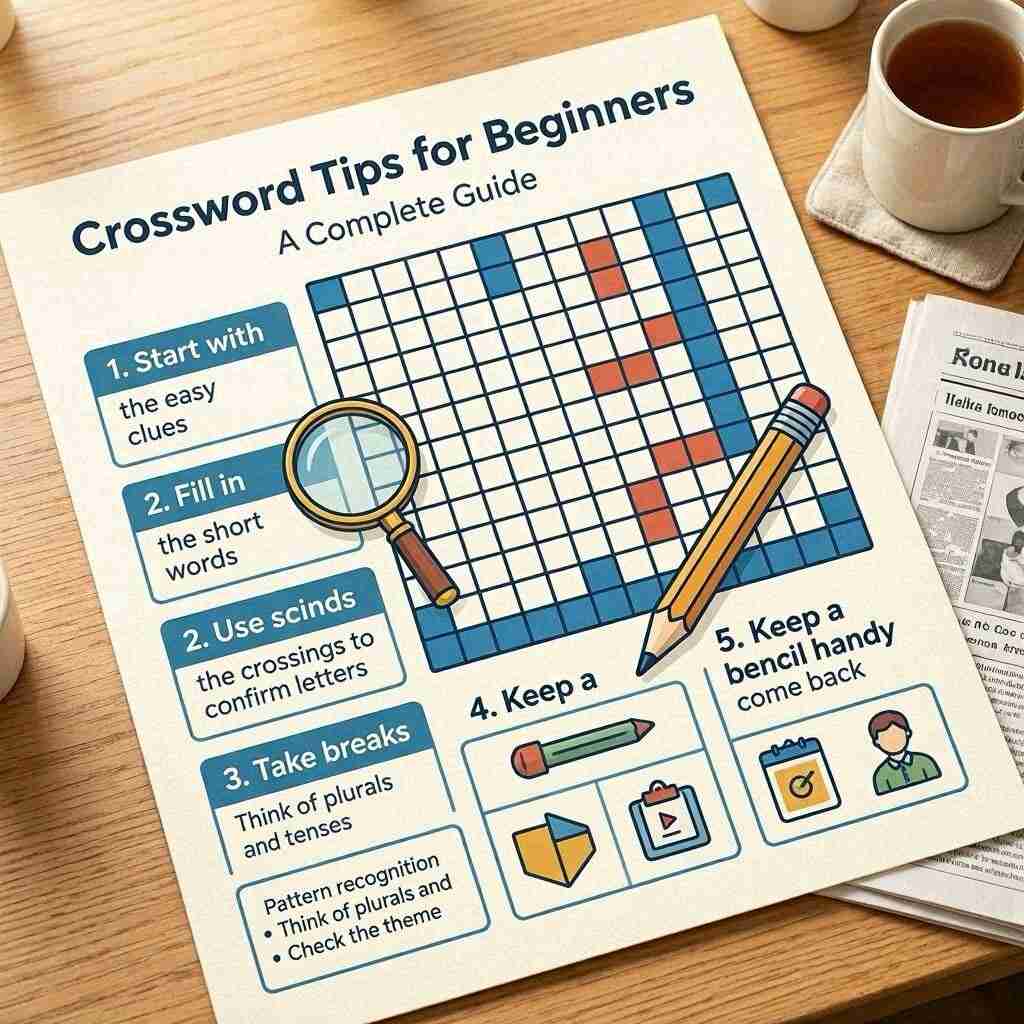
The most effective crossword puzzle tips for beginners: solve easy clues first, fill short answers early, and use crossing letters to unlock harder words. Prioritize fill-in-the-blank clues, match clue grammar to your answer, and practice in short daily sessions rather than long occasional ones. American crossword puzzles reward pattern recognition far more than raw vocabulary or trivia knowledge.
Introduction to Crossword Puzzles
Notice how experienced crossword solvers almost never panic when they hit a hard clue? Beginners assume that’s because experts simply “know more words.” Watch a skilled solver for ten minutes, though, and you’ll see something different — they’re scanning, skipping, building momentum. The hard clues don’t frighten them because they know those clues will get easier once the grid fills in around them.
Think about baseball for a second. A rookie watches a 95 mph fastball and sees chaos. A veteran hitter sees timing, angle, and rotation. The pitch hasn’t changed — the perception has. Crossword solving works the same way. Once your brain starts recognizing repeated clue patterns, everything feels slower and more manageable, even when the clues themselves don’t get any simpler.
American puzzle culture grew into a serious institution through publications like The New York Times, where the daily crossword became part hobby, part mental workout, part cultural ritual. The NYT crossword runs puzzles on a precise difficulty scale: Monday is the friendliest entry point, ratcheting up each day until Saturday’s notoriously tricky grid. Sunday puzzles are large but land around mid-week difficulty — more about stamina than brutality. Apps like NYT Games have since brought entirely new audiences into the habit, turning commutes and lunch breaks into solving sessions.
📊 Did You Know? Crossword puzzles first exploded in the United States during the early 1920s. Today’s mobile apps attract millions of daily users under 40, and the American Crossword Puzzle Tournament (ACPT), held annually, draws hundreds of competitive solvers — proof that crosswords are very much a living sport, not a nostalgic relic.
The genuinely encouraging part? Crossword skill builds faster than most people expect. A beginner who practices 10–15 minutes daily often improves more in eight weeks than a casual solver improves in a year. The reason is simple: consistent exposure trains your brain to recognize how clues behave. And once that pattern recognition starts clicking, the whole puzzle changes.
What Is an American-Style Crossword Puzzle?
An American-style crossword puzzle uses a symmetrical grid with interlocking horizontal (“Across”) and vertical (“Down”) answers. Every letter sits at the intersection of two words — which means every answer you fill in either confirms or challenges something you’ve already written elsewhere.
Most American crosswords lean on wordplay, misdirection, cultural references, abbreviations, and themed entries. The contrast with British cryptic crosswords is stark: cryptics use an entirely different clue grammar involving anagrams, hidden words, and coded wordplay indicators. American crosswords prioritize clever accessibility. The clue is always “fair” — meaning it contains enough information to reach the correct answer logically, even when it’s designed to mislead you on first read.
One thing beginners frequently miss: clue wording is deliberate. Singular clues produce singular answers. Past-tense clues call for past-tense solutions. Even punctuation carries meaning — a question mark at the end of a clue almost always signals wordplay or a pun hiding underneath. Learning this “clue grammar” is one of the highest-leverage crossword puzzle tips for beginners, because it works immediately without requiring any new vocabulary at all.
Why Crossword Puzzles Feel So Difficult at First
Most beginners attack the grid from top-left to bottom-right, refusing to skip anything. That instinct feels natural. It’s usually a mistake.
Experienced solvers jump around constantly. They hunt for easy entries, collect crossing letters the way a poker player collects chips, and build momentum before circling back to the clues that stumped them. Imagine assembling a jigsaw puzzle by sorting edge pieces first. Crosswords reward exactly that strategic thinking.
There’s another hidden challenge worth naming early: American crosswords recycle certain words because their letter combinations help constructors link sections of the grid smoothly. OREO, ERIE, ETNA, EPEE — you’ll encounter these far more often in crossword grids than in any conversation you’ll ever have.
💎 Expert Insight: Professional crossword constructors — including Will Shortz, the NYT’s puzzle editor since 1993 — deliberately lean on short, vowel-heavy words because they act as connective tissue in complex grids. Learning this “crosswordese” vocabulary isn’t glamorous, but it’s one of the fastest genuine shortcuts available to new solvers.
How Crossword Solving Actually Improves
At first, each clue feels isolated, self-contained, almost arbitrary. Over time, something shifts. Abbreviations become obvious before you’ve even finished reading the clue. Fill-in-the-blank entries feel predictable. Crosswordese stops looking random and starts feeling familiar — like seeing an old acquaintance in an unexpected place.
Pattern Recognition vs. Intelligence
Crossword solving isn’t primarily about being “smart.” That misconception quietly discourages thousands of beginners who would otherwise stick with it. A retired teacher who’s casually solved crosswords for years will frequently outperform a college student with a significantly larger vocabulary — because she recognizes repeated clue structures that the student has never encountered before.
Pattern recognition is the real engine. And unlike raw intelligence, patterns are learnable by anyone willing to repeat the exposure.
Why Small Daily Practice Matters More Than You Think
Fifteen minutes daily beats three hours once a month. This isn’t motivational advice — it’s how skill acquisition actually works. Consistency trains your brain to recognize recurring clue structures the way musicians internalize scales: not by thinking about them, but by internalizing them until the response becomes almost reflexive.
🔑 Key Takeaway: Beginners improve fastest by completing easy puzzles consistently, not by heroically struggling through difficult ones. Completion is the mechanism of learning. Your brain encodes clue-answer relationships by seeing them fully resolved — not by staring at squares that remain stubbornly blank.
Essential Crossword Puzzle Tips for Beginners
The single fastest way to stop feeling stuck? Stop trying to solve every clue on first contact.
That sounds backwards. But it’s genuinely one of the biggest breakthroughs beginners experience. Most successful solvers build the puzzle gradually — each completed word creates crossing letters, and those crossings act like hints scattered across the board, waiting to be collected. Here’s a structured set of crossword puzzle tips for beginners that actually change how you solve.
Start With Easy Clues First
Easy clues are momentum builders, and momentum is underrated. Short answers, obvious trivia, and fill-in-the-blank clues should always come first. Every solved entry hands you more letters for the harder clues that follow.
Consider:
“Peanut butter partner” (4 letters)
Most Americans reach JELLY without hesitating. That single answer can unlock five or six crossing letters nearby, suddenly making clues that looked impenetrable start to show their shape.
A practical beginner workflow:
- Scan the entire puzzle before writing a single letter
- Solve every obvious clue immediately — resist the urge to second-guess easy answers
- Fill short 3-to-4-letter entries first
- Return to hard clues after crossings accumulate
- Use partial letter patterns (like _ A _ E R) to narrow what’s left
This approach alone can meaningfully improve your completion rate within weeks.
💡 Pro Tip: Many beginner-friendly crosswords intentionally place easier clues near the top-left corner, because constructors know that’s where new solvers start. The architecture of the puzzle is often working in your favor — if you let it.
Solve Fill-in-the-Blank Clues First — Every Time
Fill-in-the-blank clues are the closest thing crosswords have to free points. They rely on everyday American phrases rather than wordplay or specialized vocabulary, which means your brain already knows the answer — it just needs a prompt.
- “___ and cheese”
- “The Big ___”
- “Break a ___”
You recognize those without effort. And that effortless recognition is precisely what makes them worth targeting before anything else. They’re not “too easy” to bother with. They’re free structure that makes hard clues solvable.
Many top crossword apps deliberately weight beginner puzzles toward fill-in-the-blank clues because quick wins keep new users engaged. The puzzle designers are, whether they know it or not, on your side.
⚠️ Common Mistake: Skipping obvious clues because they feel beneath you. That’s backwards. Easy clues build the scaffolding that makes hard clues possible. Never skip a free answer.
Use Crossing Letters Strategically — They’re Your Biggest Weapon
Crossing letters transform impossible clues into manageable ones. The difference between guessing a word with no information and guessing it with three known letters is enormous — not incremental, enormous.
Say you have a six-letter answer with this pattern:
C _ F F E E
At that point, you don’t even need to read the clue. COFFEE appears without effort. This is where crossword solving starts to feel genuinely addictive — the puzzle stops being something that happens to you and becomes something you’re actively building.
Crossings as a Self-Correction System
Crossing letters do something else that beginners often underestimate: they expose your own mistakes. If a clue suggests a plural answer but your crossings are producing a singular word, something earlier is wrong. Experienced solvers use these contradictions deliberately — they treat inconsistency as diagnostic information rather than just frustration.
The “Check Your Crossing” Habit
After solving any clue you weren’t certain about, verify that each letter intersects cleanly with its crossing answer. This single habit catches most careless errors before they cascade into ruined puzzle sections. It takes five seconds and saves five minutes.
💡 Pro Tip: Once you have three or more crossing letters for a clue, attempt the answer before re-reading the clue carefully. Often the crossings alone reveal the word — and reading the clue afterward confirms it with a small, satisfying click.
Watch Clue Grammar — It’s a Signal System, Not Just Syntax
This tip gets undersold because it sounds minor. It isn’t.
American crossword clues follow strict grammatical mirroring — the clue’s form almost always matches the answer’s form. Once you internalize this, a significant category of wrong guesses simply disappears.
| Clue Indicator | What It Means for Your Answer |
|---|---|
| Clue ends in “s” (plural) | Answer is likely plural |
| Clue uses past tense | Answer uses past tense |
| Clue says “briefly” or “abbr.” | Answer is an abbreviation |
| Clue ends with “?” | Expect a pun or wordplay answer |
| Clue appears in quotes | Often a spoken phrase or catchphrase |
The question mark is worth dwelling on. Many beginners read a “?” clue and just try harder to find the literal answer. The question mark is actually a signal to stop thinking literally. Something playful is happening. Adjust your approach accordingly.
Use a Pencil — Or Eventually, Embrace the Pen
This sounds like trivia. It’s not.
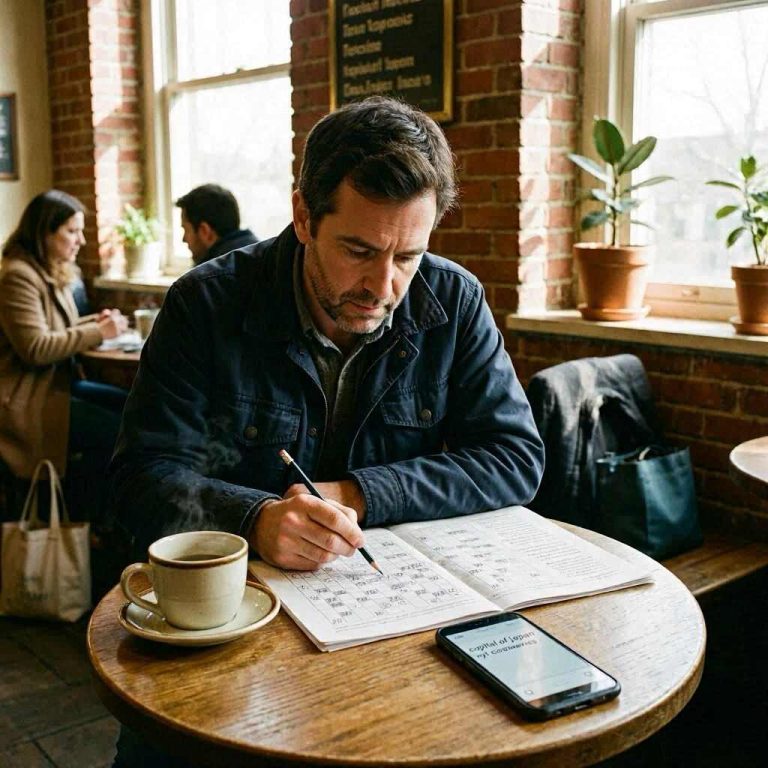
Most beginners resist committing answers they’re not fully certain of. But tentative guesses — written in pencil, ready to be erased — are essential to the solving process. Putting something down, even uncertainly, lets you test whether crossing entries confirm or contradict your thinking. The erasure isn’t a failure. It’s information.
Experienced solvers, famously, use pen. Not because they don’t make mistakes — they do — but because writing in ink builds a more decisive solving mindset. Committing fully, then crossing out errors cleanly, trains a different kind of confidence. If you’re solving on paper, start with pencil. Graduate to pen once you’ve finished a handful of complete grids. It’s a small ritual, but rituals matter for habit formation.
Understanding Common Crossword Clue Types
Read a clue and feel completely lost? That’s usually not a vocabulary problem. It’s a clue-type problem. Crossword constructors lean on misdirection and convention in ways that feel mysterious until you’ve seen them a few times — and then they feel obvious in retrospect. Recognizing these four main types changes everything.
Straight Definition Clues
The most beginner-friendly type, these work like dictionary entries. No tricks, no layers.
“Large snake” → PYTHON
The clue points directly to the answer through vocabulary alone. Monday-level NYT puzzles lean heavily on straight definitions because the goal is accessibility, not confusion. If a clue feels completely direct and literal, that’s probably intentional — take the obvious answer.
Wordplay and Trick Clues
Here’s where crosswords stop being a vocabulary quiz and become something more interesting.
“Bark producer”
Your brain immediately jumps to a tree. The answer might be DOG. That’s the whole game: the constructor has exploited a word’s secondary meaning to send your attention in exactly the wrong direction. The moment you notice the misdirection — usually after you see the answer — there’s a particular kind of delight in it.
When a clue feels nonsensical, the most useful question you can ask isn’t “what does this word mean?” but “what else could this word mean?” That single reframe solves a surprising number of beginner roadblocks.
💡 Pro Tip: Question-mark clues almost always involve wordplay. Treat the “?” as a friendly warning: your first interpretation is probably wrong, and the real answer is waiting one level of meaning deeper.
Abbreviation Clues
These follow reliable patterns once you know what to look for. Signals like “abbr.,” “briefly,” “for short,” and “in brief” all tell you the answer will be condensed.
- “California, briefly” → CA or CALIF
- “Doctor’s org.” → AMA
- “Soldier, for short” → GI
That period after “org.” is doing work. A period in the middle of a clue — after a partial word — is almost always flagging an abbreviation. Most beginners glide right past punctuation. Experienced solvers read it as carefully as the words themselves, because constructor convention makes it meaningful.
Themed Clues — The Puzzle’s Hidden Cheat Code
Themed puzzles connect several long answers through a shared idea. Once you identify the theme, clues that seemed completely opaque start to yield.
Say the puzzle’s theme is baseball. Suddenly, an ambiguous clue that could point in three directions becomes much more tractable — because the puzzle already told you where to look. Themes aren’t cosmetic. They’re structural assistance baked into the design by the constructor, and skilled solvers exploit them deliberately.
A Word About Rebus Puzzles
Every beginner eventually encounters one of these and loses their mind a little. In a rebus crossword, a single square holds more than one letter — sometimes a whole word, sometimes a symbol. One square might contain STAR, with that single square functioning as part of both its Across and Down answer. Rebus puzzles are rarer and tend to appear in Thursday NYT puzzles as the week’s signature twist. Don’t worry about mastering them yet. But knowing they exist means you won’t panic when one appears.
🔑 Key Takeaway: The four main clue types — straight definitions, wordplay, abbreviations, and themed entries — cover the overwhelming majority of what you’ll encounter. Identifying which type you’re dealing with before attempting the answer is itself a solving strategy.
Beginner Crossword Strategy Comparison Table
Not all approaches work equally at every stage. Some build genuine momentum; others feel productive while quietly burning time.
| Strategy | Best For Beginners? | Difficulty Level | Why It Works | Pitfall to Avoid | Recommended For |
|---|---|---|---|---|---|
| Fill-in-the-blank clues first | ✅ Yes | Easy | Uses familiar phrases | Skipping “obvious” answers | All beginners, every puzzle |
| Starting top-left and working in order | ⚠️ Sometimes | Easy | Feels natural | Refusing to skip hard clues | Only when puzzle flows that way |
| Using crossing letters | ✅ Yes | Moderate | Narrows possibilities fast | Guessing too early | Every solver, every level |
| Theme identification | ✅ Moderate | Medium | Unlocks hard clue clusters | Missing repeated patterns | Wednesday+ level puzzles |
| Confident partial guessing | ✅ Yes | Moderate | Gets letters in play | Forcing wrong answers | When you have 3+ crossings |
| Random guessing | ❌ No | Hard | Occasionally lucky | Creates cascading errors | Never — skip and return instead |
When to Guess and When to Walk Away
Educated guessing and random guessing aren’t the same animal. With four of five crossing letters already in place, a confident guess is low-risk — the answer space is tiny, and you’ll know immediately whether your guess creates coherent crossing words. But forcing an uncertain answer early — when you have one letter or none — can corrupt an entire puzzle section, because every wrong letter creates a wrong crossing entry somewhere downstream.
What experienced solvers actually do is less heroic than beginners imagine: they leave blanks confidently, note the clue, and return with fresh crossing context. Many experts leave dozens of entries blank on their first pass. Beginners often interpret this as struggling. It’s the opposite — it’s discipline.
⚠️ Common Mistake: Filling uncertain squares aggressively. If multiple crossing entries stop making sense, don’t keep pushing forward — revisit your earliest guesses first. One wrong letter in the wrong place can compromise an entire quadrant.
Best Tools and Resources for Beginner Crossword Solvers
The landscape for learning crosswords has shifted dramatically. Twenty years ago, you needed a newspaper, a pencil, and patience. Today there are apps designed specifically to ease the learning curve, adaptive difficulty systems that respond to how you solve, and hint tools that explain rather than just reveal. Beginners right now genuinely have it easier than any previous generation.
Best Crossword Apps for Beginners
Mobile apps remove most of the early friction. Error-checking tells you immediately when something is wrong (without revealing the answer). Hint systems give you a letter or two without spoiling the whole entry. Progression systems guide you from easier puzzles toward harder ones.
Strong options:
- NYT Games — The standard. The mini crossword (5×5 grid) finishes in two to five minutes and is ideal for daily habit-building. The full puzzle archive lets you work backward through years of Monday puzzles.
- LA Times Crossword — Free, consistently accessible, and generally slightly easier than NYT Monday difficulty. A good starting point before NYT.
- Crossword Jam — More casual, more forgiving. Worth considering if you’re genuinely starting from zero and want lower-stakes practice before newspaper-style cluing.
The mini crossword deserves particular emphasis. It provides a complete solving experience — beginning, middle, resolved end — in minutes. That completion loop is what actually trains pattern recognition. Half-finished puzzles don’t do the same work.
Dictionary and Reference Tools
Looking things up isn’t cheating. It’s how you build a vocabulary of crossword-specific knowledge over time. Every unfamiliar word you look up today is a word you’ll recognize instantly when it reappears — and it will reappear.
Merriam-Webster is the standard reference for American crossword vocabulary. For abbreviations specifically, community-built “crossword abbreviations lists” are readily searchable and surprisingly comprehensive — solvers have been compiling them for decades.
A Progression That Actually Works
The most common beginner mistake is skipping straight to hard puzzles out of impatience or pride. In crosswords, difficulty level isn’t a virtue signal — it’s a training variable. Match it to where you are, not where you want to be.
A practical progression:
- NYT Mini crosswords (daily, 5 minutes or less)
- Monday NYT or LA Times puzzles
- Tuesday and Wednesday puzzles
- Sunday puzzles (large but moderate difficulty)
- Thursday puzzles (expect at least one trick — often a rebus)
- Friday and Saturday puzzles (the real deep end)
💎 Expert Insight: Consistently finishing easy puzzles trains your brain more effectively than repeatedly abandoning difficult ones. Completion is the mechanism of learning — not the difficulty of the attempt.
Step-by-Step: How to Solve Your First Crossword Puzzle
Enough theory. Here’s exactly what to do when you open a puzzle for the first time.
Step 1: Scan Before You Write Anything
Spend 30–60 seconds looking at the full puzzle before committing a single letter. Note where the fill-in-the-blank clues are. Notice which answers are shortest. Let your brain do a quick inventory of what looks familiar. Experienced solvers compare this to surveying a hiking trail before setting out — it’s not wasted time; it shapes every decision that follows.
Step 2: Fill the Easy Ones First — No Hesitation
Solve every clue you recognize immediately. Don’t slow down to double-check yourself on things you actually know. Easy wins create crossing letters, and crossing letters unlock hard clues. Even three or four solved entries can fundamentally change how difficult the rest of the puzzle feels.
Step 3: Let the Crossings Work
Once you have some letters in the grid, start looking at partial patterns more than the clues themselves. A grid entry reading C _ F F E E doesn’t need a clue anymore — you already know the answer. This is the point where solving stops feeling like a test and starts feeling like a collaboration between what you’ve already filled in and what’s left to discover.
Step 4: Return to Hard Clues With Fresh Eyes
Patience is undervalued here. A clue that looked completely impenetrable twenty minutes ago now has two or three crossing letters that narrow the possibilities dramatically. The clue hasn’t changed. Your access to it has. Most “impossible” crossword clues are only impossible at first contact.
Step 5: Final Grammar and Theme Check
Before you call it done, run a quick check on tense consistency, plurals, and whether your filled answers honor the puzzle’s theme. Small grammar mismatches almost always signal an error upstream:
- Singular clue + plural answer = something is wrong
- Abbreviation clue + spelled-out word = recheck
- Question mark clue + completely literal answer = you may have missed the wordplay
💡 Pro Tip: Many experienced solvers keep a personal notebook of repeated crossword answers, clue patterns, and crosswordese they had to look up. It sounds like overkill. Within a few months, it becomes a genuinely useful reference — and the act of writing entries down reinforces memory better than passive recognition alone.
🔑 Key Takeaway: The best crossword puzzle tips for beginners aren’t about knowing more answers. They’re about moving through the grid more intelligently — collecting information, building structure, and trusting that the puzzle will open up if you let it.
Common Beginner Mistakes and How to Fix Them
Even motivated, attentive beginners fall into the same patterns. None of these are character flaws — they’re just habits that formed before you understood how crossword solving actually works.
Locking Onto One Clue for Too Long
Fifteen minutes on one clue while the rest of the puzzle sits untouched is one of the most common and counterproductive beginner habits. The moment a clue feels stuck, move. New crossing entries often resolve it without any additional effort on your part — the puzzle does the work if you give it the chance.
Treating Clue Grammar as Decoration
Beginners who ignore tense signals, punctuation, and abbreviation markers make their own lives harder. A clue ending in a question mark is communicating something specific. A period after a partial word is a flag. These signals are part of the language the constructor uses to be “fair” — and reading them is part of solving the puzzle correctly.
Choosing the Wrong Starting Difficulty
Jumping to Saturday-level puzzles out of ambition is one of the fastest ways to quit crosswords entirely. Saturday puzzles layer wordplay, obscure cultural references, and complex themes in ways that overwhelm pattern recognition before it has a chance to develop. Start Monday. Graduate slowly. The difficulty levels exist for a reason.
Underestimating Crosswordese
Experienced solvers don’t hesitate when they see EPEE or ETUI. They recognize them the same way a native speaker recognizes common phrases — automatically, without deliberate retrieval. That recognition comes from exposure, and you can accelerate it deliberately.
Words worth memorizing first:
- OREO — cream-filled cookie; appears in almost every American crossword publication
- ETNA — Sicilian volcano; a geography staple
- ERIE — Great Lake, often tied to Pennsylvania references
- EPEE — fencing sword; high vowel count makes it grid-friendly
- ETUI — small ornamental case; obscure in real life, ubiquitous in crosswords
- ALOE — plant, skin-care clues, nature themes
- ARIA — operatic solo; dominates arts-adjacent clues
- ERA — historical period or baseball stat
- ETA — estimated arrival time
- OLEO — old-fashioned margarine; pure crosswordese in the modern world
⚠️ Common Mistake: Assuming crossword ability is mostly about vocabulary size. Familiarity with clue patterns and crosswordese — a learnable, finite vocabulary — matters significantly more for most beginners.
People Also Ask: Crossword Puzzle Questions Answered
What is the best strategy for beginner crossword puzzles?
The most effective beginner strategy combines three moves in sequence: solve fill-in-the-blank clues first, use crossing letters aggressively, and match clue grammar to your answer. Scan the full puzzle before writing anything, then target the shortest and most recognizable entries. Every filled answer makes the next clue easier — not slightly easier, often dramatically. Most experienced American solvers skip difficult clues on their first pass without hesitation and return once crossing entries narrow the possibilities. Building momentum early, rather than solving in strict order, is the single biggest shift new solvers can make.
How long does it take to get good at crosswords?
Most beginners notice real improvement within four to eight weeks of consistent daily practice — one small puzzle per day is enough. Crossword skill develops similarly to learning a musical instrument: awkward and halting at first, then suddenly something clicks and responses start becoming automatic. Solvers who finish mini crosswords daily tend to outperform those who attempt difficult puzzles occasionally, because completion — not difficulty — is what trains the brain. Eight focused weeks of daily mini crosswords will change how you approach any puzzle you encounter afterward.
Are crossword puzzles good for your brain?
Research into word puzzles and cognitive engagement suggests regular solving may support vocabulary retention, working memory, and mental flexibility. Crosswords aren’t a clinically proven treatment for cognitive decline, but the consistent engagement with language, pattern recognition, and problem-solving makes them a genuinely healthy mental exercise — particularly as part of a broader habit of active reading and learning. For most people, the practical benefit is simpler: crosswords make you more comfortable with ambiguity, more patient with problems that don’t resolve immediately, and gradually more fluent with the vocabulary you encounter repeatedly.
What are the easiest crossword puzzles for beginners to start with?
Mini crosswords and Monday-level newspaper puzzles are the right starting point for most beginners. The NYT Games mini (a 5×5 grid) finishes in under five minutes and gives you a complete solving experience — beginning, middle, resolved end — daily. Monday NYT and LA Times puzzles use more direct cluing, smaller vocabulary demands, and fewer wordplay tricks than anything mid-week or later. The instinct to jump to harder puzzles is understandable. It’s almost always counterproductive. Start where you’ll finish consistently, then move up.
Why do the same crossword answers keep appearing in every puzzle?
Constructors reuse words like OREO, ERIE, ETNA, and EPEE because their vowel-to-consonant ratios help link complex puzzle sections smoothly. Grid architecture creates real constraints: certain letter patterns appear repeatedly at intersections, and a small vocabulary of vowel-heavy short words reliably satisfies those constraints. Once you understand this, crosswordese stops feeling random — it’s a structural necessity. Learning it is one of the fastest genuine skill-builders available to beginner solvers, because these words appear across virtually every American crossword publication, from the NYT to regional newspapers.
Advanced Insights Most Beginner Guides Don’t Cover
Most guides stop at “practice more” and “learn common words.” Those things are true, but they skip the layer underneath — the deeper understanding of how American crosswords are built, what that means for how you solve them, and how to accelerate improvement deliberately rather than waiting for it to happen passively.
The Counterintuitive Truth About Improvement
You get more from finishing an easy puzzle than from nearly finishing a hard one. This genuinely surprises people who’ve been taught that difficulty is always the variable that drives growth.
Here’s why it works: completion is the mechanism. Your brain encodes clue-answer relationships most effectively when it sees a full, resolved grid — not a puzzle abandoned at 60% completion. A Monday NYT finished cleanly gives your brain more usable information than a Saturday NYT that left you staring at twenty blank squares. Finish easy puzzles. Finish them consistently. Graduating to harder difficulty levels becomes easier, paradoxically, because you’ve internalized more complete patterns.
Learning Crosswordese as a Deliberate Practice
Crosswordese words appear constantly because they’re structurally necessary — constructors need them to fill grids with interlocking answers. They’re not random; they’re load-bearing.
The fastest way to build this vocabulary: keep a running list as you solve. Every time an unfamiliar word appears and you have to look it up, write it down. Within four weeks, you’ll have covered most of the recurring vocabulary that separates beginners from comfortable solvers. Within eight weeks, you’ll start recognizing crosswordese entries before you’ve finished reading the clue.
Common crosswordese worth prioritizing: OREO, ALOE, ERA, ETA, ARIA, OLEO, EPEE, ETNA, ERIE, ETUI. Twenty words. Start there.
How Apps and AI Are Shifting the Experience for New Solvers
Over the coming years, crossword apps will almost certainly become more personalized. Adaptive difficulty systems already analyze solving patterns and adjust accordingly. Several platforms are experimenting with hint systems that explain why an answer is correct — teaching clue logic rather than just handing over letters.
That shift matters for beginners more than for experienced solvers. Instead of hitting a wall with no feedback, new solvers will increasingly have coaching built into the experience — systems that respond to specific weaknesses, whether that’s abbreviation clues, wordplay, or themed entries.
💎 Expert Insight: The most valuable thing technology can offer crossword beginners isn’t the answer — it’s the explanation. Understanding why EPEE means fencing sword, and why that clue is constructed the way it is, matters more than memorizing the fact in isolation. The solvers who improve fastest are the ones who learn how clues work, not just what answers look like.
Conclusion: Becoming a Confident Crossword Solver
The best crossword solvers aren’t necessarily the smartest people in the room. They understand how puzzles are built. Once you learn the clue pattern language, the grammar rules, the theme logic, and the strategic habits covered in these crossword puzzle tips for beginners, the grid stops feeling like a test you might fail and starts feeling like a system you’re beginning to understand.
Progress in crosswords comes from consistency, not from pushing through difficulty. Fifteen minutes of daily practice builds recognition speed faster than occasional marathon sessions. Easy puzzles matter. Completing them matters. The moment you finish your first clean grid — however small — something changes in how you see the next one. You stop approaching it defensively and start approaching it as something you already know how to begin.
Don’t measure success by how quickly you conquer Sunday grids. A completed mini crossword every day is worth more for your actual development than a half-finished Saturday puzzle once a week. Every solved clue teaches your brain something. Every finished puzzle, including the simple ones, proves you’re further along than you were yesterday.
American crossword culture keeps evolving — through apps, AI tools, the competitive community around the ACPT, and a generation of mobile-first solvers who’ve made the daily puzzle into something social. Beginners today have more pathways in, more resources available, and more community around them than any generation of solvers before. The only requirement is starting, and then not stopping.
🔑 Key Takeaway: These crossword puzzle tips for beginners work best applied consistently — strategy first, pattern recognition next, daily practice always, and patience with the process throughout.
Frequently Asked Questions
FAQ 1: How do beginners solve crossword puzzles without getting frustrated?
The biggest shift is changing which clues you attempt first, not trying harder on the ones that stump you. Rather than moving top-left to bottom-right in order, experienced solvers scan the full puzzle first, then go directly to fill-in-the-blank entries, short answers, and obvious vocabulary clues. Every solved entry provides crossing letters that make the next clue more tractable. Apps like NYT Games and LA Times Crossword reduce frustration further by offering hint systems and real-time error-checking. The most important habit: skip difficult clues confidently and return to them later. They often resolve on their own once crossing letters do the work for you. Most beginner frustration comes from staring too long at a stuck clue while ignoring the free answers sitting elsewhere in the grid.
FAQ 2: What are the easiest crossword clues for beginners to answer first?
Fill-in-the-blank clues are consistently the easiest, because they draw on everyday American phrases rather than wordplay or specialized knowledge. Clues like “___ and cheese” or “Break a ___” don’t require any vocabulary — just cultural recognition. Short three-to-four-letter entries are also excellent early targets, because even partial crossing information often makes them obvious. Direct definition clues (“Large snake” for PYTHON) are straightforward when the vocabulary is familiar. The value in solving these first isn’t just the answers themselves — it’s the crossing letters they produce, which gradually transform harder clues from impossible to obvious.
FAQ 3: How can I improve my crossword puzzle skills quickly?
Consistent daily practice beats occasional long sessions by a significant margin. Solving one mini crossword or Monday-level puzzle every day for eight weeks produces more measurable improvement than attempting Saturday puzzles sporadically. Keep a personal notebook of unfamiliar words you look up and clue patterns you notice — crosswordese vocabulary compounds faster when you’ve written it down. Pay deliberate attention to clue grammar signals: tense, pluralization, punctuation, abbreviation markers. And test crossing letters against potential answers before committing. Pattern recognition is the mechanism of crossword improvement, and patterns only become automatic through repetition.
FAQ 4: What is crosswordese and why does it matter for beginners?
Crosswordese refers to words that appear far more frequently in crossword puzzles than in everyday conversation, because their letter combinations — particularly vowel distribution — help constructors fill grids cleanly. Common examples: OREO, ETNA (Sicilian volcano), ERIE (Great Lake), EPEE (fencing sword), ETUI (ornamental case), ALOE, ARIA, ERA, ETA. These words appear across virtually every American crossword publication, from the NYT to regional newspapers to app-based puzzles. A beginner who deliberately memorizes 20–30 core crosswordese words gains an immediate advantage that compounds with every puzzle — because recognizing these entries on sight eliminates some of the hardest-feeling moments in any grid.
FAQ 5: Are crossword puzzle apps better than newspaper crosswords for beginners?
For most beginners, apps offer meaningful practical advantages: instant error-checking, hint systems, adaptive difficulty, and accessibility during short breaks. The NYT mini crossword specifically is ideal because it finishes in under five minutes and provides a complete feedback loop daily. Traditional newspaper crosswords still offer real value — the focused attention that paper solving requires is worth developing — but digital tools generally make the early learning curve less discouraging. Many experienced solvers use both: apps for daily habit-building and newspapers when they want a more deliberate, distraction-free session. Neither is superior in every situation; they serve different purposes at different stages.
FAQ 6: How often should beginners practice crossword puzzles?
Daily practice of 10–20 minutes produces substantially better results than occasional longer sessions. Pattern recognition requires repeated exposure to become automatic — one mini crossword per day builds the clue-response instincts that experienced solvers rely on more effectively than anything else. Most beginners notice meaningful improvement within four to six weeks of consistent daily practice, often sooner. The critical factor isn’t duration — it’s completion. Finishing puzzles, even small ones, gives your brain complete clue-answer relationships to encode. Abandoned puzzles don’t do the same work, regardless of how long you spent on them.
FAQ 7: What makes a crossword clue good, according to constructors?
Good crossword clues are simultaneously fair and surprising — they provide enough logical information to reach the correct answer, but misdirect your attention on first read. Constructors like NYT puzzle editor Will Shortz emphasize that every clue should be “defensible”: once you see the trick, the answer should feel inevitable rather than arbitrary. Clues that rely on obscure knowledge without any wordplay signal — where you either know the answer or don’t, with no path in between — are generally considered weak construction. The best clues are the ones where solvers groan at being misdirected and then immediately appreciate the craft.
FAQ 8: Can crossword puzzles improve vocabulary and memory?
Crossword puzzles expose solvers to unfamiliar words, cultural references, and repeated vocabulary that reinforces language recognition over time. While crosswords aren’t a proven clinical treatment for memory decline, research into active cognitive engagement suggests regular puzzle-solving supports mental flexibility and working memory — particularly for adults who combine puzzles with other reading and learning habits. The practical vocabulary effect is genuine: solvers who complete crosswords consistently encounter and retain words they’d otherwise never encounter in daily life. For language learners and people who work extensively with written communication, that accumulated exposure compounds meaningfully over months and years.
FAQ 9: What are the best crossword puzzle books and apps for beginners in 2026?
NYT Games remains the standard for American beginners, particularly for its mini crossword and difficulty-graduated archive that lets you work through years of Monday puzzles systematically. The LA Times Crossword app offers free access to puzzles that generally run slightly easier than NYT Monday. For book-based practice, collections labeled “Monday NYT Crosswords” or “Easy Crossword Omnibus” provide well-curated entry points. Crossword Jam suits solvers who want a more casual experience before encountering newspaper-style cluing. The right choice depends largely on how much wordplay challenge you want early — apps with hint systems support beginners who need feedback, while newspaper archives work better for those who prefer to solve independently.
FAQ 10: Do you need a large vocabulary to get good at crossword puzzles?
No — and this misconception probably discourages more beginners than any other. Vocabulary helps at the margins, but the core skill is pattern recognition: understanding how clue types work, what grammar signals indicate, and which words constructors rely on repeatedly. Many experienced solvers complete Monday-through-Wednesday puzzles efficiently not because they know every word in the grid, but because they recognize clue structures they’ve encountered dozens of times before. The crosswordese vocabulary that actually matters — maybe 100–150 recurring words — is learnable by anyone within a few months of consistent solving. Starting a crossword and thinking “I don’t know enough words for this” is almost always the wrong diagnosis.