
Advanced Travel Partners: ATP History, ATPI Rebrand & Corporate Travel Logistics
The name Advanced Travel Partners appears in old contracts, legacy invoices, Companies House records, and LinkedIn profiles. If you have searched it recently — whether to verify a billing reference, reconnect with a supplier relationship, or investigate a prospective travel management partner — the picture online is fragmented. Directory records point in different directions. Some list the company as active. Others list entities now dissolved. The operating brand has changed entirely.
This guide resolves all of it. Advanced Travel Partners is the historical trading identity of the organisation now operating as ATPI — itself acquired by Direct Travel in September 2025. What follows is the definitive explanation of how that evolution happened, what it means for legacy contract holders, and how the capabilities built under the Advanced Travel Partners name now function inside one of the world’s largest travel management companies.
What Is Advanced Travel Partners?
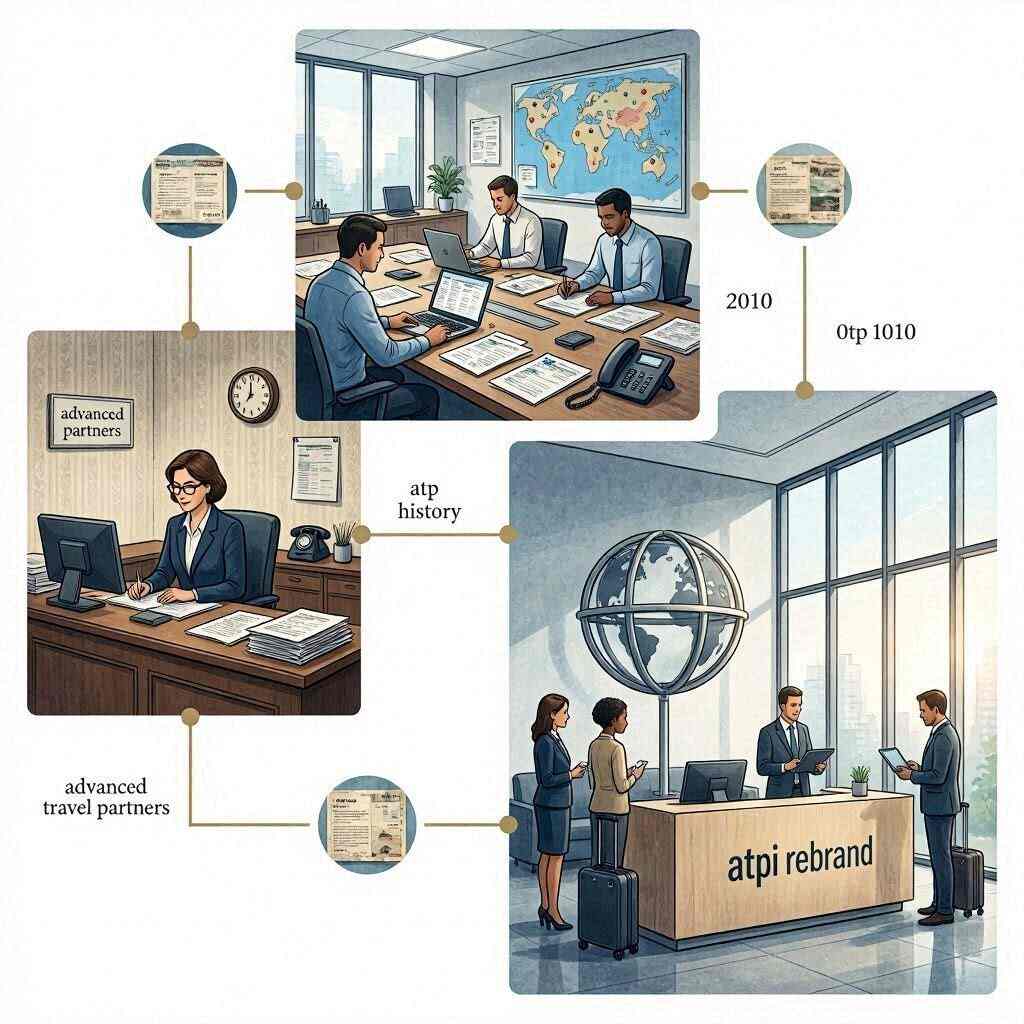
Advanced Travel Partners is the former brand name of the travel management group that rebranded as ATPI in 2009. The company no longer operates commercially under the Advanced Travel Partners name. However, several legal entities registered at Companies House under that name remain on the corporate record — which explains why the name continues to appear in searches, trade directories, and procurement databases years after the rebrand.
The core organisation was incorporated in the UK and built its business around specialist corporate travel sectors: marine crew logistics, offshore energy personnel movement, corporate travel management, sports event travel, and enterprise technology. When the group unified its brand identity as ATPI in 2009, the Advanced Travel Partners name was retired from customer-facing operations but preserved within the legal holding structure.
In September 2025, ATPI was acquired by Direct Travel, Inc. — forming a combined organisation managing over $6 billion in annual travel volume across 90 countries. The capabilities built under the Advanced Travel Partners brand remain active within that structure today.
Why both names still appear online
Corporate legal entities persist on the register after operational rebranding. Advanced Travel Partners UK Ltd (company number 02515255) remains active as a legal entity. Advanced Travel Partners International Limited (04474907) also remains active. Advanced Travel Partners Limited (04475255) was dissolved in March 2026. Directory systems, procurement databases, and legacy contracts created before 2009 still reference the old trading name, which is why searches for Advanced Travel Partners continue to surface results.
Identity Summary: Advanced Travel Partners and ATPI
| Identity Element | Detail |
|---|---|
| Original trading name | Advanced Travel Partners |
| Incorporated (UK Ltd entity) | 25 June 1990 |
| International entity incorporated | 2 July 2002 |
| Group rebrand year | 2009 |
| New brand name after rebrand | ATPI |
| Registered headquarters (current) | The Royals, 353 Altrincham Road, Manchester, M22 4BJ |
| Current operational status | Active under ATPI / Direct Travel |
| Acquisition event | Direct Travel acquired ATPI, September 2025 |
| Combined group travel volume | Over $6 billion annually |
| Global operational footprint | 100+ locations, six continents |
| Legacy UK legal entity status | Advanced Travel Partners UK Ltd — Active; ATP International Ltd — Active; ATP Limited — Dissolved March 2026 |
The Evolution of Advanced Travel Partners UK Ltd: Heritage and Legacy
Understanding how Advanced Travel Partners UK Ltd became ATPI requires tracing the group’s development across three decades of corporate travel history. The original registered entity — company number 02515255 — was incorporated on 25 June 1990. That places Advanced Travel Partners in the UK market at a period when corporate travel management was still largely transactional: an agent books the flights, issues the tickets, and the relationship ends there. What the group built over the following two decades was structurally different — and that difference shaped the eventual ATPI identity.
The UK operation expanded its footprint by concentrating on sectors that mainstream travel management companies treated as peripheral. Marine crew logistics, offshore energy personnel, and specialist corporate sectors required something the leisure market never demanded: operational continuity under pressure, 24-hour booking capability, deep knowledge of port schedules and helicopter rotation logistics, and the institutional knowledge to manage visa and immigration requirements across dozens of jurisdictions simultaneously. Advanced Travel Partners built its UK business around precisely that operational model.
The pivotal structural moment came in 2002. The ATPI Group — as it subsequently became known — was formed through the combination of several separate trading companies in the UK and the Netherlands. These included TelMe Farebase, Seaforths Travel, Ayscough Travel, and ATP itself. The resulting organisation, led by Graham Ramsey, became the foundation from which all subsequent growth was built.
Acquisitions that shaped the group
Between 2002 and 2009, the group acquired Newhaven Travel in the United States (2003), MTV in France (2005), and the majority of ATP Netherlands (2006). In 2006, the group rebranded as Advanced Travel Partners — the name that then operated across the combined international structure. A management buyout in the same year gave leadership greater operational authority to pursue the buy-and-build strategy that followed. In 2009, the acquisition of Instone International — a marine specialist business travel agency with an international network — gave the group the final major building block. At that point, with a coherent specialist identity across marine, energy, corporate, and events sectors, the organisation rebranded again: this time as ATPI.
What the brand change meant for UK Ltd continuity
Advanced Travel Partners UK Ltd did not cease to exist at rebrand. The legal entity remained in place — and remains registered today. This is standard corporate practice when an operating group unifies under a new parent brand. The UK Ltd entity became part of the ATPI group structure, its staff, operations, and client relationships continuing uninterrupted. Clients with long-term contracts or framework agreements established under the Advanced Travel Partners name retained continuity through the same entity, now operating as ATPI’s UK presence.
The address history for UK operations reflects the group’s expansion and eventual consolidation. The Lowestoft and Aberdeen offices that defined the UK’s specialist marine and energy operations were established under the Advanced Travel Partners UK Ltd banner and carried through into ATPI. The Manchester headquarters at The Royals, 353 Altrincham Road — recorded against all surviving UK legal entities — represents the consolidated governance address that replaced any earlier London-based or regional registered offices.
Why LinkedIn still shows Advanced Travel Partners
Former employees whose careers spanned the pre-2009 period often retain Advanced Travel Partners in their employment history. Procurement teams and travel managers who established relationships with the company during that era also reference the historical name. Because ATPI’s LinkedIn profile and professional network includes legacy office locations — Lowestoft, Aberdeen, London, Amsterdam — searches that originate from those locations or from the industry context of those years continue to surface Advanced Travel Partners references. This is normal in any substantial corporate rebrand and does not indicate that the company operates under two separate identities today.
Corporate Structural Heritage Timeline
| Year | Event | Significance |
|---|---|---|
| 1990 | Advanced Travel Partners UK Ltd incorporated (company 02515255) | Founding legal entity established |
| 2002 | Group formation: merger of TelMe Farebase, Seaforths Travel, Ayscough Travel, ATP | Structural consolidation creates multi-entity group |
| 2002 | Advanced Travel Partners International Limited incorporated (company 04474907) | International holding entity established |
| 2003 | Acquisition of Newhaven Travel (USA) | First transatlantic expansion |
| 2005 | Acquisition of MTV (France) | European continental reach established |
| 2006 | Acquisition of ATP Netherlands majority; Norway offices opened | North Sea and Northern European energy corridor coverage established |
| 2006 | Rebranded as Advanced Travel Partners across the group | Unified brand identity for the first time |
| 2006 | Management buyout completed | Group independence from previous ownership secured |
| 2009 | Acquisition of Instone International (marine specialist TMC) | Marine crew travel capability significantly expanded |
| 2009 | Rebranded as ATPI with four specialist divisions | Advanced Travel Partners retired as customer-facing brand |
| 2010 | International franchise and partner network development begins | Network expands to 70+ offices globally |
| 2012 | ICG-backed management buyout from Equistone for £170 million | New ownership structure under Intermediate Capital Group |
| 2022 | TripStax spun off — eight proprietary travel tech tools | Technology assets separated for independent scaling |
| 2025 | Direct Travel acquires ATPI | Legacy Advanced Travel Partners capabilities absorbed into $6B+ global group |
| 2026 | Advanced Travel Partners Limited (04475255) dissolved | Legal tidying of dormant entity; core entities remain active |
The East of England Hub: Lowestoft Operations
Advanced Travel Partners Lowestoft represents one of the most operationally significant regional hubs in the group’s history — and its significance had nothing to do with geography for its own sake. Lowestoft sits on the North Sea coast of Suffolk, directly adjacent to one of the most active offshore energy zones in the UK. The town has functioned as a staging and logistics hub for North Sea operations since the first wave of offshore development, and Advanced Travel Partners’ presence at Sapphire House on Mobbs Way, Lowestoft, NR32 3BE was a deliberate positioning within that ecosystem.
The marine and offshore energy sectors that dominate Lowestoft’s commercial identity require a very specific type of travel management capability. Crew rotations for offshore platforms operate on fixed-cycle schedules — typically two weeks on, two weeks off, though configurations vary by operator and installation type. Coordinating the simultaneous rotation of dozens of crew members across multiple shifts, flights, and ground transfers requires real-time inventory management, 24-hour booking access, and the ability to reroute immediately when weather windows close or helicopter scheduling changes. A standard corporate travel agency is not built for this. Advanced Travel Partners Lowestoft was.
The office developed deep operational knowledge of the East Anglian offshore zone — covering wind farm installations, oil and gas platforms, and the crewing agencies and ship management companies that support them. That knowledge included established working relationships with regional airports, helicopter operators, and accommodation providers clustered around the energy supply chain. For a travel manager coordinating a platform crew change on a Sunday evening, having a specialist desk with pre-negotiated rates and active relationships with local operators is the difference between a managed operation and a crisis.
Integration into the broader network
The Lowestoft operation did not function as an isolated regional office. It was part of the wider Advanced Travel Partners UK structure, which meant that Lowestoft-based clients had access to the group’s consolidated technology, negotiated air fares, and global marine expertise — while retaining local specialist knowledge at the point of contact. This combination of local expertise and group-level infrastructure is what distinguished the model from both independent regional agents and large-volume generalist TMCs.
The Sapphire House address has remained associated with ATPI’s UK marine and energy operations following the rebrand. Clients and procurement teams searching for advanced travel partners sapphire house or advanced travel partners uk ltd lowestoft are typically seeking to reconnect with that specialist capability — which continues to operate from the same location under ATPI Marine Travel.
The North Sea Energy Corridor: Aberdeen Desk
The Aberdeen office at Bridge House, 58 Bridge Street, AB11 6JN represents the onshore gateway to the most commercially significant offshore energy zone in the UK. Aberdeen’s identity as the European capital of the oil and gas industry is not incidental — it reflects decades of infrastructure investment, workforce development, and supply chain concentration. Advanced Travel Partners Aberdeen was positioned to serve that ecosystem directly.
Offshore workforce movement in the North Sea operates under constraints that make it categorically different from any other form of corporate travel. Personnel travelling to an offshore platform must clear multiple compliance checkpoints before they can board a helicopter: medical certifications, survival training currency, platform operator induction requirements, and — for international rotations — visa and immigration documentation. A delay at any checkpoint grounds the traveller and creates a gap in the platform’s manning schedule. The cost of an unfilled position on an offshore platform is measured in thousands of pounds per day.
Helicopter logistics and the Aberdeen corridor
The primary mode of transport to North Sea platforms from Aberdeen is helicopter, departing from Aberdeen International Airport. The scheduling of helicopter flights is tightly controlled by platform operators and weather windows. Advanced Travel Partners Aberdeen built its operational model around this constraint: managing the full logistics chain from the traveller’s point of origin, through surface transport to the airport, through helicopter check-in and the required pre-departure safety briefing, to the platform itself. No single booking system handles all of these elements automatically. The Aberdeen desk coordinated them manually, with specialist knowledge of each operator’s requirements.
The 2024 partnership between ATPI and Aberdeen-based Onboard Tracker — whose crew management software monitors over 100,000 energy, renewables, and marine personnel across 110 countries and 8,000+ sites — represents the direct evolution of that capability into integrated digital infrastructure. By connecting ATPI’s booking and travel management expertise with Onboard Tracker’s crew scheduling system, the Aberdeen operation created a centralised travel hub that automates the manual coordination that previously required significant desk time. The Travel Request Module now provides a single point of visibility from initial travel request through to confirmed booking, with data accessible on any device.
This collaboration, based out of Bridge House — where both ATPI and Solab IT Services (Onboard Tracker’s developer) are located — is the clearest example of how the Aberdeen desk has evolved from a specialist booking operation into a technology-integrated logistics function. For procurement directors evaluating energy sector travel management, Aberdeen is not simply an office location. It is the point where North Sea travel expertise and crewing technology intersect.
Global Operations: Tracking Advanced Travel Partners International
Advanced Travel Partners International Limited — company number 04474907, incorporated 2 July 2002 — was the legal vehicle through which the group formalised its multi-country operating structure. The incorporation date aligns precisely with the 2002 consolidation that created the modern group from its constituent UK and Dutch companies. The international entity provided the governance framework for coordinating operations across jurisdictions: different regulatory environments, different employment law regimes, different airline contracting relationships, and different client servicing expectations.
Understanding how enterprise travel management operates at international scale requires moving beyond the idea of a single company with international offices. ATPI’s global structure — built on the Advanced Travel Partners International foundation — operates as a combination of wholly owned country operations, franchise relationships, and strategic partnerships. Each element serves a different purpose in delivering consistent service to multinational clients.
Wholly owned operations provide direct management control in high-value markets. Advanced Travel Partners Nederland BV — the Dutch entity that traces its origins to the ATP Netherlands acquisition in 2006 — was one of the earliest wholly owned international operations. The Netherlands represented a critical geography: Schiphol Airport in Amsterdam is one of the largest aviation hubs in Europe, the Dutch port of Rotterdam is the largest in Europe, and the Netherlands hosts significant offshore energy and shipping sector clients. Advanced Travel Partners Nederland BV, operating from Beechavenue 101, Schiphol-Rijk, provided the group with both a gateway hub and a specialist marine and energy client base.
By the time of the 2025 Direct Travel acquisition, ATPI’s wholly owned operations extended to Australia, Canada, Denmark, Germany, New Zealand, Norway, the Philippines, Singapore, the United Kingdom, and the United States — in addition to the Netherlands. This geographic spread was not assembled randomly. Each location reflects a cluster of corporate or specialist client demand: Norway for North Sea energy, Singapore and the Philippines for Asian maritime operations, Australia for mining sector travel.
The franchise and partner network extended the group’s reach beyond what wholly owned infrastructure could economically support. Over 70 offices eventually joined the network — rising to 100+ locations across 85 countries by the time of the Direct Travel acquisition. For a multinational client with travellers operating in Kazakhstan, Angola, or Brazil, the partner network provides local servicing capability without requiring ATPI to own an office in every market.
Advanced Travel Partners Nederland BV and the continental Europe cluster
The Netherlands operation served as the anchor for continental European client relationships. Dutch corporate clients, shipping companies operating from Rotterdam, and multinational firms with Amsterdam-area headquarters were all served through the Schiphol-Rijk office. ATPI Advanced Travel Partners Nederland functioned as the Dutch market identity of the same brand — reflecting the parallel naming conventions used across different European markets during the transition from Advanced Travel Partners to the unified ATPI brand.
Multi-National Brand Transition Matrix
| Territory | Historical Entity | Current Operating Identity | Key Sector Focus |
|---|---|---|---|
| United Kingdom | Advanced Travel Partners UK Ltd | ATPI / Direct Travel UK | Marine, energy, corporate, sports events |
| Netherlands | Advanced Travel Partners Nederland BV / ATPI Advanced Travel Partners Nederland | ATPI Netherlands / Direct Travel | Marine, corporate, continental Europe |
| Norway | ATP/ATPI Norway office (opened 2006) | ATPI Norway / Direct Travel | North Sea energy, offshore workforce |
| France | MTV (acquired 2005) → ATPI France | ATPI France / Direct Travel | Corporate travel, events |
| USA | Newhaven Travel (acquired 2003) → ATPI USA | Direct Travel (primary market) | Corporate travel, specialty sectors |
| Germany | Hamburg Süd Reiseagentur GmbH (acquired 2021) | ATPI Germany / Direct Travel | Marine, corporate |
| Australia | The Travel Authority (acquired 2022) | ATPI Australia / Direct Travel | Mining, corporate, resources sector |
| Singapore | ATPI Singapore | ATPI / Direct Travel Asia | Asian maritime, energy |
| Philippines | ATPI Philippines | ATPI / Direct Travel Asia | Crewing sector, maritime |
| Global Network | Advanced Travel Partners International Ltd | Direct Travel partner network | 100+ locations, 85+ countries |
Centralized Governance: Head Office Structures
The Manchester headquarters at The Royals, 353 Altrincham Road, M22 4BJ functions as the legal and administrative centre for the surviving UK entities of what was formerly Advanced Travel Partners. This is the registered address for both Advanced Travel Partners UK Ltd and Advanced Travel Partners International Limited — and it was the ATPI Group headquarters before the Direct Travel acquisition.
For enterprise travel management organisations managing thousands of client accounts across multiple jurisdictions, centralised governance performs a specific set of functions that local offices cannot provide individually. Contract oversight is the most critical: a multinational client with a global travel programme needs a single master agreement that establishes service standards, pricing frameworks, and performance metrics — regardless of which country an individual booking originates from. That master agreement is managed from the centre.
Compliance architecture
The governance function at a consolidated travel management headquarters includes compliance monitoring across regulatory environments. UK travel management companies must comply with ABTA regulations, ATOL licensing requirements for certain package arrangements, and PCI-DSS standards for payment card handling. Operations in the Netherlands fall under Dutch travel sector regulation. Norwegian operations involve Norwegian consumer protection frameworks. Centralised compliance management ensures that local operations meet both local regulatory requirements and the group’s own standards — which typically exceed minimum regulatory thresholds because enterprise clients demand it.
Global account management structure
For clients with operations in multiple countries, the governance model means they deal with a global account manager based centrally, supported by local servicing teams in each market. The global account manager holds the commercial relationship, monitors programme performance data across all markets, and raises strategic recommendations — such as route consolidation, preferred supplier renegotiation, or policy tightening — based on aggregate data that no individual local office could generate independently.
For travel managers and procurement directors evaluating enterprise TMC relationships, the presence of a robust centralised governance function is a significant differentiator. It means that service levels, reporting standards, and duty of care protocols are applied consistently — not left to the discretion of individual local offices. The Manchester headquarters, inherited from the Advanced Travel Partners era, provides that centralised governance function for the UK-anchored entities within the now larger Direct Travel structure.
Modern Capabilities: Specialized Corporate Travel and Logistics Ecosystems
The capabilities that Advanced Travel Partners built — and that ATPI scaled — represent the most operationally sophisticated layer of what travel management companies actually do. Understanding these capabilities matters for any enterprise procurement leader evaluating whether a generalist TMC or a specialist operator better serves their organisation’s requirements.
The distinction is not simply one of market positioning. It reflects genuinely different operational architectures. A generalist travel management company is built to handle high volumes of similar, predictable transactions: point-to-point corporate travel, hotel bookings, car hire, and expense integration. That model performs well when the travel need is standardised. It performs poorly when the travel need involves offshore platforms, crew rotations, vessel port calls, international crewing agents, and simultaneous management of dozens of travellers on interdependent schedules.
Advanced Travel Partners was built from the beginning to handle the second type of requirement. The marine and energy sectors that defined its UK regional operations in Lowestoft and Aberdeen required operational capability that most TMCs never developed. When ATPI emerged from that heritage, it carried those specialist capabilities into a much larger global organisation.
What specialist capability actually looks like in practice
Consider a ship management company operating a fleet of 12 vessels across five ocean zones. At any given time, it needs to coordinate crew changes across multiple ports simultaneously — some planned weeks in advance, some arising at 48 hours’ notice when a crew member requires emergency repatriation. The travel management function must maintain real-time visibility of all 12 vessels’ manning requirements, pre-position visa documentation for crew nationals requiring advance processing time, hold negotiated fares with airlines serving every port where vessels are likely to call, and provide 24-hour emergency response for unexpected rerouting. No single booking tool manages all of this. It requires a combination of specialist technology, pre-negotiated supplier relationships, and human expertise deployed at the point of complexity.
Sector-Specific Operational Capability Checklist
| Sector | Core Capability | What Generalist TMCs Typically Lack |
|---|---|---|
| Marine crew travel | Crew rotation management, multi-port coordination, seafarer visa processing, 24/7 emergency response | Port-specific knowledge, seafarer documentation expertise, sub-24hr rerouting capability |
| Offshore energy | Helicopter logistics, platform operator compliance verification, survival training tracking, remote location routing | North Sea-specific routing, BOSIET/FOET certification awareness, platform-specific briefing requirements |
| Corporate travel | Policy-compliant booking, preferred supplier management, duty of care monitoring, expense integration | N/A — this is standard TMC capability |
| Sports event travel | Group charter coordination, equipment logistics, international tournament scheduling, athlete welfare protocols | Group inventory management at scale, sports-specific ancillary requirements |
| Government and defence | Security-cleared booking processes, classified itinerary handling, high-risk destination protocols | Security clearance workflows, zone-specific risk assessment, diplomatic facilitation |
| Mining and resources | Remote site access coordination, fly-in fly-out scheduling, mining camp accommodation linkage | Remote site logistics, FIFO scheduling complexity, isolated location servicing |
Marine Crew Logistics and Multi-Port Coordination
Marine crew logistics is the most operationally complex segment of corporate travel management, and it was the foundation of the Advanced Travel Partners specialist identity. The core challenge is this: a vessel operating internationally does not stop in the same port twice. Crew changes happen wherever the vessel’s commercial schedule dictates — Rotterdam one month, Singapore the next, Houston the month after. For each crew change, the travel management function must book flights for departing crew from their point of origin to the port, flights for joining crew from their point of origin to the port, and manage the timing so that both movements coincide with the vessel’s scheduled berth window.
This is not a booking problem. It is a logistics coordination problem. When a vessel has a 12-hour berth window in Singapore, the joining crew must arrive before the vessel departs. If a flight is delayed or cancelled, the travel manager must reroute the joining crew immediately — often through an alternative hub, often at a premium fare — because the vessel cannot wait. The cost of a missed crew change is not the price of a rescheduled ticket. It is the cost of the vessel missing its commercial departure window.
International crew movement and documentation
Seafarers working aboard international vessels carry the flag-state documentation of their vessel’s registration, but they travel on their own national passports. A vessel flying the Liberian flag with a Filipino chief engineer, an Indian first officer, and an Eastern European deck crew requires the travel manager to maintain current visa intelligence for multiple nationalities across dozens of potential port destinations. Visa requirements change. Processing times change. Some nationalities require visa applications submitted weeks before arrival. Others can obtain visas on arrival. Getting this wrong does not simply inconvenience a traveller — it prevents them from boarding their vessel and creates a compliance breach with the port authority.
Route optimisation under commercial pressure
The marine travel function also carries significant cost management responsibility. Negotiated marine fares — special fare categories available only to TMCs with established airline contracts in the marine sector — can represent substantial savings over published business class fares for the high-frequency, often last-minute bookings that crew rotation generates. Advanced Travel Partners, and subsequently ATPI, built airline relationships specifically for marine sector purchasing: consolidated volumes across multiple ship management clients generating the negotiating leverage that individual operators could not achieve independently.
Travel disruption as the operational standard
In corporate travel, disruption is an exception to be managed. In marine crew logistics, disruption is the baseline operating condition. Vessels divert from their scheduled port calls. Weather closes helicopter landing windows offshore. Port strikes delay vessel arrivals. The travel management function must maintain contingency planning for all foreseeable disruption scenarios and respond within minutes when disruption occurs — not within hours. The Aberdeen desk’s 24-hour operation was not a service differentiator. It was an operational necessity.
Offshore Energy Personnel Movement Systems
Offshore energy workforce mobility operates within a compliance framework that has no equivalent in standard corporate travel. Every person who boards an offshore installation — whether an oil platform, a gas compression facility, or an offshore wind turbine service vessel — must hold current certification in a set of mandatory survival and safety courses before they can be granted access.
The core certification for UK North Sea operations is the BOSIET (Basic Offshore Safety Induction and Emergency Training), which includes helicopter underwater escape training. This certification has a defined validity period and must be renewed before expiry. If a technician’s BOSIET certification has lapsed, they cannot board the helicopter regardless of who has booked the ticket. The travel management function for offshore energy clients must therefore maintain visibility of crew certification status alongside travel itineraries — because a booking without valid certification is an unusable booking.
Helicopter logistics and the Aberdeen corridor
North Sea platforms are reached primarily by helicopter from Aberdeen International Airport. Helicopter flights to offshore installations are not commercial services available through standard booking channels. They operate on contracts between platform operators and helicopter service providers — primarily Bristow and CHC Helicopter — and access is allocated by the platform operator against their manning schedule. The travel management function coordinates the traveller’s arrival at Aberdeen Airport in time for their allocated helicopter slot, having confirmed that all platform-specific induction requirements are met and that certification records are current.
When a helicopter slot is missed — due to a commercial flight delay into Aberdeen, for example — the rebooking process involves both the commercial airline rebooking and the offshore helicopter operator rebooking, which must be coordinated simultaneously. The Advanced Travel Partners Aberdeen desk managed this coordination as a standard function of its service model. The subsequent integration with Onboard Tracker’s crew management system automates the visibility layer — flagging approaching certification renewals, confirming travel readiness against platform requirements, and providing the travel hub functionality that allows all parties to see the status of a crew change in real time.
Energy sector scheduling and workforce mobility
Offshore rotations typically run on a 2:2 schedule — two weeks offshore, two weeks onshore — though operators use 3:3, 28:28, and other configurations depending on role and installation type. For a large offshore operator with several hundred personnel on rotation, the travel management function is coordinating dozens of simultaneous crew changes every two weeks, across multiple installations, with multiple helicopter departure points, and multiple points of origin for the personnel involved. The scale of this coordination — and the zero-tolerance compliance environment — is what makes offshore energy personnel movement a genuinely specialist travel management discipline rather than a higher-stakes version of standard corporate bookings.
Sports Team and Event Travel Logistics
ATPI Sports Events — one of the four specialist divisions established at the 2009 rebrand — represents the application of group travel expertise to professional sport. The Advanced Travel Partners heritage in group management and specialist logistics translated directly into the sports sector, where the operational demands share structural similarities with marine crew travel: groups of people moving simultaneously on coordinated schedules, with equipment that travels on separate documentation, to destinations where pre-negotiated accommodation blocks must align with event scheduling.
Group charter coordination
For international tournament travel involving national teams or top-tier professional clubs, group charter is often the operationally superior option — allowing equipment, medical staff, and playing personnel to travel together, eliminating the risk of staggered arrivals on scheduled services, and reducing the compliance burden of managing dozens of individual itineraries. Managing a charter operation requires relationships with charter operators, aircraft type selection appropriate to group size, and coordination with destination airports on arrival slots that align with training and competition schedules.
Equipment logistics
Professional sport involves substantial equipment volumes: playing kit, medical supplies, tactical technology, broadcast equipment for rights-holder coverage. International sports travel requires coordination between the travel management function and freight or cargo operators, with customs documentation appropriate to the destination. A failure in equipment logistics can compromise competitive preparation in ways that have both sporting and commercial consequences for the client.
ATPI’s work with organisations including British Wheelchair Basketball — documented in its own content about athlete welfare during international travel — demonstrates the application of group travel expertise to para-sport and the particular welfare considerations that specialist athlete travel demands.
Enterprise Travel Technology and SAP Concur Integration
The technology layer of enterprise travel management is where the difference between specialist and generalist TMCs becomes most visible to procurement teams and travel managers operating at scale. A travel booking is not simply a transaction — it generates data: traveller location, expenditure category, supplier, cost centre, project code, and carbon footprint. At enterprise scale, that data, aggregated and analysed, is a management tool. It enables route optimisation, supplier renegotiation, policy compliance monitoring, and duty of care fulfilment. Without technology integration, none of that data is accessible in usable form.
SAP Concur integration
ATPI has maintained a formal partnership with SAP Concur for over 13 years — a relationship that predates the 2009 rebrand and traces its origins to the Advanced Travel Partners era. The partnership means that clients using SAP Concur as their expense management platform can connect their travel bookings directly to their Concur implementation: itineraries flow automatically into expense reports, receipts attach to the correct cost lines, and travel policy compliance is checked at the point of booking rather than retrospectively during expense audit. For procurement directors managing large travel programmes, this integration eliminates the reconciliation overhead that non-integrated systems create.
The practical benefit for travel managers is multi-directional visibility. The traveller sees their itinerary in the Concur app. The travel manager sees booking compliance data in real time — identifying out-of-policy bookings as they occur rather than discovering them at month-end review. The finance function receives clean expense data with project and cost centre coding already applied. The data that previously required manual intervention at multiple points in the workflow is automated through the integration.
ATPI’s proprietary technology stack
Beyond SAP Concur integration, ATPI developed its own proprietary technology products during the Advanced Travel Partners and post-rebrand period. These include a traveller profile system, trip approvals capability, an analytics platform, a travel manager portal, a client sustainability programme with carbon tracking, a travel alert system, traveller tracking, and crew management services. In March 2022, ATPI spun off eight of these tools into a separate entity called TripStax — reflecting the commercial value of the technology as an independent product rather than solely as a service component.
What technology integration means for procurement decisions
For a procurement director evaluating TMC options, the technology ecosystem question is not simply “can you connect to our expense system?” It is “how does your technology architecture give us the management information we need to govern a global travel programme?” The answer involves understanding how booking data flows from the TMC’s system to the client’s internal systems, how traveller tracking data is maintained and accessible to security and HR functions, how sustainability data is captured and reported, and how the analytics layer translates raw booking data into programme optimisation recommendations. Advanced Travel Partners built its technology capability around those questions. ATPI scaled it. The Direct Travel acquisition creates a further technology integration opportunity — with Direct Travel’s Avenir platform extending the data and analytics layer across the combined group’s client base.
Legacy Contracts, Billing, and Account Migration Paths
For travel managers, finance teams, and procurement directors who encounter Advanced Travel Partners in the context of historical contracts or outstanding billing queries, the immediate practical question is: who do I contact now?
The answer depends on when the contract was established and what specific account relationship it represents. The following framework addresses the most common scenarios.
Historical invoices and purchase orders referencing Advanced Travel Partners
Any invoice issued under the Advanced Travel Partners trading name before 2009 was issued by either Advanced Travel Partners UK Ltd (company 02515255) or an associated entity. The legal entity remains registered and active, with its registered address now at The Royals, 353 Altrincham Road, Manchester, M22 4BJ. For audit or accounting purposes, historical invoices are valid documents from a still-registered UK company — the rebranding does not affect their legal standing.
Contracts established between 2006 and 2009
This window covers the period when the group operated as Advanced Travel Partners following the 2006 rebrand, before adopting the ATPI name in 2009. Contracts from this period were typically assigned from Advanced Travel Partners entities to ATPI entities as part of the rebrand process. If you hold a contract from this period and are uncertain about its current legal standing, the correct route is to contact ATPI’s UK client services — now operating as part of Direct Travel — and request confirmation of contract assignment.
Accounts migrated from ATP Nederland BV
Dutch clients with accounts established under Advanced Travel Partners Nederland BV should direct account and billing enquiries to ATPI’s Netherlands operation in Schiphol-Rijk. The Dutch entity’s account management structure has been continuous through the rebrand and subsequent acquisitions. If your primary contact left the organisation, the central Direct Travel / ATPI account management team can reassign account ownership.
Legacy Account Resolution Framework
| Scenario | Action Required | Contact Route |
|---|---|---|
| Historical invoice query (pre-2009) | Verify against Advanced Travel Partners UK Ltd (company 02515255) | Direct Travel / ATPI UK — Manchester headquarters |
| Active contract under ATP UK Ltd name | Request contract assignment confirmation | ATPI UK client services — confirm assignment to current entity |
| ATP Nederland BV account | Contact Dutch operation for account continuity | ATPI Netherlands, Schiphol-Rijk |
| ATP Aberdeen account (offshore/energy) | Contact ATPI Energy Travel division | ATPI Aberdeen desk, Bridge House, 58 Bridge Street |
| ATP Lowestoft account (marine/energy) | Contact ATPI Marine Travel division | ATPI Lowestoft, Sapphire House, Mobbs Way |
| Dissolved entity reference (ATP Limited, dissolved March 2026) | No active account management — redirect to surviving entity | Direct Travel / ATPI UK for historical records |
| Technology account (TripStax tools) | TripStax is now an independent entity | Contact TripStax directly — separate from ATPI post-2022 |
| Sports event account | Contact ATPI Sports Events division | ATPI Sports, Manchester headquarters |
The 2025 acquisition context for active contracts
Following the Direct Travel acquisition of ATPI in September 2025, existing ATPI clients — including those whose accounts carry Advanced Travel Partners legacy identifiers in their contract history — should expect to receive communications from Direct Travel outlining the account migration timeline. The acquisition is structured to maintain service continuity: the Avenir platform integration is being rolled out progressively rather than implemented as an immediate cutover. If you have not received account migration communications and hold an active ATPI contract, contact your existing account manager or the Manchester headquarters directly.
Duty of Care, Compliance, and Global Travel Risk Management
Duty of care is the legal and ethical obligation employers hold toward their employees while those employees are travelling for work purposes. For most corporate travel programmes, duty of care means knowing where travellers are, being able to reach them during disruption, and having documented emergency procedures. For the sectors that Advanced Travel Partners and ATPI specialise in — marine, offshore energy, sports event travel in international markets — duty of care operates in a significantly higher-risk environment and requires correspondingly more robust systems.
The legal framework
UK employers’ duty of care obligations extend beyond the domestic workplace. The Health and Safety at Work Act 1974 and associated regulations establish the employer’s responsibility to ensure, so far as is reasonably practicable, the health, safety, and welfare of employees — including when they are abroad for work. For offshore personnel, this duty extends through the journey to the installation and back. A seafarer who is travelling from Manila to join a vessel in Rotterdam is under their employer’s duty of care from the moment they leave their home until they return. The travel management function is part of the infrastructure through which that duty is discharged.
Traveller tracking architecture
ATPI’s traveller tracking capability — developed during the Advanced Travel Partners era and significantly enhanced through proprietary technology investment — provides real-time visibility of traveller location based on booking data. When a traveller books through the managed programme, their itinerary data is maintained in a system that the security or HR function can query at any time. If a crisis event occurs — a natural disaster, a political disturbance, a transportation incident — the travel manager can generate an immediate report showing all travellers in the affected geography and initiate outreach through the emergency alert system.
Emergency response coordination
The 24-hour emergency response function is particularly critical for marine and offshore clients. A crew member experiencing a medical emergency on a vessel in the South China Sea needs repatriation coordination that involves port authorities, medical evacuation services, and commercial airline rebooking across multiple jurisdictions — often simultaneously. ATPI’s emergency response desk — staffed around the clock — functions as the coordination point for these events, working with the employer’s own security and HR functions to manage the repatriation process.
Maritime-specific duty of care considerations
The International Maritime Organization’s (IMO) Standards of Training, Certification and Watchkeeping (STCW) convention establishes the baseline safety standards for maritime personnel. ATPI’s engagement with the IMO — noted in its marine travel capability materials — means its operational approach to seafarer travel reflects the international regulatory framework rather than treating each crew travel booking as an isolated corporate transaction.
Corporate Travel Risk Matrix
| Risk Category | Specific Risk | Mitigation Approach | Who Needs This |
|---|---|---|---|
| Location visibility | Traveller in incident zone, status unknown | Real-time itinerary tracking, GPS-linked mobile app | All enterprise clients |
| Medical emergency (offshore) | Crew member requiring medevac from platform | Pre-established medevac protocols, 24/7 response desk | Offshore energy operators |
| Political disruption | Government change, civil unrest in destination | Travel alert system, pre-departure risk briefing, evacuation routes | Corporate, mining, government |
| Maritime incident | Vessel in distress, crew requiring emergency repatriation | Port authority liaison, emergency airline rebooking, crew documentation management | Ship management companies, crewing agents |
| Certification lapse | Offshore traveller unable to board — expired BOSIET | Certification tracking integrated with booking system | Energy sector, offshore operators |
| Visa failure | Crew member denied boarding — visa rejected or expired | Pre-trip visa intelligence, advance processing for complex nationalities | Marine, offshore, multinational corporate |
| Natural disaster | Airport closure, transport infrastructure failure | Alternate routing capability, emergency rebooking protocol | All traveller categories |
| Duty of care compliance audit | Employer unable to demonstrate traveller oversight | Programme management reporting, policy compliance data, journey tracking records | All enterprise clients |
The compliance reporting function
Duty of care is not simply a real-time operational requirement — it also creates an audit trail obligation. Employers must be able to demonstrate, in the event of an incident or regulatory review, that they had appropriate systems in place to monitor and support travelling employees. ATPI’s analytics and reporting platform provides the data layer for that audit trail: booking records, policy compliance rates, traveller acknowledgment records, and emergency response logs. For travel managers whose programme is subject to internal audit or external regulatory review, having that data in a structured, exportable format is not optional. It is the evidence base for demonstrating that duty of care was operationally active — not merely a policy statement.
Conclusion
Advanced Travel Partners is not a company you will find accepting new client bookings today. What you will find — through ATPI and now the Direct Travel group it joined in September 2025 — is the complete operational heritage, specialist capability, and global infrastructure that the Advanced Travel Partners name represents.
The journey from a UK travel agency incorporated in 1990 to a constituent part of a $6 billion global travel management group is the story of consistent specialisation: building deep expertise in the sectors that mainstream travel management avoided, acquiring the businesses that complemented that expertise, and investing in technology that made complex logistics manageable at scale. The Lowestoft marine desk, the Aberdeen offshore energy operation, the Dutch maritime client base, the marine crew logistics capability, the SAP Concur integration, and the duty of care architecture — all of it originated in the Advanced Travel Partners era and all of it continues to operate today.
For procurement leaders and travel managers evaluating enterprise travel management partnerships, the relevant question is not what Advanced Travel Partners was. It is what the capabilities it built are worth to your organisation’s travel programme — and whether a specialist heritage in marine, offshore, and complex corporate travel represents the expertise your requirements demand.