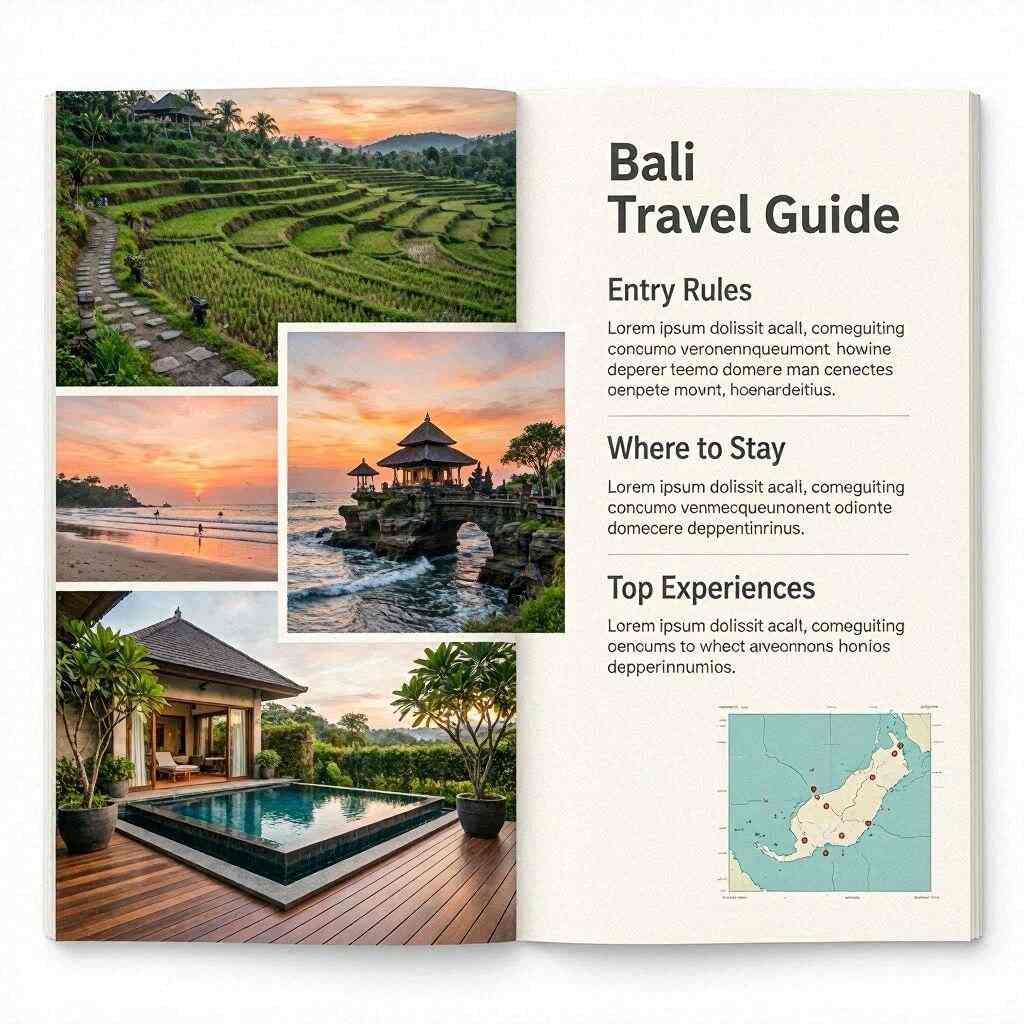
Bali Travel Guide: Entry Rules, Where to Stay & Top Experiences
Planning a trip to Bali in 2026? Between the new digital entry system, the mandatory tourist levy, shifting neighborhood boundaries, and constantly changing crowd patterns, even experienced travelers find the planning process confusing. This Bali travel guide cuts through the noise with one authoritative resource covering entry requirements, the best time to visit Bali, where to stay, top things to do, and how to get around — all current for 2026.

Bali has changed. The casual, anything-goes island of a decade ago now rewards travelers who prepare. Visa rules have moved to a fully digital e-VoA system. A mandatory tourist levy is collected before or on arrival. The neighborhood map has expanded far beyond Seminyak and Kuta, with areas like Pererenan and Seseh redefining modern Bali living. Transport — while improved by ride-hailing apps — still requires smart navigation to avoid tourist traps.
Whether this is your first Bali trip or a return visit after years away, this guide covers legal entry, seasonal planning, accommodation zones, must-do experiences, and safety — all validated against 2026 realities.
Bali Entry Requirements 2026: e-VoA, Tourist Levy & Customs Rules
Entry into Bali is no longer “show up and get a stamp.” Indonesia has built a layered digital entry system, and understanding each piece before you fly is essential — getting it wrong can mean delays at Ngurah Rai International Airport, or being denied boarding entirely.
How the e-VoA, Customs QR Code, and 150,000 IDR Tourist Tax Work
The Electronic Visa on Arrival (e-VoA) is the standard entry mechanism for most international visitors. It replaced manual visa stamping and must be applied for through the official Indonesian Immigration portal at molina.imigrasi.go.id. The process takes 10–15 minutes and requires a valid passport, a return or onward ticket, proof of accommodation, and a card for payment. Cost: USD 35, granting a 30-day stay extendable once to 60 days.
Warning: Dozens of fake third-party sites mimic the official e-VoA portal and charge inflated fees. The only legitimate platform is molina.imigrasi.go.id — always verify the URL before entering payment details.
The Tourist Levy (Pungutan Wisatawan Asing), introduced in February 2024 and still active in 2026, costs IDR 150,000 (roughly USD 9–10) per international visitor. Pay it through the official Bali provincial portal at lovebali.baliprov.go.id, separate from your visa. It can be paid before travel or at designated airport kiosks, and you’ll receive a QR code receipt that immigration may check.
The Customs Electronic Declaration (e-CD) must be submitted online up to 48 hours before arrival at ecd.beacukai.go.id. It replaces the paper customs form and generates a QR code for clearing customs. Skip it, and you’ll fill out a paper form in the arrivals hall — adding delay.
Your passport must be valid for at least six months beyond your arrival date. This is strictly enforced; airlines will deny boarding regardless of visa status. Confirm this before booking flights.
Common entry scam: unofficial “helpers” approach travelers before the immigration queue offering to fast-track levy payment or visa processing for a fee. They are not official staff — decline and go directly to official counters, or better, complete everything digitally before you arrive.
Pre-Arrival Documents Checklist
| Task | Deadline | Official Platform | Cost | Verification |
|---|---|---|---|---|
| Passport validity check | Before booking | Your passport issuer | Free | 6+ months validity beyond arrival |
| e-Visa on Arrival (e-VoA) | 3–7 days before arrival | molina.imigrasi.go.id | USD 35 | Email confirmation + QR code |
| Tourist Levy | Before arrival or at airport | lovebali.baliprov.go.id | IDR 150,000 | QR code receipt (official portal only) |
| Customs e-CD | 48 hrs before arrival | ecd.beacukai.go.id | Free | QR code screenshot saved to phone |
| Travel Insurance | Before departure | Your insurer | Varies | Medical evacuation coverage confirmed |
Best Time to Visit Bali: Seasons, Crowds & Pricing by Month
Bali has two dominant seasons — dry and wet — but the real picture is more nuanced. Crowd levels, pricing, and the actual on-the-ground experience shift month by month, shaped further by the Balinese Hindu calendar and year-round digital nomad migration.
Dry Season vs Monsoon Rains — and Navigating Nyepi
The dry season runs roughly May through October, with June–August as peak. Skies are clear, humidity low, and trade winds create ideal surf conditions on the Bukit Peninsula and Canggu’s west-facing breaks. Prices climb sharply from June, especially in Seminyak and Canggu, and weekend queues at spots like La Brisa or Tanah Lot can stretch beyond an hour.
The wet season spans November through April — though “wet” undersells it. Rain typically arrives as intense afternoon downpours lasting one to three hours, with bright, warm mornings. Many experienced Bali travelers rate May and October as the optimal months: reliable weather, moderate prices, and none of high season’s frenzy.
Nyepi (the Balinese Day of Silence) deserves special attention for anyone traveling in March or April. The entire island shuts down for 24 hours — the airport closes, streets empty, and hotel guests cannot leave their accommodation. For some travelers it’s a once-in-a-lifetime cultural experience; for those with tight onward travel plans, it can cause real disruption. Check the Nyepi date for your travel year before booking. The eve of Nyepi (Ogoh-Ogoh night) features spectacular demon-effigy parades worth timing your visit around.
A common myth: that you must avoid wet season entirely. Not true for most travelers — waterfall hikes in North Bali are at their most dramatic, rice terraces turn an impossible green, and you’ll share attractions with far fewer people.
Bali Weather, Crowds & Pricing by Month
| Month | Weather | Crowds | Pricing | Best For |
|---|---|---|---|---|
| Jan | Warm, frequent rain | Low–Medium | Budget | Budget travelers, surfers |
| Feb | Warm, moderate rain | Low | Budget | Quiet escapes |
| Mar | Transitional | Low–Medium | Mid-range | Shoulder season, culture |
| Apr | Nyepi month | Low | Low | Culture enthusiasts |
| May | Dry season starts | Medium | Mid-range | First-timers, value + weather |
| Jun | Low humidity, breezy | High | Peak | Beach lovers, surf |
| Jul | Peak dry season | Very High | Premium | Families, resorts |
| Aug | Best weather of the year | Very High | Premium | All-round travelers, diving |
| Sep | Dry, easing crowds | Medium–High | Mid–High | Value seekers |
| Oct | Transitional | Medium | Mid-range | Digital nomads |
| Nov | Rains begin | Low–Medium | Budget | Budget travelers |
| Dec | Heavy rains possible | High (festive) | Mixed | Holiday travelers |
Where to Stay in Bali: A Neighborhood-by-Neighborhood Guide
Choosing where to stay in Bali is no longer a simple Kuta-vs-Seminyak-vs-Ubud decision. The island’s accommodation map has diversified dramatically, with new zones along the northwest Canggu coast and luxury clusters in areas that barely existed on tourist maps a decade ago. Get this wrong, and a 10-minute drive can become 45 minutes — or you miss the vibe that would have made your trip.
The Canggu Sprawl: Batu Bolong, Pererenan & Seseh
Canggu is the biggest neighborhood transformation story in Bali tourism. What most sites still call “Canggu” actually stretches from Batu Bolong south, through Echo Beach to Pererenan, and now into once-sleepy Seseh.
Batu Bolong — the original Canggu core — is the most developed and congested stretch: trendy cafés, surf schools, co-working spaces, and Instagram-famous venues. It’s the most social and most chaotic. Weekend evening traffic can be genuinely gridlocked.
Pererenan, 2–3 km north, has become the preferred base for repeat visitors and digital nomads who want Canggu’s proximity without its full-intensity tourist crush. It retains village character, with local warungs beside boutique guesthouses, less-crowded beaches, and accommodation often 20–30% cheaper than central Batu Bolong.
Seseh, 4–5 km further north, is Bali’s emerging frontier — near-empty beaches, good mobile coverage, but limited amenities. You’ll need your own transport for almost everything.
Ubud Cultural Hub vs Uluwatu Cliffs
Ubud, Bali’s cultural and spiritual capital, sits 25 km inland amid rice terraces and forested valleys — world-class arts, wellness, cooking schools, and major temples. But Ubud’s center, particularly Monkey Forest Road and Hanoman Street, now feels more shopping corridor than village, with worsening day-tripper traffic. Many experienced travelers base themselves slightly outside the core — in Penestanan, Mas, or along the eastern valley ridges — to keep the atmosphere without the density. Note: Ubud is at least an hour’s drive from the coast.
Uluwatu, on the Bukit Peninsula’s southern limestone cliffs, appeals to a different traveler entirely. Dramatic cliff-edge scenery, beautiful beaches (Padang Padang, Bingin, Suluban) reached via steep stone staircases, and Bali’s premier surf culture. Uluwatu Temple sits above the ocean where monkeys steal sunglasses and phones with impressive efficiency — keep valuables out of reach.
Getting Around Bali: Drivers, Ride-Hailing Apps & Scooter Safety
Bali has no Western-style public transport network, so a deliberate strategy matters.
Ride-hailing apps (Grab and Gojek) handle short-distance transport reliably in Canggu, Seminyak, Kuta, Legian, Nusa Dua, and greater Denpasar, with fixed prices shown before booking. Important: both apps only operate from designated pick-up zones at major venues — you can’t hail one at the front entrance of a beach club or the airport.
Private drivers are the right call for day trips and cross-island journeys. A 10-hour full-day driver runs roughly IDR 600,000–800,000 (USD 35–50). Always agree on the full-day rate, inclusions, and pickup time in writing beforehand.
Scooter rental costs about IDR 60,000–100,000/day but carries real risk — Bali’s roads see a significant number of tourist injuries each year, often involving inexperienced riders unfamiliar with left-side driving. An International Driving Permit endorsed for motorcycles is legally required; a standard car license does not qualify, and police checkpoints do issue fines.
Neighborhood Comparison at a Glance
| Area | Vibe | Traffic | Beach Quality | Best For |
|---|---|---|---|---|
| Batu Bolong (Canggu) | Trendy, social | Heavy | Good | Nightlife, café culture |
| Pererenan | Calm, creative | Moderate | Very good | Digital nomads, repeat visitors |
| Seseh | Ultra-quiet | Light | Excellent | Luxury, off-grid seekers |
| Seminyak | Upscale | Heavy | Good | Couples, beach clubs |
| Ubud | Cultural, lush | Moderate | None (inland) | Culture, wellness |
| Uluwatu | Clifftop | Light–Moderate | World-class | Surfers, couples |
| Kuta/Legian | Touristy, buzzy | Very heavy | Crowded | Budget, nightlife |
| Nusa Dua | Resort, polished | Light | Calm, reef-protected | Families, conferences |
Things to Do in Bali: A 7-Day Itinerary Plus Hidden Gems
Bali punches above its size — ancient temples, an active volcano, world-class surf, jungle waterfalls, rice terrace panoramas, and a beach club scene to rival anywhere in Southeast Asia. The real challenge is prioritizing.
The Perfect 7-Day Bali Itinerary for First-Timers
- Day 1 — Arrival & South Bali: Land, clear entry, settle in. Sunset at a beachfront spot in Canggu or Seminyak.
- Day 2 — Uluwatu Temples & Cliffs: Morning at Padang Padang Beach, afternoon at Uluwatu Temple, evening Kecak fire dance (book ahead — it sells out).
- Day 3 — Ubud Arrival: Drive via Tegallalang Rice Terraces (before 8am to beat crowds). Afternoon at Monkey Forest, evening traditional dance performance.
- Day 4 — Ubud Deep Dive: Tirta Empul holy spring (sarong required), then Ubud Palace or a cooking class.
- Day 5 — Mount Batur Sunrise Trek: 3am wake-up; the 2-hour climb rewards you with sunrise over the caldera lake. Use a registered local guide.
- Day 6 — North Bali Waterfalls or Tanah Lot: Sekumpul Waterfall (guided jungle hike) or a morning Tanah Lot visit before crowds arrive.
- Day 7 — Beach Club & Departure: Morning swim, afternoon beach club, evening flight out.
Mount Batur Sunrise & North Bali’s Best Waterfalls
The Mount Batur sunrise trek (1,717m) suits travelers of reasonable fitness without mountaineering experience — a 2–3 hour guided climb rewarded with views of Mount Agung and even Lombok’s Mount Rinjani above the clouds. Go on a weekday for noticeably smaller crowds.
Sekumpul Waterfall, near Singaraja in North Bali, is widely considered Bali’s most spectacular — seven falls plunging into a jungle gorge, reached by a 30–45 minute guided hike. Munduk Waterfall and Golden Valley Waterfall are easier add-ons to a highland loop past the twin crater lakes of Tamblingan and Buyan.
Temples reward early arrivals: visit Tanah Lot at 7:30am instead of sunset for a near-empty site. Pura Luhur Batukaru, on the slopes of Mount Batukaru, sees a fraction of the crowds of Bali’s famous temples. Covered shoulders and a sarong are required at all temples.
Curated Experiences by Interest
| Interest | Top Experiences | Where | Crowd-Avoidance Tip |
|---|---|---|---|
| Culture | Tanah Lot, Uluwatu Kecak, Tirta Empul | Southwest coast / Uluwatu / Tampaksiring | Visit Tanah Lot at sunrise, not sunset |
| Adventure | Mount Batur trek, Ayung River rafting, ATV rides | Kintamani / Ubud | Trek Batur on weekdays |
| Nature | Sekumpul Waterfall, Tegallalang Terraces, Munduk falls | North Bali / Ubud / Bedugul | Arrive at terraces before 8am |
| Wellness | Traditional spa, sound healing, yoga at The Yoga Barn | Ubud | Book morning sessions |
| Nightlife | La Brisa, Ku De Ta, Potato Head | Canggu / Seminyak | Arrive at opening to secure loungers |
Frequently Asked Questions About Visiting Bali in 2026
Is Bali safe for first-time visitors?
Bali is generally safe, but a few specific risks separate a smooth trip from a costly one. Tourist scams — inflated money-changer rates, unlicensed taxi overcharging, unofficial visa “helpers” — are the most common issue; handle documentation digitally and use Grab or Gojek for transport. Road safety is the most serious physical risk: don’t rent a scooter unless you’re an experienced rider. Rip currents affect many west-facing beaches, especially in Kuta and Canggu — swim between the flags. “Bali Belly” (traveler’s diarrhea) affects many visitors; stick to bottled or filtered water, including for brushing teeth, during your first few days.
Is Bali expensive to visit?
Bali suits almost any budget, though the gap between budget and luxury has widened. Budget travelers can manage USD 40–60/day (guesthouse, warung meals, scooter, attraction entry). Mid-range travelers spending USD 100–180/day get villa stays with private pools, restaurant dining, and beach clubs. Luxury stays start at USD 300–500+/night. Hidden costs to budget for: the tourist levy (IDR 150,000), e-VoA fee (USD 35), rising temple entrance fees, “guide fees” at some waterfalls, and beach club minimum spends of USD 30–50 per person.
What is the best month to visit Bali?
May and October are widely considered the best overall months — reliable dry-season weather, moderate prices, and none of the June–August crowd surge.
Do I need a visa for Bali in 2026?
Most travelers need the e-VoA (Electronic Visa on Arrival), applied for online at molina.imigrasi.go.id for USD 35, granting a 30-day stay extendable to 60 days.
Conclusion: Planning Your 2026 Bali Trip
Bali in 2026 is simultaneously more complex and more rewarding than ever. Entry requirements, neighborhood choices, and transportation decisions that were once afterthoughts now genuinely shape whether your trip flows smoothly or turns into a frustration exercise. But the island’s fundamental magic — its light, landscapes, spiritual depth, food, and capacity to slow time down — remains completely intact.
Secure your e-VoA and tourist levy through official channels well before departure. Match your accommodation to your actual travel style instead of defaulting to the most familiar neighborhood. Build your itinerary around what genuinely interests you. And leave a day or two unscheduled — the best Bali moments usually happen when you stop planning and follow what the day offers.