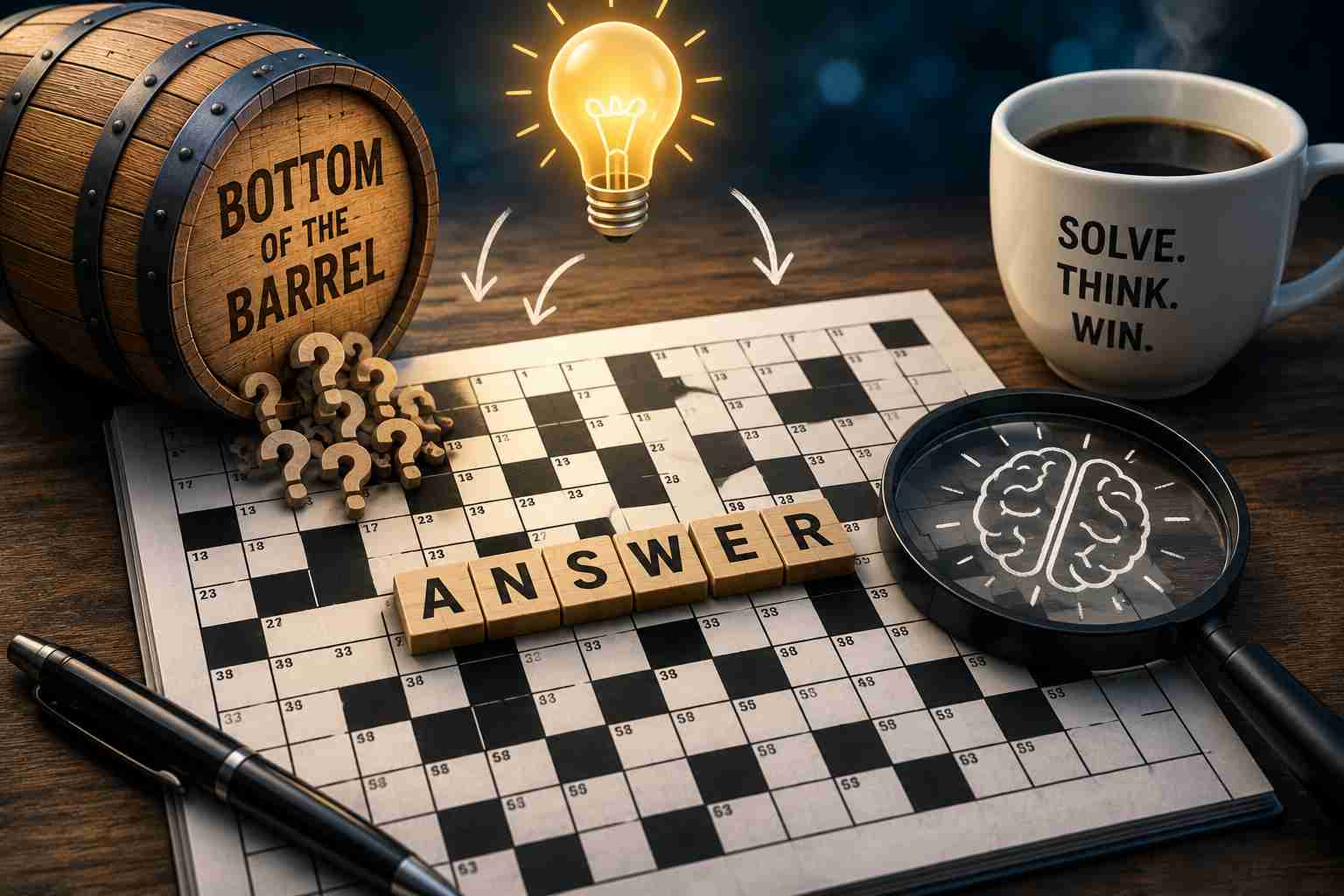
Bottom of the Barrel NYT Crossword Answer: Complete Solver Guide
Crossword puzzles have a strange way of making simple words feel impossibly complicated. One moment you are flying through the grid with confidence, and the next moment a clue like “bottom of the barrel” completely stops your progress. Sound familiar? Thousands of players search for the “bottom of the barrel NYT crossword answer” every month because the clue looks obvious at first glance while secretly hiding multiple possible meanings.
The The New York Times crossword is famous for clever misdirection, layered meanings, and tricky clue construction. That reputation is exactly why crossword enthusiasts keep returning every day. Solving a difficult clue creates the same kind of satisfaction as cracking a code or finally finding the missing piece of a puzzle.
In most NYT Crossword puzzles, the answer to “bottom of the barrel” is usually WORST. However, crossword constructors sometimes use alternative answers depending on the puzzle theme, letter count, and intersecting words. That is where many solvers get stuck.
This guide explains the exact answer, the meaning behind the clue, why crossword creators use phrases like this, and how you can solve similar clues faster in the future. By the end, you will not only know the answer — you will understand the logic behind it.
Bottom of the Barrel NYT Crossword Answer: Quick Answer
The most common answer for the “bottom of the barrel” NYT crossword clue is WORST. The phrase is usually interpreted figuratively to describe something of the lowest quality or least desirable option. Depending on the crossword theme and letter count, alternative answers like “LOWEST” or “DREGS” may occasionally appear.
🔑 Key Takeaway: NYT crossword clues often rely more on figurative meaning than literal interpretation. Recognizing idioms dramatically improves solving speed.
What Does “Bottom of the Barrel” Mean?
The phrase “bottom of the barrel” originally referred to the lowest part inside a storage barrel where residue, damaged goods, or lower-quality material would settle over time. Merchants historically considered the bottom contents less valuable because dirt and unwanted particles collected there.
Over time, the expression evolved into a modern idiom describing anything considered low quality, undesirable, or inferior. Today people use the phrase in conversations about products, entertainment, job candidates, sports teams, and almost anything else viewed negatively.
For example:
- “That movie was really the bottom of the barrel.”
- “The company hired from the bottom of the barrel.”
- “Those were the worst options available.”
Crossword constructors love phrases like this because they operate on two levels simultaneously. The clue sounds physical and literal, but the intended answer often depends on figurative interpretation instead.
Literal Meaning of the Phrase
Literal thinkers may imagine:
- the actual bottom of a container,
- a wooden barrel,
- or physical residue.
That interpretation can lead solvers toward incorrect answers like:
- base,
- floor,
- sediment,
- or dregs.
Sometimes those answers work. Most of the time, though, NYT constructors want the metaphorical meaning instead.
Figurative Meaning in Modern Language
In modern usage, “bottom of the barrel” almost always describes the lowest-quality option available. That is why “WORST” fits so naturally in crossword grids.
The clue functions like a hidden shortcut. Instead of asking directly for “lowest quality,” the constructor disguises the idea using a common idiom.
📊 Did You Know? The The New York Times crossword first appeared in 1942 and has become one of the most influential word puzzles in the world.
Why Idioms Matter in Crossword Clues
Idioms make crossword puzzles significantly more interesting because they allow multiple interpretations at once. A straightforward clue would feel boring after a while. Crossword creators intentionally create ambiguity to challenge the solver.
Think of crossword clues like magic tricks. The constructor directs your attention toward one meaning while quietly hiding the real answer elsewhere.
Literal vs Figurative Thinking
Beginners often struggle because they approach clues too literally. Experienced solvers learn to pause and ask:
- “Could this clue mean something else?”
- “Is there an idiomatic interpretation?”
- “Would the NYT constructor try to mislead me here?”
That shift in thinking changes everything.
👉 Related Reading: Best NYT Crossword Solving Strategies for Beginners
Most Common Answers for Bottom of the Barrel Crossword Clues
Different crossword grids require different answers depending on:
- puzzle structure,
- available squares,
- theme consistency,
- and crossing letters.
That flexibility explains why crossword clues rarely have only one permanent answer.
| Possible Answer | Meaning | Letter Count | Typical Usage |
|---|---|---|---|
| WORST | Lowest quality | 5 | Most common |
| LOWEST | Inferior position | 6 | Ranking clues |
| DREGS | Residue or leftovers | 5 | Literal interpretation |
| INFERIOR | Lower standard | 8 | Formal wording |
| BAD | Poor quality | 3 | Short-grid fill |
Why WORST Is Usually Correct
The answer “WORST” works extremely well because it captures the figurative meaning perfectly. It also fits crossword grids efficiently due to its compact five-letter structure.
Crossword constructors prefer flexible words that:
- connect strongly to the clue,
- fit symmetrical grids,
- and intersect smoothly with surrounding answers.
“WORST” satisfies all three conditions.
Alternative Crossword Answers
Sometimes constructors intentionally avoid obvious answers. Why? Because predictability makes puzzles easier and less engaging.
Alternative possibilities include:
- LOWEST for ranking-related themes
- DREGS for literal residue references
- INFERIOR for formal wording
- BAD for short puzzle sections
Crossword solving often feels like choosing between several believable possibilities while waiting for crossing letters to reveal the truth.
💡 Pro Tip: Never lock in an answer before checking intersecting letters. Crossword accuracy improves dramatically when you treat every answer as provisional until confirmed.
How Letter Count Changes the Answer
Letter count matters enormously. Even if “WORST” feels correct semantically, a six-letter slot immediately eliminates it.
That is why experienced solvers always:
- count available squares,
- analyze crossing letters,
- and only then finalize answers.
⚠️ Common Mistake: Many solvers become emotionally attached to their first guess and ignore contradictory crossing letters later.
Why NYT Crossword Clues Feel So Difficult
Ever notice how crossword answers suddenly feel obvious after you solve them? That strange effect happens because constructors intentionally manipulate expectations.
The NYT crossword is designed to reward flexible thinking instead of direct memorization. The puzzle wants you to hesitate, reconsider, and reinterpret clues from different angles.
The Role of Misdirection
Misdirection sits at the heart of crossword design. Constructors carefully choose wording that encourages incorrect assumptions before nudging solvers toward the intended interpretation.
“Bottom of the barrel” sounds physical initially, but the puzzle often wants a figurative answer instead.
That gap between expectation and reality creates the challenge.
Figurative Language in Crossword Puzzles
NYT crosswords frequently rely on:
- idioms,
- puns,
- homophones,
- abbreviations,
- hidden meanings,
- and cultural references.
The more familiar you become with those patterns, the faster you solve puzzles.
A crossword puzzle is not just testing vocabulary. It is testing adaptability.
Why Simple Clues Often Cause More Trouble
Oddly enough, short clues often create bigger problems than long clues. Why? Because short clues provide less context.
A long clue may practically explain itself. A short clue like “bottom of the barrel” leaves room for multiple interpretations.
That ambiguity creates tension — and tension creates challenge.
How Experienced Solvers Think Differently
Experienced crossword players rarely trust their first instinct completely. Instead, they:
- stay flexible,
- evaluate alternatives,
- and wait for confirmation from crossing letters.
Crossword solving becomes much easier once you stop demanding certainty immediately.
🔑 Key Takeaway: Great crossword solvers are not necessarily smarter. They are simply more comfortable with ambiguity and reinterpretation.
How to Solve NYT Crossword Clues Faster
Some people finish the The New York Times crossword in under ten minutes. Others spend an hour staring at the same unfinished corner of the grid. What creates the difference? Surprisingly, it is usually not vocabulary size alone. Successful crossword solving depends far more on strategy, pattern recognition, and flexibility.
Think of crossword solving like navigating a maze. Charging straight ahead rarely works. The best solvers constantly adjust direction based on new information.
Start With Easy Clues First
One of the biggest beginner mistakes involves attacking difficult clues immediately. That approach drains energy and creates frustration before momentum even begins.
Instead, experienced solvers scan the puzzle quickly and answer the easiest clues first. Every completed answer adds crossing letters that simplify harder sections later.
This method works like assembling the border pieces of a jigsaw puzzle before tackling the complicated center.
Easy clues usually include:
- fill-in-the-blank clues,
- obvious definitions,
- common abbreviations,
- and familiar trivia references.
Once those sections fill in, even intimidating clues suddenly become manageable.
Use Crossing Letters Strategically
Crossing letters are the single most powerful solving tool in any crossword puzzle. Even two confirmed letters can eliminate dozens of incorrect possibilities instantly.
For example:
- _ O _ _ T immediately narrows possibilities dramatically.
- W O R S T becomes obvious once enough letters appear.
Strong solvers constantly move around the grid collecting letter confirmations instead of obsessing over one difficult clue.
💡 Pro Tip: Focus especially on unusual letters like Q, X, Z, or J. They reduce answer possibilities faster than common letters.
Identify the Clue Type
Not all crossword clues function the same way. Learning clue categories improves solving speed dramatically.
Common clue types include:
| Clue Type | Description | Example |
|---|---|---|
| Definition | Direct meaning | “Lowest quality” |
| Idiom | Figurative phrase | “Bottom of the barrel” |
| Pun | Wordplay-based | Joke-style clues |
| Abbreviation | Shortened forms | “Org.” clues |
| Trivia | Knowledge-based | Historical references |
| Hidden Meaning | Double interpretation | Misleading phrasing |
Once you identify the clue type, your brain automatically searches more efficiently.
Analyze Puzzle Themes
Many NYT puzzles contain hidden themes connecting multiple clues together. Discovering the theme can transform an impossible puzzle into a solvable one almost instantly.
Common themes include:
- movie titles,
- word reversals,
- rhyming patterns,
- idioms,
- or hidden puns.
For example, if several answers involve figurative phrases, the clue “bottom of the barrel” likely uses figurative logic too.
That realization helps eliminate literal interpretations immediately.
Why Flexibility Matters
Here is the truth many beginners resist: your first guess is often wrong.
Experienced solvers remain comfortable revising answers repeatedly as new evidence appears. They treat early answers as temporary hypotheses instead of fixed truths.
Crossword solving works a lot like detective work. Every crossing letter acts as new evidence.
⚠️ Common Mistake: Tunnel vision causes many players to force incorrect answers even after crossing letters clearly disagree.
👉 Related Reading: Hardest NYT Crossword Clues Explained
How Crossword Constructors Build Clues
Crossword construction is both linguistic creativity and engineering. Constructors must balance:
- fairness,
- difficulty,
- entertainment,
- symmetry,
- and word compatibility.
That balancing act explains why some clues feel brilliantly clever while others feel almost impossible.
The Psychology Behind Clever Clues
Great crossword clues create a tiny moment of surprise. The constructor wants solvers to experience that satisfying “aha!” reaction after discovering the answer.
“Bottom of the barrel” works well because it naturally encourages literal thinking before revealing a figurative answer.
That moment of reinterpretation produces satisfaction. The puzzle briefly tricks your brain, then rewards you for adapting.
How Constructors Use Ambiguity
Ambiguity is the constructor’s favorite tool.
A strong crossword clue often supports:
- two meanings,
- two grammatical interpretations,
- or two emotional directions.
For example:
- “bottom of the barrel” could mean:
- physical residue,
- low quality,
- or final leftovers.
Constructors intentionally design clues that create multiple mental pathways.
The challenge comes from identifying which pathway fits the grid best.
Why Grid Design Influences Answers
Crossword answers are not chosen randomly. Every answer must fit intersecting words perfectly while maintaining puzzle symmetry.
That requirement forces constructors to think strategically.
Sometimes a less-obvious answer appears simply because:
- it fits the grid better,
- balances letter distribution,
- or supports the puzzle theme.
That is why crossword solving requires adaptability rather than memorization alone.
📚 Source: Crossword constructor interviews and NYT puzzle design discussions
The Balance Between Difficulty and Fairness
A great crossword clue feels difficult at first but logical afterward. If solvers cannot eventually understand the reasoning, the clue feels unfair instead of clever.
NYT constructors carefully walk that line every day.
The best puzzles challenge players without making them feel cheated.
🔑 Key Takeaway: Crossword constructors are not trying to confuse you randomly. They are designing controlled moments of surprise and discovery.
Common Crossword Mistakes Players Make
Even highly experienced crossword enthusiasts fall into predictable traps. Crossword solving is not just about intelligence — it is also about avoiding mental habits that create unnecessary errors.
Thinking Too Literally
Literal interpretation causes enormous problems for beginners. Many clues rely on figurative meanings, idioms, or hidden wordplay rather than direct definitions.
For example:
- “bottom of the barrel”
rarely refers to an actual physical barrel.
Instead, the constructor usually wants:
- “WORST,”
- “LOWEST,”
- or another metaphorical answer.
The ability to shift perspectives quickly separates advanced solvers from frustrated beginners.
Ignoring Crossing Letters
Some players become overly confident after finding one answer that “feels right.” Then they ignore conflicting crossing letters completely.
That approach almost always creates bigger problems later.
Crossing letters act like fact-checkers. They provide objective confirmation when clue interpretation becomes uncertain.
Strong solvers trust the grid more than their ego.
Rushing Through the Puzzle
Speed matters less than consistency. Fast but careless solving creates avoidable mistakes that waste time later.
Many players:
- skim clues too quickly,
- overlook punctuation,
- or miss subtle wording hints.
That habit creates confusion that spreads across the entire puzzle.
Why Confidence Can Hurt Solvers
Ironically, overconfidence often damages crossword performance more than uncertainty does.
Flexible solvers remain willing to reconsider answers repeatedly. Rigid solvers force incorrect interpretations because they do not want to admit uncertainty.
Crossword puzzles reward adaptability, not stubbornness.
⚠️ Common Mistake: Assuming every clue has only one logical interpretation immediately.
Advanced Crossword Solving Techniques
Once you move beyond beginner-level solving, crossword puzzles become much more about pattern recognition than raw vocabulary. Experienced solvers develop systems that help them recognize clue structures almost automatically.
Learn Common Crossword Vocabulary
Certain words appear repeatedly in crossword puzzles because they fit grids efficiently. Over time, experienced solvers memorize these recurring entries naturally.
Examples include:
- OREO
- ETNA
- ERIE
- OLEO
- EPEE
- ALOE
Why do these words appear so often? Mostly because they contain vowel-heavy letter combinations that connect smoothly with intersecting answers.
Recognizing these “crossword staples” dramatically improves solving speed.
Understand Crossword Abbreviations
Crossword clues often contain abbreviation signals.
For example:
- “Org.” usually suggests an abbreviated organization
- “Abbr.” signals a shortened answer
- “Init.” points toward initials
Ignoring these signals causes many incorrect guesses.
A clue’s formatting matters just as much as its wording.
Pay Attention to Verb Tense
Tiny grammatical details frequently reveal the correct answer structure.
If the clue appears in past tense, the answer usually appears in past tense too.
For example:
- “Ran quickly” likely requires a past-tense answer.
- “Runs quickly” likely requires present tense.
This small habit prevents many avoidable mistakes.
Recognize NYT Crossword Patterns
The The New York Times crossword has recognizable habits and conventions.
Common patterns include:
- misleadingly simple clues,
- cultural references,
- layered idioms,
- and clever wordplay.
The more puzzles you solve, the easier these patterns become to identify.
💡 Pro Tip: Solving one puzzle daily trains your brain to recognize recurring clue structures much faster.
Why Daily Practice Matters
Crossword solving resembles learning a musical instrument. At first everything feels slow and confusing. Then gradually your brain begins recognizing familiar structures automatically.
That transformation happens through repetition and exposure.
👉 Related Reading: Why Daily Crossword Puzzles Improve Mental Agility
The Psychology Behind Crossword Puzzle Addiction
Why do millions of people return to crossword puzzles every single day? The answer goes far beyond vocabulary or entertainment. Crossword puzzles trigger powerful psychological rewards that keep the brain engaged, challenged, and satisfied.
For many people, solving the daily The New York Times crossword becomes part of a morning ritual alongside coffee, news reading, or quiet relaxation. That routine creates both comfort and stimulation simultaneously.
Dopamine and Small Wins
Every solved clue produces a tiny mental reward. Neuroscientists often describe this feeling as a dopamine response — the brain’s natural reward system reacting to progress and success.
Crossword puzzles work especially well because they deliver:
- constant mini victories,
- manageable challenges,
- and visible progress.
Unlike huge long-term goals, crossword solving provides immediate feedback. Every completed answer feels rewarding.
That cycle explains why even difficult puzzles remain strangely enjoyable.
Mental Flexibility Benefits
Crossword puzzles train the brain to think laterally rather than linearly. Solvers constantly shift between:
- literal meaning,
- figurative meaning,
- abbreviations,
- cultural references,
- and hidden patterns.
That mental flexibility resembles exercise for the brain.
Instead of memorizing information passively, crossword solving encourages:
- reinterpretation,
- adaptability,
- and creative thinking.
Some researchers even suggest that regular word puzzles may help maintain cognitive engagement as people age.
📊 Did You Know? Studies on word puzzles and cognitive activity suggest that mentally stimulating activities may support memory and reasoning skills over time.
Why Daily Crossword Rituals Matter
Daily crossword routines create consistency. Many players solve puzzles at the same time every day:
- during breakfast,
- on train rides,
- during lunch breaks,
- or before bed.
That predictability creates comfort, while the puzzle itself provides challenge. The combination feels deeply satisfying.
Crossword solving becomes both:
- a mental workout,
- and a calming ritual.
Think about it like going to the gym for your vocabulary and problem-solving skills.
Why Difficult Clues Feel So Rewarding
Easy clues feel pleasant. Difficult clues feel unforgettable.
When a challenging clue like “bottom of the barrel” finally clicks, the brain experiences a stronger reward because the solution required:
- persistence,
- reinterpretation,
- and problem-solving effort.
That delayed payoff creates a stronger emotional impact than an instant answer would.
🔑 Key Takeaway: Crossword addiction is not really about words alone. It is about the rewarding feeling of solving small problems successfully over and over again.
What is the answer to bottom of the barrel NYT crossword clue?
The most common answer is WORST. In crossword puzzles, the phrase “bottom of the barrel” usually refers figuratively to something of the lowest quality or least desirable option. Depending on the puzzle structure and theme, alternative answers like “LOWEST” or “DREGS” may occasionally appear.
Is WORST always the correct answer?
No. Crossword clues can support multiple answers depending on:
- letter count,
- intersecting words,
- and puzzle theme.
Although “WORST” appears frequently, constructors sometimes choose alternatives such as:
- LOWEST,
- DREGS,
- or INFERIOR.
Crossing letters ultimately determine the correct solution.
Why are crossword clues misleading?
Crossword constructors intentionally use ambiguity and wordplay to create challenge. A clue may suggest one meaning initially while secretly pointing toward another interpretation.
For example, “bottom of the barrel” sounds literal at first, but the intended answer often relates to quality instead of physical location.
That misdirection creates the satisfying “aha” moment solvers enjoy.
Does NYT repeat crossword clues?
Yes, although not always in identical form.
The The New York Times crossword frequently reuses:
- clue styles,
- vocabulary patterns,
- and common answer structures.
Experienced solvers gradually recognize these recurring patterns, which improves solving speed significantly over time.
How can beginners improve at crossword solving?
Beginners improve fastest by:
- solving puzzles consistently,
- learning common crossword vocabulary,
- using crossing letters carefully,
- and staying flexible with interpretations.
The key is repetition. The more puzzles you solve, the more familiar clue structures become.
What are the hardest NYT crossword clue types?
Many solvers struggle most with:
- puns,
- idioms,
- cultural references,
- and misleadingly short clues.
Short clues often create the biggest challenge because they provide minimal context and allow multiple interpretations simultaneously.
Why Short Clues Cause Problems
A long clue usually guides your thinking clearly. A short clue forces your brain to explore several possibilities at once.
That uncertainty creates difficulty — but also excitement.
💡 Pro Tip: When a clue feels impossibly vague, stop assuming the obvious interpretation is correct.
Expert Insight: Why Crossword Solving Is a Skill, Not Just Vocabulary
Many people assume crossword experts simply memorize enormous dictionaries. Surprisingly, vocabulary alone explains only part of crossword success.
Great solvers develop systems for:
- pattern recognition,
- clue interpretation,
- and flexible thinking.
Crossword solving is closer to strategy gaming than pure memorization.
Pattern Recognition vs Memorization
Strong solvers recognize clue patterns almost instantly.
For example:
- quotation marks may indicate unusual wording,
- question marks often signal puns,
- abbreviations suggest shortened answers,
- and idioms usually require figurative thinking.
That recognition happens automatically after enough puzzle exposure.
Think of it like learning traffic patterns while driving. At first every situation feels new. Eventually your brain predicts what happens next naturally.
Why Experienced Solvers Adapt Faster
Experienced players rarely panic when confused. Instead, they:
- gather crossing letters,
- test alternatives,
- and revise answers repeatedly.
Beginners often expect certainty immediately. Experts tolerate uncertainty comfortably.
That mindset difference changes everything.
How Daily Practice Changes the Brain
Daily crossword solving gradually strengthens:
- verbal recall,
- pattern recognition,
- and lateral thinking skills.
The brain becomes more efficient at:
- spotting hidden meanings,
- recognizing clue structures,
- and filtering incorrect possibilities.
Over time, solving shifts from frustrating to intuitive.
🔑 Key Takeaway: Crossword mastery comes less from knowing more words and more from recognizing how crossword clues are constructed.
Conclusion
Crossword clues like “bottom of the barrel” perfectly demonstrate why the The New York Times crossword remains so addictive and satisfying. The clue appears simple initially, yet its real challenge comes from interpreting the phrase figuratively rather than literally.
In most puzzle contexts, the answer is WORST, although alternative answers may appear depending on the grid and theme. More importantly, understanding why that answer works helps you solve future crossword clues much faster.
The best crossword solvers are not necessarily the people with the largest vocabularies. They are the people who:
- stay flexible,
- recognize patterns,
- and remain comfortable reconsidering assumptions.
That skill improves with practice.
💡 Pro Tip: The fastest way to improve at crossword solving is consistency. Solving even one puzzle daily trains your brain to recognize clue patterns and constructor habits naturally over time.
The next time a tricky crossword clue appears, you will not just search for the answer — you will understand the logic hiding behind it.
Frequently Asked Questions
FAQ 1: What does bottom of the barrel mean in crossword puzzles?
In crossword puzzles, “bottom of the barrel” usually describes something considered low quality, undesirable, or inferior. Constructors often expect players to interpret the phrase figuratively instead of literally. That is why answers like “WORST” commonly appear. Depending on the puzzle structure, alternative answers may also fit.
FAQ 2: Is WORST always the answer for bottom of the barrel?
No. Although “WORST” is the most common answer, crossword constructors may use alternatives like “LOWEST,” “DREGS,” or “INFERIOR” depending on:
- letter count,
- puzzle theme,
- and intersecting words.
Crossing letters always help confirm the correct solution.
FAQ 3: Why are NYT crossword clues difficult?
NYT crossword clues rely heavily on:
- wordplay,
- ambiguity,
- idioms,
- and figurative language.
Constructors intentionally create clues that encourage incorrect first assumptions before revealing the actual meaning through crossing letters and puzzle context.
FAQ 4: How can beginners improve at crossword puzzles?
Beginners improve fastest by:
- solving puzzles regularly,
- learning common crossword vocabulary,
- analyzing clue patterns,
- and staying flexible with interpretations.
Consistency matters more than speed in the beginning.
FAQ 5: Do crossword clues repeat over time?
Yes. Crossword puzzles frequently reuse:
- common clue structures,
- recurring vocabulary,
- and familiar answer patterns.
Experienced solvers gradually recognize these repetitions, which makes future puzzles easier to solve.
FAQ 6: What is the best strategy for solving difficult clues?
The best strategy involves:
- solving easier clues first,
- gathering crossing letters,
- identifying clue type,
- and reconsidering figurative meanings before literal ones.
Flexibility is the most important skill.
FAQ 7: Why do crossword clues use idioms so often?
Idioms create ambiguity and allow multiple interpretations. Constructors use them because they make puzzles more challenging, creative, and entertaining for solvers.
FAQ 8: Can crossword puzzles improve memory?
Many studies suggest that mentally stimulating activities like crossword puzzles may help maintain cognitive engagement, memory recall, and reasoning ability over time.
FAQ 9: What makes NYT crosswords unique?
The The New York Times crossword is known for:
- clever clue construction,
- layered wordplay,
- strong themes,
- and carefully balanced difficulty progression.
That combination makes it one of the world’s most respected crossword puzzles.
FAQ 10: What is the biggest misconception about crossword solving?
The biggest misconception is that crossword solving depends entirely on vocabulary knowledge. In reality, solving skill relies much more on:
- pattern recognition,
- clue interpretation,
- and flexible thinking.